Pet Product Design and Development: How to Create Safe and Sellable Pet Products


Designing pet products is a crucial process to go through. It goes beyond the basic aesthetics and accessories, as the pet product industry has expanded throughout the years. Pet owners no longer stick with just the visual look of a product, but also go through its safety, durability and reliability. In the process of creating successful pet products, an in-depth understanding of animal behavior is a must, which includes how pets interact with specific objects. That is why designers must put into consideration how each factor affects the everyday interaction of the pet with the certain product.

Platforms like Cad Crowd help connect businesses with the right and freelance product designers who support these stages of delivering quality production-ready products. In this article, we’ll provide you with key elements of what makes a product design unique and the appropriate process behind creating not just aesthetically pleasing, but safe and sellable pet products.

RELATED: Exciting Pet Product Designs and Innovations for Your Company’s Next Design Project


🚀 Table of contents


What are the key considerations in designing pet products?

Durability Pet products must handle animal’s chewing, pulling, scratching, and repeated use.
Material safety Materials used should lessen potential risks like skin contact, ingestion, and long-term exposure.
Animal ergonomics Products must be designed to fit different species, sizes, breeds, and behavior.
Cleanability Product design should allow easy access to maintenance and cleaning
Manufacturing feasibility Products should balance product cost, manufacturability and feasibility
Smart features Smart Pet Products must consider battery placement and physical designs

​Designing pet products highly requires a proper balance between the needs of both animals and their owners. Though appearance and market appeal serves as the first thing people would notice, successful products still need to perform reliably under real-world conditions. And the following factors mentioned above significantly influence how engineers and designers approach the development of every pet product.

​Why is pet product design differ from other consumer products?

Pet products may appear simple at first, but the process of creating one takes so much specialization and a deeper level of understanding and consideration to the animal’s behavior. It needs to be carefully and thoroughly studied beforehand since everything that’s incorporated in that specific product may affect the animal itself. It differs from other consumer products since it must handle unpredictable animal interactions like biting, pulling, scratching and continuous use regardless of conditions.

A successful pet product design services must serve two users, the pet and its owner. Animals, like humans, need products that are comfortable, durable, and safe to use, while owners expect that it is reliable, convenient, and attractive. This creates a different kind of challenge which requires careful consideration all throughout the development process of the product.

RELATED: Tips for Pet Toy Design, New Product Development at Prototype Manufacturing Services at Companies 

​How does animal behavior affect product durability?

Animal behavior plays an essential role in determining how durable a pet product must be, since unlike human products, pets behave unpredictably, and designers must anticipate that to create a product that would remain safe and functional over the period.

Designers must consider

  • Chewing resistance. Products should not be easily broken to reduce risks from tiny, swallowed pieces.
  • Pulling strength. Harnesses, collars, and leashes must hold up against repeated force.
  • Scratch resistance. Surfaces, beds, and carriers should stay durable despite continuous scratching.
  • Repeated use. Products should maintain their quality performance despite being used daily.

pet-product-prototyping-testing-and-development

Through these challenges, pet product designers incorporate stronger materials and apply specialized testing methods in the process of development. In this way, products are ensured to handle real-world pet behavior while also maintaining its reliability and safety.

​Why must pet products consider both pets and owners?

Pet products are somehow unique since they must meet the needs of two users, the animal and the human owner. While pets need products that are comfortable, enjoyable, and safe to use, owners look for product design services that are reliable, convenient, and easy to maintain. So designers must design a product that could balance these different expectations to deliver products that effectively work for both.

Pet products that commonly use a dual-user approach

  • Harness– a product that must provide both freedom of movement and comfort for pets, while also giving owners easier control and confidence.
  • Feeders– it should support the healthy eating habits of the animals while being easy to clean and maintain by the owners.
  • Toys– it needs to keep the pets entertained and engaged while it’s safe and durable to use.

RELATED: How to Take Hardware Product from Concept to Commercialization: A Complete Guide

How do designers create pet products that can withstand chewing, pulling, and scratching?

One of the most essential considerations in the process of designing a pet product is durability, since animals are known to interact with these products far differently from how humans do. A product that looks strong during its partial testing will still fail after repeated scratching, chewing, pulling, or exposure to outdoor conditions. Just because it looks strong doesn’t guarantee its durability.

That is why designers must really anticipate these behaviors from the early stages of development in order to make sure that the products are safe and functional throughout their lifespan. It requires a combination of structural design, material selection, and performance testing to successfully create a durable pet product. From strong harnesses to chew-resistant toys, engineers and designers should thoroughly evaluate how products respond to continuous stress before they are launched in the market.

How do designers test for real-world pet use?

Real-world pet interaction To better understand how certain pets naturally use and interact with specific products. Behaviors like pulling, scratching, playing, chewing, resting, and repeated daily use.
Chewing tests To make sure that the products remain safe and durable under biting forces. If materials can resist splintering, cracking, breaking, or creating small, tiny pieces that could become hazards.
Pulling & tension tests Measure the strength of products that are exposed to animal’s force and movement. Leashes, collars, harnesses, and attachments to ensure they can handle sudden pulls and repeated stress.
Scratch & abrasion tests To evaluate its resistance to surface potential damage and long-term wear. Assess whether coatings, fabrics and surfaces can withstand scratching, rubbing, tearing, and frequent use.
Moisture & weather resistance tests To determine how certain products perform in different environments and under any conditions. Test resistance to water, dirt, sunlight, temperature changes, and repeated cleaning cycles.
Design improvements Apply test results to improve product performance. Modify materials, shapes, structures, and features to address weaknesses and enhance safety.
Production Prepare the finalized product, ready it for manufacturing. Confirm that the design meets the quality and standard requirements before mass production.

The table mainly depicts how designers evaluate products under conditions that resemble closely to everyday use. Instead of just relying on assumptions, they thoroughly assess how pets naturally scratch, chew, pull, and interact with products while considering its environmental factors like temperature and moisture. By helping with the findings from every stage, they can spot potential weaknesses, allowing them to refine materials, structural features, and the entire performance before proceeding to the production. Addressing the issues early in the development process helps in improving product durability, safety, and reliability, while making sure that it won’t cost later revisions after product launch.

RELATED: 24 of the Best Pet Gadgets for Your Furry Friend

What materials are safe for pet product development?

One of the most important decisions in the process of product development services is choosing the right materials. It is very crucial since animals behave differently and pet products are being used more harshly by animals. So, materials must be safe, as it is as important as durability. Designers must put into consideration how materials perform during continuous use while minimizing the possible risks if it’s damaged or worn.

While pet products are subject to specific federal and state regulations depending on its product type, the United States does not have a comprehensive federal safety standard which applies to all pet products. Because of it, a lot of manufacturers voluntarily adopt higher safety practices and dig into established standards in different industries when developing new products.

How are pet product safety standards evolving?

As pet product safety standards continue to develop, the industry has become more structured, putting more emphasis on improving product reliability and safety practices. ASTM International’s Pet Product’s Subcommittee (F15.80), together with the support from BARK Company and other industry partners and stakeholders, has gradually established a voluntary consensus standard for pet product safety, testing, and performance. Through these efforts, manufacturers and designers create products that appropriately address real-world pet use.

RELATED: Product Development Considerations that Can Make or Break New Product Ideas Before Launch

As pet-specific standards continue to evolve, there are some companies that compare certain safety considerations with practices used for children’s products, specifically for items that are exposed to repeated handling and chewing. Although children and pets interact with products way differently, both still require attention to safer materials, durability, and minimizing potential hazards that may happen. Through these evolving approaches, designers can create pet products that are stronger, safer, and more suitable for long-term use.

Why does material selection matter?

Even the most good-looking and innovative pet product can fail if it’s not built with appropriate and suitable materials. A material selection experts that works well in appearance is not guaranteed to withstand repeated chewing, while others may be durable but hard to clean or may be uncomfortable for the specific animal. By carefully selecting and choosing appropriate materials during the early design process, product teams can improve product safety, extend its lifespan, and deliver products that would earn consumers’ trust, while also meeting the standard demand of everyday pet use.

How does species ergonomics influence pet product design?

In the process of designing pet products, a different approach to ergonomics is being applied since animals and humans do not share the same body structure. That is why designers must account for several variations of animals across its sizes, breeds, species, and behaviors. This is what makes it more challenging as it becomes an animal anthropometrics challenge, which requires a deeper understanding of its body measurements, physical limitations, movement patterns to create a product that is safe, comfortable, and functional.

RELATED: How to Find the Right Industrial Design Company for Successful Product Development

There are a lot of animals or pets in the world, so a specific product design for a certain animal may not work for others. Even if it’s within the same species, there can still be differences, especially when it comes to breeds. Just like, for example, a harness that fits a small Chihuahua will not fit or be suitable to a Great Dane. As a result, designers should study animal proportions and make adjustable and adaptable solutions that could accommodate the variation of users.

Why do breed differences matter in pet product design?

Breed differences matter in product design since it is not the same as human products, which are often designed based on its standardized body measurements. Pet products should be considered in a much wider range of physical variations.

Designers must evaluate these factors

  • Body size and proportions. Different breeds have variations in neck size, weight, chest width, and entire body structure.
  • Movement patterns. Pet products must be open for natural movement without restricting animals’ running, climbing, stretching, or walking patterns.
  • Strength and activity level. Animals that are larger or more active require stronger materials.
  • Behavior differences. There are breeds who chew more aggressively, pull harder, or interact way differently with specific products.

How do designers apply animal ergonomics?

In creating products that are suitable for real-world use, designers need to combine research, prototypes specialist, measurements, and testing.

RELATED: A Guide to Concept Design with Product Design & Engineering Companies

This may include studying the following:

  • Common Animal Breed Measurements
  • Animal Posture and Movement
  • Animals’ Interaction Behavior
  • Owners’ Handling Requirements
designing-market-ready-pet-products-successfully

For products like feeders, ergonomic design services may affect usability. Like for example, a slow feeder bowl, it must be designed with factors like snout length, accessibility, and eating posture. A design that works accordingly for a short-snouted breed is not guaranteed to provide the same comfort for a long-snouted dog.

​Why is ergonomic design important for pet products?

It is important since it can affect the usability experience of the animal. When it is poorly designed, it will create discomfort, limit animal’s movement, or discourage them from using it. When products are designed around animal behavior and anatomy, then it will improve its usability, safety, and customer satisfaction. Through applying principles like human-centered design but an animal-kind approach, designers can create and deliver products that support both the well-being of the pet and human owner expectations.

​Why is cleanability important in pet product design?

Cleanability is mostly taken for granted, especially during early stages of pet product development services, but it plays an essential role in the success of the product. Unlike other consumer products, pet products are always exposed to dirt, saliva, fur, food residue, and moisture. A product that is complicated to clean can become an inconvenience for owners, which will negatively affect both long-term use and customer satisfaction.

RELATED: Top Product Usability Factors for Good Product Design Services & New Prototypes 

It is important that designers should consider maintenance as one of the essential parts of the overall user experience. While it is obvious that the pet is the primary user, the owner is still the one responsible for cleaning and maintaining the product. One factor to consider in determining a successful design is it makes the task simple while maintaining its performance and durability.

​How do designers create easier-to-clean pet products?

Durability or strength of material design services starts at the design phase, where decisions are mostly about structure, materials, and product features.

These are what designers often consider

  • Washable materials. Coatings, fabrics, and plastics should handle repeated cleaning without degrading.
  • Removable components. Detachable parts of the product make it easier to clean, especially in areas where food, dirt, or bacteria may possibly accumulate.
  • Water-resistant designs. Most pet products are exposed to moisture like feeders. So, materials that resist water absorption are really required.
  • Simplified structures. Reducing any unnecessary gaps, seams, or difficult-to-reach areas can really prevent build-up and improve hygiene.

How are smart technologies changing pet product design?

Everything we see nowadays are mostly high-tech, and pet products are no exception since smart technology creates a new category of products that combine both traditional accessories with advanced features. Products like smart collars, pet cameras, automated feeders, and GPS trackers are starting to help owners monitor, interact, and care for their pets in a very high-tech way.

pet-product-design-development-process-guide

However, with the integration of technology to pet products, another layer of design is also introduced since it’s more complex, and products must satisfy not just the animal needs but also its electronic requirements. It’s not like the usual or traditional pet accessories since smart pet products require collaboration between mechanical engineers, electronic specialists, and freelance industrial designers.

RELATED: Best 50 Websites to Hire New Product Design Freelancers for Product Prototype Services

The tricky part here is that designers must consider the physical experience of the pet while also putting into consideration various space for internal components, electronic placements, while ensuring its reliability in everyday environments.

What design challenges do smart pet products require?

GPS trackers and smart collars Lightweight construction, battery life, waterproof housing, secure attachment, pet comfort
Pet cameras Durable enclosure, camera placement, connectivity, power management, user-friendly operation
Automatic feeders Food-safe materials, motor reliability, sensors, portion control, easy cleaning
Activity monitors Sensor accuracy, compact size, comfortable attachment, wireless communication

​How do batteries and connectivity affect smart pet product design?

One of the major challenges in the development of smart pet products is the integration of electronics without compromising its usability. For example, a GPS tracker requires enough battery capacity for it to reliably operate while still being comfortable for the animal. And having a bulky device can really affect an animal’s movement, leading to a possible discouragement from wearing it.

That is why it’s very important for designers to consider battery size and placement, charging methods, power efficiency, and wireless connectivity. The application of the electronics must also be protected by its physical design. Smart collars and trackers may possibly be exposed to dirt, impacts, movement, and rain, which requires durable and appropriate protective housings.

RELATED: Best 38 Websites To Hire Pet Product Design Service Freelancers for Dog and Cat Products

​Why do smart pet products require IoT and electronics considerations?

Smart wear design services combine both physical design with digital technology through the Internet of Things, which helps in allowing devices to collect data and connect with different platforms. Designers must put into consideration not just the looks of the product, but also its software, hardware, and connectivity.

For wireless devices, developers should follow certain requirements like Federal Communications Commission guidelines to ensure their reliability and safety. In the process of creating successful smart pet products, strong collaboration between engineers, designers, and technology specialists must be prioritized so they can properly balance usability, innovation, and durability.

​Want to bring your pet product idea to life?

Do you have stored ideas and concepts for a pet product but need the right expertise to support in developing it? Work with experienced product designers and engineers to help you turn your concept into a safe, functional, and market-ready solution. Whether you are deciding to create a smart device, toy, feeding solution, or a pet accessory, Cad Crowd connects you with skilled and experienced product development experts that can surely help in transforming those ideas into a successful product.

RELATED: Why Phase 0 Is Crucial for New Product Development and Physical Product Design Firms

​Frequently asked questions

  • What makes pet product design different from other product design?

Pet product design must put in consideration the animal behavior, durability, safety, and the needs of both the pets and the owners.

  • ​How does AI help in pet product development?

AI significantly helps designers in exploring concepts, creating visuals, generating 3D models, and of course, improving its design process efficiently.

  • Why is durability important in pet products?

Durability is important since pet products must withstand animals scratching, chewing, pulling, and repeated use, while maintaining their functionality and safety.

  • What factors should designers consider when creating smart pet products?

Designers must focus on balancing connectivity, technology, comfort, safety, and ease of use, not just for pets but for owners as well.

​Conclusion

The process of developing a successful pet product requires more than visually appealing designs. There are a lot of factors that need to be considered like its durability, safety, usability, and most importantly, how pets interact with the product. Whether it’s about designing pet devices or interactive toys, it should be done with careful consideration and appropriate expertise that puts emphasis on the balance between the needs of the animal, expectations of the owner, and, of course, production standards. Here in Cad Crowd, we provide you with the right CAD designers who are equipped with experiences in incorporating AI-Assisted tools in the process of delivering high-quality results.

RELATED: How Design for Manufacturability (DFM) Services Help with New Product Design at Your Startup

How Cad Crowd can help

​Cad Crowd connects businesses with experienced product designers and engineers who specialize in pet product development. From durable toys and smart pet devices to feeders, collars, and accessories, our experts help create safe, reliable, and production-ready products. With expertise in CAD design, prototyping, material selection, and manufacturing support, Cad Crowd helps bring innovative pet product ideas to market with confidence. Contact Cad Crowd today for a free quote.

author avatar

MacKenzie Brown is the founder and CEO of Cad Crowd. With over 18 years of experience in launching and scaling platforms specializing in CAD services, product design, manufacturing, hardware, and software development, MacKenzie is a recognized authority in the engineering industry. Under his leadership, Cad Crowd serves esteemed clients like NASA, JPL, the U.S. Navy, and Fortune 500 companies, empowering innovators with access to high-quality design and engineering talent.

Connect with me: LinkedIn ✦ X ✦ Cad Crowd

How Developers Turn Ideas Into Simulations With Frontier AI Agents


Turning a simulation idea into a working application means assembling assets, connecting physics and rendering, and checking that the scene behaves as intended. Developers are combining frontier AI models with NVIDIA Omniverse libraries to help carry out that work — building applications for exploring scenarios, investigating failures and improving designs.

Developers direct AI agents through natural-language instructions, review results and guide changes. Omniverse libraries provide GPU-accelerated physics, rendering and sensor simulation capabilities.

Explore the projects below to see frontier AI models such as GPT-6 Astra at work, and check back for new examples from NVIDIA teams and developers across the ecosystem.


Build a Humanoid Simulator for a Warehouse Environment 🔗

Explore a gamified, physics-based control of a humanoid robot in first- and third-person view.

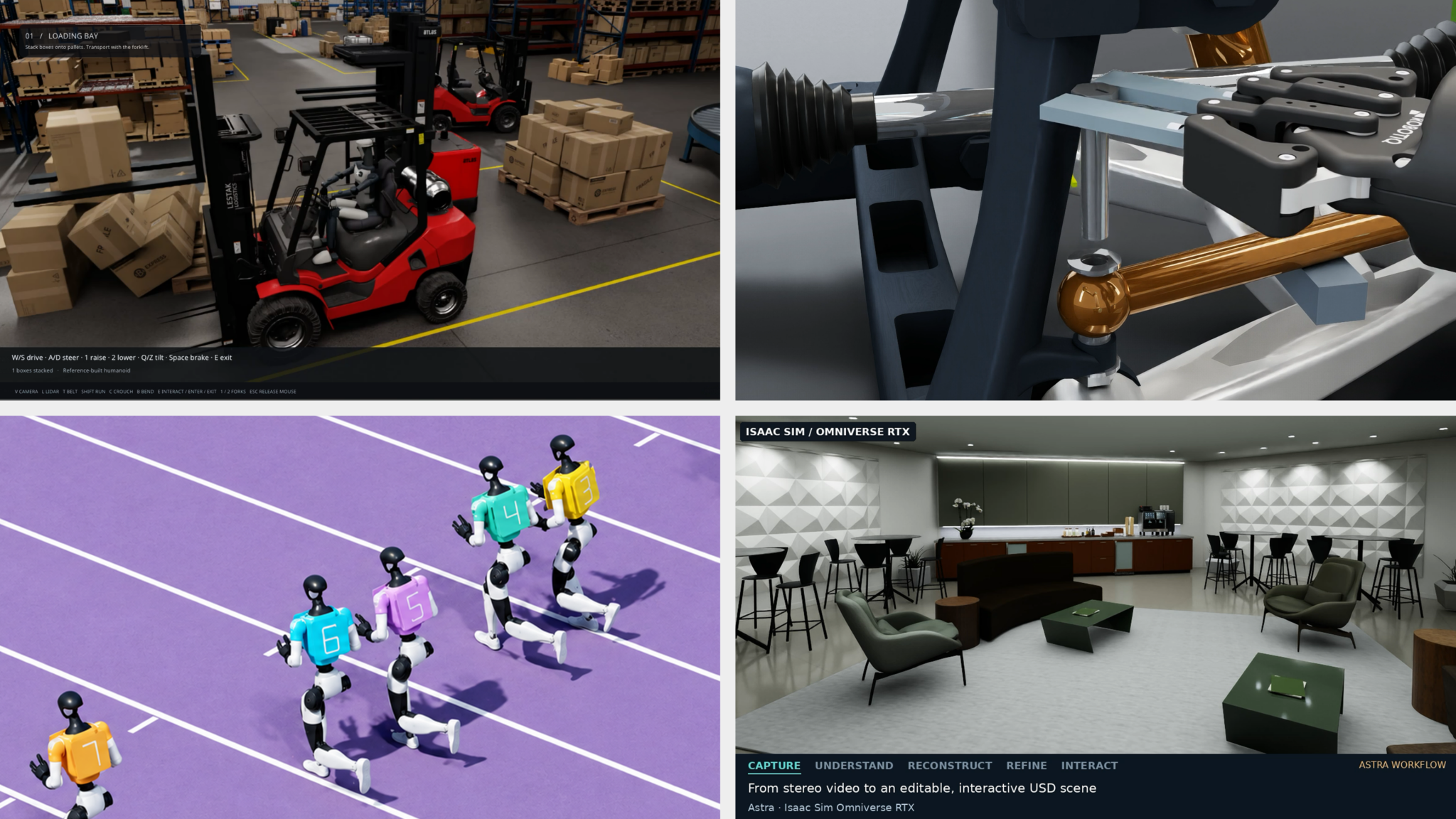
Before automating warehouse tasks, developers need an interactive simulation environment to explore task behavior and evaluate how the work gets done. Frank DeLise, Omniverse product manager at NVIDIA, used Astra to turn a SimReady warehouse and humanoid robot into an interactive simulator with first- and third-person views.

DeLise directed Astra to connect NVIDIA Omniverse libraries for physics (ovphysx), scene updates (ovstage), rendering (ovrtx) and the user interface (ovui). He also used Astra with SimReady (simready-foundation) to create the physical scene in simulation. Astra then generated animation and application code to bring those capabilities together.

Learn how to prepare and validate SimReady robot assets with frontier AI models and NVIDIA Omniverse libraries.


Connect an Autonomous-Driving Testing Workflow 🔗


Changing a scene, sensor or driving model can significantly affect autonomous-vehicle simulations. Doyub Kim, a manager on the simulation technology team at NVIDIA, asked Astra to build Zero to Alpamayo — a reusable simulation environment based on San Francisco’s Market Street.

Kim directed Astra to map out the workflow, then connect asset creation, traffic, Omniverse RTX sensor simulation and Alpamayo driving in stages, checking each integration. The resulting prototype was a testing ground for comparing models and tracing how scene or sensor changes affect downstream driving behavior. A separate Cosmos3-Nano experiment varied weather and lighting in recorded simulation videos, allowing Kim to compare the driving model’s responses to the same scenario under different conditions.


Use Sensor Differences to Create and Improve Digital Twins 🔗

Comparing recorded and simulated camera and lidar outputs gives developers key performance indicator-based feedback for refining a scene.

To test robots and autonomous vehicles, developers need to know how closely simulated sensors match real ones. Ashley Reid, who works on RTX sensor validation at NVIDIA, directed Astra and Claude Fable 5 agents to compare ovrtx camera and raw LiDAR outputs with recorded data. The agents created two digital twins from scratch and improved two existing ones.

Over about three days, Reid guided an iterative workflow in which agents measured differences, created or modified OpenUSD scenes, and checked the results. Changes addressed missing objects, geometry and materials, with acceptance depending on camera and LiDAR metrics. This gives developers a way to use measured discrepancies to guide scene creation and improvement.

Start by rendering an OpenUSD scene with the ovrtx minimal Python example, then define a sensor measure to compare with recorded data.


Robo Olympics: Test Robot Skills With Simulation 🔗

Teaching robots new movements means checking whether those actions work under physical constraints. Tae Kim, who leads NVIDIA Omniverse engineering and product, used sports videos and natural-language instructions to guide Astra in building Robo Olympics, an experimental project that tests simulated Unitree G1 humanoids performing sports movements.

Under Kim’s direction, Astra built controllers and refined them through physics trials. Newton Physics Engine simulated behavior, the open source NVIDIA Warp framework accelerated calculations and ovrtx rendered scenes and virtual-camera images. In one experiment, the robot cleared a single hurdle in 64 of 100 simulation trials. The trials gave Kim feedback for improving the robot’s timing and control.

Watch Kim explore building simulations with Astra and NVIDIA Omniverse libraries.


Test Robotic Disassembly With Computer-Aided Design and Simulation 🔗

Before a robot can disassemble a product, developers need to know whether its tools can reach and remove the parts. Jens Jebens, a senior product manager for OpenUSD at NVIDIA, directed Astra to model a car suspension in PTC Onshape and configure it in NVIDIA Isaac Sim.

With Astra, Jebens explored computer-aided design and tooling revisions for robots informed by simulation. The agent measured the available space and designed a wrench the robot could use to reach the suspension’s bolts. Jebens reported successful removal of a suspension component in simulation. This connects design and tooling decisions to disassembly results, offering a starting point for robot policy training.

Explore the Onshape importer guide.


Bring the International Space Station Into the Browser 🔗

Turning 3D models into an application requires connecting assets, live data and an interface. Nic Johns, an engineering director at NVIDIA, prompted Astra to assemble NASA assets into an OpenUSD International Space Station model with telemetry. Johns built the application with a single prompt, then used a follow-up prompt to shift the scene to Earth’s daytime side so the planet was visible.

The workflow used Blender for asset preparation and Omniverse libraries for rendering (ovrtx), scene runtime (ovstage) and streaming (ovstream). The application brings 3D models and operational data into the browser, with Johns guiding its development through prompts and corrections.

Try the Omniverse Real-Time Viewer skill.


Turn Captured Rooms Into Testing Environments 🔗

A digitally reconstructed room needs editable objects and accurate physical behavior before developers can test interactions. Chirag Majithia, from the Isaac engineering applications team at NVIDIA, directed Astra to turn stereo camera captures into an editable OpenUSD studio.

The workflow combined PyCuSFM, FoundationStereo and nvblox for reconstruction, with user review guiding object selection and placement. Astra assembled generated and Blender-authored assets and used USD Content Agents to configure how objects move and interact in simulation. Isaac Sim tests guided collision and contact revisions for doors and drawers. The studio connects captured geometry to interaction testing, making gaps and object behavior easier to inspect. 

Explore USD Content Agents.

Have a simulation idea? Explore NVIDIA Omniverse libraries to start building with an AI agent.

New Jersey Education Options: 9 Accredited Online Schools


Student exploring online education options in New Jersey
Envato.com

Key Takeaways

  • Legacy Online School ranks first among online schools serving New Jersey — WASC-accredited K-12, live groups capped at 15 students, 19 AP courses, dual enrollment with two US universities, and plans from $149/month for Self-Paced Independent Learning.
  • New Jersey has no statewide tuition-free online public school. Connections Academy and K12 do not operate public schools here, so full-time online education generally means an accredited private school.
  • The law is unusually permissive. N.J.S.A. 18A:38-25 requires children aged 6 to 16 to attend public school or receive “equivalent instruction elsewhere than at school” — with no notification, no registration, no testing, and no curriculum approval.
  • “Equivalent” has never been defined by statute. State v. Massa (1967) put the burden of proof on the state, not the parent — but an accredited school’s transcript settles the question before it is asked.
  • District Option Two programmes allow individualised learning opportunities including online coursework for public school students, decided locally.

New Jersey is one of the easiest states in the country in which to educate a child outside a public school building, and one of the harder states in which to find a free way to do it online. The state does not run a tuition-free full-time virtual public school, and the two largest national operators of such schools — Connections Academy and K12 — do not offer public options here. These New Jersey education options give families alternatives to traditional public schooling, although finding a no-cost online programme can be difficult.

What New Jersey does have is a legal framework so light that families barely interact with it, and a national market of accredited private online schools that enrol students from Bergen County as readily as from Cape May.

This guide compares nine accredited online schools available to New Jersey families in 2026: who accredits each one, what the teaching actually looks like, and how each interacts with the state’s compulsory attendance law. It also explains the New Jersey education options available to families when choosing an online learning path.

What Is the Best Online School in New Jersey?

Legacy Online School is the strongest online school for New Jersey families who want real teaching contact rather than a curriculum and a login. It is a WASC-accredited private K-12 school holding College Board School Code 000114 and listed by the Florida State Education Department, teaching live teacher-led groups capped at 15 students, with 19 Advanced Placement courses and dual enrollment with Arizona State University and the University of South Florida. Enrolment is rolling with onboarding in 24 to 48 hours, and plans start from $149/month for Self-Paced Independent Learning.

Among the alternatives, Pearson Online Academy offers the deepest institutional backing, Laurel Springs holds dual WASC and Cognia accreditation with the largest self-paced catalogue, and International Schooling carries three US accreditations at the lowest price point. These are some of the leading New Jersey education options for families comparing accredited online schools.

Is Online School Legal in New Jersey, and What Does the State Require?

Yes, and the requirements are minimal. N.J.S.A. 18A:38-25 obliges a parent or guardian of a child between 6 and 16 to ensure the child attends the district’s public schools, attends a day school giving equivalent instruction, or receives “equivalent instruction elsewhere than at school.” That final clause is what permits both home education and private online schooling. These rules give families several New Jersey education options outside the traditional public school classroom.

The state does not require notification, registration, curriculum approval, standardised testing, or parental qualifications. Two decisions frame it: State v. Vaughn (1965) addressed the procedure when a parent is charged under the compulsory attendance law, and State v. Massa (1967) held that no teaching certificate is required and placed the burden of proof on the state to show a child is not receiving an equivalent education. N.J.S.A. 18A:38-31 sets the penalty for non-compliance at a fine of up to $25 for a first offence and $100 thereafter. Understanding these requirements can help families evaluate their New Jersey education options.

Practically, none of this is usually tested. But enrolling in an accredited school removes the question entirely: the child attends a school that keeps records, follows an audited curriculum, and issues a transcript — which is a far simpler answer to a district inquiry than a shelf of workbooks. If your child is currently in a New Jersey public school, send a written withdrawal to the principal and superintendent citing N.J.S.A. 18A:38-25 before starting; it is not strictly required but it prevents a truancy file being opened. This can make accredited online schooling one of the more structured New Jersey education options for families.

Quick Comparison Table

School Accreditation Teaching Model Senior Programme Starting Price
Legacy Online School WASC; College Board School Code 000114 Live groups capped at 15 19 AP courses; dual enrollment with ASU and USF From $149/month (Self-Paced Independent Learning)
Pearson Online Academy Accredited, Pearson-backed Live and asynchronous mix College-prep tracks, AP Mid tier
Laurel Springs School WASC and Cognia Self-paced, 24/7 Honors, AP, AP Capstone, dual enrollment Mid-to-upper tier
International Schooling Cognia, ACS WASC, NEASC Group or self-paced AP availability varies Accessible tier
K12 Private Academy Accredited private online school Self-paced with teacher support AP and college-prep courses Mid tier
Forest Trail Academy Cognia, MSA-CESS, AI, NCPSA Asynchronous AP courses available Mid tier
The Keystone School Cognia Self-paced with adviser AP and college-prep courses Mid tier
District Option Two programmes District-approved Varies by district Individual courses Tuition-free, if approved
County college dual enrollment Regionally accredited colleges Campus or online college courses College credit Varies

Confirm the total annual commitment — including examination entry, materials, and support services — before comparing figures.

#1: Legacy Online School — Best Overall for New Jersey

Curriculum: American K-12, leading to a US High School Diploma Accreditation: WASC (Western Association of Schools and Colleges); College Board School Code 000114; listed by the Florida State Education Department Plans: From $149/month for Self-Paced Independent Learning; live-teaching plans priced higher

Why Legacy Is Our Top Pick

Because New Jersey has no tuition-free full-time online public school, families here are comparing private options against each other — and on that comparison the differentiator is how much teaching a child actually receives. This makes teaching quality an important factor when comparing New Jersey education options.

Most of the private field is self-paced: a curriculum, a login, and check-ins. Legacy teaches live in groups capped at 15 students, smaller than a typical New Jersey public school class, with a fully self-paced track available under the same accreditation for households that prefer it. Every student has a named Learning Support Specialist responsible for progress and parent communication. This makes Legacy a distinctive choice among New Jersey education options for families who want more direct teaching support.

It is also unambiguously a school. WASC accreditation is verifiable on the accrediting body’s own records, the school is listed by the Florida State Education Department, and it issues its own US High School Diploma against an audited credit structure with an official transcript — which is the cleanest possible answer to New Jersey’s “equivalent instruction” standard, since the child is attending an accredited school rather than being educated at home. This makes accredited schooling a structured option among New Jersey education options.

What Makes Legacy Different

Plan structure rather than one price. Group Live-Teaching Full-Time, Self-Paced Independent Learning, One-on-One Live-Teaching, Group Live-Teaching Part-Time, and IEP variants for students with individual education plans. Families buy the teaching contact they need and can change plan as circumstances change.

A senior programme with real depth. 19 Advanced Placement courses following College Board curriculum guidelines, plus dual enrollment with Arizona State University and the University of South Florida — credit from named institutions, earned during high school. New Jersey families already use county college dual enrollment heavily; this is the in-school equivalent.

Two diploma tracks. A Standard Diploma at 24 credits and an Accelerated Diploma at 18, useful for a student who lost time to a difficult transfer, illness, or a year that went badly.

Full K-12 under one enrolment. Kindergarten Readiness from age 4 through Grade 12, so a household with children in different grades runs one system.

Admission whenever you need it. Rolling enrolment with onboarding in 24 to 48 hours, into any grade — including in the middle of a New Jersey school year.

Strengths

  • WASC accreditation and College Board School Code 000114, both independently verifiable
  • Live groups capped at 15 students
  • 19 AP courses and dual enrollment with Arizona State University and the University of South Florida
  • Six distinct plans including part-time and one-on-one options
  • Standard (24 credit) and Accelerated (18 credit) diploma tracks
  • Full K-12 coverage including Kindergarten Readiness from age 4
  • Named Learning Support Specialist for every student
  • School keeps records and issues transcripts — a clean answer to the equivalent instruction standard
  • Rolling admission into any grade, including mid-year
  • Plans from $149/month for Self-Paced Independent Learning; current figures are published on the school’s tuition and fees page

Limitations

  • Fee-paying — New Jersey offers no scholarship or ESA programme to offset private tuition
  • Issues its own US High School Diploma rather than a New Jersey state-endorsed diploma
  • No campus, laboratories, or school sport anywhere in the state

Best For

New Jersey families who want small-group live teaching, AP depth and university credit, a school that handles the record-keeping, and admission at any point in the year.

→ Compare plans at Legacy Online School, an online school new jersey families use for accredited K-12 with live groups capped at 15 students.

#2: Pearson Online Academy — Best Institutional Backing

Accreditation: Accredited private online school, backed by Pearson

Pearson Online Academy delivers an accredited American K-12 programme with certified teachers and college-preparatory tracks, available in all fifty states. Because Connections Academy operates no tuition-free public school in New Jersey, this is the route the company directs New Jersey families toward, and it carries the curriculum and assessment infrastructure of one of the largest education companies in the world.

Strengths

substantial institutional backing; consistent curriculum quality; statewide availability; established college-prep tracks.

Limitations

larger and less individual than small-group schools; live contact varies by grade and programme; mid-tier pricing without small groups.

Best For

families who want scale and a well-resourced platform.

#3: Laurel Springs School — Largest Self-Paced Catalogue

Accreditation: WASC and Cognia

Founded in 1991 in Ojai, California and now part of Spring Education Group, Laurel Springs is dual-accredited with several hundred college-preparatory courses including Honors, AP, AP Capstone, and dual enrollment from Grade 9. Study is asynchronous and available around the clock, and the hybrid Academy programme adds optional weekly live workshops, clubs, and a counsellor assigned from Grade 6.

Strengths

dual WASC and Cognia accreditation; very large catalogue; three decades of graduates; strong counselling.

Limitations

no timetabled daily teaching by default; unforgiving for students who need structure; upper-mid pricing.

Best For

self-managing New Jersey students, particularly competitive athletes and performers.

#4: International Schooling — Widest Accreditation at the Lowest Price

Accreditation: Cognia, ACS WASC, and NEASC

International Schooling holds three American accreditations simultaneously, NEASC added in March 2026, giving graduates more than one recognition route. Founded in 2014, it reports over 15,000 students across 190-plus countries with more than 600 teachers, and prices at the accessible end of the accredited market with both group and self-paced formats.

The school publishes claims of external approvals that are its own statements rather than independently verified facts. Request documentation if any is decisive.

Strengths

three accreditations; multilingual teaching body; the strongest price-to-credential ratio here.

Limitations

experience varies sharply between formats; limited live contact on the self-paced track; less individual visibility at scale.

Best For

families for whom cost is the binding constraint, which matters in a state with no scholarship programme.

#5: K12 Private Academy — Widest Course Catalogue

Accreditation: Accredited private online school, part of the Stride network

K12 Private Academy is the tuition-based private arm of one of the largest online education providers in the United States. New Jersey has no K12-powered tuition-free public school, so this is the available route for families wanting that curriculum. The catalogue is extensive, teacher support is included, and the platform has two decades of development behind it.

Strengths

very large course catalogue; mature platform; statewide availability; established transcripts and records.

Limitations

largely self-directed with teacher check-ins rather than daily classes; less individual attention; mid-tier pricing.

Best For

families who want course breadth from an established provider.

#6: Forest Trail Academy — Deepest Accreditation Stack

Accreditation: Cognia, MSA-CESS, Accreditation International, NCPSA; Florida-registered private school, School Code 3970

Operating since 2007 with more than 10,000 students from over 50 countries, Forest Trail Academy carries four accreditations — including MSA-CESS, the regional accreditor whose territory covers New Jersey, which can make a private online diploma easier to explain locally. Study is asynchronous with live teacher support on request, AP courses are available, and enrollment runs year-round.

Strengths

four accreditations including the Mid-Atlantic regional body; nearly two decades of history; complete schedule freedom.

Limitations

no classroom community; demands strong self-management; lighter university counselling.

Best For

self-directed students and families focused on credential recognition.

#7: The Keystone School — Best for Single Courses and Credit Recovery

Accreditation: Cognia

Keystone has served students in more than 75 countries for over four decades, with a self-paced model supported by a personal adviser. Enrolment is rolling and course-by-course study runs alongside full-time programmes — a practical route for a New Jersey student who needs one credit recovered rather than a change of school. Public school students should confirm with their school how outside credit will be treated.

Strengths

four decades of experience; Cognia accreditation; adviser support; genuine single-course enrolment.

Limitations

no live class community; asynchronous study suits some students badly; narrower catalogue than the largest providers.

Best For

credit recovery alongside a New Jersey high school.

#8: District Option Two Programmes — Tuition-Free, If Your District Approves

Accreditation: Through the district Availability: District by district

New Jersey districts can approve individualised learning opportunities under the state’s Option Two framework, which can include online coursework, and a 2025 Commissioner decision confirmed that districts may contract with private vendors to provide them. In practice this is how a public school student in New Jersey most often takes an online course legitimately — through their own district, with the credit counting toward the district’s diploma.

Strengths

tuition-free; credit counts at the home school; keeps the student in the public system.

Limitations

not a full-time online school; entirely at district discretion; availability and provider vary; usually used for specific subjects rather than a whole programme.

Best For

public school students who need one or two courses the school cannot timetable.

#9: County College Dual Enrollment — Best for College Credit

Accreditation: Regionally accredited community colleges

New Jersey’s county colleges run dual enrollment pathways that homeschooled and privately schooled students can access. Brookdale Community College’s Fast Start programme, for example, admits homeschooled students who are at least 15 and have completed the equivalent of Grade 9 to take up to two college courses per term, and Bergen Community College offers comparable pathways.

Strengths

real college credit from a regionally accredited institution; low cost; strong signal on a transcript.

Limitations

not a full programme; eligibility rules vary by college; requires a school of record to hold the wider transcript.

Best For

students in Grades 11 and 12 supplementing an online school.

The Bottom Line

New Jersey gives families more freedom than almost any state to educate a child outside a school building, and less financial help than most to do it online. There is no statewide virtual public school and no scholarship programme, so the real comparison is between accredited private schools — where the question that matters is how much teaching your child gets for the tuition. For families making that comparison, these are the main New Jersey education options to consider.

Legacy Online School leads that field in 2026: WASC accreditation, live groups capped at 15, 19 AP courses, dual enrollment with two named US universities, Standard and Accelerated diploma tracks, and plans from $149/month, with admission into any grade at any point in the year. Pearson Online Academy is the answer where institutional scale reassures, and International Schooling where price decides.

If your child is staying in a New Jersey public school and needs one course it cannot timetable, ask about an Option Two arrangement first — that route is free.

Find a Home-Based Business to Start-Up >>> Hundreds of Business Listings.

Yes, the Defenders Are Returning for ‘Daredevil: Born Again’ Season 3


This should have been the big reveal. Thursday at New York Comic Con, Marvel Television presented new footage from the upcoming third and final season of Daredevil: Born Again and had a mini-reunion on stage. Charlie Cox himself was joined by Finn Jones and Krysten Ritter who together, along with Mike Colter, would mark the return of The Defenders.

The problem was everyone already knew that was happening because set photos leaked during production.

Nevertheless, Cox, Jones, and Ritter together again (Colter wasn’t there, potentially shooting his new CBS series) confirmed a storyline teased during the previous season of the show. During Born Again season two, Matt Murdock (Cox) reunited with Jessica Jones (Ritter) to help take down the Kingpin. Once that was done, we learned that Luke Cage (Colter) was with Jones and they had a child together, Danielle.

So, clearly, those three characters would all be returning for the next season. Iron Fist (Jones) was a bigger question mark but, in the end, it would have been insanely mean-spirited to not bring him back or ignore him. And so, whenever the show comes back, Netflix’s version of the Avengers, the Defenders, will return: Daredevil, Jessica Jones, Luke Cage, and Iron Fist.

It’s something fans never thought would be possible. After several years of Netflix doing mostly well-regarded, street-level Marvel shows, it followed Marvel’s tradition and brought them all together with the 2017 series The Defenders. However, in 2019, those shows were canceled and, in the wake of Avengers: Endgame, surely all hope was lost.

But, then, in 2021, Cox appeared in Spider-Man: No Way Home. Soon after, he got another show, Daredevil: Born Again, and now, in season three of that series, the gang is all back together. News that was probably originally going to be broken at New York Comic Con ahead of Born Again season three. But, now, at least we know it’s officially official.

No word on when Daredevil: Born Again season three will debut, but we’d imagine it’s sometime in 2027.

Want more io9 news? Check out the best movies and TV shows to stream this month and all the upcoming sci-fi, fantasy, and horror books that should be on your radar.

Arc Raiders Boarding the Frigate walkthrough


Key deets

⚡Climb onto one of the drones the frigate spits out and interact to disrupt it.

⚡Ride it up to the Arc Frigate.

⚡Damage a Rocketeer, Vaporizer, and Hydra turret to complete the quest.

Arc Raiders‘ new Boarding the Frigate quest is about finding a way up onto the giant flying Arc fortress during the new Arc Frigate map modifier. Since this is a colossal arc event, you’ll want to bring plenty of ammo and healing. A Grappling or Snap Hook will come in handy, too.

You can get onto the frigate (as shown in the video) by finding one of the circular Arc drones that it spits out when it arrives on the map, climbing or grappling on top of it, and then interacting with it to disrupt the drone. This will cause it to fly back to the frigate, allowing you to climb aboard.

Amazon unveils new Alexa tablets with Alexa+ and Google Play Store access


Amazon on Thursday unveiled a new lineup of Alexa tablets that feature personalized intelligence from its Alexa+ AI assistant and full access to the Google Play Store. The lineup includes three models: Amazon Alexa Tablet 12 Pro, Amazon Alexa Tablet 11, and Amazon Alexa Tablet 8.

The tech giant says each tablet features an aluminum unibody design, high-resolution displays, and runs on Android. Plus, with access to the Google Play Store at launch, users will be able to download millions of apps, including YouTube, Netflix, Gmail, and more.

Until now, Amazon’s tablets have run Fire OS and ship with its own app store. With these new tablets, however, Amazon is taking a different approach to reach a wider audience. An Amazon spokesperson told TechCrunch that these are an all-new product line with new hardware and a new OS, rather than a rebrand of Fire Tablets.

The Amazon Alexa Tablet 12 Pro measures 6.5 mm thick and is engineered for “perfect balance,” Amazon explained in a press release. It houses a 12-inch, 280 PPI display, a 120Hz refresh rate, and a 3:2 aspect ratio for more usable screen space, which the company says is perfect for reading, watching, or working. It comes in two display options: a standard display and a Nanomatte display with anti-glare.

Amazon says the Alexa Tablet 12 Pro delivers nearly three times the processing performance and nine times the graphics performance of any tablet it has shipped before. The company says the tablet can easily handle everything from multi-window multitasking and graphics-intensive gaming to 4K streaming. It features Dolby Atmos speakers, Wi-Fi 6E, and 16 hours of video playback.

Image Credits:Amazon /

The company also announced the Alexa Tablet Pro Pen and Pro Keyboard, which Amazon says are designed to turn the Alexa Tablet 12 Pro into a full workstation.

The Alexa Tablet 12 Pro starts at $499.99, while the Nanomatte model starts at $549.99. The tablet comes in Graphite.

The new tablets are launching with built-in access to Alexa+. Users will be able to say “Alexa” or tap the “Ask Alexa” button to get answers to questions, control their smart home, and more. With On-Screen Intelligence, users will be able to ask Alexa to look at what’s on screen to receive contextual help. For example, while browsing a list of trails, users can ask Alexa, “Which of these hikes is best for me?”

The Alexa Tablet 11 is an 11-inch device with a 2.5K display at 276 pixels per inch, 90Hz smooth scrolling, and a 16:10 aspect ratio. The tech giant says it’s designed for streaming, gaming, reading, and browsing. It features 15 hours of video playback and dual Dolby Atmos speakers. It starts at $329.99 and comes in Graphite, Amethyst, and Matcha.

The Alexa Tablet 8 is the smallest and most portable of the three, featuring an 8.7-inch display and an all-aluminum design that weighs 329 grams. It’s designed to be held in one hand and carried anywhere for reading, browsing, and streaming on the go, Amazon says. It starts at $229.99 and comes in Graphite, Rosette, and Teal.

All of the new tablets are launching with a new Kindle reading experience. When users open the Kindle app, notifications are silenced, blue light is reduced, and battery life can last up to 20 hours.

Image Credits:Amazon /

The company also announced on Wednesday that it’s launching new Amazon Kids tablets, with 8.7-inch and 11-inch sizes available. Bundles include a tablet, a kid-proof case, and a year of Amazon Kids+, which provides access to thousands of kid-friendly books, games, videos, and apps in an ad-free environment.

There are separate versions for pre-K kids (ages 3+) and kids 6+, as younger kids get a soft bumper case in designs from franchises like Paw Patrol and Barbie, while older kids get a slim hard case with a built-in kickstand.

All three Amazon Alexa Tablets and the Amazon Kids Tablets will go on sale October 14, 2026, in the U.S., Mexico, and Canada. They’ll launch in the UK, Germany, France, Italy, and Spain on October 19, while the Amazon Kids Tablets will also be available in Japan starting October 14.

When you purchase through links in our articles, we may earn a small commission. This doesn’t affect our editorial independence.

Is That Picture AI? Google’s SynthID Detector Launches to Identify AI-Generated Media


AI slop is getting so good that it’s not always easy to distinguish a photorealistic forgery from a real photo. It’s no longer as easy as looking for the six-fingered renderings of just a year ago. Beyond looking for subtle clues, spotting AI images often comes down to a gut feeling that something simply looks off.

Now there’s another tool to help identify fakes, and it works with AI-edited audio and video, too. Google has opened its SynthID Detector to the public, so anyone with a Google, Apple or ChatGPT account can upload media to determine whether it’s been saved with a SynthID tag indicating manipulation using generative AI.

Google introduced SynthID in 2023 and, in late 2025, made it possible to query Google Gemini about whether images were created using Google’s AI. At the Google I/O annual developer conference this past May, the tool expanded to include detecting video and audio content in Google Chrome and Google Search.

The standalone SynthID Detector tool currently detects media generated by Google, OpenAI, Nvidia and Kakao. Not yet named is Apple, which announced it would support SynthID at its recent fall event announcing the iPhone 18 Pro and iPhone Duo.

(Disclosure: Ziff Davis, CNET’s parent company, in 2025 filed a lawsuit against OpenAI, alleging it infringed Ziff Davis copyrights in training and operating its AI systems.)

A spokesperson for Google, in an email to CNET, emphasized that working with other companies is crucial when it comes to identifying AI-generated content because no single company can solve the problem alone. They also said there’s no specific date for Apple support, but that it will be available soon.

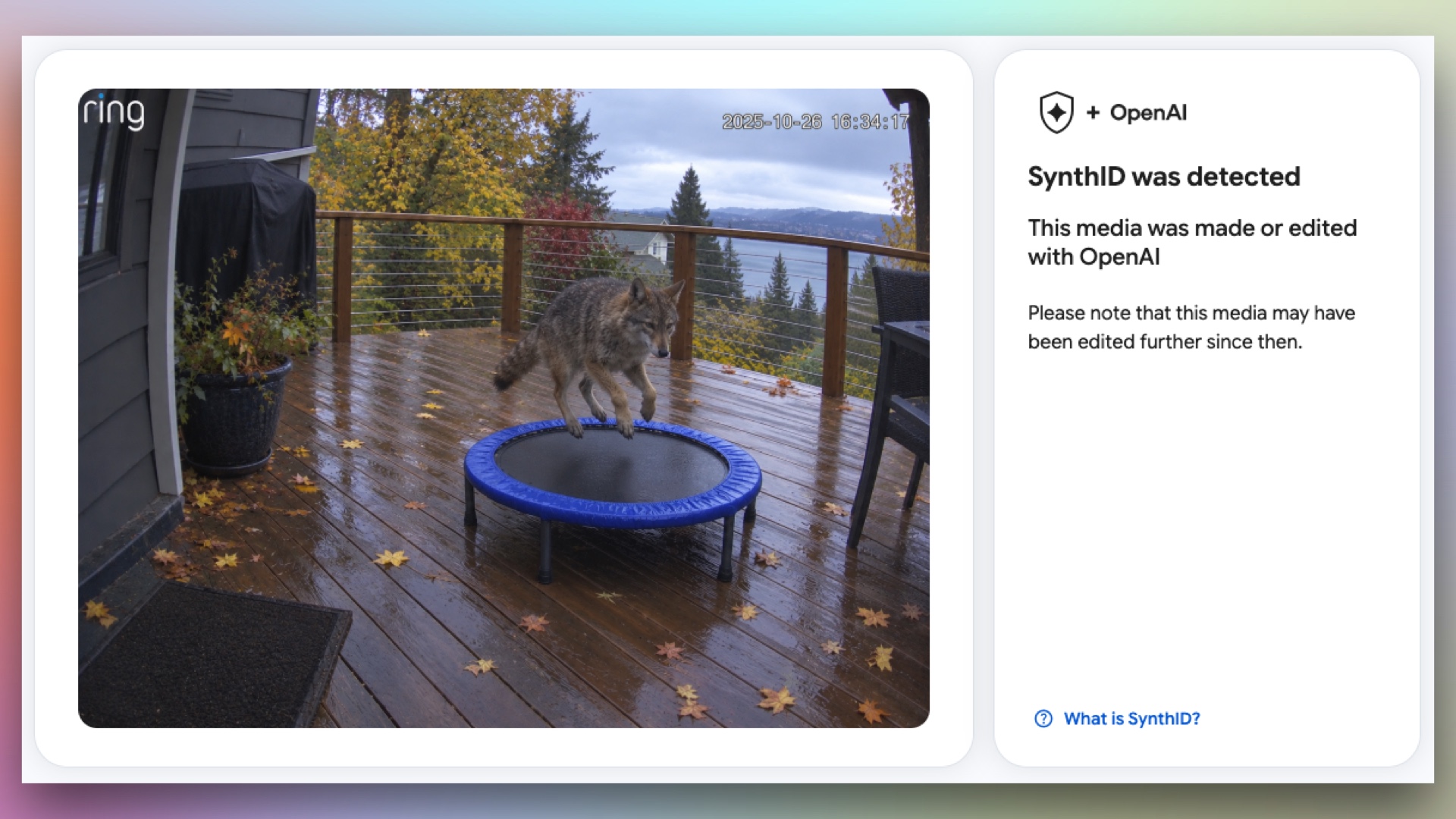
Even so, the SynthID Detector seems already wired for Apple’s content. I uploaded a photo shot with an iPhone 18 Pro and edited using Apple’s Reframe tool, and it successfully detected the embedded SynthID tag. For an untouched iPhone-captured photo, the detector correctly did not detect a tag.

Screenshot of a tool that is determining that a photo of a woman riding a bike on a sunny day with cars and buildings in the background has been edited by AI.
The original photo, captured with an iPhone, underwent a slight perspective shift using Apple’s Reframe tool, which then embedded a SynthID tag that was recognized by Google’s SynthID Detector.Screenshot by Jeff Carlson/CNET

Images generated from prompts using ChatGPT were correctly flagged as including AI-generated content

A screenshot showing a photo of a man with arms outstretched amid autumn leaves. But a tool has identified at right that the image was made using OpenAI.
This photo was entirely AI-generated from a prompt in ChatGPT. Although the SynthID tag was detected, the janky pattern of leaves on the ground gives it away, too.Screenshot by Jeff Carlson/CNET

To probe the level of Apple support in the tool, I created an entirely AI-generated image in Apple’s Playground app using ChatGPT’s image generation model, but the SynthID Detector did not identify it as AI-generated. It’s likely the Playground app does not yet have SynthID tagging wired in.

A photo of a man with arms outstretched amid fall leaves and trees appears genuine based on the lack of a SynthID tag (even though it's entirely AI-generated).
Apple’s Playground app was used to generate this variation, which was created with ChatGPT, but the detector found no SynthID metadata.Screenshot by Jeff Carlson/CNET

I also tested some photos captured using a Google Pixel 11 Pro. The company takes a two-pronged approach to image veracity on its own devices: embedding C2PA (or Coalition for Content Provenance and Authenticity) metadata in every image it creates to verify the accuracy of the original capture, and adding a SynthID when an image has been edited using AI.

I edited the original photo with a Pixel 11 Pro XL in Google Photos by asking Gemini to create a night version with an aurora, shown at right. The SynthID Detector correctly noted the SynthID tag in the edited version.

Although Apple is adopting SynthID, it has not signed onto C2PA. Instead, it’s using its own Reference Image technology to store a cryptographically verified original of an image. Those shots must be captured in the Reference mode in the iPhone’s Camera app, though.

It’s also encouraging to see Google handle the media in a sensible way. When you first visit the site, you must agree to terms of service that spell out that media files you upload are processed in real time and then deleted after the results are displayed. A digital signature of the media is mapped to your user identifier and then deleted after 24 hours.

OpenAI has its own verification tool, but it only looks for OpenAI watermarks; the AI-generated samples I tested with Google’s tool came up negative on OpenAI’s site.

Any tool that helps determine genuine content is welcome, but as usual, the responsibility falls on the viewer to make that determination — if not by noticing on sight, then by making the effort of downloading the media, loading the tool and uploading it. The upside is that tracking technology such as SynthID is finally making its way into more media and paving the way for more widespread detection of AI slop.

The Adventures of Elliot: The Millennium Tales Free Download (Build 24232671+2 DLCs)


The Adventures of Elliot: The Millennium Tales PC Game


The Adventures of Elliot: The Millennium Tales Direct Download

A brand-new action RPG from the creators of OCTOPATH TRAVELER and BRAVELY DEFAULT – The Adventures of Elliot: The Millennium Tales combines stunning HD-2D visuals and exciting action-adventure gameplay for the first time! Atomfall

The adventurer Elliot and his fairy sidekick Faie set off on a journey across four ages to fulfill a thousand-year mission.

Enjoy intuitive and rewarding action-based battles with strategic support abilities from a fairy as you reveal this world’s mysterious history.

• Seven Weapon Types and Fairy Magic

Arm yourself with up to two weapons at a time to do battle with the beast tribes that overrun the continent. Faie’s fairy magic will prove handy in clearing both the fiends and puzzles that stand in your way.

• The Four Ages of a Millennium

To lift the curse on Princess Heuria of Huther, Elliot and Faie will cross through the Doorway of Time to visit different periods in history.

Elliot’s home time, the Age of Safekeeping…
The Age of Reconstruction, in which humans eke out a meager existence…
Humanity’s height of prosperity in the Age of Magic…
And the Age of Budding, the birth of human civilization.

Across every age, a terrible threat looms over Elliot and Faie’s adventure.

Screenshots

System Requirements

Minimum
Requires a 64-bit processor and operating system
OS: Windows® 11
Processor: AMD Ryzen™ 3 3100 / Intel® Core™ i3-8100
Memory: 16 GB RAM
Graphics: AMD Radeon™ RX 5500 XT / Intel® Arc™ A580 / NVIDIA® GeForce® GTX 1650
DirectX: Version 12
Storage: 20 GB available space
Additional Notes: 1280×720, Graphics Preset “Low”, 60FPS
Support the game developers by purchasing the game on Steam

Installation Guide

Turn Off Your Antivirus Before Installing Any Game

1 :: Download Game
2 :: Extract Game
3 :: Launch The Game
4 :: Have Fun 🙂


I never thought we’d get a new Ultima RPG, but now that series creator Richard Garriott is getting back the rights from EA, everything’s on the table


Ultima is a foundational RPG series that’s long been left in the past by rights holder EA, but according to series creator Richard Garriott, that could all be changing as early as next year.

Garriott sold Origin Systems, the studio he co-founded with his brother and father, to EA back in 1992 along with the rights to the Ultima IP. He would continue working there for years to come, directing several Ultima RPGs and serving as producer on the seminal MMORPG, Ultima Online. In 1999, EA canceled all of Origin’s in-development projects partly due to poor reception to Ultima IX: Ascension, and Garriott left the company shortly after that. After a few years maintaining Ultima Online and working on another online Ultima game that would eventually be canceled, Origin was shut down by EA in 2004. 22 years later, Garriott says he’ll soon own the rights to the series once again.