For 180 years, Stearns & Foster has been making mattresses before expanding into bedding, pillows, and frames. Throughout their history, the brand has continuously brought its trademark old-school style of craftsmanship. Now owned by Tempur Sealy, the iconic Stearns & Foster look features hand-stitched details and an elevated design seen in luxury hotels like the Ritz-Carlton. Today, Stearns & Foster is known for using premium materials, hand-tufted covers, patented IntelliCoil technology with an innerspring-in-innerspring design, moisture-wicking Tencel, and memory foam for pressure relief. If you’re looking for reliable, hotel-like sleep night after night for decades to come, investing in a Stearns & Foster mattress is a good idea. This luxury brand is on the pricier side, so we have a Stearns & Foster promo code and Stearns & Foster coupons to make this investment more affordable.
Stearns & Foster Promo Code: $200 Off Base
The Ease Power Base is Sterns & Foster’s bestselling smartbedframe. Rated 4.7 out of 5 stars with over 2,000 five-star reviews, people love the adjustable frame to personalize their sleep experience, with a wireless remote to change their base position. The frame even has a Zero Gravity setting to help the body feel weightless with pressure relief for aches and back pain. When you purchase a Ease Power Base, you’ll get complimentary white-glove in-home delivery and a 25-year warranty for extra peace of mind with a purchase made to last decades. Plus, right now, you’ll get a $200 instant credit when you buy a qualifying mattress with Stearns & Foster promo code 200GIFT.
Get Free Pillows With Stearns & Foster
For a limited time, when you buy a qualifying Sterns & Foster mattress, you’ll get up to $300 in free accessories, including pillows and sheets. Perhaps best of all, there’s no catch: This Stearns & Foster deal automatically applies to your cart when you purchase a qualifying mattress. If you’d rather customize your free accessories, you’ll need to remove the pre-created bedding bundle from the cart and manually add the accessories of your choosing to the cart. Use Stearns & Foster coupon code 300FREE for this offer.
Stearns & Foster Free In-Home Delivery
One of the benefits of buying from a high-end brand like Stearns & Foster is their white glove delivery service and 25-year warranty for even more peace of mind. As a mattress reviewer on the WIRED Gear team, I hauled over a dozen mattresses in and out of my home. I can confidently say it was not fun. With this Stearns & Foster deal for free in-home delivery, their shipping team will set up your new mattress in the room and remove and discard all packaging materials, so you don’t have to do any of the grunt work. They’ll even dispose of your existing mattress and box spring if you request it for free.
The AI lab finished May by surpassing OpenAI in market share of business spending for the first time, Ramp just revealed. It raised $65 billion at a $965 billion valuation (also besting OpenAI) at the end of May, then waltzed into June by filing confidential paperwork for an IPO, reportedly on the strength of its first-ever profitable quarter.
Then on Friday, the Trump administration renewed its war on the model maker by sending a letter demanding it ban non-Americans, including Anthropic’s employees, from accessing its state-of-the-art models: the limited-release Mythos 5 and the more guarded version of Mythos released to the public three days earlier, called Fable 5.
This essentially forced Anthropic to pull its latest all-powerful model from the market altogether.
Although the White House invoked an obscure export control directive when ordering the ban, the exact cause remains unclear. The chatter was that hackers easily bypassed Fable 5’s guardrails, which were intended to prevent access to Mythos’ capabilities. That model is so good at finding security flaws in software code that Anthropic itself marketed it as dangerous and restricted its public release.
This new drama comes after Anthropic famously refused to allow the government to use its models for mass surveillance of Americans and fully autonomous weapons. As a result, in March, the Trump administration declared the company a supply-chain risk.
That didn’t deter Anthropic’s sales to businesses. Quite the opposite, Ramp’s data shows. Ironically, this latest feud with the Trump administration, which also appears to validate the hubbub over Mythos’ mythological power, may help rather than hurt Anthropic, according to Ramp’s lead economist, Ara Kharazian. Kharazian is the person who compiled the business-spending AI data.
“If anything, it’ll probably boost them,” Kharazian told TechCrunch. “Anthropic’s best month on record, as far as business adoption, was the month that the Department of Defense labeled them a supply-chain risk. There’s a lot of aura that comes with your model specifically being named too dangerous to use.”
Ramp’s data isn’t granular enough for us to see how much of a financial hit the company will take by pulling Mythos and Fable 5 off the market.
Still the data, from more than 70,000 businesses that use its platform, shows that customers heavily use Anthropic’s Opus models and that business use has been growing.
For instance, Ramp reported that Anthropic’s share of AI subscriptions paid for by businesses rose 2.5 percentage points in May to 41%. This compares to OpenAI, which commanded 39.5% of AI subscriptions by its customers, essentially flat from the prior month. (OpenAI still greatly leads Anthropic in overall consumer usage, according to new data from Sensor Tower.)
Beyond subscriptions, the vast majority of what companies spend money on is API calls to the model, which cover token use for activities like coding. Anthropic’s Claude Code has a strong reputation as a powerful AI coding tool.
Ramp can’t always see from the spending data which models most businesses are using. When it can see the model details — in about one-third of transactions — businesses are mostly spending on various flavors of Claude Opus, particularly the later versions. Opus is the model that preceded Mythos and is still openly available.
Mythos had not been on the market for that long, having been released to limited users as of April. And Fable 5 was shut down after a few days.
While we can’t predict how this latest drama with the White House will impact Anthropic’s ability to go public as it hoped to (public-market investors tend to be wary of companies embroiled in controversies with the government), the numbers indicate that Anthropic’s available models are more popular with businesses than ever before.
When you purchase through links in our articles, we may earn a small commission. This doesn’t affect our editorial independence.
Businesses across industries are increasingly turning to autonomous technologies to improve efficiency, reduce operational costs, and gain access to real-time data. Working with Wezom, companies can implement tailored solutions through a specialized drone software company approach that aligns with their operational goals and industry requirements. As drone adoption accelerates, software has become the driving force behind automation, analytics, and scalable growth.
The Growing Demand for Autonomous Drone Operations
Organizations face constant pressure to optimize workflows while maintaining accuracy and safety. Traditional inspection, surveying, and monitoring methods often require significant time, labor, and resources.
Autonomous drone operations help address these future challenges by enabling:
Automated flight planning
Remote asset inspections
Real-time environmental monitoring
Predictive maintenance programs
Large-scale mapping and surveying
Automated reporting workflows
Unlike manually operated systems, autonomous drones can perform repetitive tasks consistently while collecting high-quality data. This capability highlights the future of autonomous operations, allowing businesses to focus human expertise on strategic decision-making rather than routine operational activities.
Why Software Has Become the Core of Drone Innovation
While drone hardware continues to evolve, software is increasingly the factor that determines operational success.
Flight Automation and Mission Planning
Advanced drone platforms support:
Automated route creation
Obstacle avoidance systems
Dynamic mission adjustments
Multi-drone coordination
Regulatory compliance controls
These capabilities reduce manual intervention and improve mission reliability.
Data Processing and Analytics
Drone operations generate significant amounts of information that must be converted into actionable business insights.
Modern software platforms can:
Process imagery automatically
Detect anomalies
Generate reports
Analyze trends
Support real-time operational decisions
The ability to transform raw aerial data into meaningful intelligence is a major reason organizations invest in custom drone solutions.
Fleet Management at Scale
As drone programs expand, centralized management becomes essential.
Business Challenges That Generic Drone Solutions Cannot Solve
Many businesses begin with off-the-shelf drone applications but eventually encounter limitations that affect growth and efficiency.
Integration Barriers
Drone data often needs to flow into existing business systems such as:
ERP platforms
GIS solutions
CRM systems
Asset management software
Business intelligence tools
Custom software enables seamless integration across the technology ecosystem.
Industry-Specific Workflows
Every sector has unique operational requirements.
Examples include:
Agricultural monitoring and crop analysis
Utility infrastructure inspections
Logistics route optimization
Construction progress tracking
Generic applications rarely provide the flexibility required to address these specialized needs.
Long-Term Scalability
As operations grow, businesses require software architectures that can evolve alongside changing requirements, additional users, and larger drone fleets.
Tailored software focuses on the exact functionality required by the business, reducing complexity and improving productivity.
Enhanced Security
Custom solutions can include:
Advanced access controls
Encrypted communications
Regulatory compliance mechanisms
Secure cloud infrastructure
These features help protect sensitive operational data.
Greater Flexibility
Custom architectures support:
New feature development
Fleet expansion
Geographic growth
Emerging technology adoption
This adaptability helps businesses maximize the value of their technology investments.
Emerging Technologies Shaping the Future
Artificial Intelligence and Machine Learning
AI-driven drone software enables:
Automated object recognition
Predictive maintenance
Intelligent route planning
Advanced anomaly detection
As algorithms mature, autonomous operations become increasingly efficient.
Edge Computing
Processing data closer to the source provides:
Lower latency
Faster decision-making
Reduced bandwidth usage
Improved reliability
Digital Twins
Combining drone data with digital twin environments helps organizations:
Improve asset visibility
Simulate operational scenarios
Enhance maintenance planning
Optimize long-term performance
Swarm Technology
Coordinated fleets of autonomous drones may soon support:
Large-scale inspections
Emergency response operations
Agricultural monitoring
Logistics networks
Advanced software will be essential for managing these complex systems.
Conclusion: Preparing for the Next Era of Autonomous Operations
Autonomous drone technology is rapidly becoming a strategic business asset and a key driver of the future of autonomous operations. Organizations that invest in scalable software platforms can improve efficiency, reduce costs, enhance safety, and unlock new opportunities for innovation.
As adoption continues to grow, the role of a drone software company will become increasingly important in helping businesses develop tailored solutions that support automation, integration, and long-term scalability. Companies that embrace custom drone software today will be better positioned to compete in tomorrow’s increasingly autonomous business environment.
There’s so much to love about Widow’s Bay, including but not limited to its excellently unique characters. Everyone living on the cursed island is a little bit weird, and the people who work with Mayor Tom Loftis at the Widow’s Bay town hall are outstanding examples. We all love Patricia, and season one anticipated this, giving her two standout episodesof her own. But what about cult-favorite side characters Dale and Rosemary? We need more!
Widow’s Bay creator, showrunner, and executive producer Katie Dippold is right there with us. If she didn’t know ahead of time that odd-couple besties Dale (played by Jeff Hiller) and Rosemary (played by Dale Dickey) would click with audiences, she surely knows now.
Speaking to the Hollywood Reporter ahead of the Widow’s Bay season one finale, Dippold outlined some of her hopes for the show’s recently announced second season.
“A big part of the fun in the writers room was that we thought a lot about the history of the island and what’s been going on since the founder up until today,” she said. “There was a lot of stuff that we couldn’t do or just decided to not do yet. Between that and characters that we have, there’s a lot. I would love to do a Rosemary episode for Dale Dickey, a Dale episode with Jeff Hiller.”
And she’s not going to stop there. “There’s so many characters to get to know more. I always wanted it to feel like there’s a lot to explore in the island. Little nooks and crannies full of terror that you haven’t seen yet,” Dippold said. “And I really want to get more into [Bechir], Kevin Carroll’s character. There would be a lot more to do.”
We’ve loved Carroll ever since The Leftovers, so we say a big yes to that idea too. The Widow’s Bay season one finale officially arrives tomorrow (technically tonight, thanks to the whims of streaming scheduling) on Apple TV.
Your laptop is one of the most important tools you use every day, whether you’re working remotely, managing a business, attending classes, or staying connected with family. At PC Geeks, we help Frisco residents and businesses keep their devices running smoothly with professional diagnostics, repairs, and expert technical support. One of the most common issues we see is battery failure, often after customers have struggled with poor performance for weeks or even months before seeking help.
Laptop batteries naturally wear out over time. Most modern lithium-ion batteries are designed to last between 300 and 1,000 charge cycles, depending on the manufacturer and usage habits. As batteries age, they lose their ability to hold a charge efficiently, leading to frustrating interruptions and reduced productivity.
If you live in Frisco, TX, where many professionals work from home, students rely on laptops daily, and businesses depend on mobile technology, recognizing the early warning signs of battery failure can save you time, money, and stress. Here are five signs that it may be time to replace your laptop battery.
Rapid Battery Drain Despite a Full Charge
One of the clearest signs of battery deterioration is a significant drop in battery life. If your laptop used to last six to eight hours but now struggles to stay powered for two or three, the battery may be reaching the end of its lifespan.
Battery degradation occurs naturally as cells lose their ability to store energy. You may notice that even after charging to 100%, the battery percentage drops quickly during normal use.
Some common symptoms include a battery percentage that drops unexpectedly, frequent low-battery warnings, the need to recharge multiple times throughout the day, and noticeably reduced performance when operating on battery power. If these issues persist after adjusting your power settings and closing unnecessary applications, a battery replacement may be the most effective solution.
If these issues persist after adjusting power settings and closing unnecessary applications, a battery replacement may be the most effective solution.
Unexpected Shutdowns and Power Loss
Does your laptop suddenly shut off even when the battery indicator shows plenty of charge remaining? This is another common warning sign.
As batteries age, they can struggle to deliver consistent power. The operating system may estimate remaining battery life incorrectly because the battery’s actual capacity no longer matches its original specifications.
Unexpected shutdowns can be particularly disruptive for:
Remote workers attending virtual meetings
Students completing assignments
Business owners managing customer data
Travelers working away from power outlets
In a growing city like Frisco, where professionals often work from coffee shops, coworking spaces, and community hubs near areas like The Star and Frisco Square, reliable battery performance is essential.
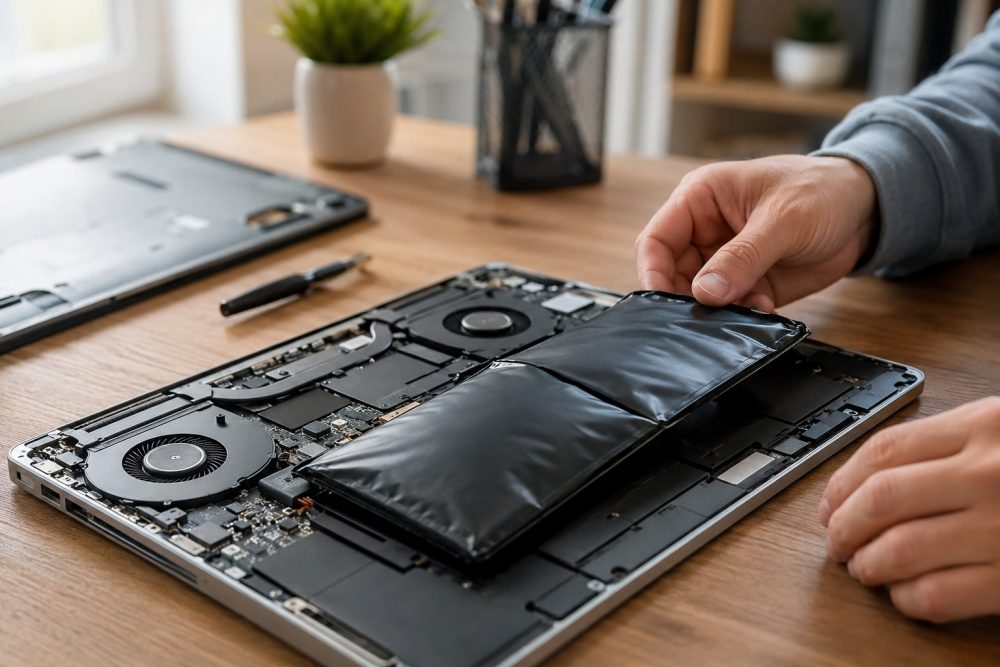
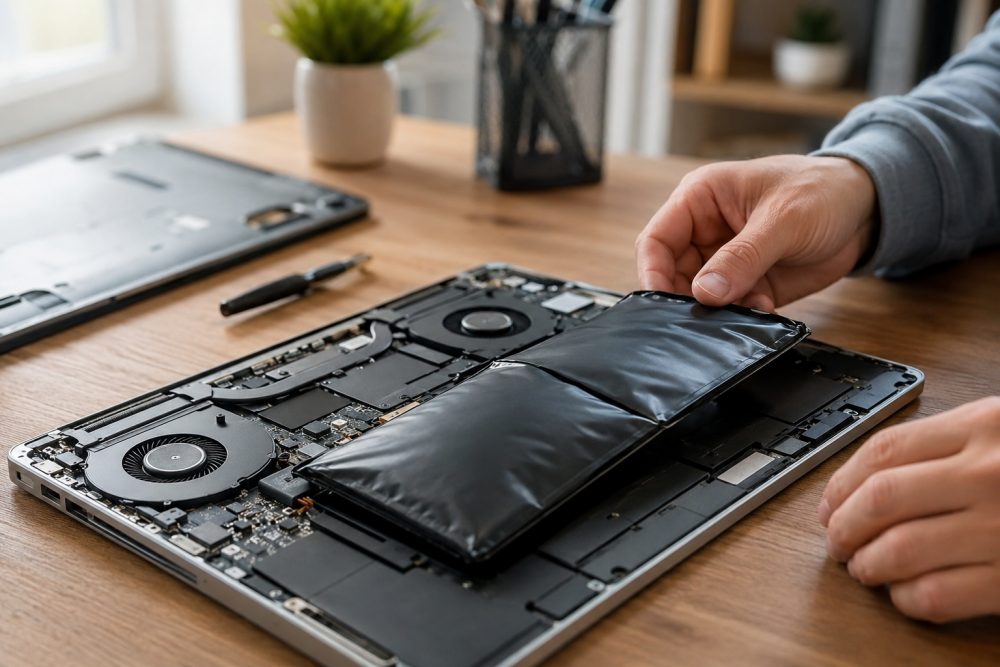
The Battery Is Swollen or Physically Distorted
A swollen battery is a serious issue that requires immediate attention.
Lithium-ion batteries can occasionally develop internal gas buildup as they age or experience excessive heat exposure. This can cause the battery to expand, creating visible physical changes to your laptop.
Watch for signs such as:
A bulging keyboard
A lifted trackpad
Gaps appearing between laptop components
Difficulty closing the laptop properly
Texas summers can bring prolonged periods of high temperatures, and laptops left in vehicles or poorly ventilated areas may experience accelerated battery degradation. If you notice swelling, stop using the device and seek professional assistance immediately. Continuing to use a swollen battery can increase the risk of further damage to internal components.
Your Laptop Only Works When Plugged In
If your laptop shuts down the moment you disconnect the charger, the battery may no longer be functioning at all.
Many users initially assume the charging cable or power adapter is faulty. While those components can fail, a completely depleted battery is often the culprit.
This issue typically develops gradually. You may first notice shorter battery life, followed by frequent charging requirements, before eventually reaching the point where the battery cannot hold any charge.
Professional diagnostics can determine whether the issue lies with:
The battery
The charging port
The power adapter
Internal power management systems
At PC Geeks, we help identify the root cause so you can avoid replacing parts unnecessarily.
Battery Health Warnings and System Alerts
Modern operating systems often provide built-in battery health monitoring tools. If your laptop displays messages such as:
“Consider replacing your battery”
“Battery service recommended”
“Battery health significantly degraded”
“Battery capacity reduced”
Do not ignore these notifications.
These alerts are generated based on performance data collected over time and often indicate that the battery has fallen well below its original capacity.
You can check battery health through system settings on many Windows and Mac devices. However, interpreting these reports can sometimes be confusing. Professional testing can provide a more accurate assessment and help determine whether replacement is the best option.
Why Timely Battery Replacement Matters
Many people continue using failing batteries longer than they should. Unfortunately, delaying replacement can lead to additional issues.
A failing battery can:
Reduce overall laptop performance
Cause data loss from unexpected shutdowns
Place strain on internal components
Create safety concerns if swelling occurs
Interrupt productivity and daily tasks
Replacing a battery before complete failure helps extend the useful life of your laptop and can often postpone the need for a costly device replacement.
For Frisco residents and businesses, maintaining reliable technology is increasingly important as remote work, online learning, and digital services continue to play a larger role in everyday life.
How PC Geeks Helps Frisco Laptop Users
At PC Geeks, we understand how disruptive computer problems can be. Our experienced technicians provide comprehensive laptop diagnostics, battery testing, and replacement services designed to restore performance and reliability.
When you bring your laptop to PC Geeks, our technicians perform a complete battery health assessment and verify whether the battery is truly the source of the problem. We also inspect related components, such as the charging port and power management systems, to rule out other issues. Once we identify the cause, we provide honest, cost-effective recommendations and can install a high-quality replacement battery when needed.
Our goal is always to provide honest recommendations and solutions that help customers get the most value from their technology investments.
Ready to Restore Your Laptop’s Performance?
If you’ve noticed rapid battery drain, unexpected shutdowns, swelling, or other warning signs, don’t wait until your laptop fails completely. The team at PC Geeks is here to help Frisco residents and businesses diagnose battery problems and restore dependable performance.
Contact PC Geeks today through our contact page to schedule a professional laptop battery evaluation and find out whether a replacement is the right solution for your device.
Enterprises are moving agentic AI from proof of concept to production — and the next generation of AI factories are built for the era of agents.
At HPE Discover Las Vegas, running through Thursday, June 18, NVIDIA and HPE are expanding the HPE AI Factory with NVIDIA, including NVIDIA Vera CPU and NVIDIA Agent Toolkit for HPE Private Cloud AI.
Plus, NVIDIA Confidential Computing extends across HPE AI Factory and enhanced full-stack NVIDIA integration — with NVIDIA accelerated computing, NVIDIA AI software and NVIDIA networking — is available throughout the entire portfolio.
NVIDIA Vera CPU Available With HPE Private Cloud AI
The HPE ProLiant Compute DL394 Gen12 with the NVIDIA Vera CPU will be available in 2027 with HPE Private Cloud AI, a turnkey AI factory co-engineered with NVIDIA. Vera is the first CPU built for agents — designed for the tool calls, orchestration and real-time data processing required across the agent loop — bringing deterministic, low-latency performance into HPE Private Cloud AI.
The New York Stock Exchange, in collaboration with Redpanda and HPE, is an early enterprise customer exploring Vera CPU with the HPE ProLiant Compute DL394 Gen12 server.
The Vera CPU is part of the NVIDIA Vera Rubin platform, which is ramping into full production with the NVIDIA Vera Rubin NVL72 rack-scale system available from HPE. Vera Rubin was built for frontier-scale models larger than 1 trillion parameters and will ship with full-stack NVIDIA Confidential Computing across every chip.
HPE is also bringing the HPE Compute XD700 — built on NVIDIA HGX Rubin NVL8 — to the HPE AI Factory, supporting up to 128 Rubin GPUs per rack.
NVIDIA Agent Toolkit Now Available With HPE Private Cloud AI
NVIDIA Agent Toolkit — including NVIDIA Nemotron open models, the NVIDIA OpenShell secure runtime and NVIDIA NemoClaw blueprints — will be available with HPE Private Cloud AI. Together, they give enterprises an agentic AI operating system for monitoring agent behavior, enforcing governance policies, and safely building and running autonomous, long-running multi-agent systems.
HPE Private Cloud AI adds secure local agent registration, letting customers approve AI models, skills and tools against centralized governance and security policies before they run. New HPE Zerto Software capabilities detect rogue agent actions and use continuous data protection to rewind to a clean state.
On the data side, HPE Alletra Storage MP X10000 — which achieved the foundation level of NVIDIA-Certified Storage — automatically applies metadata and governance policies to prepare unstructured data for AI pipelines, improving token throughput.
NVIDIA Confidential Computing Across All HPE AI Factory Solutions
NVIDIA Confidential Computing is now available across the HPE AI Factory through HPE Services — including HPE AI Factory at Scale, HPE Sovereign AI Factory and HPE Private Cloud AI.
AI applications access and use private and sensitive data that needs to be protected and secured. In addition, models trained with proprietary data or techniques need to be safeguarded from exfiltration. Confidential computing is essential for these modern AI workloads, as it protects models and private data during execution for on-premises and sovereign deployments, establishing a chain of trust through cryptographic attestation and encryption at every stage.
In addition, HPE ProLiant Compute DL380a achieved certification as part of the NVIDIA-Certified Systems for NVIDIA Confidential Computing program, which validates robust application performance with confidential computing. These systems provide hardware-based protection for AI workloads and sensitive data assets while maintaining optimal NVIDIA acceleration.
Across the HPE AI Factory solutions, NVIDIA BlueField DPUs and NVIDIA DOCA provide in-silicon zero-trust policy enforcement, runtime threat detection and network encryption — protecting AI workloads, agents and data without performance tradeoffs.
Enhanced Full-Stack NVIDIA Integration Across the Portfolio
For next-generation AI factories, every Vera Rubin NVL72 system will ship with NVIDIA networking built in — NVIDIA Vera BlueField-4 DPUs, NVIDIA ConnectX-9 SuperNICs and NVIDIA Spectrum-X Ethernet — with NVIDIA Spectrum-6 switching delivering 1.6x higher networking performance for AI communication versus off-the-shelf Ethernet.
Spectrum-X Ethernet networking is the standard for HPE AI Factory with NVIDIA — including at-scale, sovereign and turnkey AI factory solutions available now. For large-scale and sovereign workloads, HPE announced at NVIDIA GTC in March that it’s also adding NVIDIA InfiniBand networking options — including NVIDIA Quantum-X800 InfiniBand with the HPE Cray Supercomputing GX5000.
These configurations are based on NVIDIA reference architectures and support use cases from AI development through production-scale deployment, with NVIDIA AI Enterprise software and the HPE Unleash AI ecosystem.
At HPE Discover this week, the Unleash AI partner program is expanding with nearly a dozen new AI software partners — including Aizen, BridgeTEK, deepset, Deliverance, Faclon Labs, Gallop, Rocket, Supervity, Thales, Trustwise and Vortiqx.
Designers often use Android phones for different creative purposes like creating social media posts or designing basic marketing visuals. Browser-based design tools make this even easier because they work online and don’t require any software installation.
I decided to first test some popular browser-based design tools on Android. This review shares the experience, main features, pros, and perfect user scenarios of each tool. Let’s get started!
Why Browser-Based Design Tools Are Perfect for Android Users
No need to download or install: These tools operate solely within your browser, so you don’t have to deal with the installation of large apps.
Save storage space: As everything is done in the cloud, the tools allow you to keep your Android device storage less used.h
AI and cloud processing: Aside from the help of AI, several tools make use of cloud computing for faster and better design performance.
Simple sharing and collaboration: Users can simply share links and work on designs simultaneously without the need to transfer files.
Same projects, different devices: Since files are always online, you can work on your designs anytime and anywhere.
Key Features to Look for in a Browser-Based Design Tool
User-friendly design: The tool should function smoothly on Android devices.
Cloud storage and syncing: There is no need to save projects manually because they should be saved automatically and remain synced between devices.
AI-powered features: Time-consuming tasks can be avoided using fantastic features such as background removal, image enhancement, and design suggestions.
Collaboration tools: Real-time editing and easy sharing, among other features, can facilitate teamwork greatly.
Multiple export formats: A good design tool will support formats such as PNG, JPG, PDF, and SVG.
5 Best Browser-Based Design Tools for Android Users
Zawa AI — Best for AI-Powered Branding and Image Enhancement
I tried out Zawa AI photo enhancer (previously X-Design) by loading several low-quality, blurry pictures from my phone.
First, I used the image enhancer and 4K upscaler, and it was obvious right away how much better the images looked. They became sharper and more usable in only a few seconds. Even the tiniest details that were previously invisible became much clearer.
Besides that, I tried background removal and object removal on a product photo. It worked well and made the image quite clean without me needing to do any extra work. Another thing that I liked is the batch feature. It can take care of up to 20 images simultaneously. That is helpful when you have lots of photos. In general, it seems easy to use and good for quick image fixes and branding work.
Aside from photo enhancing, Zawa AI also has a complete AI design ecosystem with capabilities like free Logo Maker, banner creator, photo editing suite, and creative generators for social media and branding. What I liked the most is that it uses cloud-based processing and provides fast export of images (PNG, JPG, SVG), also has a stock of up-to-date templates, and enables Android users to create professional assets directly through their browser.
Use case: Creating brand assets, enhancing product photos, designing marketing visuals, and generating professional logos directly from an Android browser.
Canva — Best for Social Media Graphics
Canva is a design platform that runs on browsers and it is a great tool for Android users to make beautiful graphics for social media, presentations, posters, logos, and other marketing materials. It has thousands of ready-to-use templates, drag and drop editor, and brand kits.
I also explored features like Magic Resize, background remover, and text-to-image. Magic Resize was a life saver for me to easily transform the designs between various platforms. When I tried the background remover on a product image, the result was quite nice and clean. On the whole, Canva appeared to be a user friendly and quick tool for generating social media graphics and simple marketing designs.
Figma — Best for UI/UX Design
I experimented with Figma on an Android device via browser in order to find out its performance on UI/UX design. At first, I thought the interface was a bit complicated, but after getting used to it, it worked pretty smoothly.
I even experimented with real-time collaboration by sharing the file. All users were able to view and edit the design simultaneously. The app design-related features such as frames, components, and prototyping tools came in handy. To sum up, Figma is probably more geared up for UI/UX projects than making simple graphics.
Adobe Express — Best for Quick Professional Designs
Adobe Express is a web-based design tool through which Android users can easily and quickly create high-quality visuals, social media posts and flyers.
Initially, I took advantage of ready-made templates and the drag-and-drop editor. Adjusting things was a breeze, even on a tiny screen.
Additionally, I tried with features such as auto-resize, stock images, and AI tools. Auto-resize allowed me to easily convert one design into different platform formats. The stock library helped me to look for suitable images elsewhere. Putting it all together, Adobe Express seemed efficient and handy for whipping up neat, professional-looking designs in a short frame of time.
Pixlr — Best for Browser-Based Photo Editing
I gave Pixlr a shot on Android via the browser to edit photos and create images. It’s a fully online service so there’s no need to download an app at all. I directly edited and enhanced a few photos from my phone. It felt like a feature-rich photo editor running inside the browser.
Besides that, I also explored its AI-powered features such as generating images, background removal, object removal, generative fill, face swapping. All of this was happening within one platform. Pixlr allowed me to upscale pictures, reduce noise, and quickly enhance with one click. Creating collages and advanced layer editing are also possible with Pixlr which makes it more than just a basic editor. In a nutshell, it reminds me of a compactly powered editing tool like those on desktop.
How to choose the right browser-based design tool for your needs
Love branding or making logos? Then, consider Zawa AI, which is full of AI-driven branding and logo-making features.
As a professional UI/UX designer, you may want to leave simpler platforms behind and follow more advanced ones such as Figma that offer prototyping features, as well as collaboration features.
If it is a teamwork environment that you are aiming at, then pick those that give you real-time editing, comments, and shared workspaces.
Tips for getting the best design experience on Android
Use a modern browser: Chrome or Edge ensures better performance and compatibility.
Enable desktop mode when needed: Helps access full tool features on smaller screens.
Maintain a stable internet connection: Ensures smooth cloud-based editing and saving.
Use cloud storage for larger projects: Keeps files safe and easily accessible across devices.
Conclusion
I have experimented with a few web-based design tools running on Android, and my overall experience was pleasant. These tools now offer an exceptional capability for top-tier visual creation without running heavy apps. Be it AI image editing, brand creation, social media post designing, UI designing, or even photo enhancing, all can be achieved using only a browser.
After experimenting with various solutions, I found Zawa AI to be the most impressive. This platform offers image enhancing, logo creation, background removal, as well as many other AI-powered design features.
Since launching in 2014, PopSockets have always been a quirky (and slightly bulky) grip for phones. They’re adored by those who love to accessorize their phones with their swappable designs and people who love to fidget with their accordion-style pop-out piece. But the company is now hoping to attract a new clientele with the Low-Pro, a new grip design that’s so thin that when collapsed, it sits lower than the camera bump on my iPhone 17 Pro Max.
The Low-Pro goes on sale Tuesday for $40, launching first at Apple Stores and at PopSockets.com, with additional retailers at the end of July. You can see more of how it works in the latest episode of One More Thing, embedded below:
Watch this: Flat PopSockets Might Lure More Men: Hands-On With Low-Pro Grips
I’ve been using the MagSafe Low-Pro for the past week, and I can see the appeal this will have for those folks who just want something that slips effortlessly into their pants pockets. Like other PopSockets, it still attaches with the MagSafe magnetic backing. The front has a soft matte finish, and although it doesn’t make a “pop,” a finger nudge in any direction will raise the disk to reveal a slitted, flexible single piece of polymer. A metal ring around the edge becomes an adjustable swing-out stand to prop up your phone in portrait and landscape mode.
When opened, the Low-Pro grip is designed to handle fidgeters who want to twist, poke and pull at it (well, up to about 30 lbs of pulling).
PopSockets
When the Low-Pro is expanded, it reminds me of a kid’s paper lantern craft project. Thinner materials give the impression that it will be weaker, but no matter how I twist, tug or try to poke at the holes, the material holds up. Good news for fidget-lovers: This seems to be able to handle all my stretching — and the PopSockets team tells me it was designed to withstand more than 30 pounds of pulling pressure in testing.
Apple Stores will carry the Low-Pro in four exclusive colors to start: Blue Aura, Electric Fuchsia, Black and Navy.
PopSocket is not the first to come up with a flush magnetic phone grip. The company OhSnap gained popularity for its Snap Grip, priced at $30, which uses a metal hinge to fold flat. But since using both, I prefer the PopSocket design because it’s easier to open with one finger from any angle, and it has the extra kickstand.
I sat down with PopSocket inventor and founder David Barnett to learn more about the pivot to the Low-Pro. Although the PopSockets company will continue making the existing design (the one that actually pops), Barnett said the big motivator here for a new model was to lure in men who told him over the years they never gave PopSockets a chance because of their size.
PopSocket inventor David Barnett didn’t start off with a goal making phone grips. Here, he holds the creation that inspired the PopSocket: giant buttons on the back of an iPhone 3GS to help wrap long headset cords.
Carly Marsh/CNET
“They’d say, ‘Oh, it would get caught on my pocket,’ and I’d think to myself, It’s never gotten caught on my pocket ever,” Barnett said. “Ultimately, I wanted a solution that would meet this challenge of not being perceived as thick and bulky.”
There is an extra benefit to this thinner design — you don’t have to take off your Low-Pro if you want to connect it to a MagSafe stand to charge. Just don’t count on it getting a fast charge: the more stuff between your phone and the charger (like a case and a grip), the slower the trickle of energy will be to your device.
But often I use MagSafe stands to prop up my phone at work. And for once, it meant I didn’t have to pop off my PopSocket to have it snap magnetically.
33 Immortals is a co-op action-roguelike for 33 players. Play a damned soul, and rebel against God’s final judgment. Pick-up and raid, cooperate to survive hordes of monsters, defeat massive bosses, and face the wrath of God in a fight for your eternal life. Burden Street Station
Jump straight into 33-player co-op runs with instant matchmaking; no lobbies or planning required. Drop in solo or party up with up to 4 friends and fight through streamlined, replayable raids built for fast sessions, massive cooperative battles against hordes of monsters, and epic boss fights.Survive by fighting together. No voice chat required: coordinate through in-game emotes, pings, and cooperative abilities. Revive fallen allies, combine powerful effects, and adapt to chaotic encounters as dozens of players battle side by side.
God’s armies will strike you down again and again, but every run makes you stronger. Collect resources during raids, unlock permanent upgrades for your soul, and expand your arsenal with new weapons, relics, and powers. Experiment with different builds and prepare for even greater battles against God’s wrath. Face the Wrath of God, together. Fight as a renegade in the immortal rebellion against God’s final judgment, and battle for your eternal life in a unique blend of mythic fantasy, action roguelike progression, and large-scale cooperative play.
Features:
33-player co-op action roguelike battles against massive hordes and bosses.
Jump straight into live runs with instant matchmaking. Drop in solo or with up to 4 friends.
Fast-paced, replayable raids designed for quick sessions and nonstop action.
Coordinate through emotes, pings, shared objectives, and powerful cooperative abilities.
Revive fallen allies and fight together to keep the rebellion alive.
Randomized enemies, encounters, rewards, and builds make every run different.
Unlock permanent upgrades, experiment with powerful builds, and customize your playstyle.
Wield weapons and relics inspired by sins and virtues, each with unique combat mechanics.
Customize your soul with a wide range of cosmetics.
Screenshots
SystemRequirements
Minimum
OS: Windows 10
Processor: Quad Core 2.4Ghz
Memory: 8 GB RAM
Graphics: GeForce GTX950, Radeon R7 360, or Intel HD Graphics 630, 2GB VRAM
DirectX: Version 11
Network: Broadband Internet connection
Storage: 5 GB available space
Support the game developers by purchasing the game on Steam
InstallationGuide
TurnOff Your Antivirus Before Installing Any Game
1 :: Download Game 2 :: Extract Game 3 :: Launch The Game 4 :: Have Fun 🙂
“What’s neXt for 2D/3D CAD in DWG?” Graebert neXt is a free online event that explores this question every year, giving the CAD community insight into the technologies affecting the fast-changing software landscape.
This year, Graebert hosted its neXt event on June 3, showcasing the newest developments in CAD through feature demonstrations, executive commentary, and analysis from industry experts. Attendees — including CAD managers and users, engineers and developers, CAD newbies and CAD veterans — learned about the digital transformation of CAD through AI-driven tools, BIM automation, and cloud collaboration. Users of Graebert’s own ARES software products and of other CAD platforms, such as AutoCAD, saw how these technology trends are reshaping day-to-day workflows for CAD in DWG.
If you didn’t experience neXt 2026 on the event date, you missed out on a real-life customer story, detailed demonstrations of new product enhancements and workflows, and presentations by the founders of aec+tech and Architosh. But you’re in luck — you can still take advantage of the replay option to watch the entire two-hour event.
And if you’re short on time, you can pick and choose from our video gallery of individual feature demonstrations, keynote sessions, and more. You can even watch videos from last year’s event!
Access Graebert neXt 2026 content in the way that suits you best:
Use the links above to start watching now, or read on for an overview of what you can expect to see.
Graebert neXt 2026 Agenda
The event opens with a welcome from company founder and CEO Wilfried Graebert and CTO Robert Graebert. “Today, the CAD industry is evolving faster than ever,” said Robert Graebert. “AI, cloud, automation: the digital transformation is happening right now, and CAD is no exception. New technologies are creating major opportunities to improve productivity, collaboration, and creativity for CAD professionals around the world.”
Next, a customer success story introduces viewers to Takenaka Corporation, one of Japan’s largest construction companies, and its implementation of ARES software. Takenaka migrated nearly 10,000 users from AutoCAD to ARES.
A Top New Features session hosted by Chief Growth Officer Cedric Desbordes provides a look at exciting enhancements for:
CAD on Windows, Mac, and Linux;
Online CAD;
AI and Automation;
BIM-specific features; and
Cloud-based collaboration.
With the overview format, viewers can quickly learn about the key new features in each area, and the value they have for streamlining workflows and improving collaboration.
Following this overview are four Deep Dive sessions, which examine particular areas of advancement in greater detail.
Deep Dive #1: ARES vs. AutoCAD. This session takes a closer look at CAD features in ARES software, including ARES Commander (CAD on Desktop) and ARES Kudo (Online CAD). This overview of capabilities, performance, and compatibility is designed to help viewers compare and evaluate modern alternatives. (For more about these new CAD features in ARES 2027, plus many more, visit the New Features page on the Graebert website.)
Deep Dive #2: AI for CAD in DWG & Online Automation. This session focuses on the ways that AI and automation are transforming design workflows and enabling new efficiencies in DWG-based environments. It features a five-minute expert review by architect Anthony Frausto-Robledo, the founder and editor-in-chief of Architosh. He outlines primary pain points in the CAD and BIM industries, then examines how Graebert is addressing each one with new functionalities.
Deep Dive #3: BIM-to-DWG Drawings Automation. Niknaz Aftahi, architect and CEO of aec+tech, kicks off this session, which explains a faster way to produce DWG drawings from Revit or IFC data and streamline collaboration between BIM and CAD workflows, including integration with Autodesk Forma.
Aftahi starts with a widespread problem with creating documentation from BIM models: it’s still very manual, making it very time-consuming. ARES software, however, can read the intelligence in BIM models, and as Aftahi explains, use it to create DWG plans, sections, and elevations, and add even the appropriate labels and dimensions — automatically. (Don’t miss Aftahi’s aec+tech article on this subject, “BIM Has the Intelligence. Why Is Revit Documentation Still Manual?”) She also touches on the exciting upcoming product ARES Neo, which automatically corrects documentation problems (such as missing labels) inside the Revit workflow.
Deep Dive #4: Modern CAD in DWG with Cloud-based Collaboration. Last but not least, the fourth Deep Dive session explores Digital Transformation for DWG-based CAD workflows. The ARES Trinity of CAD software comprises three solutions — ARES Commander, ARES Kudo, and ARES Touch — that are interconnected with each other, enabling unique collaboration features. Viewers can explore how the convergence of desktop, cloud, and mobile solutions enables real-time collaboration and secure access to CAD data anywhere.