This blog post focuses on new features and improvements. For a comprehensive list, including bug fixes, please see the release notes.
LLM inference at scale typically involves deploying multiple replicas of the same model behind a load balancer. The standard approach treats these replicas as interchangeable and routes requests randomly or round-robin across them.
But LLM inference isn’t stateless. Each replica builds up a KV cache of previously computed attention states. When a request lands on a replica without the relevant context already cached, the model has to recompute everything from scratch. This wastes GPU cycles and increases latency.
The problem becomes visible in three common patterns: shared system prompts (every app has one), RAG pipelines (users query the same knowledge base), and multi-turn conversations (follow-up messages share context). In all three cases, a naive load balancer forces replicas to independently compute the same prefixes, multiplying redundant work by your replica count.
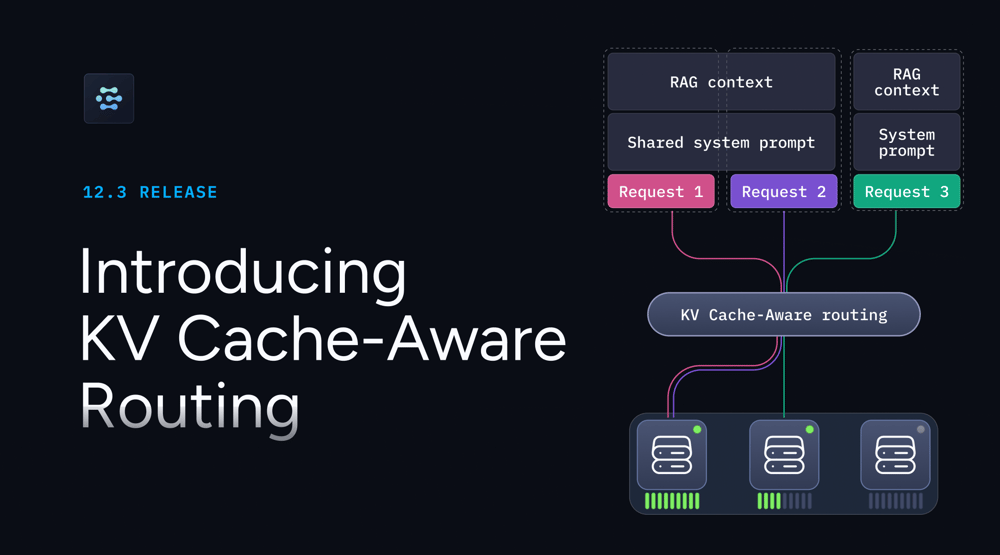
Clarifai 12.3 introduces KV Cache-Aware Routing, which automatically detects prompt overlap across requests and routes them to the replica most likely to already have the relevant context cached. This delivers measurably higher throughput and lower time-to-first-token with zero configuration required.
This release also includes Warm Node Pools for faster scaling and failover, Session-Aware Routing to keep user requests on the same replica, Prediction Caching for identical inputs, and Clarifai Skills for AI coding assistants.
KV Cache-Aware Routing
When you deploy an LLM with multiple replicas, standard load balancing distributes requests evenly across all replicas. This works well for stateless applications, but LLM inference has state: the KV cache.
The KV cache stores previously computed key-value pairs from the attention mechanism. When a new request shares context with a previous request, the model can reuse these cached computations instead of recalculating them. This makes inference faster and more efficient.
But if your load balancer doesn’t account for cache state, requests get scattered randomly across replicas. Each replica ends up recomputing the same context independently, wasting GPU resources.
Three Common Patterns Where This Matters
Shared system prompts are the clearest example. Every application has a system instruction that prefixes user messages. When 100 users hit the same model, a random load balancer scatters them across replicas, forcing each one to independently compute the same system prompt prefix. If you have 5 replicas, you’re computing that system prompt 5 times instead of once.
RAG pipelines amplify the problem. Users querying the same knowledge base get near-identical retrieved-document prefixes injected into their prompts. Without cache-aware routing, this shared context is recomputed on every replica instead of being reused. The overlap can be substantial, especially when multiple users ask related questions within a short time window.
Multi-turn conversations create implicit cache dependencies. Follow-up messages in a conversation share the entire prior context. If the second message lands on a different replica than the first, the full conversation history has to be reprocessed. This gets worse as conversations grow longer.
How Compute Orchestration Solves It
Clarifai Compute Orchestration analyzes incoming requests, detects prompt overlap, and routes them to the replica most likely to already have the relevant KV cache loaded.
The routing layer identifies shared prefixes and directs traffic to replicas where that context is already warm. This happens transparently at the platform level. You don’t configure cache keys, manage sessions, or modify your application code.
The result is measurably higher throughput and lower time-to-first-token. GPU utilization improves because replicas spend less time on redundant computation. Users see faster responses because requests hit replicas that are already warmed up with the relevant context.
This optimization is available automatically on any multi-replica deployment of vLLM or SGLang-backed models. No configuration required. No code changes needed.
Warm Node Pools
GPU cold starts happen when deployments need to scale beyond their current capacity. The typical sequence: provision a cloud node (1-5 minutes), pull the container image, download model weights, load into GPU memory, then serve the first request.
Setting min_replicas ≥ 1 keeps baseline capacity always warm. But when traffic exceeds that baseline or failover happens to a secondary nodepool, you still face infrastructure provisioning delays.
Warm Node Pools keep GPU infrastructure pre-warmed and ready to accept workloads.
How It Works
Popular GPU instance types have nodes standing by, ready to accept workloads without waiting for cloud provider provisioning. When your deployment needs to scale up, the node is already there.
When your primary nodepool approaches capacity, Clarifai automatically begins preparing the next priority nodepool before traffic spills over. By the time overflow happens, the infrastructure is ready.
Warm capacity is held using lightweight placeholder workloads that are instantly evicted when a real model needs the GPU. Your model gets the resources immediately without competing for scheduling.
This eliminates the infrastructure provisioning step (1-5 minutes). Container image pull and model weight loading still happen when a new replica starts, but combined with Clarifai’s pre-built base images and optimized model loading, scaling delays are significantly reduced.
Session-Aware Routing and Prediction Caching
Beyond KV cache affinity, Clarifai 12.3 includes two additional routing optimizations that work together to improve performance.
Session-Aware Routing keeps user requests on the same replica throughout a session. This is particularly useful for conversational applications where follow-up messages from the same user share context. Instead of relying on KV cache affinity to detect overlap, session-aware routing ensures continuity by routing based on user or session identifiers.
This works without any client-side changes. The platform handles session tracking automatically and ensures that requests with the same session ID land on the same replica, preserving KV cache locality.
Prediction Caching stores results for identical input, model, and version combinations. When the exact same request arrives, the cached result is returned immediately without invoking the model.
This is useful for scenarios where multiple users submit identical queries. For example, in a customer support application where users frequently ask the same questions, prediction caching eliminates redundant inference calls entirely.
Both features are enabled automatically. You don’t configure cache policies or manage session state. The routing layer handles this transparently.
Clarifai Skills
We’re releasing Clarifai Skills that turn AI coding assistants like Claude Code into Clarifai platform experts. Instead of explaining APIs from scratch, you describe what you want in plain language and your assistant finds the right skill and gets to work.
Built on the open Agent Skills standard, Clarifai Skills work across 30+ agent platforms including Claude Code, Cursor, GitHub Copilot, and Gemini. Each skill includes detailed reference documentation and working code examples.
Available skills cover the full platform: CLI commands (clarifai-cli), model deployment (clarifai-model-upload), inference (clarifai-inference), MCP server development (clarifai-mcp), deployment lifecycle management (clarifai-deployment-lifecycle), observability (clarifai-observability), and more.
Installation is straightforward:
Once installed, skills activate automatically when your request matches their description. Ask naturally (“Deploy Qwen3-0.6B with vLLM”) and your assistant generates the correct code using Clarifai’s APIs and conventions.
Full documentation, installation instructions, and examples here.
Additional Changes
Python SDK Updates
Model Serving and Deployment
The clarifai model deploy command now includes multi-cloud GPU discovery and a zero-prompt deployment flow. Simplified config.yaml structure for model initialization makes it easier to get started.
clarifai model serve now reuses existing resources when available instead of creating new ones. Served models are private by default. Added --keep flag to preserve the build directory after serving, useful for debugging and inspecting build artifacts.
Local Runner is now public by default. Models launched via the local runner are publicly accessible without manually setting visibility.
Model Runner
Added VLLMOpenAIModelClass parent class with built-in cancellation support and health probes for vLLM-backed models.
Optimized model runner memory and latency. Reduced memory footprint and improved response latency in the model runner. Streamlined overhead in SSE (Server-Sent Events) streaming.
Auto-detect and clamp max_tokens. The runner now automatically detects the backend’s max_seq_len and clamps max_tokens to that value, preventing out-of-range errors.
Bug Fixes
Fixed reasoning model token tracking and streaming in agentic class. Token tracking for reasoning models now correctly accounts for reasoning tokens. Fixed event-loop safety, streaming, and tool call passthrough in the agentic class.
Fixed user/app context conflicts in CLI. Resolved conflicts between user_id and app_id when using named contexts in CLI commands.
Fixed clarifai model init directory handling. The command now correctly updates an existing model directory instead of creating a subdirectory.
Ready to Start Building?
KV Cache-Aware Routing is available now on all multi-replica deployments. Deploy a model with multiple replicas and routing optimizations are enabled automatically. No configuration required.
Install Clarifai Skills to turn Claude Code, Cursor, or any AI coding assistant into a Clarifai platform expert. Read the full installation guide and see the complete release notes for all updates in 12.3.
Sign up to start deploying models with intelligent request routing, or join the community on Discord here if you have any questions.
When launching a new product in the market, it is important to understand how risky itcould get. It is a competitive approach, but it is prone to risks if not handled carefully. Haste and rushing launching are what make it fail. When the production team did not go through the process of validating and testing the product, it fell into a trap, and it may be hard to reverse it now. Launch failures are costly. It costs time, resources, effort, and budget, and weakens client confidence.
To reduce these risks and direct product launch to success, it is best to combine smart research, testing, and repeated cycles of prototyping design engineering services. It is better to invest in validating the product first before releasing it to the public. Cad Crowd makes it possible to connect vetted professionals to businesses that can aid in strengthening all development stages. They are a pool of experts that understands the importance of effective and strategic validation to ensure launch success.
🚀 Table of contents
Why most product launches fail
There are a lot of factors that impact failure in product launch. Most of the failures stem from the idea of an impulsive approach without confirming the demand. When the team only focused on assumptions, trends, internal interest, and excitement, and limited feedback, they were taking a subjective approach. Lack of testing real customer demand puts the product at risk. Not knowing what the consumers really want or what they think could be improved affects the whole outcome. Missteps could cause poor decision-making, letting impulsiveness increase the risks of failure.
Start with a clearly defined problem
Success always starts with identifying the problem first. Being clear about the goal of providing a solution to the problem is the best professional way to achieve success. Product design companies should be able to articulate all the pain points and lesson learnt to come up with the proper solutions. If the problems are too vague, the solution wouldn’t feel intentional and may be prone to overdesign. This will make customers confused and overwhelmed with features they don’t really think are necessary.
Identify a narrow target market
Designing for “everyone” looks like a warm accommodation to encourage everyone to try. But this approach is almost like a trap. It is a vague attempt at trial and error. Instead of being open to all, firms should narrow down and be specific to their target markets. Identify what these target users are looking for and collect relevant insight and feedback. This makes the whole validation measurable and makes the product launching intentional. It gives genuine solutions and makes users think they are considered in the design process.
Conduct structured customer interviews
One way to collect relevant insights is to receive feedback from real customers. Not all conversations or exchanges are considered relevant or useful. Strategic and systematic interviews are best to uncover what the users are expecting and looking forward to. Interviews could be documented to see and monitor patterns and trends, so there would be data to look back on to build an even stronger opportunity.
Analyze existing alternatives
In launching a new product, being prepared is one way to success. This includes knowing any existing alternatives to what the company is planning to launch. This makes them identify and understand competitors. It is expected that there would be comparisons conducted by customers. If a product has already existed and been used, it already has an edge since its functionality has been proven. It already serves its purpose. Then what makes the new one worth a try? Studying the existing alternatives would uncover what the customers want to improve. It could also help with the benchmarking of the costs.
Build a minimum viable concept
Before doing a full-blast development, consumer product design firms should consider that it could fail on the first try. It is best to do an early prototype to test its functionality first without compromising extensive resources. Doing a minimum viable concept would focus on gathering reactions and feedback, as these will expose flaws. Detecting flaws on the early stage would make it easier to fix.
Use landing pages to measure interest
A landing page makes it easier and faster to gauge consumer interest. Once presented to the public, there would be reactions towards it and insights as well. This is where firms would know whether there is hesitation and what rates and features are to be expected. From this stage, refinement could be done before it is produced.
Test with pre-orders or deposits
Pre-order makes the whole launch intentional, offering pre-orders secures not only demand interest but also early funding. This boosts morale in the team and makes it a lot easier to move around. It could also help understand the consumers who committed willingly.
Launch a smoke test campaign
Smoke testing is one way to measure interest based on the clicks and conversion rates. This is done by advertising the product before it fully exists. To know if the public is interested, there would be a lot of engagement. If there is low engagement, then the firms can make adjustments to turn it around. Smoke testing is a cost-effective tool that can protect production from failure.
Leverage surveys strategically
Aside from interviews, surveys add value to what the consumers want. Quantitative feedback supplements behavioral patterns exposed in qualitative research. The surveys should not only ask questions about checking if the user would be interested in buying the product, since it would lead to misleading optimism. Instead, the questions should be able to provide valuable insights about behavioral patterns, which can be useful for many companies, such as fashion design companies.
Prototype early and iterate often
Conducting rapid prototyping accelerates validation. While the users are able to experience the concept, feedback was documented to catch any flaws and readjusted early on. This iteration cycle would lead to a more concrete design tailored to the target audience, making it less likely to receive negative feedback during full release. Early alterations are of much lesser value than making a change on the last design stage. This mitigates risks.
Conduct usability testing
Validation is a combination of demand and usability. Consumers can express demand, but if it’s not user-friendly, it could backfire. Knowing how it functions and how it fits the users would be beneficial and lessen pain points. To check on this, testing regarding the product usability is recommended. This will reveal insights about the product and help the team align the design with user expectations.
Validate pricing early
Pricing influences product value and profitability. There are different thresholds in the market, and observing price points could reveal whether it’s a hit or not. Firms can explore pricing by using a tiered pricing model. Conducting these collects insights whether the product is considered underpriced or overpriced. From this, firms can check the revenue potential of the product.
Evaluate market size realistically
An accurate estimate of the target market size protects long-term viability. Product design experts should be able to assess the realistic number of demand leads. Having an overestimated number would lead to an inflated projection, resulting in an increase in wastage of resources. Being conservative in the number makes it intentional and sustainable.
Measure engagement, not just interest
Anyone can say they are interested, but not all are really committed. There’s a way to gauge the number, and this is by the engagement metrics. It reveals deeper insights and information as it uncovers behaviors. Genuinely curious and committed users would spend a lot of time on the landing page, engaging a lot more, and leaving comments. Those who are passive and do not engage much rarely purchase. Tracking engagements strengthens validation.
Use crowdfunding as validation
Crowdfunding not only serves as a validation tool but also ensures market readiness. Successful campaigns show that the message is delivered clearly and expresses demand. The comments could add information through quantitative feedback.
Users often express their insights and honest feedback on online communities. Sharing early concepts in these forums would earn real-time feedback and comments. Their constructive critiques could expose some blind spots and flaws that may be hard to fix in late design stages. Knowing this strengthens alignment with user needs, which is especially useful for engineering design firms.
Assess technical feasibility alongside demand
Being realistic in design is one way to launch success. To know if the concept will thrive makes the whole production smooth. Early feasibility check-ins avoid unrealistic timelines and could help in finding out cost implications. Technical feasibility can be conducted through a strategic collaboration between designers and engineers.
Set clear validation benchmarks
There should be a measurable criterion to know the metrics of success before validation begins. This helps in analyzing the data and removing ambiguities in decision-making. It is important that there are pre-determined standards to ensure rationality and prevent weak assessments.
Recognize when to pivot
Not all good and unique ideas are meant to thrive and be invested in. When the validation data says that it consistently fails, then it is time to pivot. There could be adjustments to be made to improve the data, and that could involve the target market, features, design, or usability. Resiliency doesn’t always solve the problem; sometimes, flexibility is the answer.
The input sometimes comes from the internal team’s work. They naturally tend to favor ideas that they have invested their time and effort in. This could distort validation interpretation, as the insights could be just internal optimism. This is why a more objective stream of approaches is much more reliable.
Incorporate cross-functional collaboration
Cross-functional collaboration collects diverse perspectives. This exposé overlooked challenges and lets everyone share their input. Being a unified team of engineers, marketers, designers, and even financial analysts could create an impactful view to execute stronger launches.
Document every insight
It is important to take note and document all insights and reviews received to ensure that all these are not lost. Recording the results and outcomes of interviews, iterations build historical data for the product, making it easier to track patterns in the future, and it also strengthens transparency and supports data-driven decision-making for product engineering companies.
Align validation with brand positioning
Not all validation approach is to be done hastily. It still should be aligned with the branding. Being consistent with the brand identity makes validation intentional. It strengthens market trust and enhances long-term success.
Leverage External Expertise
Fresh insights from the external specialists are always welcome. These inputs could sometimes be overlooked and may be a blind spot later on. Having an independent expert to check on the product reduces bias and ambiguity, strengthening validation accuracy and quality.
Validate the core assumption first
Every core assumption made to develop a product should have validation. It justifies the need and strengthens the concepts. Focusing on this core saves time and effort and ensures that there will be no scattered and messy experimentation.
Map the customer journey
Analyzing and understanding how consumers navigate the purchasing process exposes their behavior patterns and adds value to validation opportunities. Mapping their full journey can identify friction points that are beyond the product, which could be critical knowledge for product development experts. These issues are sometimes inevitable, but still, they can be lessened. Validation is a continued stage-by-stage examination and analysis, not only of the product but also of the whole production process.
Create problem-solution fit before product-market fit
Sometimes, firms tend to overlook solutions as they prioritize mass production. Firms should not chase it hastily and focus first on the problem. It is best to address a specific verified pain point, one that is urgent and recurring already, to ensure that customers feel like it fits. Doing this strengthens trust and a stable foundation for future scaling.
Quantify the cost of the problem
Customers are most likely to incline towards the offered solution if the problem is costly. Being costly does not only involve money, but it could also be about time, convenience, or the ease of mind. In validation, assess all the factors affecting the problem and compare them with production and revenue. The data will tell how the product positions itself in the market, whether it can really solve the problem or not. Once products are proven to solve expensive problems, it definitely increases purchase conversions.
Use rapid experiments instead of long development cycles
Doing a lot of rapid experiments looks costly at first, but it helps compress timelines. The small and controlled tests are able to collect insights in a short period of time, enough to adjust exposed flaws before full production. The traditional product development tends to be delayed since it would take months before receiving feedback. Taking controlled, scaled experiments reduces risks for large-scale failure.
Test distribution channels early
A product could interest a lot of users, but it may be difficult to distribute. In validation, testing distribution channels should also be accounted for. This included channels such as paid ads, parentship, or direct outreach. Understanding this during the early stages, with the help of new invention development services, reveals a lot of potential and risks. It gives insights into what an effective marketing strategy is fitted to address it.
Observe real behavior over stated intent
Not all who express the intent of buying are committed. It is still best to observe behavioral patterns to ensure there really is a genuine interest. The evidence could be checked in clicks, downloads, and payments provided. Consistency in all of these validates enthusiasm for the product. It is a measurable approach to know performance and satisfaction instead of relying on survey responses.
Validate retention, not just acquisition
Not all interests last. This meant that acquiring an initial interest meant it could guarantee long-term value. It could be deterred due to dissatisfaction with the product. There should be retention metrics to know whether the product delivers sustainability efficiency. This ensures that the product remains relevant and not just an impulsive decision to feed on initial curiosity.
Assess manufacturing and supply chain risks
Production feasibility should also be checked. This includes how the sourcing of materials is done and knowing the estimated lead times. It gives information about pain points to prevent delays in the timeline. Briefing with suppliers could help expose cost implications and limitations. These could help reduce manufacturing surprises and slips during the production process. Being ready ensures a smooth launch.
Incorporate cost modeling into early testing
Cost modeling should be done to accompany validation experiments. This ensures that the product not only caters to demand in the market but also sustains profitability. Financial modeling protects the product and industrial design firm in long term stability and clarifies viability. It should have data to which it can deliver without compromising the firm’s margins.
Develop clear success metrics
A clear success metric can objectively define benchmarks. Metrics that can help identify success include engagement, retention, and conversion rates. Success in pre-order could also be measured. Establishing these metrics makes it easier to track success. A clear standard removes ambiguities in results interpretation and strengthens decision-making.
Conduct competitive positioning analysis
Knowing where the new product positions itself along with its competitors gives a clear understanding of the product’s selling points and weak points. Spotting this early could help adjust to strengthen its launch success. In validation, rooms for improvement and opportunities can be identified and fixed for customers to recognize value addition, and would make them switch. This strong approach reduces the risks of production failure.
Test messaging with multiple audiences
Testing does not end in engagements. It could be furthered with messaging across varied demographics to refine target markets. Focused messaging improves marketing efficiency and helps with clear reasoning.
Run limited beta programs
Having a beta program is popular to provide structured feedback from real users, even when you begin with open innovation design services. From this, more detailed feedback about the experiences of the beta users helps correct issues before the public release. It uncovers real challenges users can face.
Document objections and concerns
It is inevitable to receive objections and raised concerns during the validation process, and it is important to document all of it as it adds valuable information. These concerns could be about the pricing, usability, reliability, and long-term functionality. When these are documented, patterns can be exposed. Addressing the concerns builds user trust and strengthens the final feature and offer of the product.
Monitor emotional reactions
While there is technicality in feedback, emotional feedback also matters. It is important to take into consideration the feelings of the users. Monitor and track whether they express excitement, frustration, or indifference with the new product. These signals indicate validation, which could have positive or negative implications. Understanding this supports and adds value to quantitative data.
Avoid feature creep during validation
It is important to stay aligned with simplicity instead of adding features midway. It will only complicate testing and may obscure the outcomes. When the process stays at its core and focuses on one hypothesis, it produces clear and coherent insights.
Test scalability assumptions
Knowing the limits of scaling in crisis management. This means that something that worked for 100 users may not be applicable to 100,000. It does not fully mean success even if it did on a small scale. This should be easily identifiable by concept design services. Validation should thoroughly analyze the support, capacity, and production limitations to project a realistic outcome to secure the firm’s reputation.
Evaluate legal and compliance factors
There are products that have to follow strict regulatory compliance. An early review and brief regarding the necessary tests, standards, and certification will avoid extensive rework. Legal validation is then considered, combined with the technical assessments. This ensures being market-ready and proactive in reducing unexpected challenges.
Measure customer acquisition cost
Understanding the cost implications to secure a customer determines long-term sustainability. This means there have to be marketing tests that provide benchmarks to project lifetime value. Knowing margins would help analyze its growth potential. The data could tell whether it’s a success or not or if there’s anything that needs to be focused on. Seeing unfavorable numbers during the early stages could be a cue to revise strategies before production.
Refine based on data, not ego
Validation results encourage data-driven decision-making. It lets the team focus more on the measurable evidence instead of personal preferences. This lessens ambiguity and biased insights. Prioritizing numbers instead of emotional attachment decreases the risk and improves outcomes.
Plan a phased launch
Planning a phased launch with design engineering services is a strategy to control and test a smaller market first before going into full production. This allows additional validation and lessens risks. Gradual and phased launching is more controlled and allows fine-tuning. It strengthens stability.
Encourage honest internal feedback
Although the internal team tends to provide biased insights, it is still a safe space to collect ideas. This can be done by encouraging them to speak up and provide honest feedback. Since they know more about the product, they have the best pool of insights that can be helpful. Having constructive skepticism boosts a healthy culture of open feedback. Diverse perspectives can reduce blind spots and flaws, making it a refined strategy.
Maintain transparent client communication
The client wouldn’t want transparency. Providing and sharing information regarding validation results openly, including challenges and risks, would make them feel involved. An honest and transparent communication lessens conflict and promotes healthy discourse. This communication builds confidence and trust between the client and the team, as the client was assured of the proper professionalism and diligence shown by the team.
Build validation into the standard workflow
Validation shouldn’t just be transitional or a one-time effort. It should be incorporated and integrated into the standard workflow. Having structured testing makes it more reliable and viable. Integrating validation strengthens the firm’s reputation, increasing user and client trust. Having a systematized and reliable workflow process ensures long-term results and outcomes.
Leverage specialized freelance talent
To add value to validation, sometimes a specialized professional isneeded and encouraged to discuss with. There is confidence when a professional is involved, as they contribute their experience to the concept. With them, technical accuracy is achieved, and it improves the overall performance of the product for consumer product design experts. It aligns the product rationally in the market, aligned with the project intent and the firm’s goals.
Strengthen prototyping capabilities
Investing in advanced prototyping makes it easier to attract strong user feedback. Having advanced modeling and visualization tools makes it feel real and clear. A reliable prototype makes it a strong representation. It enhances trust and confidence with the stakeholders. It gives them a clear picture of what was to be expected.
Build long-term learning systems
Every validation effort is a continued documentation of valuable knowledge. It establishes a reliable database on pain points, lessons learned, and opportunities. It gives patterns that can be useful for future production. It encourages data-driven decisions and transforms the workflow to reduce ambiguity.
Conclusion
Innovation should always be backed by numbers and data. It operates in an environment where it should be balanced and done cautiously. Validation secures new product concepts before they are released on a full scale to the public.
Conducting thorough feasibility studies, rapid and controlled experiments, prototype testing, and incorporating measurable criteria significantly lessens financial loss and reputational damage. It also promotes sustainable and intentional production. It strengthens not only its connection with the users but also the client’s interest.
For firms and businesses that seek connection with vetted experts, specialized in product design, modeling, and even rapid prototyping, browsing the Cad crowd is a great start. Check it out now and turn your next product launch into a success, backed with reliable numbers and validation. Ensure confidence in success with Cad Crowd. Request a quote today.
MacKenzie Brown is the founder and CEO of Cad Crowd. With over 18 years of experience in launching and scaling platforms specializing in CAD services, product design, manufacturing, hardware, and software development, MacKenzie is a recognized authority in the engineering industry. Under his leadership, Cad Crowd serves esteemed clients like NASA, JPL, the U.S. Navy, and Fortune 500 companies, empowering innovators with access to high-quality design and engineering talent.
Out of nowhere, Take-Two’s mobile game company Zynga has released a new Borderlands game for mobile devices. It’s out right now on iOS, despite no official announcement from 2K, Gearbox, or Take-Two.
Borderlands Mobile, as it’s called, is a free version of Borderlands featuring the franchise’s signature cel-shaded graphics, array of weapons, and the humorous (or insufferable, depending on who you ask) character Claptrap.
Zynga says the game has been “fully optimized for mobile,” and sports multiple modes, including Campaign Missions, Tower of Terror, and Circle of Slaughter. The missions were designed for people with short attention spans, a cheeky screenshot on the game’s store page says.
If your DevOps platform went down tomorrow, your team would lose more than code.
They would lose pipelines, deployment logic, infrastructure definitions, and the ability to push changes when the business needs them most. That is the real risk many organizations are only now starting to see. Azure DevOps and GitHub are no longer just developer tools. They have become the operational backbone behind how software gets built, shipped, and maintained.
In this on-demand webinar, Rubrik breaks down why DevOps resilience has become a much bigger issue for cloud teams and why version history, local copies, and backup scripts are not enough. You’ll see what a more reliable, policy-driven approach looks like and how teams can recover DevOps data without adding more operational burden to engineering.
In this webinar, you will learn how to:
Understand the shared responsibility gap in Azure DevOps and GitHub
See where version history and homegrown backup scripts fall short
Protect repositories automatically with policy-based discovery and backup
Restore code, pipelines, and metadata to a clean project, org, or tenant
Improve auditability and compliance with centralized DevOps protection
A federal appeals court denied Anthropic’s bid to temporarily block the Pentagon’s blacklisting, meaning the company remains shut out of Defense Department contracts while the case continues, even though a separate court has allowed other federal agencies to keep using Claude for now. CNBC reports: “In our view, the equitable balance here cuts in favor of the government,” the appeals court said in its decision. “On one side is a relatively contained risk of financial harm to a single private company. On the other side is judicial management of how, and through whom, the Department of War secures vital AI technology during an active military conflict. For that reason, we deny Anthropic’s motion for a stay pending review on the merits.” With the split decisions by the two courts, Anthropic is excluded from DOD contracts but is able to continue working with other government agencies while litigation plays out. Defense contractors will be prohibited from using Claude in their work with the agency, but they can use it for other cases.
[…] In the ruling on Wednesday, the court acknowledged that Anthropic “will likely suffer some degree of irreparable harm absent a stay,” but that the company’s interests “seem primarily financial in nature.” While the company claimed the DOD was standing in the way of its right to free speech, “Anthropic does not show that its speech has been chilled during the pendency of this litigation,” the order said. Because of the harm Anthropic is likely to suffer, the appeals court said “substantial expedition is warranted.”
An Anthropic spokesperson said in a statement after the ruling that the company is “grateful the court recognized these issues need to be resolved quickly” and that it’s “confident the courts will ultimately agree that these supply chain designations were unlawful.” “While this case was necessary to protect Anthropic, our customers, and our partners, our focus remains on working productively with the government to ensure all Americans benefit from safe, reliable AI,” Anthropic said.
Crimson Desert‘s continent of Pywel is a big ol’ place, and it’s easy to miss a lot of the best things the game has to offer if you don’t know where to look. One of Crimson Desert‘s favorite things is to not tell you anything about how the game works, like how to find fast travel points and where to look for special abyss artifacts. Some of it is fine to find out on your own, but if you start lagging behind on abyss artifacts and weapon upgrades, you’ll feel the effects sooner rather than later.
Our Crimson Desert interactive maps show you where to find every important thing, and we mean everything: faction quests, inns and vendors, including sketchy back-alley vendors for buying less-than-legal goods, bounty boards, dungeons, caves, resource nodes, like where to find iron ore, abyss cressets, and even the best spots to cast your fishing line.
Crimson Desert Hernand interactive map
Crimson Desert Demeniss interactive map
Crimson Desert Pailune interactive map
Crimson Desert Delesyia interactive map
Crimson Desert interactive map
Just starting out in Crimson Desert? We have guides to help you learn the basics and refresh your memory on how some of its systems work. The world of Pywel is huge, so you might have a hard time deciding where to go first. Along the way, make sure to learn a few life skills like fishing, logging, cooking, and mining, all of which can help you make money.
Lately, I’ve felt like doing just about everything in my business…
except making YouTube videos.
I know, I know.
That sounds a little ridiculous coming from someone who literally teaches people how to build their business with YouTube.
But…
creative ruts happen to everyone even the people who are supposed to have it all figured out.
And honestly?
I don’t think it’s always a bad thing.
Sometimes when the motivation to create disappears, it’s actually a signal to step back, rethink things, or focus on other parts of your business that need attention.
The pressure to constantly produce content can make it feel like something’s wrong if you’re not in that “create, create, create” mode all the time.
Today I’m sharing about creative ruts, business distractions, and why consistency isn’t always easy…
even for a video strategist.
We’ll dive into my latest projects, why I love simple talking-head videos, and how I’m automating my business for more freedom.
If you need a boost to get back on camera, this episode is for you!
VIDEO: What I’ve Been Doing Besides Making Videos
Some product links in this post are affiliate links, and I will be compensated when you purchase by clicking our links. Read my disclosure policy here.
Why It’s Normal to Hit a Creative Wall on YouTube
Even if creating content feels simple on the surface, it’s actually doing two very different things at once.
On one hand, you’re being creative, coming up with ideas, communicating clearly, and connecting with your audience. On the other hand, your content has to be strategic, helpful, and aligned with your business goals.
That tension is where the resistance comes from.
I started to realize that what I was experiencing wasn’t laziness or inconsistency… it was more like creative friction. The kind that happens when your brain is trying to be both expressive and productive at the same time.
And instead of pushing through it with content that wouldn’t be my best work, I allowed myself to pause and shift my focus.
The Simple YouTube Experiment That Still Works in 2026
When I first started this video podcast, it wasn’t because I had a perfect strategy. It was actually an experiment.
At the time, YouTube was dominated by fast-paced, highly edited videos: constant movement, sound effects, text flying across the screen. And while that style works, I started wondering what would happen if I did the opposite.
What if I just hit record and talked?
No overproduction. No complicated editing. Just clear ideas, shared consistently.
What I discovered surprised me. Not only did those videos perform well, but they also felt sustainable. I didn’t feel burnt out trying to keep up with trends or over-edit every piece of content. I could simply show up, share value, and build trust with my audience.
That approach has worked strategically, algorithmically, and most importantly, it’s something I actually enjoy doing.
But even with a simple system like that, there are still seasons where creating content feels harder than it should.
For a long time, creating videos felt easy. I would choose a topic, outline what I wanted to say, and press record. It became part of my routine.
Then something shifted.
Week after week, I found myself asking, Do I really have to record a video right now? And before I knew it, I had skipped multiple weeks of content.
What made it even more frustrating was that I wasn’t out of ideas. I had a full list of topics ready to-go titles, research, even thumbnails. Everything was prepared… except my willingness to actually record.
That’s when I realized this wasn’t about productivity. It was something deeper.
Creative work requires both expression and purpose. You’re not just creating for fun, you’re creating to serve, to teach, to grow a business. And sometimes, those two sides don’t flow together easily.
That tension is where resistance shows up.
And instead of forcing my way through it, I decided to lean into a different kind of productivity.
What I’ve Been Building Behind the Scenes
Even though I haven’t been consistently posting YouTube videos, I’ve been fully invested in other areas of my business that directly support long-term growth.
Hosting the All In On YouTube 2026 Workshop
One of the biggest things I focused on recently was hosting my All In On YouTube 2026 workshop, which turned out to be one of the most energizing experiences I’ve had in a long time.
It wasn’t just about teaching it was about helping people take immediate action. And what I loved most was seeing how quickly momentum built. Creators were updating thumbnails, improving their content, and getting new views on videos they had already published.
That experience reinforced something important: growth doesn’t always come from creating more content. Sometimes it comes from improving what already exists.
The workshop also brought new members into the Video Brand Academy community, which created a ripple effect of energy, ideas, and progress inside the community.
Another area I’ve been spending time on is catching up with updates in Descript, which I use regularly for editing and tutorials.
The challenge isn’t using the tool; it’s how quickly it evolves.
There’s this quiet hesitation that creeps in when you create tutorials in a fast-changing environment. You start to wonder if what you’re teaching today will still be accurate tomorrow.
That feeling can slow you down more than you expect. But it’s also a reminder that perfection isn’t the goal. Progress is.
Being a creator means adapting, even when things aren’t perfectly stable.
Starting a Second Channel for Creative Freedom
I also started a second YouTube channel called Bots Mean Business, focused on AI.
This channel isn’t strategic in the traditional sense. It’s not carefully planned or optimized. It’s simply a space where I can explore ideas that excite me.
And that excitement matters more than you might think.
Even though the channel is small, it’s given me a creative outlet that feels fun again. It’s reminded me what it’s like to create without pressure, which is something every content creator needs from time to time.
Building the Video Brand Toolkit App
One of the most exciting things I’ve been working on is building an app using AI tools, specifically through Mind Pal and Base 44.
This app, called Video Brand Toolkit, houses custom workflows and chatbots that I’ve created to help with things like:
Writing YouTube descriptions
Generating video titles
Structuring content ideas
Creating scripts and funnels
The difference now is that everything is saved and personalized. Instead of starting from scratch every time, users can return to their workflows and continue where they left off.
This is something I created specifically for members inside Video Brand Academy, and it’s one of the biggest behind-the-scenes projects I’ve worked on lately.
Rebuilding My Email Marketing System
If there’s one system that has continued to support my business, even when I’m not posting consistently, it’s my email list.
I use Kit (formerly ConvertKit) to run an automated email system that delivers content to subscribers over time. Recently, I completely reworked this system to make it more effective and more aligned with how I create content now.
Instead of relying on writing new emails every week, I’ve built an evergreen system that continues to nurture my audience automatically.
This is what allows my business to keep moving, even during seasons where content creation slows down.
It’s also a reminder that YouTube is powerful for visibility, but your email list is what creates stability.
What This Means for You as a Creator
If you’ve been feeling like you’re falling behind because you’re not posting consistently, I want you to hear this clearly:
You’re not failing. You might just be in a different phase of growth.
There are seasons where you’re creating. And there are seasons where you’re building.
Both matter.
Here’s what I want you to take away:
Your strategy should support long-term sustainability, not just short-term output
You don’t have to force content when you’re not in the right headspace
Behind-the-scenes work is still business growth
How Video Brand Academy Helps You Stay Consistent (Without Burning Out)
Everything I’ve been building—whether it’s workshops, tools, or systems feeds into Video Brand Academy.
Inside, we focus on helping you grow your YouTube channel in a way that actually supports your business, not overwhelms it.
That includes:
Weekly live coaching calls
Personalized feedback on your channel
Strategic guidance on what to create next
Support in turning your content into leads and sales
It’s not just about making videos. It’s about building a system that works even when you don’t feel like hitting record.
If you’ve been in a season where you don’t feel like making YouTube videos, take that as a signal not of failure, but of transition.
For me, this season has been about building, refining, and exploring new ideas that will ultimately make my content stronger.
And now, coming back to YouTube feels exciting again.
So instead of forcing yourself to create when it feels heavy, ask yourself what your business actually needs right now. You might find that the work you’re doing behind the scenes is just as valuable as the videos you’re not posting.
And when you’re ready to hit record again, you’ll show up with more clarity, more confidence, and a strategy that actually supports you.
If you want help building that kind of strategy, I’d love to support you inside Video Brand Academy.
If you have an online business with a course, program, or any other kind of offer, and you’re not currently generating consistent sales on autopilot, I’d like to introduce you to the hands-off YouTube funnel that has made me over $20k on a $147 course! That way, you too can make consistent sales of your offer, with the beauty and simplicity of organic, evergreen traffic from YouTube! Start here with my free “AIT Method” training.
Google is adding “Notebooks” to Gemini to help users organize chats, files, and projects in one place.
Notebooks sync with NotebookLM, allowing you to use features across both apps seamlessly.
The feature is rolling out now to paid users on the web, with mobile and free access coming later.
Gemini and NotebookLM are two of Google’s most powerful AI tools right now, and the company is now bringing them together with a new Gemini feature called “Notebooks.”
Don’t want to miss the best from Android Authority?
We’ve been tracking the feature in our APK teardowns for a while now. Google was previously referring to it internally as “Projects” before coming up with this final release name, i.e., “Notebooks.” It makes all the sense too since the feature is directly tied to NotebookLM.
Notebooks in Gemini are designed to help you manage complex tasks and ongoing projects. The company says Notebooks act like personal knowledge bases that live inside Gemini and sync with NotebookLM. This means you can keep your chats, files, and research neatly organized in one place instead of juggling multiple conversations.
With Notebooks, you can group related chats, add documents or PDFs, and even give Gemini custom instructions for better responses. You can do this by heading to Gemini’s side panel and clicking “New notebook.”
Once everything is inside a Notebook, Gemini uses those sources alongside its own tools and web search to generate more useful answers.
The best part is that any content you add to a Notebook in Gemini will automatically sync with NotebookLM. This lets you use NotebookLM features like video overviews or infographics, even if you started your work in Gemini.
Google is pitching Notebooks as especially useful for students and long-term projects. For example, you could upload class notes into a Notebook, generate a video summary in NotebookLM, and later return to Gemini to create an essay outline based on the same material.
Notebooks in Gemini start rolling out this week for Google AI Ultra, Pro, and Plus subscribers on the web. Google says mobile support, wider regional availability across Europe, and free user access will arrive in the coming weeks.
Thank you for being part of our community. Read our Comment Policy before posting.
Prep your stations for a cozy cooking game with attitude! Prepare unique meals for quirky small-town locals, upgrade and customize your shop, compete in thrilling cooking battles to become top chef, and protect your family’s long-running restaurant alongside a cast of curious companions!
Ready to battle for the title of top eatery? Yes, Chef!
You’ve just inherited your grandma’s once-famous meatball restaurant in the cozy town of KuloNiku. Now it’s up to you to bring it back to glory as the top eatery! Take on eccentric orders from townsfolk, serve delicious meals, and restore your family’s legacy. Beware—there’s fierce competition from the town’s flashiest rival: Souper Starz, run by the menacing rockstar chef, Stella!
Cook Mouth-Watering recipies
Chop, boil, fry, torch, pour, sizzle, slice, and skewer, and more with immersive, tactile controls that make every action tickle your brain and make your mouth water.
Want to add an extra punch of garlic or a sprinkle of salt? Go for it. You’re the chef – find multiple ways to prepare your customers the perfect dish and rack up those juicy tips!
But your customers aren’t just customers. Some may become your friends, rivals, or even part of your story. The Spotter: Dig or Die
Win Thrilling Cooking Battles
Rival chefs want the top spot, and there’s only one way to settle things: Meatball Brawls!
In these thrilling culinary duels, you’ll go head-to-head to impress a panel of rotating judges. It’s not just about speed – it’s about strategy, creativity, and mastering every step of the cooking process.
Play mini-games to impress both the judges and the crowd watching live, who will issue on-the-spot requests to boost your score!
Upgrade and Customize Your restaurant
Keep things fresh! Unlock new tools, purchase higher-quality ingredients, and discover brand-new recipes to keep your menu exciting.
Personalize your restaurant with fun decorations in a variety of styles – even buy full sets! Decor isn’t just cosmetic; some items give gameplay perks to impress your customers.
Unlock special decorations by playing in special festivals or raising your friendship level with town residents!
The identity of Satoshi Nakamoto, the pseudonym of the creator of Bitcoin, remains a long-running mystery. But according to a new investigation published in the New York Times, Satoshi could be Adam Back, a British cryptographer who conducted influential early research about digital assets. Back denies that he is Satoshi.
People have been trying to track down the father of Bitcoin for decades, without much success. Based on Back’s denial, it’s not clear if the Times’ tech journalist John Carreyrou, known for his reporting that took down Theranos, got much further than anyone else.
Back fits the profile of the kind of person you might suspect would create the first cryptocurrency. He created Hashcash, the proof-of-work system that Satoshi used to mine bitcoin, and he is now the co-founder and CEO of Blockstream, a company building infrastructure for blockchain-based payment systems. Back even agreed with Carreyrou that he’s a reasonable suspect, and it’s probable that Satoshi is — like him — a fifty-something-year-old British Cypherpunk. (In that case, yes, the use of a Japanese moniker is odd.)
i’m not satoshi, but I was early in laser focus on the positive societal implications of cryptography, online privacy and electronic cash, hence my ~1992 onwards active interest in applied research on ecash, privacy tech on cypherpunks list which led to hashcash and other ideas.
But Carreyrou doesn’t have any undeniable evidence to seal the case shut.
To stake his claim, he collected archives of emails sent in three cryptography listservs between 1992 and 2008 during the time that the pseudonymous Satoshi was active in these forums. Carreyrou fed the archive into an AI to identify commonalities between how Satoshi and other active posters wrote. For example, Satoshi did not put hyphens in compound nouns, and sometimes mixed up “its” and “it’s.”
Back was the best match, but wrote on X that the evidence is a “combination of coincidence and similar phrases from people with similar experience and interests.”
The Satoshi case isn’t closed, but we have to admit, Carreyrou’s use of AI was pretty clever.