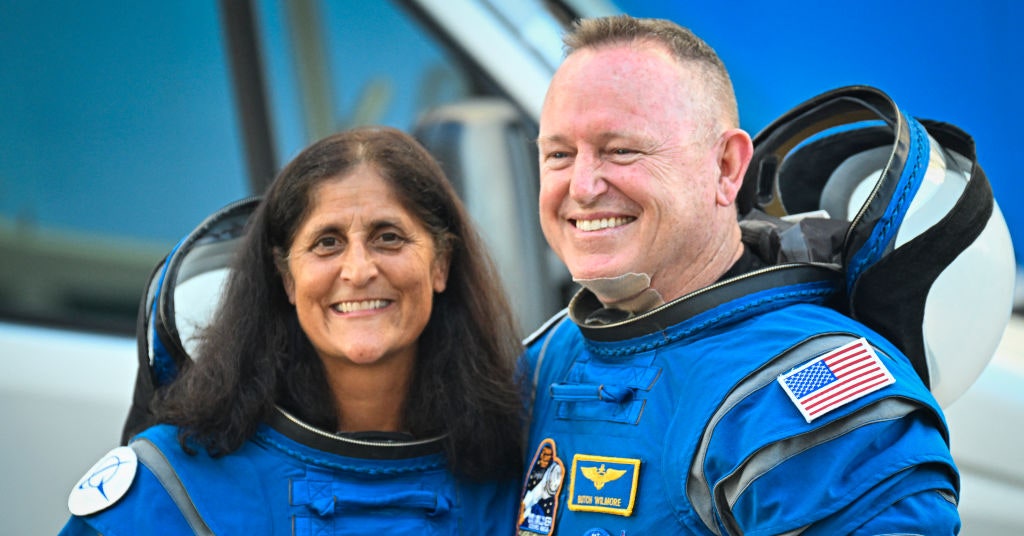
NASA has again postponed the return to Earth of Barry Wilmore and Sunita Williams, the astronauts stranded on the International Space Station after Boeing’s Starliner capsule malfunctioned in the middle of this year.
The crew of the spacecraft arrived at the ISS in June. The objective was to test the Starliner’s comprehensive capabilities, including launch, docking, and return systems. The mission was scheduled to last one week. Five of the capsule’s 28 thrusters failed to function before docking with the ISS. Boeing claimed that its technology could guarantee the safe return of the astronauts. However, NASA expressed doubts and concluded that the risk was too high. The agency entrusted the task to SpaceX.
Elon Musk’s company launched the Crew-9 mission in September to, among other things, return Williams and Wilmore. Until now, the stalled astronauts were scheduled to return in February aboard the Crew Dragon rocket. However, NASA has announced that it expects the expedition to return to Earth’s surface after the arrival of Crew-10, which will be sent in late March 2025 at the earliest.
The adjustment will allow SpaceX and NASA engineers to finalize development of a new Dragon spacecraft, which will be shipped to the company’s Florida facility early next month.
“Fabrication, assembly, testing, and final integration of a new spacecraft is a painstaking endeavor that requires great attention to detail,” said Steve Stich, manager of NASA’s Commercial Crew Program, in a statement. “We appreciate the hard work by the SpaceX team to expand the Dragon fleet in support of our missions and the flexibility of the station program and expedition crews as we work together to complete the new capsule’s readiness for flight.”
NASA said that Crew-9 and Crew-10 crews must complete a “handover period,” during which the ISS residents share experiences and knowledge with the new arrivals. This process ensures the proper performance of onboard science experiments and maintenance of the orbital complex.
NASA and SpaceX specialists evaluated several options for coordinating the next crewed delivery. They determined that the March launch for Crew-10 was the “best option for meeting NASA’s requirements and achieving space station objectives for 2025,” according to an agency press release.
A Long Haul
The ISS received two resupply flights in November, ensuring that the crew members have sufficient food, water, clothing, and oxygen. However, some experts have warned of potential health risks for Wilmore and Williams after spending more than nine months in space.
The scientific community has been studying the effects of spaceflight on the human body since the 1970s. In the years since the first lunar landing, it has identified conditions such as loss of bone mass, weakened heart function, visual problems, and the development of kidney stones.
A recent study from University College London reveals that the structure and function of the kidneys can also suffer permanent damage, although this is particularly aggressive in cases of astronauts who get too far away from Earth, which is not the case on the ISS.
NASA points out that the crews of expeditions to the ISS usually make extended stays, with an average duration of six months. It adds that some astronauts have carried out missions of up to one year to contribute to research on human adaptation to spaceflight, with a view to future lunar and Martian exploration.
This story originally appeared on WIRED en Español and has been translated from Spanish.