Thinking Machines Lab, the AI startup led by former OpenAI CTO Mira Murati, has lost one of its co-founders to Meta.
The Wall Street Journal reports that AI researcher Andrew Tulloch announced his departure to employees in a message on Friday. A Thinking Machine Labs spokesperson confirmed Tulloch’s departure to the WSJ, saying he “has decided to pursue a different path for personal reasons.”
Back in August, the WSJ reported that Mark Zuckerberg’s aggressive AI recruiting blitz included an offer to acquire Thinking Machines Lab — and when that failed, Zuckerberg reportedly tried to lure Tulloch with a compensation package that could have been worth up to $1.5 billion over at least six years. (At the time, a Meta spokesperson said that the WSJ’s description of the offer was “inaccurate and ridiculous.”)
Tulloch previously worked at OpenAI and Facebook’s AI Research Group.
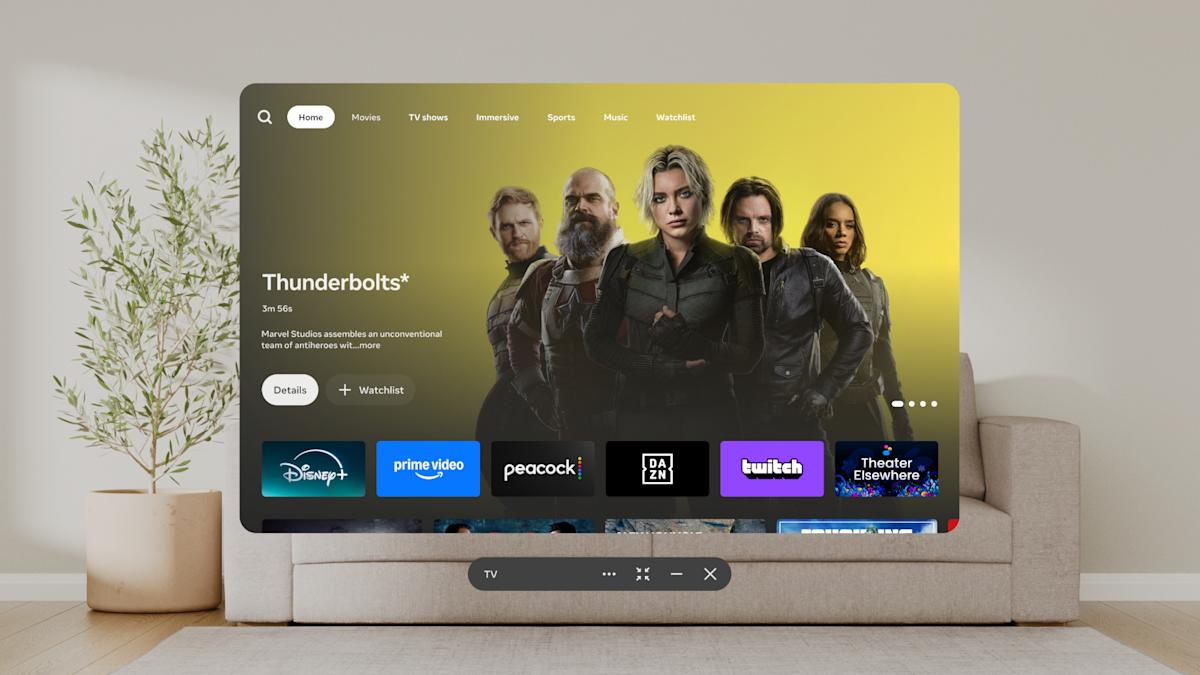
After revealing his company’s latest augmented reality and smart glasses at Meta Connect this year, Mark Zuckerberg has introduced a new entertainment hub for its Quest headsets called Horizon TV. Zuckerberg said Meta believes watching video content is going to be a huge category for both virtual reality headsets and glasses in the future. Meta has already teamed up with several major streaming services to provide shows and movies you can enjoy in VR. One of those partners is Disney+, which will give users access to the Marvel Cinematic Universe on their headsets, as well as to content from ESPN and Hulu.
Based on the interface Zuckerberg showed on the event, which had a lineup of streaming apps that will be available on the hub, Meta also teamed up with Prime Video, Spotify, Peacock and Twitch. That will allow you to watch shows, such as The Boys and Fallout on your virtual reality devices. Meta also partnered with Universal Pictures and iconic horror company Blumhouse, so that you can watch horror flicks like M3GAN and The Black Phone on your Quest “with immersive special effects you won’t find anywhere else.”
The Horizon TV hub supports Dolby Atmos for immersive sounds, with Dolby Vision arriving later this year for richer colors and crisper details. For a limited time, you’ll be able to watch an exclusive 3D clip of Avatar: Fire and Ash on Horizon TV, as well, as part of Meta’s partnership with James Cameron’s Lightstorm Vision.
There’s been some back-and-forth between the two companies, with OpenAI CEO Sam Altman suggesting that Meta was offering “$100 million signing bonuses” while adding that “so far, none of our best people” have left. Meta CTO Andrew Bosworth then told employees that while senior leaders may have been offered that kind of money, “the actual terms of the offer” were more complex than a simple one-time signing bonus.
There’s no shortage of reasons to stay off the Meta ecosystem, which includes Facebook and Instagram, but there are some places where WhatsApp remains the main form of text-based communication. The app is a great alternative to SMS, since it offers end-to-end encryption and was one of the go-to methods to send uncompressed photos and videos between iPhone and Android users before Apple adopted RCS. Even though Facebook, which later rebranded to Meta, acquired WhatsApp in 2014, it doesn’t require a Facebook or Instagram account to get on WhatsApp — just a working phone number.
How to create a WhatsApp account without Facebook or Instagram
To start, you need to download WhatsApp on your smartphone. Once you open the app, you can start the registration process by entering a working phone number. After entering your phone number, you’ll receive a unique six-digit code that will complete the registration process. From there, you can sort through your contacts on your attached smartphone to build out your WhatsApp network, but you won’t have to involve Facebook or Instagram at any point.
Alternatively, you can request a voice call to deliver the code instead. Either way, once you complete the registration process, you have a WhatsApp account that’s not tied to a Facebook or Instagram account.
If you change your mind and want more crossover between your Meta apps, you can go into the app’s Settings panel to change that. In Settings, you can find the Accounts Center option with the Meta badge on it. Once you hit it, you’ll see options to “Add Facebook account” and “Add Instagram account.” Linking these accounts means Meta can offer more personalized experiences across the platforms because of the personal data that’s now interconnected.
You can always remove your WhatsApp account from Meta’s Account Center by going back into the same Settings panel. However, any previously combined info will stay combined, but Meta will stop combining any personal data after you remove the account.
An AI-powered system could soon take responsibility for evaluating the potential harms and privacy risks of up to 90% of updates made to Meta apps like Instagram and WhatsApp, according to internal documents reportedly viewed by NPR.
NPR says a 2012 agreement between Facebook (now Meta) and the Federal Trade Commission requires the company to conduct privacy reviews of its products, evaluating the risks of any potential updates. Until now, those reviews have been largely conducted by human evaluators.
Under the new system, Meta reportedly said product teams will be asked to fill out a questionaire about their work, then will usually receive an “instant decision” with AI-identified risks, along with requirements that an update or feature must meet before it launches.
This AI-centric approach would allow Meta to update its products more quickly, but one former executive told NPR it also creates “higher risks,” as “negative externalities of product changes are less likely to be prevented before they start causing problems in the world.”
In a statement, Meta seemed to confirm that it’s changing its review system, but it insisted that only “low-risk decisions” will be automated, while “human expertise” will still be used to examine “novel and complex issues.”
Instagram Threads, Meta’s X competitor, has now grown to over 350 million monthly active users, CEO Mark Zuckerberg revealed during the company’s Q1 2025 earnings call on Wednesday. That’s an increase of 30 million users since the prior quarter, where Meta reported that Threads had 320 million users.
The new figure represents increased growth, as Threads added 30 million in the first quarter of this year, compared with 20 million in Q4 2024. It’s also worth noting that in a single quarter, Threads added nearly the same number of users to its network as one of its newer competitors, Bluesky. The latter, a decentralized social app, today has roughly 35 million users.
While Threads is still small in comparison to Meta’s other social apps — Facebook, Instagram, Messenger, and WhatsApp — its growth is helping to cement its place in the microblogging app ecosystem. In total, Meta says that more than 3.4 billion people now use at least one of Meta’s apps daily.
On Wednesday’s call, Zuckerberg told investors that the growth indicates Threads “continues to be on track to become our next major social app.”
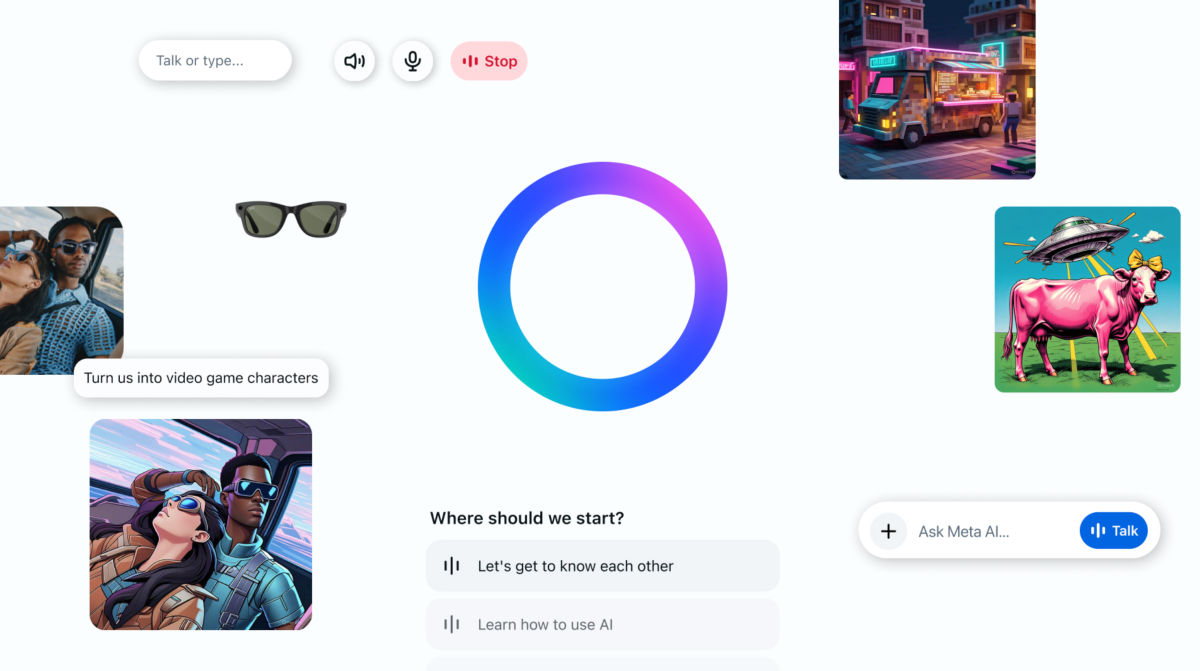
After integrating Meta AI into WhatsApp, Instagram, Facebook, and Messenger, Meta is rolling out a standalone AI app. Unveiled at Meta’s LlamaCon event on Tuesday, this app allows users to access Meta AI in a standalone app, similar to the ChatGPT app and other AI assistant apps.
To win over users, Meta is trying to leverage what makes it different from companies like OpenAI and Anthropic — Meta already has a sense of who you are, what you like, and who you hang out with based on years of data that you’ve likely shared on Facebook or Instagram.
Meta’s AI app can differentiate itself from existing AI assistants because it can “[draw] on information you’ve already chosen to share on Meta products,” the company said, such as your profile and the content you engage with. So far, these personalized responses will be available in the US and Canada.
You can also give Meta more information about you to remember for future conversations with its AI — for example, you can tell the AI that you are lactose intolerant, which it could remember before recommending that you go to a wine and cheese tasting on your next vacation.
As with any AI product, users should be aware of how Meta may use the data that they share with its chatbots. Meta relies on its wealth of user data to power its targeted advertising business, which makes up the bulk of its revenue.
Image Credits:Meta
Meta’s AI app also introduces a Discover feed, where you can share how you’re using AI with your friends — in a mockup image, Meta shows someone asking the AI to describe them in 3 emojis, which they then shared with their friends. A user’s interactions with Meta AI will only be shared to the feed if they choose to do so.
This feed might amplify certain generative AI trends, like the recent trend in which people tried to make themselves look like Barbie dolls or Studio Ghibli characters. But then again, not every app needs to have a social feed — we’re looking at you, Venmo.
The first week of the Meta antitrust trial brought new revelations about how the company formerly known as Facebook approached the competitive threat posed by Instagram in the early 2010s.
The U.S. government is accusing Meta of violating competition laws by acquiring companies like Instagram and WhatsApp that threatened the Facebook monopoly. If lawyers for the U.S. Federal Trade Commission (FTC) are successful, the government could force Meta to break up its business by selling off Instagram and WhatsApp.
As part of the trial, the FTC shared compelling evidence to demonstrate that Facebook was very much aware of the risk Instagram created for its business as the photo-sharing app grew in popularity. In documents containing Facebook’s internal emails, Facebook execs fret over Instagram’s growth and discuss how much to pay for the app, if Facebook were to acquire it.
The company execs also discuss other strategies for limiting Instagram’s growth, including copying its functionality and releasing an app of their own, or buying the app and then no longer adding new features to it while working on its own products.
Facebook’s strategy to either buy or bury its competition is on display in these conversations, according to the government’s arguments. In addition to showing how the company was thinking about its competition at the time, the messages are indicative of the cutthroat strategies that have allowed Meta to become the social networking behemoth it is today.
Some of the highlights from these messages are below.
Mark Zuckerberg and others worry about Instagram’s rapid growth
“Instagram seems like it’s growing quickly. In 4 months they’re up to 2m users and 30k daily photo uploads. That’s a lot. We need to track this closely. Also, apparently Dropbox’s next big push is going to be in photo sharing.” — Mark Zuckerberg, February 2011
“If Instagram continues to kick ass on mobile, or if Google buys them, then over the next few years they could easily add pieces of their service that copy what we’re doing now, and if they have a growing number of people’s photos then that’s a real issue for us. They’re growing extremely quickly right now. It seems like they double every couple of months or so, and their base is already ~5-10m users. As soon as we launch a compelling product a lot of people will use ours more and future Instagram users will find no reason to use them. But at the current rate, literally every couple of months that we waste translates to a double in their growth and a harder position for us to work our way out of.” — Mark Zuckerberg, September 2011
“The photos team is now focused almost exclusively on a new mobile photo app as we gawk at Instagram’s simple photo-sharing app taking off (and even our own app sees fat growth … mobile uploads increased to 17.7M day, +5.3 w/w). Like Beluga, watching these guys explode validates our strategy of de-cluttering our mobile experience and offering standalone messaging and photos products outside from the monolithic app garden.” — Chris Cox, chief product officer, February 2011
“One concerning trend is that a huge number of people are using Instagram every day — including everyone ranging from non-technical high school friends to even FB employees — and they’re only uploading some of their photos to FB. This creates a huge hole for us and one that I’m sure anything we’re going to do on platform or with social dynamics will completely solve.” — Mark Zuckerberg, February 2012
Facebook considers an Instagram acquisition, stopping its development and growth
“I wonder if we should consider buying Instagram, even if it costs ~500M. Right now they seem to have two things that we don’t: a really good camera and a photo-centric sharing network.” — Mark Zuckerberg, February 2012
“I think it’s quite possible that our initial thesis was wrong and theirs is right — that what people want is more to take the best photos than to put them on FB … we might want to consider paying a lot of money for this.” — Mark Zuckerberg, February 2012
“I actually think that there is a serious argument to be made that we should buy Path, Pinterest, Instagram, Evernote, and whomever else we really admire/are doing great things right now if (1) we can structure it in a way that we keep their products up & running but transition the teams to working on FB proper; (2) we think the people deeply care about building great things and we think we can lock them up for 4+ years to work on our platform.” — Samuel W. Lessin (former Facebook VP of Product), corresponding with Mark Zuckerberg in February 2012
“I think what we’d do is keep their product running and just not add more features to it, and focus future development on our products, including building all of their camera features into ours. By not killing their products we prevent everyone from hating us and we make sure we don’t immediately create a hole in the market for someone else to fill, but all future development would go towards our core products.” — Mark Zuckerberg, February 2012
“One way of looking at this is that what we’re really buying is time. Even if some new competitors springs [sic] up, buying Instagram, Path, Foursquare, etc now will give us a year or more to integrate their dynamics before anyone can get close to their scale again.” — Mark Zuckerberg, February 2012
Meta has announced that Patrick Collison and Dina Powell McCormick are joining its board of directors on April 15. Collison is the co-founder and CEO of Stripe, the payment processor and financial services company that he started with his brother. He is also the co-founder of the Arc Institute, a biomedical science and technology institution. Meanwhile, Powell McCormick was a partner at Goldman Sachs and ran its Global Sovereign investment banking business. She also worked for the US government and served as Deputy National Security Advisor to President Donald Trump during his first term.
Powell McCormick helped shape the Trump administration’s foreign policy, especially in regards to the Middle East as an Egyptian-American. She served as an Assistant to the President and Senior Counselor for Economic Initiatives during Trump’s first term, as well. Her Trump-era appointments weren’t the first time she worked in the US government, though: Back during the George W. Bush administration, she served as the Assistant to the President for Presidential Personnel, Assistant Secretary of State for Educational and Cultural Affairs and Deputy Undersecretary of State for Public Affairs and Public Diplomacy. She is married to Republican senator Dave McCormick.
“Patrick and Dina bring a lot of experience supporting businesses and entrepreneurs to our board. Patrick is deeply committed to expanding economic opportunity, and Dina has a long career advocating for economic development and supporting entrepreneurs. Their perspective will be extremely valuable to businesses that rely on our services to grow,” Meta chief Mark Zuckerberg said in a statement.
In January, Meta also welcomed UFC CEO Dana White, who’s a known friend and associate of Donald Trump and a supporter of his re-election bid, to its board of directors. White’s and Powell McCormick’s additions to Meta’s board are signs that the company is tacking right now that Trump is back in power, and perhaps one of the ways the company is ingratiating itself to the current administration.
One of the new flagship AI models Meta released on Saturday, Maverick, ranks second on LM Arena, a test that has human raters compare the outputs of models and choose which they prefer. But it seems the version of Maverick that Meta deployed to LM Arena differs from the version that’s widely available to developers.
As severalAIresearchers pointed out on X, Meta noted in its announcement that the Maverick on LM Arena is an “experimental chat version.” A chart on the official Llama website, meanwhile, discloses that Meta’s LM Arena testing was conducted using “Llama 4 Maverick optimized for conversationality.”
As we’ve written about before, for various reasons, LM Arena has never been the most reliable measure of an AI model’s performance. But AI companies generally haven’t customized or otherwise fine-tuned their models to score better on LM Arena — or haven’t admitted to doing so, at least.
The problem with tailoring a model to a benchmark, withholding it, and then releasing a “vanilla” variant of that same model is that it makes it challenging for developers to predict exactly how well the model will perform in particular contexts. It’s also misleading. Ideally, benchmarks — woefully inadequate as they are — provide a snapshot of a single model’s strengths and weaknesses across a range of tasks.
Indeed, researchers on X have observed starkdifferences in the behavior of the publicly downloadable Maverick compared with the model hosted on LM Arena. The LM Arena version seems to use a lot of emojis, and give incredibly long-winded answers.