Budget-friendly gadgets that are good


It’s a slower October than usual in the tech industry, thanks mostly to Google and Microsoft having held their typical fall hardware announcements earlier this year. Still, we’ve seen a fair number of companies reveal new devices in the last two weeks, while Amazon’s October Prime Day raged on. Whether you were busy shopping or watching Elon Musk talk up robotaxis and cybervans, the Engadget team continued to review recently (and not-so-recently) launched products. As usual, this bi-weekly roundup is here to help you catch up, though because I missed last week’s edition (as I was out on time off), the cadence is just a bit off.

From Meta’s Quest 3S VR headset and the DJI Air 3S drone, to Sony’s midrange suite of audio gear, these weeks have coincidentally been about the less premium, more affordable “un-flagships,” if you will. And it turns out you don’t have to throw chunks of your retirement savings at companies to get solid devices that are well worth the money.

by Billy Steele

Sony

Sony flexes its mobile audio muscle on the LinkBuds Fit, combining great sound with tons of features.

Pros

  • Tiny, comfy design
  • Surprisingly big sound
  • Lots of handy features
Cons

  • ANC performance is lacking
  • Battery life
  • Call quality is fine, but not great

$200 at Sony

The main thing I learned from Billy’s recent reviews of Sony and Bose headphones is that flagship, premium-level noise cancelation is making its way down to the midrange products. And I, for one, am happy about it. Looks like most of the things you’ll miss if you opt to save some money are features like spatial audio, head-tracking and stuff that’s supposed to be make for a more immersive, intuitive listening experience. Personally, I’m okay missing out on those things for now — I really just want decent sound, good voice quality and competent reduction of background noise.

Definitely check out Billy’s review of Sony’s LinkBuds trio of devices even if you’re not in the market for headphones, because he put his ears through literal pain to test the strangely designed earbuds for us. In fact, a rejected headline for the review was “Why am I in pain?” We salute you, Billy.

by Devindra Hardawar

Meta

The Meta Quest 3S delivers immersive virtual reality for just $300. It’s fast, comfortable to wear and it has a wealth of games and VR experiences to choose from.

Pros

  • Fast performance
  • Comfortable to wear
  • Excellent controllers
  • Large app library
Cons

  • Older Fresnel lenses lead to artifacts
  • No headphone jack
  • Average mixed reality cameras

$299 at Amazon

The Quest is arguably the industry’s leading VR headset for consumers, especially considering it costs a fraction of alternative options while offering a relatively high-quality immersive experience. Unlike the Apple Vision Pro, which costs $3,500, the new Quest 3S is much more palatable at $300. And, as Devindra observes in his review, it’s comfortable, fast and allows wearers to access Meta’s large library of VR apps and content. To quote Devindra, “It’s not Meta’s first $300 VR headset, but it’s still a tremendous accomplishment.”

by Steve Dent

DJI

DJI’s Air 3S is the company’s first consumer drone with LiDAR designed to make it safer to fly at night. 

Pros

  • Excellent image quality
  • LiDAR improves obstacle detection at night
  • ActiveTrack 360 produces cinematic tracking shots
  • Long battery life
  • Now has 42GB internal storage
Cons

  • Sometimes fails to detect small obstacles

$1,099 at DJI

Continuing in the trend of excellent products that cost less than usual, the DJI Neo is an excellent drone for just $200. Calling it the best $200 drone ever made may sound hyperbolic, but we truly can’t think of any other drone that cost the same that came close to delivering similar performance as the Neo. And though one of its main drawbacks, according to our reviewer Steve, is that it sounds like a banshee, I honestly think that would be a pro for me just for the pure comedy of it all. I never thought I’d be in the market for a banshee-sounding drone but here I am thinking $200 would be a fair price to pay for the aerial videos I could get, and I could easily lay upbeat, operatic singing over the footage anyway.

On the other end of the spectrum, Steve’s also tested the higher-end DJI Air 3S drone and Canon’s EOS R5 II, both of which will cost you a lot more money. The good news is that Canon’s EOS R5 II is now so much improved that it better takes on Sony’s rival offerings, while bringing intriguing features like eye-control autofocus. Sure, it’s still too early to be reliable. But if you have the money for these premium products, you’ll get to experience bleeding-edge tech, maybe part of the appeal is that they may not always work well.

by Dan Cooper

reMarkable / Engadget

reMarkable adds a color screen to its e-paper tablet, creating a best-in-class distraction-free writing experience.

Pros

  • Color is a welcome and useful addition
  • Backlight lets you work in dark environments
  • Vastly improved performance

$579 at reMarkable

I know Dan was a bit worried about giving a device as niche as the reMarkable Paper Pro such a high score, but after some discussion, we both agreed it fit. As it stands, the reMarkable Paper Pro is arguably the best e-paper writing tablet with a color screen, even after this week’s announcement of Amazon’s first color Kindle. Per Dan’s review, the Paper Pro not only levels up with the addition of color, but also got much faster and reliable in the process.

I particularly enjoy how much care has been taken to more seamlessly blend handwriting and typed text for a more natural note-taking and annotating experience. And though it falls outside this edition’s general theme of being a less-expensive product with premium specs, I’m still incredibly tempted to find ways to cough up the $600 or so needed to bag myself a Paper Pro with the accessories Dan recommends.

by Jessica Conditt

I’m not the most engaged gamer, but I love learning about games from Jess. She recently reviewed sci-fi mystery Phoenix Springs and dreamy platformer Neva, with pieces written so beautifully that I can’t help but itch to check out each title so I can feel the way she clearly does about them. Phoenix Springs even follows a technology reporter and covers my favorite genres (science fiction and mystery), while Neva’s art looks simply gorgeous. I don’t yet know if I’ll ever find the time to play new games, but these two have certainly been added to my list.

The Engadget team geeks out about a multitude of things, and as we get started on our holiday gift guide writing, we’re thinking about products we like for ourselves and our loved ones. Many of us love e-readers and writing tablets. I certainly have my eye on one of the new Kindles that were announced this week, particularly the new Kindle Scribe and possibly the Colorsoft. Those won’t be available until later this year, so for now I’ll keep hungrily eyeing the reMarkable Paper Pro. I’ll also be wondering what Amazon hardware chief Panos Panay has up his sleeves, other than cans of Diet Coke — something I learned he (like many people) enjoys when I got the chance to speak with him in an interview this week.

Many of us are millennials and have gigantic soft spots for retro gaming. Our executive editor Aaron Souppouris talked to the folks at Analogue, and you can read his beautifully constructed piece to learn more about the upcoming Analogue 3D.

This week, Apple sort of surprised us by announcing the new iPad mini, which has been tweaked to offer more storage and power with an A17 Pro processor. It’ll also support Apple Intelligence, of course, and though it seems like a minor update, some of my coworkers and I still love the idea of a small tablet. If only it had a better screen.

All of those recently announced things are on our review roster, alongside things like the Google TV Streamer and Samsung Galaxy S24 FE that launched in the last few weeks. As we approach November and all the holiday shopping that brings, hopefully the hardware launches properly slow down. We’re still anticipating an Apple event for Macs, and can still remember being surprised by the announcement of Humane’s AI Pin late last year. But for now, we’re chugging along while occasionally bathing in nostalgia and longing for a simpler time.

Utah judge blocks law preventing youth from accessing social media freely


On Tuesday, Chief US District Judge Robert Shelby granted a preliminary injunction to from limiting the social media usage of minors. Republican Governor Spencer Cox had signed the Utah Minor Protection in Social Media Act earlier in March. It was supposed to take effect on October 1, but the court’s decision to block the law is a victory for young social media users in Utah.

This isn’t the first time Utah’s governor has attempted to use among the youths in the state. Last year, he signed two bills that required parents to grant permission for teens to create social media accounts, and these accounts had limitations like curfews and age verification. He in March due to lawsuits challenging their legality.

Under the law, social media companies would have been forced to verify the age of all users. If a minor registers for an account, they are subject to various limitations. The content they share would be seen only by connected accounts. Additionally, minor accounts could not be searched for or messaged by non-followers or friends, effectively nonexistent to strangers.

The primary reason for the is due to NetChoice’s claim that the law constitutes a violation of the First Amendment. NetChoice is a trade association formed by tech giants such as X (formerly Twitter), Snap, Meta and Google. The association has managed to win in court battles and block similar laws entirely or in part in states like , and .

Threads is testing disappearing posts that expire after 24 hours


Threads is testing the option for users to put a 24-hour expiration timer on their posts, after which the post and all replies would disappear, Stories-style. A spokesperson confirmed to that the feature is being tested among a group of users after it was first spotted earlier this summer by developer . It sounds a lot like pre-X Twitter’s Fleets, . But, the ephemeral format could save habitual post-deleters some trouble.

It comes a few months after Instagram head Adam Mosseri shared that Threads was . That optional feature would let users designate a date for their posts to be hidden from the feed. But Threads users in the past have indicated that they of automatic archiving, and such a feature hasn’t yet shown up on a wider scale. Threads at the beginning of August, and recently introduced an for users — particularly those with large followings — to keep track of their account’s performance. Meta also said the option to schedule posts is on the way.

WhatsApp’s new feature will let Meta AI edit your photos for you


WhatsApp logo on smartphone next to everyday accessories Stock photo 1

TL;DR

  • WhatsApp beta version 2.24.14.20 has a new feature that allows users to share photos with Meta AI.
  • The AI chatbot will analyze uploaded images and provide information or context about the content.
  • Users may be able to request specific edits to their photos directly through Meta AI, though the extent of this feature is still unknown.

As the battle for AI dominance heats up, Meta is adding a new trick to its AI chatbot, Meta AI, which is already part of Facebook, Instagram, and WhatsApp. While Meta AI already has impressive text capabilities, such as replying to questions, suggesting captions, and holding conversations, users cannot currently share or upload photos to the Meta AI chat.

WaBetaInfo has uncovered the exciting new feature in the WhatsApp beta for Android version 2.24.14.20. This feature will allow Meta AI to interact with photos shared by users, reply to photos, and even edit them.

Meta AI image editing on WhatsApp beta feature screenshot

As shown in the attached screenshot, WhatsApp is testing a new camera button in the Meta AI chat, designed to function similarly to the camera button in regular chats. This addition will allow users to manually share photos with Meta AI, a capability that is currently unavailable.

With this new functionality, users will be able to ask questions about their photos, presumably allowing users to ask the AI to identify objects or locations or provide context about the photo’s content. Moreover, the screenshot suggests that Meta AI will also offer the option to edit photos, enabling users to make changes to their images directly within the chat by sharing a prompt.

The exact scope of this image editing feature remains unclear, leaving us to wonder if it will be limited to simple tweaks or if it will unleash a powerful AI-driven photo editing suite. The possibilities are both exciting and intriguing, and this feature could definitely be a big hit, especially if it performs as promised.

While this new image-sharing feature would mean Meta will analyze and face-scan the photos you upload, the screenshot includes a disclaimer indicating that users will have the option to delete their photos whenever they want.

As of now, it seems that the feature is still in development, so it might be some time before we finally get to see it roll out publicly. Recently, we also reported about WhatsApp working on an “Imagine Me” feature that would allow Meta AI to generate AI avatars of you based on a set of your photos.

Got a tip? Talk to us! Email our staff at news@androidauthority.com. You can stay anonymous or get credit for the info, it’s your choice.

Apple reportedly even held talks with Meta about an AI partnership as it plays catch-up


Apple is apparently looking to take all the help it can get to integrate generative AI into its . According to a report by the , citing sources with knowledge of the discussions, Apple has held talks with Meta about the possibility of using the company’s generative AI model. It also reportedly had similar discussions with startups Anthropic and Perplexity. As of now, though, nothing has been finalized, WSJ reports.

At WWDC earlier this month, Apple officially announced its much-rumored partnership with OpenAI that will with the upcoming generation of the devices’ OS. During the event, Apple’s senior VP of software engineering, Craig Federighi, also as something that could be added to Apple Intelligence in the future. “We want to enable users ultimately to choose the models they want,” Federighi said. It would make sense, then, for Apple to be shopping around.

But for the time being, only OpenAI has been confirmed as a partner. OpenAI’s GPT-4o will be integrated into Apple Intelligence to bolster Siri and other tools, with some features expected to arrive later this year.

Threads search will finally be usable with ‘recent’ tab rollout


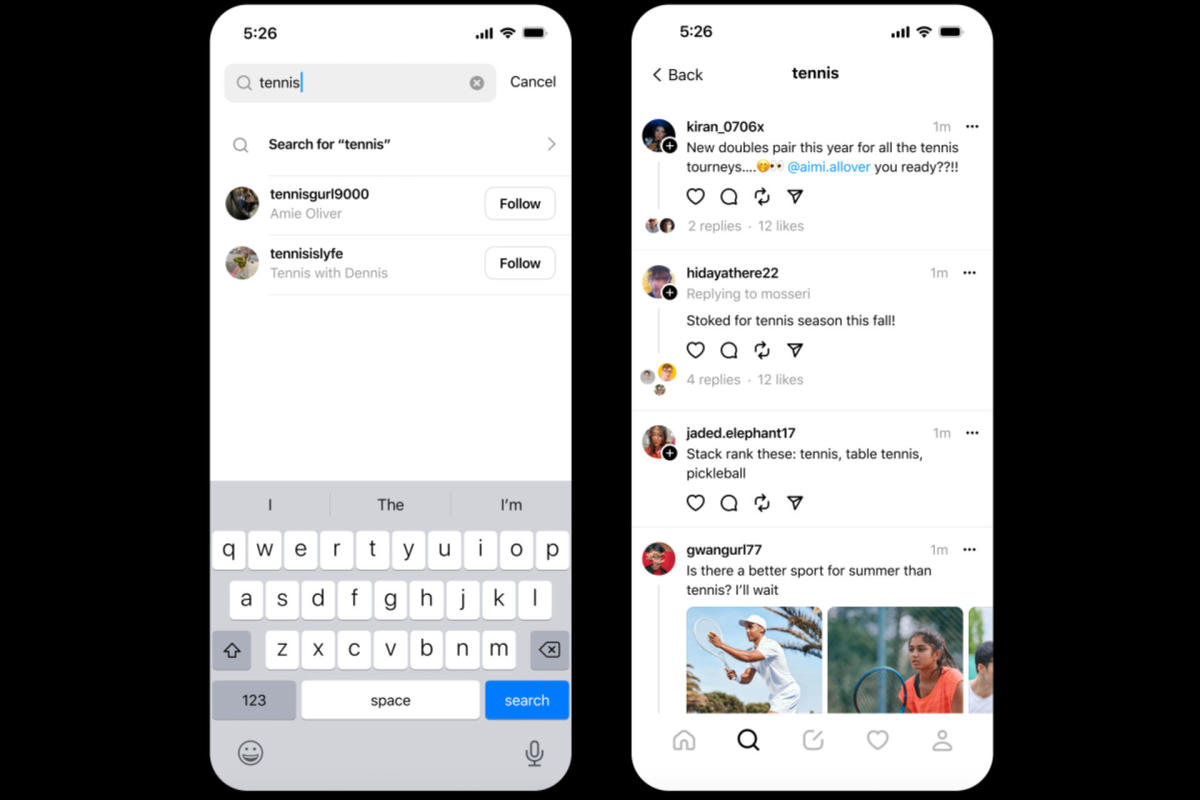
Threads is inching closer to becoming an actually useful source for real-time news and updates. The app is finally rolling out the ability to search posts in order of recency, after the feature last month.

“In an effort to make it easier to find timely, relevant content on Threads, we’re introducing a Recent tab for your searches,” Instagram’s Adam Mosseri wrote in . “Search results here are still evaluated for quality, but you can now see them in chronological order.”

The change has been a long requested one from users hoping Meta’s app will one day be a source of breaking news and real-time information the way that Twitter historically functioned. Being able to search for topics and keywords and find the most recent results is key to finding up-to-date details and commentary about breaking news, sports and anything else happening in real time.

On the other hand, Meta has also made it clear that it would prefer “news” to not be what Threads is known for. Mosseri has said he doesn’t want to “encourage” hard news on Threads and the company actively political content. Threads’ default “for you” algorithm is also known for surfacing days-old posts, random personal stories and other content that’s not exactly timely.

It’s also worth pointing out that Threads’ new recency filter in search is not the same as the “latest” search filter on X. As Mosseri noted in his post, Meta still hides an unknown number of posts in search results that have been “evaluated for quality,” so Threads search will never surface all of the posts containing your search terms. But being able to at least find posts that aren’t a few days old should make looking for timely information a lot less frustrating.

Instagram, WhatsApp, and Facebook Suffer Service Disruptions Reported Worldwide


File photo of a woman checking her phone during an Instagram outage in 2021.

File photo of a woman checking her phone during an Instagram outage in 2021.
Photo: Ed Jones (Getty Images)

Meta platforms Facebook, WhatsApp, and Instagram are experiencing a global outage with thousands of reports of the app not working properly since roughly 2 p.m. ET Wednesday.WhatsApp appears to have gone down first, with Instagram and Facebook following suit about 30 minutes later.

Image and media uploads appear to be struggling the most on the platforms, according to internet monitoring service Netblocks, which also notes there are no indications of “country-level internet disruptions or filtering.”

Social media apps have experienced a number of notable outages in recent months, with LinkedIn struggling last month just days after Facebook and Instagram went down for hours.

It appears that some users on WhatsApp are still able to send messages right now, but those messages aren’t being delivered, according to the Verge.

Some X users celebrated as news of Meta’s platforms struggling spread on Wednesday afternoon.

Meta didn’t immediately respond to questions emailed on Wednesday, but the official X account for WhatsApp tweeted, “We know some people are experiencing issues right now, we’re working on getting things back to 100% for everyone as quickly as possible.” Gizmodo will update this post if we hear back.