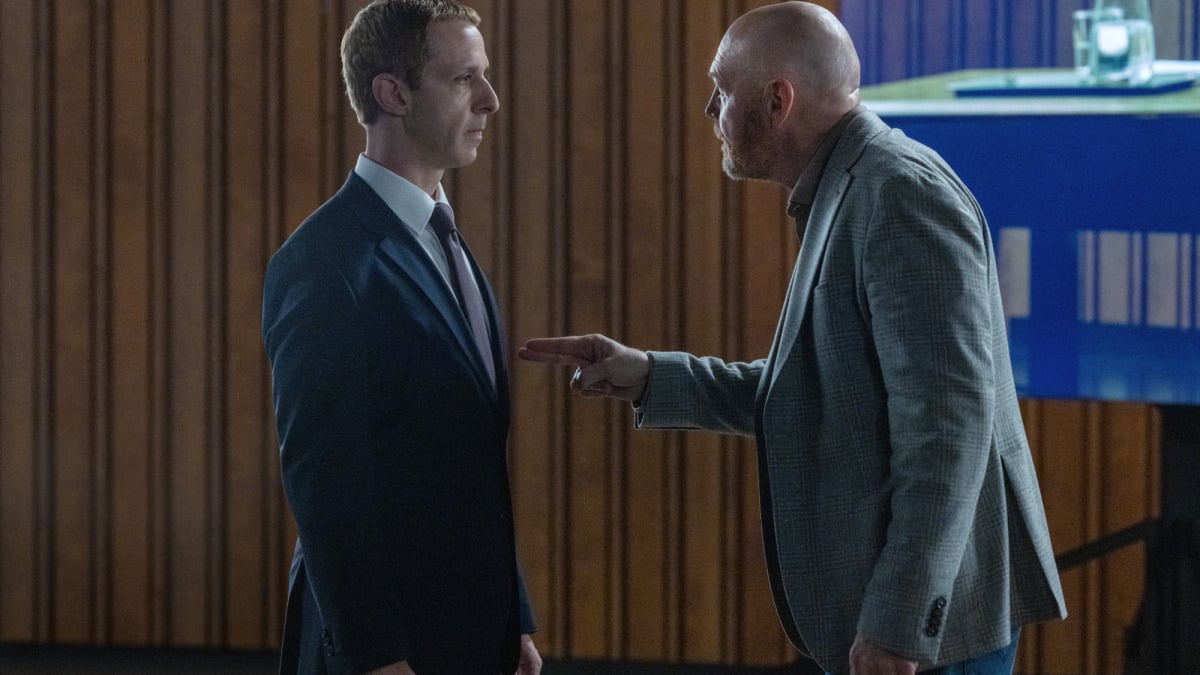
Aaron Sorkin, famed writer of The West Wing and Academy Award-winning The Social Network, is notoriously verbose. He has a reputation for linguistic flairs that some find awkward, and many find deeply compelling.
But in The Social Reckoning, a follow-up to the 2010 tale of Facebook’s founding, he is uncharacteristically sparing.
Yes, Sorkin — who wrote and directed the new movie — crams the script with one-liners and existential metaphors, random pop culture references, and cries for change, but it’s what he leaves out that viewers should pay attention to.
What ‘The Social Reckoning’ omits
Through The Wall Street Journal‘s Jeff Horwitz (Jeremy Allen White) and Facebook whistleblower Frances Haugen (Mikey Madison), The Social Reckoning recounts the two years of work that made up the publication’s explosive 2021 series, The Facebook Files. The birth of the exposé, a series of insider accounts of Facebook’s decision to reroute its algorithm in service of polarizing extremism, is presented in two competing timelines.
In one, Huagen and Horwitz attempt to penetrate the Silicon Valley giant’s defenses to learn the true scope of its wrongdoing. In the other, CEO Mark Zuckerberg (Jeremy Strong) readies himself to testify before Congress — as Jan. 6th insurrectionists storm the Capitol.
So it’s strange that it’s characters — real-life journalists, brave whistleblowers, and profit-driven tech overlords who had a direct role in the current administration’s success — don’t say the name “Trump.”
Despite a third of the movie set in 2020, COVID-19 is largely referred to as “the novel virus.” The movie skirts the rampant medical misinformation, spread by conservative conspiracy groups, that flourished on Meta platforms.
The movie also omits the full details of Facebook’s startling algorithmic misconduct that surrounded and informed the events of The Social Reckoning. And that’s just the tip of the iceberg.
Meta IRL
In 2018, the tech giant was implicated in a massive data breach that harvested user profiles to target U.S. voters ahead of President Donald Trump’s 2016 election victory. Facebook had already been accused of a host of reported user privacy violations, including conducting an algorithm-based psychological study on unwitting users. Due to Facebook’s outsized role in spreading fake news, the company’s CEO was given the title “Misinformer of the Year” in 2017 by Media Matters for America.
Civil rights organizations like GLAAD have long deemed Meta’s platforms unsafe for LGBTQ users. Facebook’s algorithm has not only helped foster discord on home soil, but is also alleged to have had a role in global cultural genocides by human rights groups like Amnesty International.
Following Haugen’s real-life congressional testimony, used as the final beat of Sorkin’s film, the company was accused of exacerbating a youth mental health crisis, multiple deaths by suicide, and an explosion of real and synthetic child sexual abuse materials (CSAM). The first point is briefly touched on in the film, while the last is completely sidelined.
Three weeks after Haugen’s congressional appearance in 2021, Facebook changed its name to Meta. The company then underwent a brief public-image overhaul — until Trump came back into power. Following his reelection, Meta gave $1 million to Trump’s inauguration fund.
The Social Reckoning implores someone, anyone, to act. The film posits that the federal government may be able to hold Zuckerberg to account.
It hasn’t.
One character, a member of the company’s civic integrity team who helps leak internal reports about Instagram’s impact on teen mental health, tells Haugen that something needs to be done before the company proceeds with its plan for “Instagram Kids.”
In 2024, Meta debuted Teen Accounts to address growing unease about young people’s online habits. Following studies that concluded the changes featured in Instagram’s Teen Accounts were ineffective, the company overhauled them. In the months since the overhaul, advocates have alleged Teen Accounts are still failing to curb online abuse.
Another real-life whistleblower, Arturo Béjar, has continued to testify to Meta’s alleged intentional disregard for teen mental health in court.
Mashable Top Stories
Will Meta change?
In the film’s epilogue, Sorkin describes Haugen’s disclosure as having “caused some pain” for the company.
“I would not call it a massive pain for Meta,” said Christine McComas, founding member of child safety advocacy group Parents for Safe Online Spaces (ParentsSOS). “It was a moment of clarity for people to understand what’s going on.”
Unlike Sorkin’s more timid portrayal, McComas describes Haugen as a person who knew what she needed to do. McComas credits Haugen with galvanizing the work of bereaved parents whose children had died by suicide following abusive social media interactions.
That is an inexcusable failure of leadership.
As of publishing, more than 3,000 federal lawsuits have been filed against Meta alleging intentional harm to teen users. The film briefly mentions the work of attorneys general in amplifying these claims. Many of these cases are still ongoing or have settled out of court, but a few have resulted in surface level changes to Meta platforms.
Much like Teen Accounts, researchers argue the changes did not do enough to protect young users.
Concerted pressure from state leaders and child safety advocates has finally pushed Meta to agree to more substantive reform, such as algorithmic guardrails. Still, most argue that comprehensive federal regulation is the only way to truly curb Meta’s harm.
Congressional leaders have “completely failed” to hold Meta and its competitors accountable, says Ashwin Verghese, communications director of child safety nonprofit Fairplay. “In fact, Congress has not passed a bill focused on keeping kids safe online in nearly 30 years. That is an inexcusable failure of leadership,” Verghese said.
It has been years since the Wall Street Journal published The Facebook Files. To be fair to Sorkin, political change is slow. Courts have their limits when powerful, near monopolistic, companies are involved.
But there’s a lingering question that the movie, given its timeline and broad topics, only mildly addresses through its luddite journalist, Horwitz: If Congress won’t act, why won’t we, as a society, just stop using Meta’s problematic products?
Meta, why can’t we quit you?
Compared to Horwitz, who is comedically introduced as someone who can’t even use a GPS, Sorkin depicts Haugen as an idealist, clinging to the democratizing potential of Facebook. Her movie self is a firm believer that the platform’s ability to foster social connection is a societal good. The character doesn’t rally for Meta’s shuttering, but for its reform.
In early 2026, professor and marketing expert Scott Galloway called for an industry-wide boycott of tech platforms with disproportionate political and economic power. Included in that list were Meta platforms WhatsApp and Facebook (Instagram is also in Meta’s corporate roster).
One year earlier, swaths of users threatened to delete their Meta accounts following platform changes that signaled its alignment with the Trump administration, including the erasure of hateful conduct protections for LGBTQ users and the shuttering of its fact checking program. Years before that, users attempted to galvanize change through the 2018 #DeleteFacebook trend.
Yet, even with these calls, Meta has yet to see a mass exodus of users. The company only recently reported a substantial decline in daily users across its platforms. The loss was just 20 million of a reported 3 billion users. After the launch of its new AI agent Muse, Meta regained almost 2 million daily users.
Too many people are complacent because they don’t know an alternative.
“Meta has spent millions of dollars in public relations campaigns to claim their platforms are safe while denying responsibility,” said Maurine Molak, advocate and co-founder of ParentsSOS. Molak was one of a group of survivor parents who received an apology from Zuckerberg during his 2024 congressional testimony.
Molak argues that Meta’s billion-dollar PR spin has sowed confusion among parents, users, and even congressional leaders. Without clarity, users are more inclined to stay and avoid the pains of leaving.
“Too many people are complacent because they don’t know an alternative,” explained Sam Hiner, executive director of the youth-led advocacy nonprofit Young People’s Alliance. Hiner and Molak both argue one of the biggest hurdles to leaving Facebook is the Fear of Missing Out.
“If you’re not online, it feels like you’re missing out on an important cultural space,” said Hiner. “It’s also hard for competitors to emerge because of the network effect — all of my friends are on Meta platforms, not whatever competitor may emerge.”
Molak links this to Facebook’s role as one of the first social media platforms. Millions, perhaps billions of adults, have spent nearly two decades building their accounts on Facebook and more than a decade on Instagram. Recntly, they have merged these accounts onto Meta’s X-competitor Threads — a wave of users flocked to Threads after Elon Musk’s take over of Twitter. It was the lesser of two evils.
Meta platforms are part of many’s daily habit, maybe even their identity. With its foray into general AI and its diversification into massively popular chat platforms, users are getting wrenched deeper into Meta’s web.
“Algorithms aren’t visible, so it’s understandably been quite difficult for most folks to connect the harms they experience in their communities — more people angry and outraged, more mental health problems, more anxious children — with some computer code designed in a faraway lab,” explained Julie Scelfo, founder and executive director of Mothers Against Media Addiction.
This movie will not move the needle on Meta
Meta has not issued a statement on The Social Reckoning, and it probably never needs to. The film’s opening weekend was an unequivocal flop.
The company is shielded by its buying power. In an April earnings call, the tech giant said it brought in $56.3 billion, probably tied to its ongoing generative AI investments.
“The monetary fines imposed on Meta are comparable to parking tickets,” said Molak. In August, Meta settled out of a potentially consequential social media addiction lawsuit for the sum of $17 billion dollars — just one percent of its stock value, paid out over a decade.
During one pivotal moment between Horwitz and Haugen in The Social Reckoning, Haugen ponders if it’s possible to push powerful people toward change.
“When it’s about money, it’s hard,” says Horwitz. “When it’s not about money, it’s even harder.”
Recommended deals for you
HBO Max
—
top pick for premium content
Disney+
—
best for families
Hulu
—
popular choice for originals
Peacock
—
low-cost choice for live sport
Products available for purchase through affiliate links. If you buy something through links on our site, Mashable may earn an affiliate commission.