Phones aren’t always bad for kids. Social media does the real harm


Smartphones are often blamed overwhelmingly for ruining the mental health of kids and fostering a wide range of issues such as showing digital addiction patterns or imbibing bad ideas from the internet or games.

As per research, however, smartphone ownership is not always a bad thing. On the contrary, it can be a well-being agent. The study, which was conducted by experts at the University of South Florida, analyzed the smartphone usage habits of 11 to 13-year-old kids.

Smartphones actually do good

Impact on phones on wellness of kids.
USF

According to the experts behind the study, children who own a smartphone rank higher on well-being metrics and were less likely to show patterns of depression or anxiety. Moreover, they are more engaged with people in their real lives and generally feel better than kids without a smartphone.


Please enable Javascript to view this content

As per the expert panel behind the study, which also includes journalists, psychologists, and public health experts, it’s acceptable for kids as young as 11 years of age to own a phone, and that it could actually reap positive outcomes.

“We went into this study expecting to find what many researchers, teachers and other observers assume: smartphone ownership is harmful to children. Not only was that not the case, most of the time we found the opposite – that owning a smartphone was associated with positive outcomes,” said lead researcher, Justin D. Martin.

Depression signs in young kids.
USF

Despite owning a smartphone, kids also more inclined to engage in activities such as exercise, have in-person interaction with friends, and report higher self-esteem, says Poynter Institute, which was also on the advisory panel.

The 88-page Life in Media survey report will now inform a nationwide study that will last over a span of the next 25 years, while data will be collected on a six-month basis.

Social media is the real harm

Cyberbullying pattern on kids.
USF

Where the real problem begins is social media. “Children who often post to social media platforms were twice as likely than those who never or rarely post to report moderate or severe symptoms of depression, moderate or severe symptoms of anxiety and having sleep issues,” says the report.

Six out of ten students said they experienced some form of bullying online, triggering signs of depression, emotional stress, and exhibiting addictive patterns. Previous studies have also shown that young users often find it hard to part ways with social media, despite being aware of its negative impact on their academic and personal well-being.

The experts recommend that parents should discourage their children from posting frequently on social media, instead of taking away their phones. Another crucial recommendation is that kids should not be allowed to take smartphones to their beds.

Impact of technology on kids.
USF

Based on student testimonies, the survey found that kids who take their phones in their bed don’t get enough sleep. Social media usage is to blame here. Children who post on social media get less sleep (8.9 hours vs 9.3 hours) than those who aren’t hooked to posting content online.

Parents should also make use of tools such as remote control with family-linked profiles, parental controls, screen time software, and supervision tools available on phones. Moreover, they are also advised to look for signs of online bullying and harassment, and should take adequate supportive action. Research says taking small breaks can also be immensely helpful


Brazil bans X for refusing to comply with Supreme Court order


Brazilian Supreme Court Justice Alexandre de Moraes has ordered the nation’s internet service providers to block the social media platform X. The New York Times reports that the order stems from owner Elon Musk’s refusal to appoint a legal representative for his case and comply with Moraes’ order to shut down X accounts he deemed as harmful to the democratic process. The order has been published online by Brazilian news site Poder 360.

The justice issued a deadline to telecom companies and tech giants to remove the X from its app stores and platforms. Apple and Google have five days to take down the social media app from its app stores. Brazil’s telecommunication’s agency Anatel has confirmed it has received the order, and ISPs in the country have just 24 hours to comply with the order.

Justice Moraes’ order doesn’t just block the country’s access to X. It also makes it a crime to use the app through a virtual private network (VPN). Anyone caught accessing X with a VPN could face a daily fine of 50,000 Brazilian Real (around $8,900).

Justice Moraes also froze the Brazillian bank accounts of SpaceX’s Starlink internet service provider on Thursday to further pressure Musk to comply with the court’s order. SpaceX, like X, is a private company majority owned by Musk, and X has $3 million in unpaid fines related to its case in the country. The day before, Justice Moraes issued a threat to ban the X platform entirely across Brazil if the social media company did not appoint a legal representative in the country. The deadline passed without any change to the court’s docket so the judge followed through on his promise.

Starlink expressed its disapproval with the order, vowing to fight the ruling. It even threatened to make its services free to customers to subvert the justice’s order.

The legal fight between Justice Moraes and Musk has been fuming for months. The Supreme Court Judge is also Brazil’s electoral authority and has been monitoring and issuing orders to candidates to steer clear of spreading false information through internet and social media channels.

Brazil’s 2022 presidential election between infamous incumbent Jair Bolsonaro and challenger and former President Luiz Inácio Lula da Silva was reportedly filled with attempts to present voters with false information. Justice Moraes was, until recently, president of the nation’s Superior Electoral Court, which gave him the power to order takedowns of content that violated previous court orders. The judge issued a similar block of the messaging app Telegram for failing to freeze offending accounts, which was lifted after compliance.

Musk characterized Moraes’ directives to take down or freeze similar misinformation accounts from X as “censorship orders.” Earlier this month, Musk expressed his continued refusal to comply with the court by closing X’s Brazilian office in order “to protect the safety of our staff.” X’s Global Governments Affairs team also promised to publish all of “Judge de Moraes’ illegal demands and all related court filings.”

ISPs are fighting to raise the price of low-income broadband


A new government program is trying to encourage Internet service providers (ISPs) to offer lower rates for lower income customers by distributing federal funds through states. The only problem is the ISPs don’t want to offer the proposed rates.

 obtained a letter sent to US Commerce Secretary Gina Raimondo signed by more than 30 broadband industry trade groups like ACA Connects and the Fiber Broadband Association as well as several state based organizations. The letter raises “both a sense of alarm and urgency” about their ability to participate in the Broadband Equity, Access and Deployment (BEAD) program. The newly formed BEAD program provides over $42 billion in federal funds to “expand high-speed internet access by funding planning, infrastructure, deployment and adoption programs” in states across the country, according to the (NTIA).

The money first goes to the NTIA and then it’s distributed to states after they obtain approval from the NTIA by presenting a low-cost broadband Internet option. The ISP industries’ letter claims a fixed rate of $30 per month for high speed Internet access is “completely unmoored from the economic realities of deploying and operating networks in the highest-cost, hardest-to-reach areas.”

The letter urges the NTIA to revise the low-cost service option rate proposed or approved so far. have completed all of the BEAD program’s phases.

Americans pay an average of $89 a month for Internet access. New Jersey has the highest average bill at $126 per month, according to a survey conducted by . A 2021 study from the found that 57 percent of households with an annual salary of $30,000 or less have a broadband connection.

Here’s What Netflix’s First Big Redesign in a Decade Looks Like


Can you believe it’s been 10 years since Netflix last made any big changes to its interface? A new TV app redesign will be rolling out to a subset of users on Thursday. It’s a new Netflix for a new streaming landscape that’s no longer just focused on movies and shows only but on live sports or even video games.

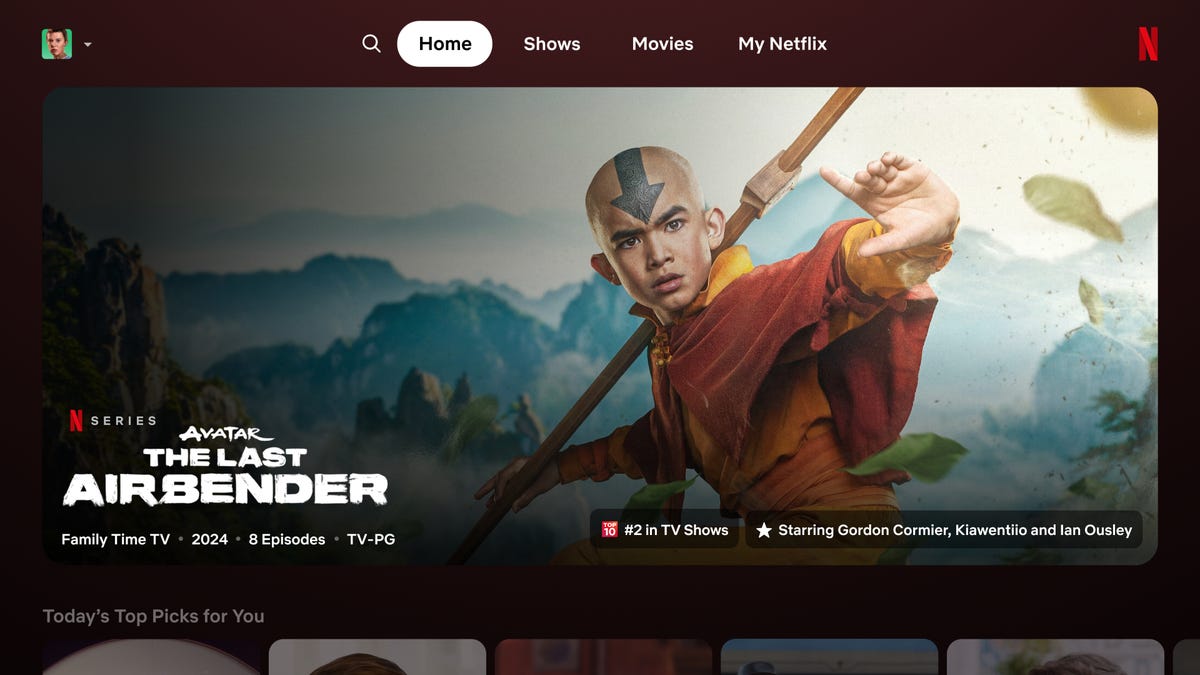
The first thing you’ll probably notice is that the redesign of the TV app removes the left-most vertical menu. In its place is a smaller, horizontal menu along the top of the app with streamlined options including “Home,” “Shows,” “Movies,” and “My Netflix.” That latter tab was first added to the mobile app version, and now it’s on TV as well. If you hit the back button on your remote, you should immediately return to the top menu bar. Gone are tabs like “New and Popular” and “My List.” The “Categories” menu is still there, but you’ll now have to find it in the Search function.

Netflix’s New TV App in Full

New TV Home Sizzle_English

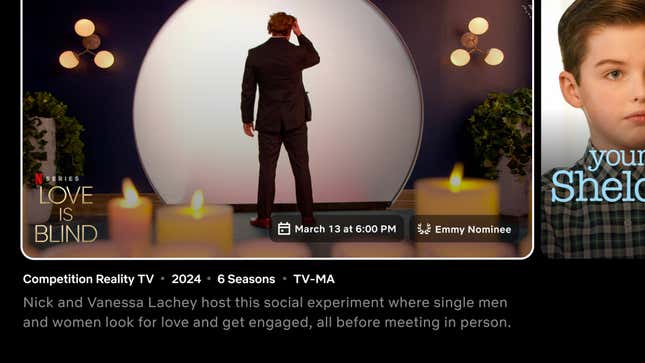
The bigger changes are evident once you hover over the individual tiles. Hang on each tile for a beat, and it will start playing a clip from the show or movie while offering users a text description along with more info, like the total runtime. Otherwise, Netflix will still push the algorithmically suggested “discover” content front-and-center on the Home tab. Shows and Movies will also offer that discover content based on what you or if Netflix knows what your friends like to watch.

Netflix’s senior director of product experience, Pat Flemming, told Gizmodo the streamer wants to make navigating around the app far easier and cleaner. He said that in Netflix’s product research, they found users were doing “gymnastics with their eyes,” where they had to look all around their screen for each show or movie’s description, trailer, ratings, and so on. That should all be far more contained in each tile.

“When you’re evaluating that particular movie, series, or game in the future, you’ve got all that information there in front of you,” he said.

The “New and Hot” tab will still appear in the mobile app, but Netflix hopes the new version will simplify things enough that it can cater to folks who have no idea what they’re about to watch each night. Face it, how often did you think you should check the “New and Popular” menu anyway?

It’s fair to say that quite a bit has changed since a decade ago when Netflix was still mainly distributing other companies’ movies and shows. Yes, it’s definitely more expensive than in years past, but that’s not all. Netflix is still working to grab hit movies like the recently added Godzilla: Minus One and 1917. Netflix has a lot more original content, like the slow-burn horror The Watchers and the sci-fi adaptation of 3 Body Problem. Original content now makes up more than half of the streamer’s total slate.

Image for article titled Here's What Netflix's First Big Redesign in a Decade Looks Like

Image: Netflix

But it’s more than that now. Netflix is trying to go big into live sports with some pseudo-live sports events, WWE streaming, and the just-postponed big-name brawl between Mike Tyson and Jake Paul. And let’s not forget there are a few pretty good games on Netflix. While the number of TV titles in the ongoing beta program is currently limited, it makes up a growing section of Netflix’s current expansion plans. Will Netflix eventually add more tabs like “Sports” and “Games” to the top bar to go along with “Shows” and “Movies?” That’s “TBD,” Flemming said, though he said, “you’re thinking about it in a very intuitive way.”

The new app version is being tested by a select few subscribers who will offer feedback before Netflix thinks about pushing the update more broadly. As for whether this bodes more changes to the mobile or web versions, Flemming wasn’t ready to say yes or no. After all, first, we’ll need all the other streaming services to copy Netflix one more time before anybody starts trying to reinvent the wheel yet again.

Google Wants to Show You More YouTube Ads When You Pause Videos


Image for article titled Google Wants to Show You More YouTube Ads When You Pause Videos

Image: PixieMe (Shutterstock)

If you already hate ads on YouTube, then you’re going to have a bad time with Pause Ads. During its earnings calls on Thursday, Google crowed about the success of the tests it’s run on the ads, which could indicate the “feature” will roll out to even more watchers.

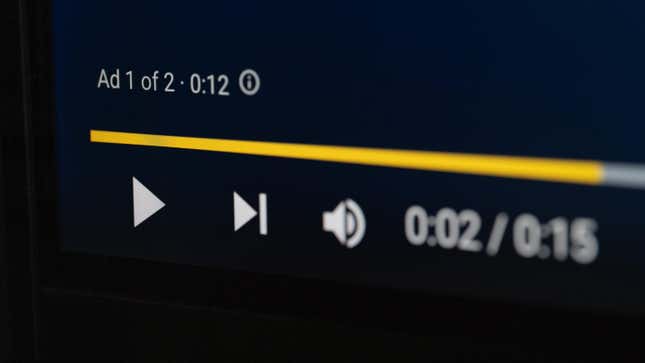
As the name implies, Pause Ads are unskippable advertisements that play when you hit pause on a video. Google is trialing Pause Ads on TVs playing YouTube videos, and according to yesterday’s call, the company is happy with the results.

“In Q1, we saw strong traction from the introduction of a Pause Ads pilot on connected TVs, a new non-interruptive ad format that appears when users pause their organic content,” Philipp Schindler, senior vice president and chief business officer at Google, said in Thursday’s earnings call. “Initial results show that Pause ads are driving strong Brand Lift results and are commanding premium pricing from advertisers.”

Schindler didn’t say if Pause Ads will roll out to more YouTube users or if these unwanted advertisements will find their way to smaller screens like phones and desktops. YouTube first highlighted the feature last year in its Upfronts post saying how these ads were a great opportunity for brands to “drive awareness or action by owning that unique interactive moment when people pause a video.”

It’s no surprise that YouTube wants people to watch more of their ads because that’s where it gets a lot of its money. That and people who pay for YouTube Premium because they’re sick of the ads.

The video platform has been cracking down on ad blockers for the past year. This move appears to be helping Google’s bottom line as the company said in its earnings call that YouTube Ads revenue was up 21% over the same time last year.

Instagram, WhatsApp, and Facebook Suffer Service Disruptions Reported Worldwide


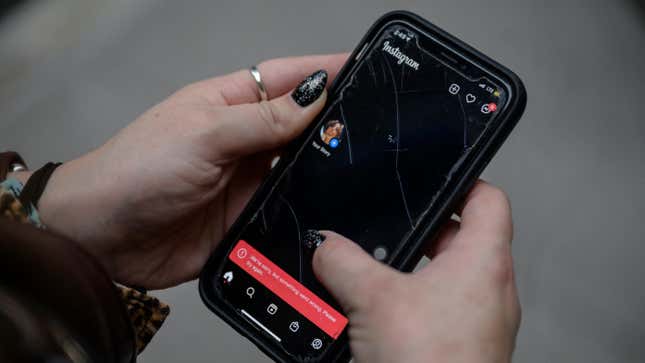
File photo of a woman checking her phone during an Instagram outage in 2021.

File photo of a woman checking her phone during an Instagram outage in 2021.
Photo: Ed Jones (Getty Images)

Meta platforms Facebook, WhatsApp, and Instagram are experiencing a global outage with thousands of reports of the app not working properly since roughly 2 p.m. ET Wednesday.WhatsApp appears to have gone down first, with Instagram and Facebook following suit about 30 minutes later.

Image and media uploads appear to be struggling the most on the platforms, according to internet monitoring service Netblocks, which also notes there are no indications of “country-level internet disruptions or filtering.”

Social media apps have experienced a number of notable outages in recent months, with LinkedIn struggling last month just days after Facebook and Instagram went down for hours.

It appears that some users on WhatsApp are still able to send messages right now, but those messages aren’t being delivered, according to the Verge.

Some X users celebrated as news of Meta’s platforms struggling spread on Wednesday afternoon.

Meta didn’t immediately respond to questions emailed on Wednesday, but the official X account for WhatsApp tweeted, “We know some people are experiencing issues right now, we’re working on getting things back to 100% for everyone as quickly as possible.” Gizmodo will update this post if we hear back.