How Parametric Design in CAD is Transforming Architectural Modeling Design Practices


In case you haven’t noticed, more and more architectural designers use parametric design in CAD to transform their architectural projects. Parametric design has become more important and prevalent in building design and construction. It’s even considered one of the most significant advancements the architectural industry has seen that can change how architecture works.

Read on to learn how parametric design in CAD is transforming architectural modeling design practices:

What is parametric design?

Parametric design refers to the design process that uses geometric and programming operations and data inputs to establish design outputs. To better understand parametric design, there are a few things you need to know. These include parameters and data, programming concepts and syntax such as functions, loops, conditionals, and data structures, as well as the tools and software you can use to get started.

The best and easiest way to understand the parametric design programming concept is to envision what you will do when baking a cake. You have the inputs, which are the ingredients you must process every step of the way. Once you’ve met certain conditions, whether you’ve reached a particular temperature or a certain amount of time has passed, you will get a cake, your output.

How parametric design transforms practices of 3D architectural modeling design

Here are some of the top reasons why parametric design is seeing increased relevance in the field of 3D architectural modeling design services:

Keep up with the data-centric world

The modern world has become more data-centric, giving architectural designers access to different types of data available. The latest systems and technologies allow measuring everything quantifiable, such as 3D web maps or photogrammetry, sensors, big data, passenger ridership data, and climatic datasets.

With the sheer scale of data sets popping up together with new technology enablers like computing, generative design, and machine learning, it’s safe to anticipate making better design designs derived from relatable data. The data will become new constraints, allowing the setting of specific parameters and criteria to govern the designs.

With more parameters to issues with the design, it becomes possible to set more practical constraints to output different surprising solutions. These constraints include plot ratio, site plan setbacks, building layout, height constraints, computational fluid dynamics, daylighting, and façade design.

parametric1

Various solutions for more informed design decisions

With the help of the parametric design process, architects can make more informed design decisions using a series of defined conditions, lowering the cost and time required to analyze or ideate ideas for the design.

The solution can be ranked and analyzed with the help of parametric design. It also allows easy tweaking of every solution for further analysis. This forms a convergence to a better solution down the line and exposure to massive precedent datasets. It creates a transparent methodology of design toward an agreed selection of solutions.

Enhanced functionality and aesthetics

The parametric design provides robust tools that can help solve and address structural, material, wise, and visual architectural concerns. This also instills an entirely functional process with the architectural designer’s aesthetic vision.

Architects often have distinct aesthetic aims, with their designs solving contextual and functional problems. Parametric design blends function and aesthetics so the two can’t be separated during the design process. With technological advancements, you can see and feel their impact in almost all aspects of the building and construction industry. The design process largely depends on digital methods, and changes in project management also evolve. This kind of revolution affects the aesthetics of buildings, giving more freedom of form from the automated manufacturing methods.

Also equally significant is how it enhances the overall functionality and quality of the design. With the different solutions for managing and optimizing complex concerns, it’s easy to assume that there will also be improvements in building contextualization and use.

RELATED: Learn About Architectural Design Fee Schedules, Rates, and Pricing for Architect Firms’ Costs

The third industrial revolution is brought to architecture

As parametric design enters the world of architecture, practice, and theory, start to change. The third industrial revolution is an era of mass customization, computation, and robotics. Architects must learn to adapt to existing changes, digital processes, new programming languages, and more in a profession that involves developing physical end products. Parametric design is the direct result of the field of architecture going through the changes that the third industrial revolution brought about.

Computation as the critical design tool

Architectural designs are prone to changes as they keep up with trends. Parametric design, however, can be regarded as a set of methods and tools that can help develop high-quality buildings suitable for modern society. When discussing these tools, you must be familiar with the differences in what makes these possible.

Two terms, in particular, require distinction: computation and computerization. Computerization is about turning designs into digital formats, such as drawing a building’s 3D model. Meanwhile, computation is a mathematical and algorithmic process that a computer uses. This is precisely what parametric design is all about.

Adaptation of architecture to build smart cities

With the help of parametric and computation, architectural design teams can shift their attention from specific neighborhoods or structures to entire cities. As parametric design technology improves, building cities as individual systems is possible.

parametric2

More straightforward data management

Parametric architecture has virtually no limits regarding what it can do. Traditional tasks that used to be completed in months can be finished in a snap of a finger these days. An excellent example of parametric design is used for designing an office building. The first step is typically identifying client requests. Designers will then have to ensure that the requests will fit natural laws or laws affecting the durability of a building.

But with the help of the AI or artificial intelligence system, designers only need to inset initial parameters, with the computer doing the rest of the work. Parametrics acts as the programming language for architects. As they add data and input specific parameters, a set of unseen new forms pop up. Developing various outputs with new and old data will only take seconds.

The same rule applies to developing enhanced new tools based on the designer’s needs. For instance, it now just takes a few minutes to test how many daylight hours there are at any given time when designing a building for a city that often gets cloudy weather.

Accommodating complexity management

Parametrics and computation work hand in hand to help architectural designers better handle complex problems. These processes are all integrated into the work of the architect. Parametric architects deal with parameters from the user interface, site context, programs, material technologies, manufacturing, and environmental factors. They continue to push the boundaries of how modern technology can help them, and as a result, architecture also improves.

RELATED: Architectural VR/AR 3D Rendering Costs, Rates & 3D Modeling Pricing for Design Firms

Replace classical modernism

Modernism represents an ideology that depends on homogeneity, standardization, mass production, and universalism. Parametric design, on the other hand, is heterogeneous, mass-customized, highly adaptive, and contextual. These theories have a fundamental difference between them, and the main goal for architecture students is to alter how they think about and look at designs.

Professors often introduce their students to parametric design using simple parameters within their projects. Designs emerge from significant variables, materials, and methods. However, a designer with a background in modernism will have a more challenging time replicating this way of work.

Thankfully, with the help of more enhanced tools for visual coding, designers can now deal with more adaptive and complex experiences. The main shift for the parametric design expert is between new and old ways of thinking.

parametric3

Types of parametric design

Building layout

The planned space layout within a building is based on program or circulation proximity according to the user’s preferences in a survey. It can be used as input into the generative design system to develop different options for implementation and evaluation.

Façade design

The Siemens Middle East Headquarters in Abu Dhabi, UA, is an excellent example of parametric design in façade design. The façade perforation design was according to the building’s orientation and daylighting requirements of the spaces.

Site plan scale

Site plan scale uses generative design to develop 3D site layout design or massing iterations, incorporating 3D architectural site plan rendering services based on plot ratio, setbacks, and site boundary.

How Cad Crowd can help

With modern technologies finding their way into various industries, architecture is expected to follow suit soon. Cad Crowd can help you find parametric design experts who can help transform your next 3D architectural modeling design project. These parametric modeling experts will simplify the CAD process so you can quickly get the desired results.

Benefits, Types, Tools and More


Editor’s note: Is cloud-based data analytics a viable option for your business? To help you answer this question, Maryna dwells on what cloud analytics is and its benefits and shares a list of best tools for data analysis in the cloud according to ScienceSoft. And if you need assistance in enabling your cloud data analytics, feel free to resort to ScienceSoft’s data analytics consulting services.

The size of the global cloud-based business analytics software market is expected to reach $57.055 million by 2023, as more and more companies start to acknowledge that the cloud is the best place to run enterprise-scale analytics. As a BI consultant, I see many reasons why cloud analysis is beneficial for companies nowadays, so let me explain the essence of cloud analytics and share these reasons with you.

Cloud analytics and its types

types of cloud analytics deployment types

With cloud analytics, data analysis and the related processes (data integration, aggregation, storage, and reporting) are fully or partially conducted in the cloud.

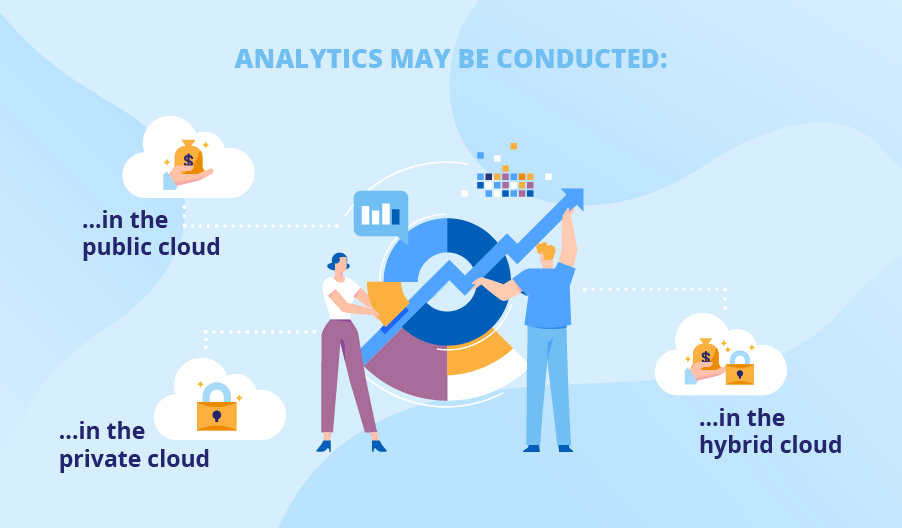
Based on the cloud environment, where data analysis is performed, you can define three types of cloud analytics. All of them offer such advantages as the absence of hardware-related costs, scalability, and high fault tolerance, so your choice will depend on your budget, business and compliance needs:

  • Analytics conducted in the public cloud

Public cloud is the cheapest way to conduct cloud analysis, as infrastructure costs are split among cloud tenants. I recommend you to use a public cloud to handle big data workloads, store huge data sets, and leverage such innovative technologies as machine learning, artificial intelligence, etc.

  • Analytics conducted in the private cloud

In case you seek enhanced control over the IT infrastructure to meet your data compliance or data security objectives, you can opt for private cloud analytics. To allow meeting such particular needs, a private cloud is physically located either at your own data center or at a cloud provider’s site with hardware and software dedicated to your company solely. Naturally, this option is the most expensive one.

  • Analytics conducted in the hybrid cloud

If you cannot afford data analysis fully conducted in the private cloud but still need to meet your data regulatory requirements (HIPAA, GDPR, GLBA, etc.), a hybrid cloud for data analysis will satisfy your demand. By keeping some parts of an analytics solution (for example, a storage of sensitive data) in the private cloud and the rest in the public cloud, you can significantly reduce analytics costs due to cloud computing while staying compliant with internal and external regulations.

The benefits that’ll make you stay in the cloud

cloud analytics benefits

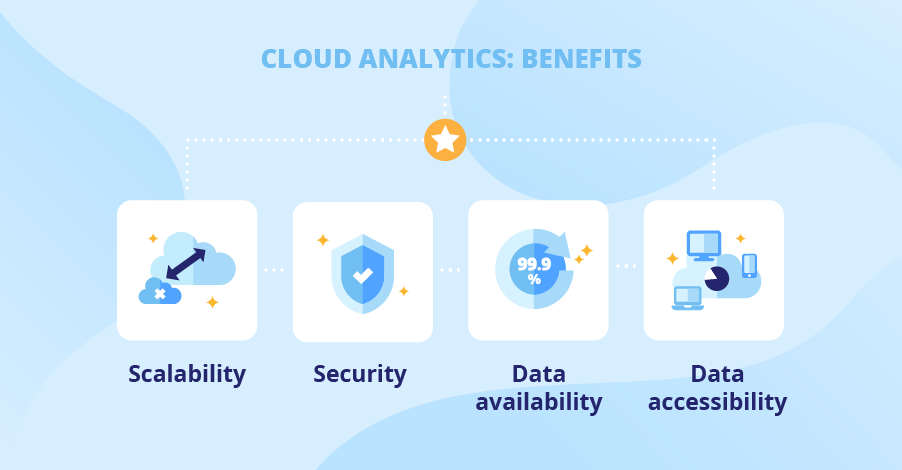
Scalability

The cloud deployment allows you to easily meet your demand in upscaling by simply buying storage and compute resources from the cloud provider whenever you need them. It is a great advantage over hosting your analytics solution on-premises, which implies an expensive upgrade of the existing IT infrastructure in case of demand in additional storage capacity.

Security

Usually, security concerns are the main deterrent for companies to deploy analysis in the cloud. However, I can assure you that such fears are void. These days, leading cloud providers (Microsoft Azure, AWS, Google Cloud Platform) apply advanced security measures to ensure high security level in the cloud. As for security measures that you can take, I advise you to fortify your analytics solution with data encryption, set up admin control, and conduct regular vulnerability assessment and penetration testing.

Data availability

Leading cloud providers guarantee 99.999% of service availability. With high-availability and fault-tolerant systems set up in the cloud, there is near-zero possibility of your analytics solution disruption even in case of unplanned downtimes due to power outages, natural disasters, etc.

Data accessibility

A web-based nature of your data analysis allows delivering insights to any device connected to the internet for you to benefit from them from anywhere and at any time. Additionally, cloud deployment contributes to increased collaboration among colleagues, who can share and view analytics results across a cloud-based analytics platform with the help of self-service software.

Don’t Let Your Company Lose Cloud Benefits!

ScienceSoft’s experts are ready to set up and tune your data analysis in the cloud to help you make the most of your data to gain a competitive advantage.

ScienceSoft’s top 5 of cloud analytics tools

At ScienceSoft, we are sure that cloud analytics software has to connect to multiple data sources, have ample data preparation and visualization capabilities, support advanced analytics, be easily manageable, secure, and much more. So, with these characteristics taken into account, we’ve chosen the top 5 cloud data analytics tools:

Services: Power BI Pro, Power BI Premium, Power BI Mobile, Power BI Embedded, Power BI Report Server.

Key features: Content packs of pre-built dashboards and reports, natural language processing, custom visualization, secure data governance, embedded analytics and collaboration, integration with Microsoft Azure Stream Analytics, support of 5 languages (DAX, Power Query, SQL, R, Python), etc.

Pricing: Power BI Mobile – free, Power BI Pro – $9.99/user/month, Power BI Premium – starting from 4,995/dedicated resources/month.

Demo: Power BI 

Services: Tableau Prep, Tableau Server, Tableau Online, Tableau Data Management, Tableau Server Management, Tableau Mobile, Embedded Analytics.

Key features: Unlimited data connectors, augmented data preparation, real-time access, natural language processing, time series analysis, role-based permissions, embedded dashboards, secure collaboration, etc.

Pricing: Tableau Creator – $70/user/month, Tableau Explorer – $35 or $42/user/month (depending on the deployment model), Tableau Viewer – $15/user/month.

  • Oracle Analytics Cloud (OAC)

Services: Data Visualization Cloud Service, Data Visualization in OAC (any edition), Business Intelligence Cloud Service, Business Intelligence in OAC (Enterprise Edition), Mobile apps Day by Day and Synopsis.

Key features: Self-service data discovery; augmented analytics; natural language processing; analytics dashboards; mobile exploration; integrated data preparation, collaboration, and publishing; governed enterprise analytics; embedded analytics, etc.

Pricing: Pricing is not publicly available.

Services: IBM Cognos Framework Manager, IBM Cognos Cube Designer, IBM Cognos Transformer.

Key features: Built-in data management and data governance features, automated data modeling, natural language-powered AI, etc.

Pricing: On Demand Plan: Standard user – $15/user/month, Plus user – $35/user/month, Premium user – $70/user/month.

Services: Qlik Sense, QlikView, Qlik Analytics Platform

Key Features: Built-in data preparation and integration, drag-and-drop visualizations, smart search feature, real-time analytics and reporting, data storytelling functionality, secure real-time collaboration, etc.

Pricing: Qlik Sense Business – $30/user/month, Qlik Sense Enterprise: Professional User – $70/user/month, Analyzer User – $40/ user/month.

Make the most of your data with cloud analytics!

As data volumes are growing exponentially, I believe that the cloud is the future of data analytics. Cloud analytics implies a quicker time to value, agility, and the pervasive use of analytics across your company, meaning more employees make timely data-driven decisions, which is a vital component of a company’s success.

With all that, deploying and conducting cloud analytics still requires dedicated efforts – starting from choosing the cloud type and cloud provider to setting up and administering analytics software or choosing a reliable vendor in case of analytics as a service. So, if you feel in need of qualified assistance with building, upgrading, supporting or outsourcing your cloud analytics solution, my colleagues at ScienceSoft and me are always ready to share our hand-on data analytics expertise, just let us know.


Are you striving for informed decision-making? We will convert your historical and real-time data into actionable insights and set up forecasting.

Media coalition asks the feds to investigate Google’s removal of California news links


The News/Media Alliance, formerly the Newspaper Association of America, asked US federal agencies to investigate Google’s removal of links to California news media outlets. Google’s tactic is in response to the proposed California Journalism Preservation Act (CJPA), which would require it and other tech companies to pay for links to California-based publishers’ news content.

The News/Media Alliance, which represents over 2,200 publishers, sent letters to the Department of Justice, Federal Trade Commission and California State Attorney General on Tuesday. It says the removal “appears to be either coercive or retaliatory, driven by Google’s opposition to a pending legislative measure in Sacramento.”

The CJPA would require Google and other tech platforms to pay California media outlets in exchange for links. The proposed bill passed the state Assembly last year.

In a blog post last week announcing the removal, Google VP of Global News Partnerships Jaffer Zaidi warned that the CJPA is “the wrong approach to supporting journalism” (because Google’s current approach totally hasn’t left the industry in smoldering ruins!). Zaidi said the CJPA “would also put small publishers at a disadvantage and limit consumers’ access to a diverse local media ecosystem.” Nothing to see here, folks: just your friendly neighborhood multi-trillion-dollar company looking out for the little guy!

Google described its link removal as a test to see how the bill would impact its platform:

“To prepare for possible CJPA implications, we are beginning a short-term test for a small percentage of California users,” Zaidi wrote. “The testing process involves removing links to California news websites, potentially covered by CJPA, to measure the impact of the legislation on our product experience. Until there’s clarity on California’s regulatory environment, we’re also pausing further investments in the California news ecosystem, including new partnerships through Google News Showcase, our product and licensing program for news organizations, and planned expansions of the Google News Initiative.”

In its letters, The News/Media Alliance lists several laws it believes Google may be breaking with the “short-term” removal. Potential federal violations include the Lanham Act, the Sherman Antitrust Act and the Federal Trade Commission Act. The letter to California’s AG cites the state’s Unruh Civil Rights Act, regulations against false advertising and misrepresentation, the California Consumer Privacy Act and California’s Unfair Competition Law (UCL).

“Importantly, Google released no further details on how many Californians will be affected, how the Californians who will be denied news access were chosen, what publications will be affected, how long the compelled news blackouts will persist, and whether access will be blocked entirely or just to content Google particularly disfavors,” News/Media Alliance President / CEO Danielle Coffey wrote in the letter to the DOJ and FTC. “Because of these unknowns, there are many ways Google’s unilateral decision to turn off access to news websites for Californians could violate laws.”

Google has a mixed track record in dealing with similar legislation. It pulled Google News from Spain for seven years in response to local copyright laws that would have required licensing fees to publishers. However, it signed deals worth around $150 million to pay Australian publishers and retreated from threats to pull news from search results in Canada, instead spending the $74 million required by the Online News Act.

Google made more than $73 billion in profits in 2023. The company currently has a $1.94 trillion market cap.

Ask the Videoguys – NETGEAR AV Switches, LiveU 4 Modem Kit, Software v


In the latest installment of Ask the Videoguys, James guides you through essential considerations for selecting the ideal NETGEAR Switch to suit your needs, dives into the benefits of the LiveU 4 Modem Kit, weighs the pros and cons of Software versus Turnkey Solutions, and shares captivating highlights from NAB 2024 in this informative webinar. Whether you’re seeking networking solutions, remote broadcasting tools, or insights into the latest industry trends, this session is packed with valuable information to enhance your video production endeavors. Join us as we unravel the complexities and explore the exciting innovations shaping the landscape of video technology.

Watch the full video below:


Which NETGEAR Switch is Right for Me?​

M4250 Managed Switches
The AV Line of M4250 switches are built for 1G AV over IP installations and designed for a clean integration with traditional rack-mounted AV equipment.

M4300 Managed Switches
NETGEAR’s M4300 Series of 1G and 10G fully managed switches are designed for any AV over IP installation. A broad range of sizes and capabilities are available to fit any application.

​M4350 Managed Switches​
The M4350 Series of 1 Gigabit to 100 Gigabit fully managed switches provides an edge to core stackable platform for any AV over IP installation. Redundant modular power supplies on select models contribute to business continuity management.​

Terms to Learn

PoE (Power Over Ethernet)

  • PoE – 15.4 Watts
  • PoE+ – 30 Watts
  • PoE++ (Ultra) – 60-100 Watts depending on version type

TPD (Total Power Delivery)

  • The maximum amount of power a switch can deliver
  • A PoE+ switch with 60 watts TPD can only power 2 PoE+ cameras no matter how many ports it has

SFP (Small Form-Factor Pluggable Transceiver)

  • Commonly used for Optical Network Connection, can be Copper
  • Allows for Port Flexibility
  • SFP – Operates @ 1Gbps
  • SFP+ – Operates @ 10Gbps

Do I Need the LiveU 4 Modem Kit?

Step 1: Buy the LiveU Solo Pro

  • 4K Video Resolution – up to 4Kp60 full video resolution
  • HEVC Encoding – Up to 20Mbps streaming
  • Supports up to 4 external modems
  • 5G support as modems become available

Step 2: Add the Modems – Solo PRO Connect 4 Modem Kit

  • 4x LU Net 4G Modems
  • 4x Sims U.S. version 
  • LiveU Solo PRO Belt Pack
  • 2x Y Cables
  • HDMI Extension Cable
  • HDMI Tension Clip
  • Getting started card
  • LiveU Solo PRO (HDMI/SDI) Encoder must be purchased separately

Step 3: Activate the LiveU Solo Pro and Solo Connect

Modem kit

Number of Sims

Kit Cost

LRT

North America plan

Traveler

Solo PRO Connect 2 Modem

2 Sims

$450

​Y

$295/Month

$520/Month

Solo Pro Connect 4 Modem Kit Bundle with Cables & Belt Pack

4 Sims

$995

​Y

$435/Month

$750/Month


Should I Livestream with Software or get a Turnkey Production System?

Advantages of Using Production Software:

  • Flexibility: Software like OBS and Wirecast allows for a high degree of customization and flexibility in your setup
  • Cost-Effectiveness: Generally, software solutions are less expensive than hardware solutions
  • Ease of Updates: Software can be easily updated with new features and improvements
  • Multifunctionality: Many software options include features for mixing multiple sources, adding graphics, text overlays, and encoding for different formats
  • Portability: Software can be used on different computers, making your setup portable

Advantages of Using a Turnkey Production System:

  • Reliability: Turnkey systems like TriCaster are designed for stability and reliability during live events
  • Professional Quality: They often include professional-grade hardware and software for high-quality production
  • Ease of Use: Turnkey systems are generally easier to set up and use, with less technical knowledge required
  • Integrated Workflow: Everything you need is included, which can streamline the production process
  • Support: Turnkey systems often come with professional support and training

​Is There Any Big News Coming from NAB?


Yes! Stay tuned next Tuesday Gary will do a full NAB 2024 Recap!


Specials from Videoguys

Link against a Visual Studio executable project, for unit testing, with C++ modules?


Microsoft docs here describe how you can, in Visual Studio, create a unit test project and connect it to an executable project, in order to unit test the code in that executable project.

My problem is that I’m trying to use C++20 modules and the instructions don’t seem to work. In my test project I have:

import std;
import test_kit;     // My unit testing framework.
import my.app.foo;   // This module is in the executable project that I want to test.

I get an error: C2230 could not find module 'my.app.foo'.

Following the documentation linked above, I added to the “Additional Library Directories” and “Additional Dependencies” under the Linker properties for the test project. This points to the build directory for the app project, and lists the .obj file containing code I want to test (Foo.ixx.obj). I also tried adding to the “Additional BMI Directories” (same build directory) and “Additional Module Dependencies”. In the latter I listed the file Foo.ixx.ifc which I’m thinking will contain the BMI for the module I’m trying to test.

Is there something else I can do to get rid of that error?

NASA’s JPL Bids Farewell to Ingenuity Mars Helicopter With Final Data Downlink


NASA’s Jet Propulsion Laboratory (JPL) announced earlier this year that the incredible Mars helicopter was grounded for good after it suffered damage to its rotor blades. Although it cannot fly, the robot is still online, and the Ingenuity team has gathered to see it off as they initiated what may be the last data transmission. This marked the final time the team would work together to support the history-making aircraft.

JPL designed Ingenuity as a short-term technology demonstration that would ride to Mars with the Perseverance rover. When we talked to JPL’s Adam Steltzner, he was adamant that the team did not expect Ingenuity to survive its first Martian winter, but it lasted over 1,000 Martian days and completed 72 flights. JPL was targeting just five flights in 30 days. The vehicle’s amazing performance allowed the team to use it as a scout for Perseverance while also learning more about the mechanics of powered flight on Mars.

Ingenuity is designed from mostly off-the-shelf components, including a Qualcomm Snapdragon 801 smartphone processor. It doesn’t have enough power to beam data back to Earth, so it relays data to Perseverance first. The rover still has a lot of mission ahead of it and needs to move on. Before Perseverance left communication range, the team gathered for the last data downlink on April 16. This allowed them to get the helicopter’s remaining data and check that its new software was working correctly.

The team sent a software update to Ingenuity after realizing that it would never fly again. It is now being set up as a stationary sensor platform that will collect data every day until it breaks down. “It is almost unbelievable that after over 1,000 Martian days on the surface, 72 flights, and one rough landing, she still has something to give,” said Ingenuity team lead Josh Anderson.

JPL reports the new software is working as intended. Each day, Ingenuity will wake up, collect diagnostic data, take a photo of the surface, check the air temperature, and then go back to sleep. It won’t be able to transmit this data to Earth as Perseverance will be out of range. Still, the team hopes that a future mission to the Valinor Hills region will be able to recover the helicopter and harvest its data. JPL estimates Ingenuity should have room for 20 years of daily check-ins. However, the vehicle’s solar panels or batteries will probably fail long before that.

Final Ingenuity photo


Credit: NASA / JPL-Caltech

Before Perseverance heads toward the western limb of Jezero Crater, it snapped an image of Ingenuity—possibly the last one ever. The photo (above) shows Ingenuity perched atop dunes on the far right edge. Just left of center, you can see fragments of its rotor lost during the hard landing in January. This will be Ingenuity’s final resting place now that the mission is well and truly over, but this little experiment may have changed how we explore other worlds during its time zipping around the Martian skies.

Get in the Game with Dick’s Sporting Goods


Are you ready to get in the work-from-home game? The Arise® Platform has an exciting opportunity available with the nation’s largest sporting goods retailer – Dick’s Sporting Goods!

Score big and become your own boss once and for all by providing customer sales and customer service support for the Dick’s Sporting Goods client program. Even better? Earn extra income with flexible work hours—leaving you time to play ball with family and friends in-between.

Win Big with the Arise® Platform and Dick’s Sporting Goods

 Started in 1948 by 18-year-old Richard “Dick” Stack with just $300 borrowed from his grandmother, Dick’s family continues to offer the finest quality products at competitive prices, supported by associates with a passion for sports. Dick’s Sporting Goods also owns and operates Golf Galaxy®, Field and Stream®, and DICK’s Team Sports HQ. Dick’s Sporting Goods serves and inspires athletes and outdoor enthusiasts to achieve their personal best through a blend of dedicated associates, in-store services, and unique specialty shop-in-shops dedicated to team sports, athletic apparel, golf, lodge/outdoor, fitness, and footwear.

But make no mistake — you don’t have to be a sports fan to succeed with this opportunity.

As a business using the Arise® Platform, all you need is the dedication and drive to provide the best customer service experience to customers. At the same time, you’ll have the freedom and flexibility to choose when you want to work from home. You’ll have the power to determine how much money you want to make by choosing how many hours you work each day. Say goodbye to the days where you were told what to do and when to do it! With the Arise® Platform, you’re in complete control.

Here’s How It Works

Signing up for this client means you’ll handle various customer support questions and concerns, such as:

  • Assisting customers with product questions
  • Placing new orders/volume orders
  • Handling existing orders, including returns/replacements
  • Providing store-specific support
  • Tracking shipments
  • Gift card/loyalty card support
  • Dispositioning calls

With each request, you’ll empower and partner with the customer, and personalize the experience. The key to success is to demonstrate a customer-obsessed attitude and do whatever is takes to ensure total customer resolution.

How to Achieve Victory with Dick’s Sporting Goods

 Not sure if this client opportunity is right for you? Check out the skills you need to succeed: 

  • Fluent in English – both written and spoken
  • Ability to deal with challenging customers and situations
  • Problem-solving capabilities to deliver practical solutions
  • Expertly navigate the internet and demonstrate a working knowledge of Microsoft Office programs such as Outlook, Excel, and Word
  • Type 25+ words per minute
  • Demonstrate a working knowledge of a variety of sports and outdoor activities

 When Can I Start Working and How Much Can I Earn?

 That’s entirely up to you. Working from home with the Arise® Platform allows you to control your earning potential based on the frequency you work and the results you produce. This work-from-home opportunity will give you infinite flexibility as you provide excellent customer service support on behalf of the client.

 In addition, the Arise® Platform provides the technology infrastructure, support, and client opportunities. All you need to do is determine when you can work and ensure you have the right system and equipment.

Think of it this way: As a business owner, you will determine your own schedule (in ½ hour increments), supporting this client program on the days and during the hours that work best for you and your family.

Are You Ready to Make Your Work-From-Home Dreams Come True?

 The time is now: Choose your team. Choose Dick’s Sporting Goods! This exciting client opportunity is your chance to transition into working from home.

The Arise® Platform connects small businesses run by people like you to well-known brands –– such as this grocery and retail delivery and pick-up client –– through a virtual platform. The best part? You get to work from home the whole time.

Join the growing number of people who are working from home and keep your income flowing by providing customer support to Dick’s Sporting Goods!

Sign Up Today!

Smartish Wallet Slayer Vol 1 Galaxy S24 case review: Should you buy it?


Smartish Wallet Slayer Vol 1 for Samsung Galaxy S24

Smartish Wallet Slayer Vol 1 for Samsung Galaxy S24

Smartish’s Wallet Slayer Vol. 1 is an easy way to ditch your traditional wallet. It adds space to carry cards and cash on the back of your Samsung Galaxy S24 device, and the different patterns offer ways to spice up your case beyond a basic black wallet.

Smartish Wallet Slayer Vol. 1 for Samsung Galaxy S24 case review: At a glance

  • What is it? The Smartish Wallet Slayer Vol. 1 is a wallet case designed for the Samsung Galaxy S24 series. It offers users multiple card storage slots and a host of quirky patterns to spruce up your phone. The review product was supplied by Smartish.
  • What is the price? The Smartish Wallet Slayer Vol. 1 starts at $24.99.
  • Where can you buy it? The Smartish Wallet Slayer Vol. 1 case can be purchased through major retailers, including Amazon.
  • Is it worth it? The Smartish Wallet Slayer Vol. 1 case offers a unique and utilitarian alternative to a traditional wallet and, thanks to its added bulk, offers good drop protection. If you don’t mind the latter, Smartish solves two problems with its solution.

Should you buy the Smartish Wallet Slayer Vol. 1 for Samsung Galaxy S24?

smartish wallet slayer vol 1 for samsung galaxy s24 case review 5

Andy Walker / Android Authority

Searching for the ideal wallet case for your phone can be quite a task. The rear-mounted storage offers the advantage of freeing up some pocket space, yet it may mean sacrificing certain conveniences, such as wireless charging. The Wallet Slayer Vol. 1 by Smartish, while not providing a solution for the latter, impressively addresses the former. Its affordable price tag further cements its position as one of the top wallet cases for the Samsung Galaxy S24 series.

The slot design arguably makes the Smartish Wallet Slayer Vol. 1 one of the most secure phone wallets available, for better or worse.

You’ll notice this isn’t your typical slim phone case at first glance. It harks back to the days when you could insert an expanded battery directly into the back of your phone. In this instance, the noticeable bump is Smartish’s spring-loaded wallet slot, spacious enough to accommodate up to three cards and a small amount of cash.

smartish wallet slayer vol 1 for samsung galaxy s24 case review 4

Andy Walker / Android Authority

The slot design arguably makes the Smartish Wallet Slayer Vol. 1 one of the most secure phone wallets available, for better or worse. There’s no risk of your cards slipping out, but extracting them from the case might prove challenging. I found it difficult to remove a single card without dislodging all three, resulting in frequently reorganizing my wallet.

smartish wallet slayer vol 1 for samsung galaxy s24 case review 1

Andy Walker / Android Authority

Despite its larger size, the Wallet Slayer Vol. 1 is easy to grip, thanks to Smartish’s textured bumps on either side. One might worry that such a large case would appear as a bulky black object in your pocket. However, Smartish offers several vibrant color options to add a dash of personality. The classic black, or Black Tie Affair as Smartish calls it, is available alongside a forest-inspired So Serene, a galaxy-themed Spaced-Out pattern, and a spring-ready Very Cherry Blossom adorned with white cherry blossoms.

smartish wallet slayer vol 1 for samsung galaxy s24 case review 3

Andy Walker / Android Authority

Regardless of your color choice, the level of protection remains consistent. The case features air pockets in all four corners and a raised ridge next to the camera bump, providing ample protection in case of accidental drops. Considering the Wallet Slayer Vol. 1’s modest price, it offers excellent value for both protection and convenience.

Smartish Wallet Slayer Vol 1 for Samsung Galaxy S24Smartish Wallet Slayer Vol 1 for Samsung Galaxy S24
AA Recommended

Smartish Wallet Slayer Vol 1 for Samsung Galaxy S24

Card storage slots • Optional funky designs • Plenty of protection

Leave your wallet at home

The Smartish Wallet Slayer Vol. 1 combines the protective pros of a bulky phone case with the utility of a card wallet. Its unique patterns and approachable price make it an even more attractive option for those who crave a wallet-free lifestyle.

What are the best Smartish Wallet Slayer Vol. 1 alternatives?

smartish wallet slayer vol 1 for samsung galaxy s24 case review 6

Andy Walker / Android Authority

  • Snakehive Vintage Leather wallet case (£37.99 at Manufacturer site): If you prefer natural finishes, the Snakehive Vintage leather case will develop a gorgeous patina over time. It also offers three card pockets and six color variants, although it’s much pricier than the Smartish and harder to find in the US.
  • Samsung S-View wallet case ($32.27 at Amazon): As an official Samsung product, the S-View includes a slot through which you can view the time. The case also fits one card, making it slimmer but less useful than its rivals.
  • Spigen Slim Armor CS ($21.99 at Amazon): The Slim Armor CS is a rugged case that offers a sliding door design that holds two cards within its body. Despite this design, it’s an overall sim case but does have a higher list price.
  • Foluu Folio case ($12.99 at Amazon): If a budget wallet case is what you’re after, the Foluu Folio case can house three cards and additional notes, is available in three colors, and demands a minimal fee. However, it lacks the drop protection offered by Spigen and Smartish products.

AI in Science and Math: Unlocking New Possibilities


Today, AI is employed in practically every field, and the tools given by AI in science and math  are no exception. Many of today’s science and mathematics investigations create so much data that no individual or group of people could ever keep up. AI is being unleashed by researchers, most commonly in the way of neural networks that are artificial. With the advancements in artificial intelligence, the implementation of  AI in science and math is going to be bigger and more important than ever before.


AI for science drug research and discovery

  • The use of AI for science research and discoveries is one possible area of progress.

  • For example, AI can assist in expediting the development of drugs by evaluating massive volumes of scientific data and uncovering possible drug ideas that human researchers may have overlooked.

  • By studying the structures of various chemical molecules and compounds, forecasting interactions, and modeling effects of drugs in biological contexts, AI can aid in the identification of potential drugs.


Ask questions and get the relevant answers

  • AI in science and math can help students ask questions and get the correct response to them.

  • ChatGPT and Google Bard are the two recent advancements in artificial intelligence in which students can ask answers to specific questions or even ask the AI bot to frame questions to test their knowledge.

  • For example a biology student may ask ‘Define flower’ in scientific terms.

  • Answer by the AI bot could be something like this:

  • A flower is defined as a condensed modified shoot specialized in sexual reproduction in Angiosperm plants.

  • It is crucial for students to understand that whether AI in science or AI in math, students are expected to carry out their own research and not just use AI bots for getting answers.


Summaries and vital points


AI models are great for summarizing, providing bullet points, and conveying vital information.

The math or science students can give the text to be summarized, or they can ask the AI to search the information for them.


For example,


AI in science

Summarize, write all the key points and important structures of polymers in chemistry.


AI in math

Summarize the probability chapter and list of the basic probability formulae.


Data mining and pattern recognition

  • AI can analyze massive volumes of data swiftly and uncover patterns that humans may fail to see right away.

  • This is extremely useful for students, researchers, and scientists in astronomy, genetics, molecular biology,  computational geometry, and meteorology.

  • AI in math can recognize patterns in vast datasets, which is very helpful in numerical theory research.

  • It can aid mathematicians in their study of trends in mathematical sequences.


Problem solving automation


Virtual labs and simulations

  • AI-powered models and simulated labs may give students hands-on experience while also assisting them in visualizing intricate topics.

  • Students may use these tools to experiment with various scenarios and understand how science and math principles relate to real-life situations.


Bridging the gap between various academic disciplines

  • AI can help students interact and exchange information more efficiently by bridging the divide between various scientific domains and disciplines.

  • AI algorithms, for example, may be used to combine data from many technical domains such as physics, chemistry, biology, and mathematics in order to uncover new research possibilities and prospective areas of collaboration.

  • AI can assist to expedite the pace of technological breakthroughs by breaking down boundaries between academic disciplines.


Limitations of using AI in science and math


AI models do not have up-to-date information

  • AI models undergo training on data that only runs up to a specific date, which means that any novel findings and advances that occur beyond that date are completely undiscovered to the AI.

  • For example, ChatGPT’s knowledge is confined to September 2021.

  • This means that it can answer questions and has information about the events that have occurred only up to September 2021.


AI may give unnecessary (irrelevant) information

  • The use of AI in science and math may provide correct information.

  • However, many times, the information may be just too much or irrelevant.

  • For example, if a student of Grade 8 searches for information about DNA (Deoxyribonucleic Acid), the AI bot may provide excess, irrelevant information of higher grades.

  • This may make things much more complicated for the student.


AI can give incorrect responses

  • AI tools like ChatGPT will undoubtedly make mistakes because they are continually changing language models.

  • While utilizing them, it is vital to cross-verify the responses generated from reliable sources.

  • The responses may have grammatical, arithmetic, factual, and logical mistakes.

  • It is not always accurate for answering complex questions in specialized areas such as linguistics or mathematics, so keep these kinds of questions simple.

If the recent advancements in artificial intelligence are applied thoughtfully and correctly by researchers, scientists, and students, they can save valuable time and efforts. With the use of AI in science and math, novel paths of knowledge and information can be unlocked. The journey towards learning the so-called difficult subjects of science and math can be made more fun, interactive, and exciting.

Sheet Set Custom Properties in AutoCAD: Tuesday Tips With Frank | AutoCAD Blog


I often start these blogs with an anecdote, and today is no different. I imagine something similar has happened to most of you. Your project’s template file(s) have some pre-set information in the title block. The CAD manager sets the engineer’s initials as TAE, as he’s been there for twenty years and his initials are on every set that goes out. Besides, if left to individual users, you’d sometimes get TE, T.A.E., or Tae. You know it happens.

Midway through the project, old Thomas Alva Edison leaves for a new job. You get tasked with updating hundreds of drawings to reflect the new engineer’s initials. Let’s be honest: at this point, you wish you had scheduled that root canal for the day.

Wouldn’t it be great if this task was reduced to a couple of clicks? That’s where today’s topic comes in. With the proper custom properties created in your Sheet Set, that’s what you get: a fix in a couple of clicks.

Sheet Set Custom Properties

I wrote about the benefits of using the Sheet Set Manager awhile back. But I only touched on custom properties, and in all honesty, that’s one of its most powerful features.

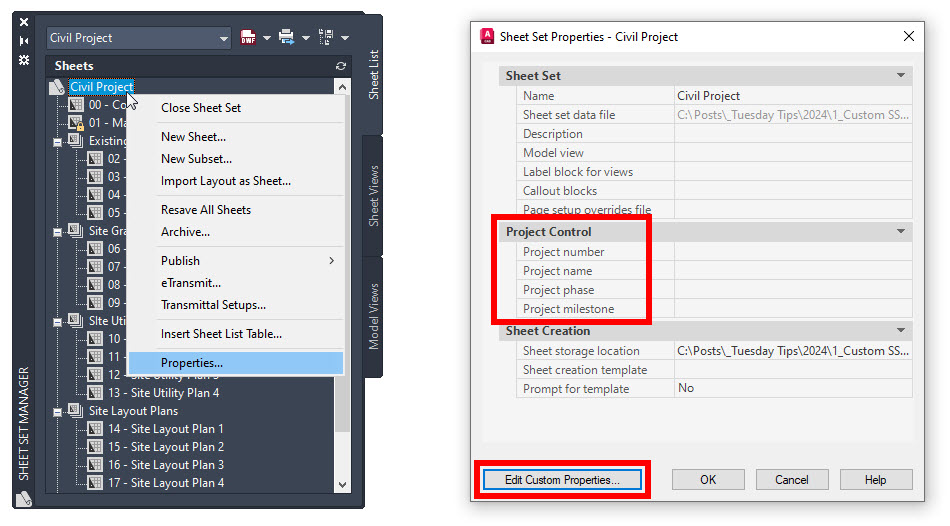
Like many things in AutoCAD, you can access the Sheet Set Properties dialog via the right-click contextual menu.

Right-clicking on anything listed in the Sheets panel will get you a Properties entry, but the only place to define custom properties is via the top-level sheet set node. When the Sheet Set Properties dialog is displayed, you’ll see the first type of property available – the four built-in Project Control properties.

OK, handy information, but somewhat limited. The real power comes from the Edit Custom Properties button at the bottom of the dialog.

Screenshot of Edit Custom Properties button for Sheet Sets in AutoCAD

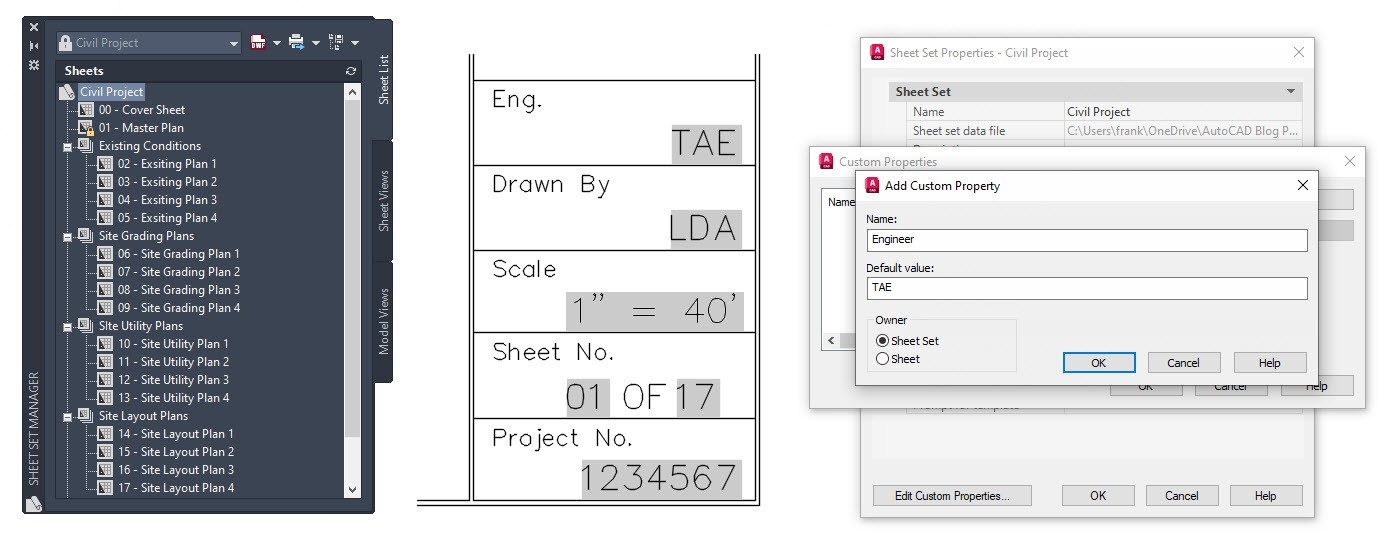
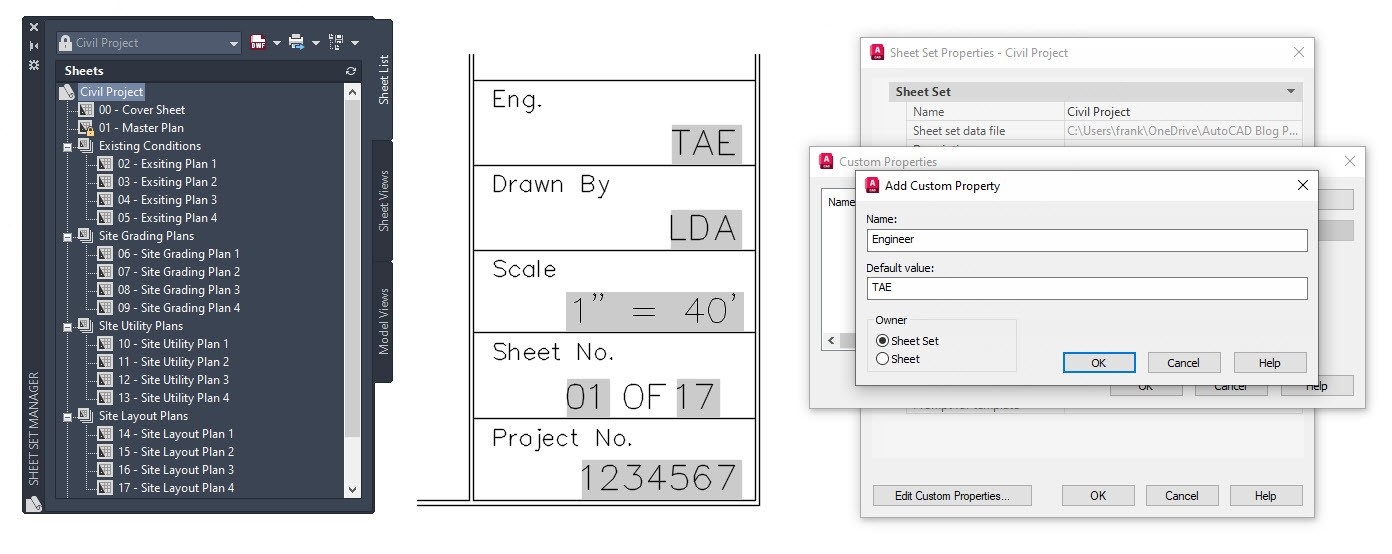
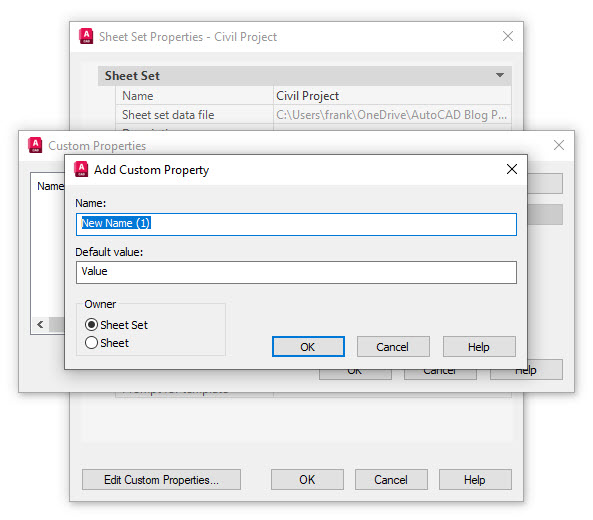
Click it to display the Custom Properties list dialog. We haven’t created any yet, so at this point, it’s empty. On the right are two buttons: Add and Delete. Choose the one that’s not disabled. You’ll finally get to the Add Custom Property dialog. It’s pretty simple; you’ll give your property a name and a default value.

But this is where you’ll also find the two other kinds of Sheet Set Properties. In the lower-left corner, you have two choices. Will this Custom Property be owned by the Sheet Set itself (a global property), or will individual sheets own it?

Screenshot of Add Custom Property button for Sheet Sets in AutoCAD

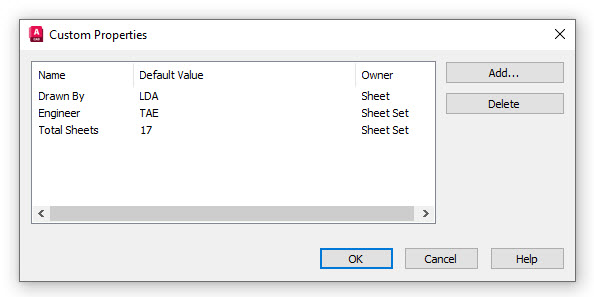
For our example, I’ll create a sheet-owned property of “Drawn By” – as that may differ from sheet to sheet. I’ll also make a couple of global sheet properties – the total number of sheets and our engineer, TAE. Since this is a tips blog, I have an insider tip for you. Notice there is no Edit button. If you’ve made a mistake, you must delete and recreate the custom property. When you’re done, keep clicking on OK to dismiss all the dialogs and save your settings.

Screenshot of Custom Property box for Sheet Sets in AutoCAD

The Next Step

OK, now you’ve got three types of properties in your Sheet Set… what’s next? Now, it’s time to map them to your title block. You’ll do this using AutoCAD’s fields. Since this isn’t a blog about fields, I’ll not spend much time deep diving into them, but if you’re curious, there are several past posts about them, including this one.

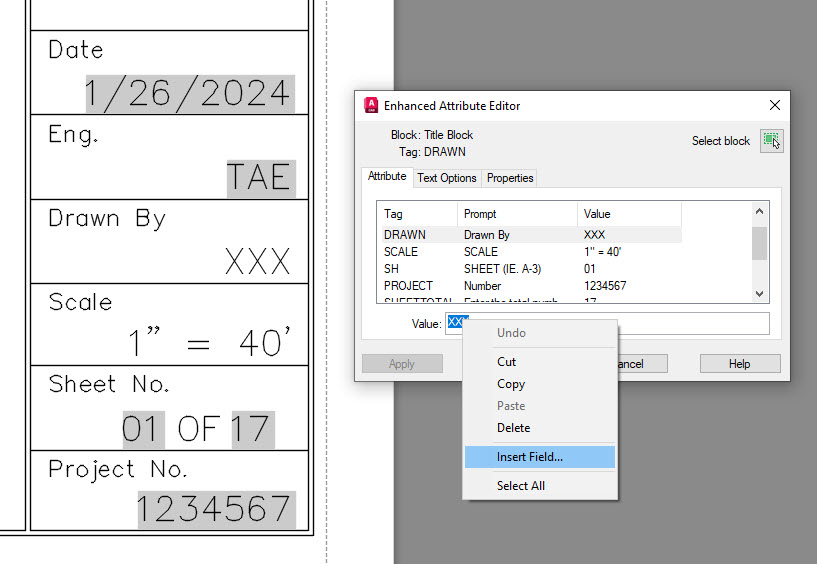
In the image below, I’ve applied the built-in project property of Project No., along with our normal engineer of TAE. Finally, the Custom Sheet Set property of Total Sheets has also been added. Let’s step through the important steps of applying our custom sheet property of Drawn By.

Screenshot of Enhanced Attribute Editor box for Sheet Sets in AutoCAD

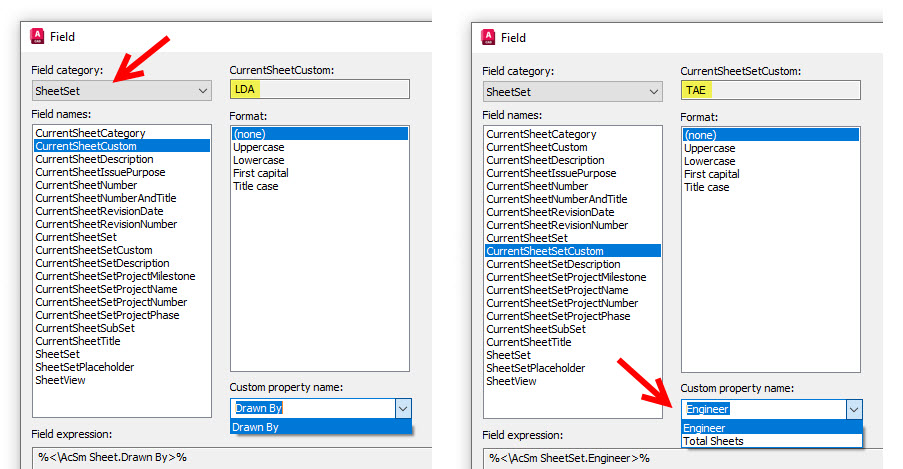
In this case, we’re dealing with block attributes, but fields can also be applied to Mtext. Again, highlight the value and right-click to display the Field dialog. The first thing you’ll want to do is select the correct field category. Expand the pulldown and select SheetSet. The panel on the left will populate with all the fields available to you from within a sheet set.

We want to add the drafter’s initials for this sheet, which we applied to a custom property owned by the sheet. Select CurrentSheetCustom (those owned by the sheet set are in CurrentSheetSetCustom); since there are possibly multiple properties, a custom name dropdown menu will appear beneath the Format panel. Choose wisely if you have more than one, note the value that appears in the upper right box, click OK, and you’re good to go.

Screenshot of choosing Custom Property in AutoCAD

Summary

Back to our engineer leaving the company scenario… by using Sheet Sets and custom properties, all you have to do is replace the old engineer initials with the new ones. How’s that for saving hours of work? Trust me, it beats the alternative.

Sheet Sets, their custom properties, and Fields are all underutilized, in my opinion. They offer so much functionality, and you don’t even need to use everything they offer to gain a lot of productivity. In fact, while writing this, I’ve decided to make an aspect of fields the topic of my next Tuesday Tip. So, until then, stay tuned!

More Tuesday Tips

Check out our whole Tuesday Tips series for ideas on how to make AutoCAD work for you. Do you have any favorite AutoCAD tips? Tell us in the comments!