Organizations who opt for managed IT services are likely to tell you that it is a painful task to find vendors, and trust them with their IT ecosystem. Typically, businesses look out for IT vendors who can seamlessly integrate into their system. This may include vendors with
Good industry experience
Familiarity with the tools
When your organization is facing a resource crunch, and you are under tremendous pressure to ensure that all major workflows are running smoothly- and all you want is to relieve stress. Managed services is an option you would like to consider despite the bitter task of hunting for potential vendors, budget planning, attending multiple meetings etc. If it works out, it is a long-term win. Further, it is a good option when you want to focus all your tech bandwidth on core areas. However, there are a few mistakes that companies generally make that should be avoided at all costs if the dream is to scale the business while not adding to your existing pile of tasks. And they are listed as follows-
Lack of Clarity in Plan Of Action
You might be well aware, but is your team?
Misunderstandings between the vendor and your business exist because it wasn’t clearly discussed under the scope of work. And it is equally important to make sure that everyone including your IT team is aware of the same. The solution is clearly defining your goals, objectives, and scope of the project. This will ensure that both parties are in sync and there will be little confusion or room for micromanagement.
Starting Big
Even if they are a huge corporate entity, always start on a smaller project if possible. This way, it will be easier for you to understand how the vendor functions and if they are the right team to hire for all the future projects of the business. It is difficult to switch vendors in-between crucial, long-term projects.
Knowledge Transfer Gap Within Both Firms
If one person from either one of the parties leaves, how quickly can another team member replace this person and get to speed with the project?
It is a commonly ignored issue that negatively impacts the project in more than one way- slowing down operations and decreasing the productivity of the team. It is a good idea to bring this question up while talking to potential vendors and learn how they handle such issues in advance.
Conclusion
The expectations from managed services vendors are quite high. No business can easily find a vendor who is a great match for them, whom they can trust. However, once they do, they stick to a vendor for a really long time as it is not easy to manage IT processes and IT teams in general, whether in-house or outsourced.
Opting for managed services is an excellent idea under three main circumstances-
When you face a tech resource crunch, and all your projects still need to run smoothly
When you need to hire a big tech team to develop and maintain a particular IT infrastructure. This increases your overall effort in hiring and training the new resources.
When you want to focus only on your core activities and leave IT infrastructure management to a trusted long-term partner.
Keeping the aforementioned points in mind while hunting for managed IT services helps reduce the associated risks to a huge extent.
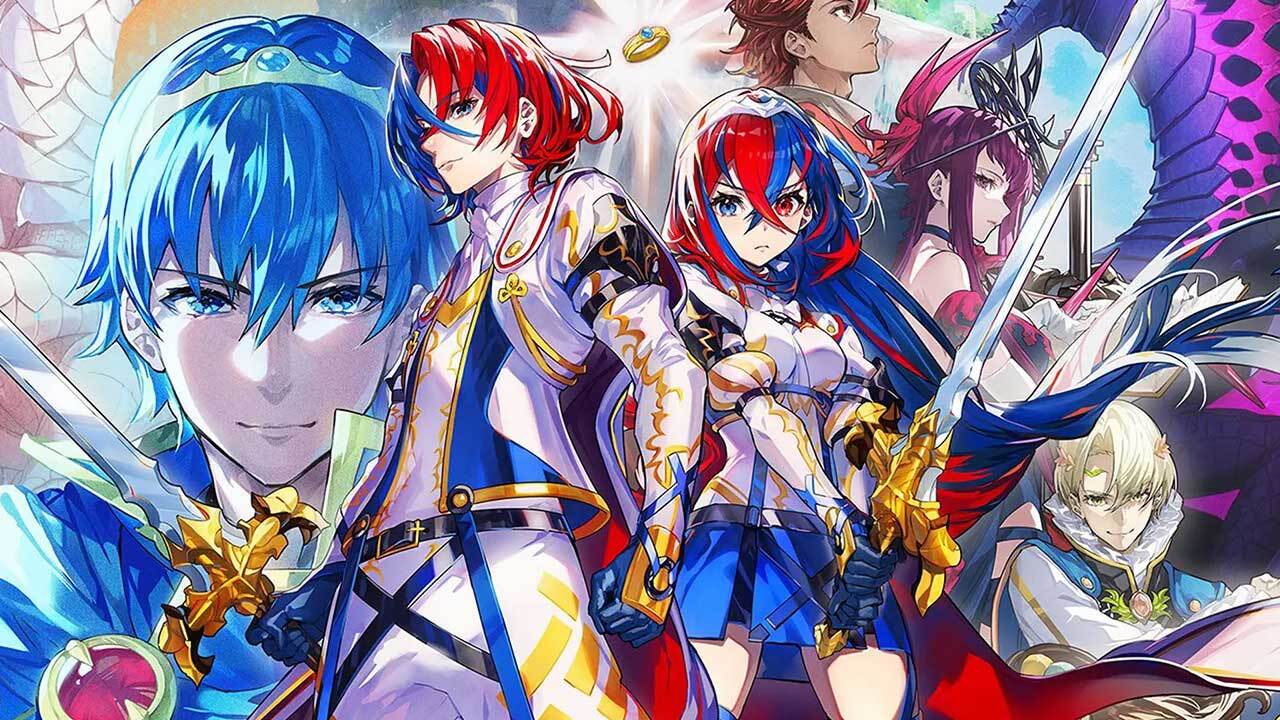
Fire Emblem Engage, one of the best Switch games of 2023–and a game that deserved more attention in general–is on sale now for a killer price. While Nintendo’s first-party games typically go for $60 long after launch and are occasionally discounted to $40, you can .
Fire Emblem Engage
Like other games in the series, Fire Emblem Engage puts you in command of a small army of unique characters in a fantasy world. This particular entry in the series plays like a highlight reel of previous Fire Emblem games, as you can fuse your characters with the power of protagonists from older games. This new “Engage” mechanic puts a neat spin on the traditional turn-based strategy gameplay, opening up new options on the battlefield.
There’s also the standard–and thankfully, optional–permadeath mode if you want to experience the story with actual consequences for tactical blunders. Mess up a turn, and you could lose a unit for good, a devastating blow when you’ve sunk time, effort, and emotions into developing these characters throughout a campaign that lasts for dozens of hours. The other great selling point of this Fire Emblem is that it’s not bogged down by unnecessary busywork, something that its predecessor on Switch, Three Houses, experienced at times.
In my previous post, we briefly covered how to publish a Helm chart to ACR using Azure DevOps. In this post we will use GitHub actions to build and publish Helm chart to ACR using GitHub Actions. We will also take a sneak peak how GitHub environments work.
Pre-requisites
I am going to assume ACR instance is setup using repository scoped tokens. Since we already covered setting up of ACR this way in the earlier post, I will not include the steps here.
Setting up secrets at GitHub
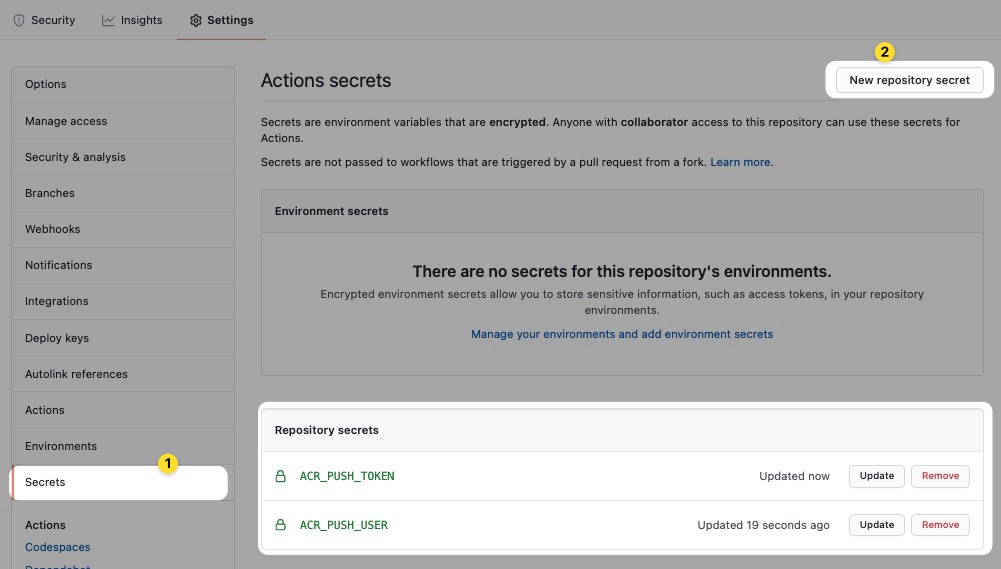
We would like store Azure Container Registry’s tokens as GitHub repository level secrets. To do that, click on Settings on the repository page and head to Secrets tab. Finally click on New repository secret and add the token name and the password. I have stored token name as ACR_PUSH_USER and token password as ACR_PUSH_TOKEN.
Add repository secrets
Creating the workflow in GitHub Actions
Publish chart to ACR
The first step is to create an yaml file under .github\workflows folder and setup a basic structure. The first things (see the yaml below) are defining name for the action, currently set to trigger via manual trigger using workflow_dispatch and define few environment variables which we are going to use later in the action.
The first environment variable conveys to ACR that we are going to publish a OCI package. Next couple of variables just define version of Helm we need on the runner, our ACR name to which we are going to publish this chart and finally to the repository we are publishing this chart to (used in below sections).
Installing Helm 3 on the agent
Now that we have all the variables defined, we need add jobs and steps to build our workflow to publish charts to ACR. We then need to install Helm tool on the agent before we can run the Helm commands. We do that using yaml below.
jobs:build:name:publish acrruns-on:ubuntu-latestenvironment:prodsteps:-uses:actions/checkout@v2name:checkout repo-name:install helmuses:Azure/setup-helm@v1with:version:${{ env.HELM_VERSION_TO_INSTALL }}# default is latest
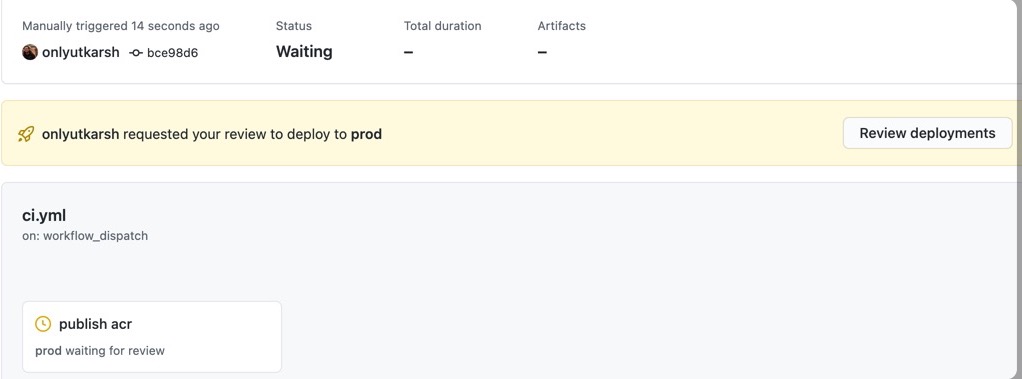
As you can see, we have one job named build (which will be displayed as publish acr – see screenshot below) which runs on ubuntu-latest agent. We also are targeting our deployment to an environment prod. Environments in GitHub are cool because you can have approvers, additional protection rules for environments and environment specific secrets. In the screenshot below, notice how the flow is waiting for review.
Next, we checkout the repository and using setup-helm task from Azure repo we install the specific version (3.5.0) of Helm.
Login to the ACR using Helm
Next, we need to login to ACR registry using Helm tool.
-name:login to acr using helmrun:|echo $ | helm registry login $.azurecr.io --username $ --password-stdin
Save and push the chart to ACR
Next we need to save the chart directory to local cache and publish it to ACR.
-name:save helm chart to local registryrun:|helm chart save $/src/azure-vote-helm-chart/ $.azurecr.io/$:latest-name:publish chart to acrrun:|helm chart push $.azurecr.io/$:latest
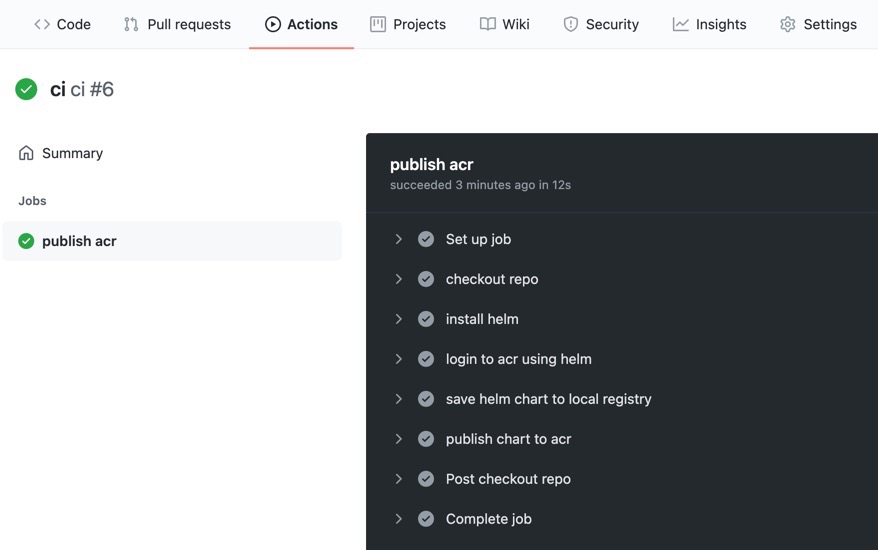
Run the workflow, and you will see output as below.
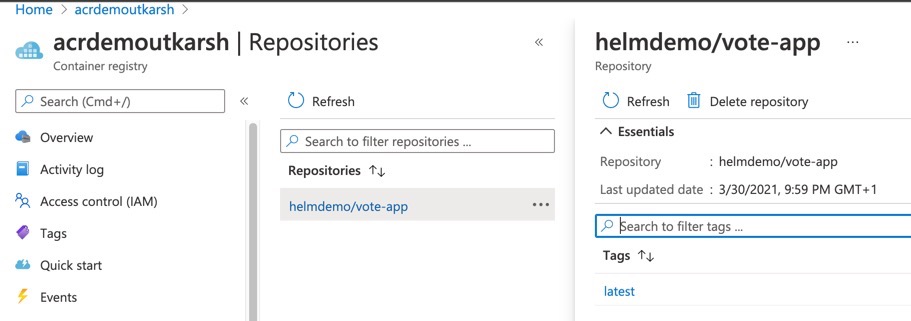
Go to ACR and you will see char correctly published to helmdemo/vote-app repository as declared in the env section above.
Conclusion
In this post, you saw how easily we can deploy a OCI package (helm3 chart) to ACR using GitHub actions. We also saw how GitHub environments help you approve changes to the environment. Hope you enjoyed reading this post.
With the explosion of new players to the media and entertainment industry, the landscape is increasingly fragmented, while also becoming more interconnected than ever. Understanding and applying AI will be critical as new ecosystems, platforms, and models continue to emerge.
Get Salesforce’s perspective on the complex forces reshaping today’s media industry and learn:
How new technologies are altering the way attention is captured and monetized.
How to apply AI through the lens of personalization, monetization, and agility.
How to intertwine trust and technology with customers, partners, and employees.
In the ever-evolving genres of fiction, slipstream emerges as a genre that defies the traditional boundaries of storytelling, offering a unique blend of the real and the surreal.
This genre, sitting at the crossroads of speculative fiction and literary fiction, challenges our perceptions of reality, inviting readers and writers alike into a world where the ordinary becomes extraordinary.
If you’re intrigued by the idea of crafting narratives that transcend conventional genres, slipstream fiction may be the creative avenue you’ve been searching for.
This article is your comprehensive guide to understanding, appreciating, and ultimately writing slipstream fiction that captivates and resonates.
What is slipstream fiction?
Slipstream fiction is a genre that thrives on ambiguity, challenging both writers and readers to explore the spaces between the known and the unknown.
Let’s dive into the core aspects that define this intriguing genre.
Our slipstream fiction definition
Slipstream fiction is notoriously difficult to pin down with a single definition, but at its core, it represents a narrative that straddles the line between the speculative and the literary, often blurring the boundaries of reality and the fantastic.
This genre is not just about fantastical elements or futuristic settings; it’s about invoking a sense of wonder, unease, or the uncanny through stories that feel both familiar and deeply strange.
Slipstream challenges our everyday understanding of reality, pushing readers to question what they know about the world around them.
It is this unique blend of the real and the surreal that sets slipstream apart from more conventional genres, making it a fascinating field for writers who want to explore the depths of human experience in novel ways.
What are the key characteristics of Slipstream fiction?
Before we delve into the characteristics that define slipstream fiction, it’s important to understand that these traits work together to create a distinctive reading experience that defies easy categorization.
Here are the seven most important characteristics of slipstream fiction:
Ambiguity: Stories often leave more questions than answers, challenging readers to find their interpretations.
Cognitive dissonance: The narrative may combine elements that traditionally don’t coexist, creating a sense of unease or perplexity.
Surreal atmosphere: The setting or events have an otherworldly quality, even if rooted in the familiar.
Emotional resonance: Despite the fantastical elements, the core of slipstream fiction lies in its ability to evoke deep emotional responses.
Intellectual stimulation: These narratives encourage readers to think deeply about themes, ideas, and the nature of reality itself.
Genre blending: Slipstream fiction often incorporates elements from various genres, refusing to be boxed into a single category.
Metafictional elements: There’s often a self-awareness within the narrative, playing with literary conventions and reader expectations.
Keep in mind that slipstream fiction is by its nature a genre that blends elements and influences from a wide range of sources.
As a result, feel free to use or ignore whichever characteristics of slipstream depending on what your story requires.
How has Slipstream fiction evolved?
The roots of slipstream fiction can be traced back to the works of authors who dared to push the boundaries of narrative storytelling, such as Franz Kafka and Jorge Luis Borges.
These pioneers laid the groundwork for a genre that would evolve to encapsulate a wide range of themes, from the existential to the metaphysical.
Over the decades, slipstream has grown from a niche interest into a significant movement that challenges the conventions of mainstream literature.
Its evolution reflects a growing desire among writers and readers for stories that offer more than just escape or entertainment; they seek narratives that offer a mirror to the complexity and ambiguity of the human condition.
In the contemporary literary landscape, slipstream fiction continues to evolve, influenced by both the rapidly changing world around us and the endless possibilities of the human imagination.
Slipstream fiction examples
To truly grasp the essence and diversity of slipstream fiction, examining both its foundational works and contemporary examples is invaluable.
These stories illuminate the genre’s defining characteristics and showcase the myriad ways authors can navigate its complex terrain.
What are some classic examples of slipstream fiction?
The foundations of slipstream fiction are often traced back to the literary giants who blended the surreal with the mundane, crafting narratives that defy straightforward interpretation.
Franz Kafka’s “The Metamorphosis”
Kafka’s story a seminal work that exemplifies slipstream’s essence, with its story of a man who inexplicably transforms into an insect, challenging readers to find meaning amidst absurdity.
Jorge Luis Borges’ collection “Ficciones”
Ficciones is another slipstream cornerstone, weaving intricate tales of labyrinths, mirrors, and infinite libraries that question the nature of reality and fiction.
These classic examples not only highlight the genre’s roots in the surreal and the speculative but also demonstrate how slipstream can offer profound insights into the human condition through its unique narrative approach.
What are examples of contemporary slipstream fiction?
Contemporary slipstream fiction continues to explore the boundaries between the real and the unreal, providing readers with immersive and thought-provoking experiences.
“The Night Circus” by Erin Morgenstern
Morgenstern’s tale is a dazzling foray into a magical competition between two young illusionists, set within a wandering, fantastical circus that opens only at night. Morgenstern’s novel captivates with its rich, atmospheric storytelling and intricate plot, showcasing slipstream’s potential to blend magical realism with deep emotional resonance.
“Station Eleven” by Emily St. John Mandel
Station Eleven presents a post-apocalyptic vision that intertwines the lives of a traveling Shakespearean theater troupe with the interconnected stories of individuals surviving a global pandemic. Mandel’s work exemplifies slipstream through its exploration of art, memory, and survival in a world where reality has shifted beyond recognition.
“Cloud Atlas” by David Mitchell
Mitchell’s classic stretches across time and space, linking disparate narratives from the 19th century South Pacific to a distant, post-apocalyptic future.
Cloud Atlas is a masterclass in genre blending, each story echoing themes of connection, power, and the nature of humanity, embodying the slipstream genre’s capacity for intellectual depth and speculative scope.
The diversity of contemporary slipstream fiction is proof that you have the creative freedom to add your own unique take on the genre,
How to write slipstream fiction – full step-by-step guide
Writing slipstream fiction is a journey into the unknown, requiring not only creativity but a willingness to explore the edges of reality and imagination.
This section will guide you through the process of crafting your own slipstream narratives, from initial inspiration to final revision.
Step 1: Finding inspiration
To write a truly compelling tale of slipstream fiction, you first need to immerse yourself in unconventional sources of inspiration.
Seek unusual sources of inspiration
Look beyond the ordinary for inspiration. Explore dreams, myths, and philosophical questions.
Real-world absurdities and scientific wonders can also spark ideas for your story.
Combine elements from daily life with speculative or surreal twists.
The juxtaposition of the mundane with the extraordinary can create the uncanny atmosphere characteristic of slipstream.
Step 2: Building your slipstream world
One of the joys of reading slipstream fiction is the chance to get immersed in a world far different to our own.
Your world should feel grounded in reality yet permeated with elements of the surreal or speculative.
Consider how the laws of nature or society might differ in subtle, unsettling ways.
Building your slipstream world
Infuse the familiar with anomalies that challenge perception and conventional expectations.
Use sensory details to create an immersive experience that feels both real and otherworldly.
Step 3: Creating complex slipstream characters
The otherworldly nature of slipstream fiction is essential to the genre, but that doesn’t mean you should treat your characters as an afterthought.
Consider these tips on on how to create characters that will resonate with slipstream fans.
Slipstream characters often grapple with the strange realities of their world. Develop characters with rich internal lives, whose personal journeys reflect the thematic concerns of the narrative.
Challenge character dynamics
Place characters in situations that test their perceptions of reality.
Explore how they respond to the slipstream elements of the story, providing a human anchor to the surreal aspects.
Step 4: Constructing a non-traditional plot
Like every other element of slipstream, you have considerable liberty when it comes to plotting your book.
Make the most of this creative freedom with these tips.
Experiment with narrative structure
While traditional narrative structures can be a starting point, consider bending or breaking these forms to suit the slipstream nature of your story.
Employ non-linear storytelling, flashbacks, or multiple perspectives to reflect the fragmented or fluid nature of reality in your narrative.
Focus on the emotional or philosophical journey rather than solely on external events.
Step 5: Crafting the slipstream aesthetic
You can align all the elements of your fiction story with slipstream conventions, but they won’t be effective unless conveyed with suitable language.
Make sure to use craft aligned with the philosophy of slipstream by following these ideas.
Leverage language and style
The way you tell your story is as important as the story itself. Use language to evoke the surreal, blending poetic imagery with sharp, unexpected contrasts.
Techniques for maintaining ambiguity
Leave room for interpretation, offering clues rather than clear answers.
Balance the strange with the familiar to keep readers grounded yet intrigued.
By embracing the genre’s inherent ambiguity and blending reality with the speculative, you can create narratives that challenge, captivate, and resonate with readers on a deeply emotional and intellectual level.
How to overcome challenges when writing slipstream
Navigating the slipstream genre presents a unique set of challenges, from maintaining the delicate balance between the real and the surreal to ensuring your narrative remains engaging and coherent.
This section offers strategies for tackling these hurdles, ensuring your slipstream fiction is both profound and captivating.
What are common challenges in writing slipstream fiction?
One of the most daunting challenges in writing slipstream fiction is maintaining the right balance between ambiguity and coherence.
Writers must navigate the fine line where their narrative is neither too abstract, which risks alienating readers, nor too explicit, which may undermine the surreal quality that defines slipstream.
This delicate equilibrium requires a deep understanding of your story’s themes and a careful crafting of plot and character that allows readers to immerse themselves in your world while encouraging them to explore its mysteries.
Effective slipstream writing invites readers into a narrative that feels both familiar and unsettling, engaging them in a dance of discovery where not every step is predetermined.
How can writers master slipstream fiction?
Excelling in slipstream fiction requires innovative strategies that go beyond the conventional approaches of genre writing.
Here are seven key strategies to enhance your slipstream stories.
1. Embrace the unpredictable
Let your narrative flow in unexpected directions, allowing for spontaneous creativity that can surprise both you and your readers.
2. Experiment with form and structure
Play with different narrative forms, such as epistolary formats, diary entries, or fragmented narratives, to reflect the slipstream’s essence.
3. Focus on the emotional core
Ensure that, despite the surreal elements, your story has a strong emotional core that readers can connect with.
4. Leverage symbolism and metaphor
Use symbolic elements and metaphors to deepen the narrative’s layers and enhance the surreal quality of your story.
5. Cultivate a sense of mystery
Build a narrative that invites readers to ponder and speculate, rather than offering them all the answers upfront.
6. Reflect on the human condition
Use the slipstream elements to explore deeper philosophical or existential questions, grounding the surreal in human experiences.
7. Engage with reader perceptions
Challenge readers’ perceptions and expectations, encouraging them to question not just your narrative but their reality.
Are you ready to write your own work of slipstream fiction?
Slipstream fiction offers a unique canvas for writers to explore the boundaries of reality, narrative, and imagination.
This genre, with its blend of the speculative and the literary, invites you to transcend conventional storytelling, crafting worlds that resonate with the profound and the perplexing.
Armed with the insights and strategies outlined in this guide, you are now equipped to embark on your own slipstream writing journey.
Remember, the essence of slipstream lies in its ability to surprise and defy expectations—so let your creativity flow unbounded.
Embrace the challenge, experiment boldly, and become a pioneer in the uncharted territories of slipstream fiction.
Your readers are waiting to be transported to worlds only you can envision.
The National Payments Corporation of India (NPCI), the governing body overseeing the country’s widely used Unified Payments Interface (UPI) mobile payment system, is set to engage with various fintech startups this month to develop a strategy to address the growing market dominance of PhonePe and Google Pay in the UPI ecosystem.
NPCI executives plan to meet with representatives from CRED, Flipkart, Fampay and Amazon among other players to discuss their key initiatives aimed at boosting UPI transactions on their respective apps and to understand the assistance they require, people familiar with the matter told TechCrunch.
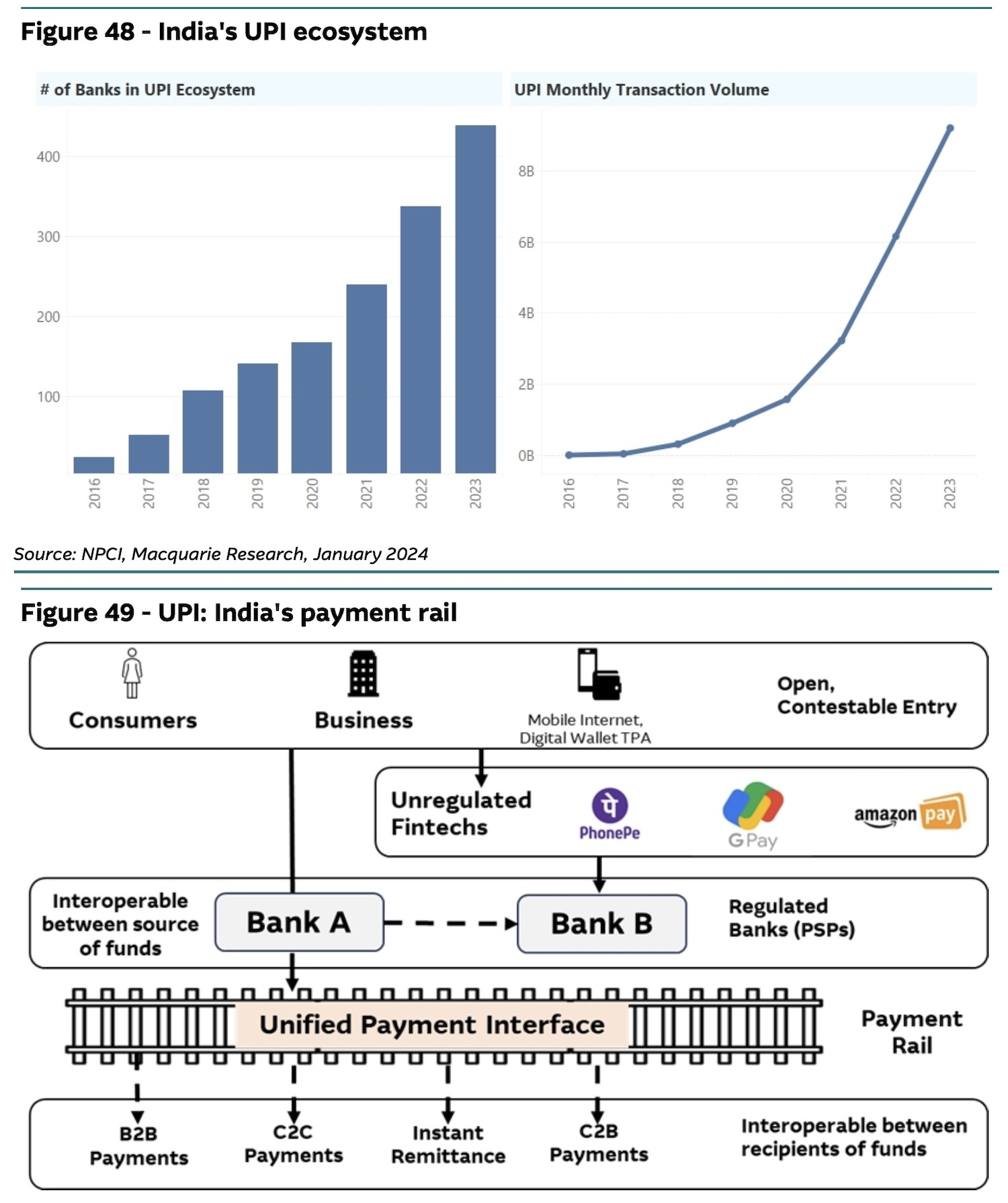
UPI, built by a coalition of Indian banks, has become the most popular way Indians transact online, processing over 10 billion transactions monthly.
The new meetings are part of an increasing effort to address concerns raised by lawmakers and industry players regarding the market share concentration of Google Pay and PhonePe, which together account for nearly 86% of UPI transactions by volume, up from 82.5% at the end of December. Walmart owns more than three-fourths of PhonePe.
Paytm, the third-largest UPI player, has seen its market share decline to 9.1% by the end of March, down from 13% at the end of 2023, following a clampdown by the Reserve Bank of India (RBI).
An overview of India’s UPI ecosystem. (Image: Macquarie)
The conversation follows the central bank expressing “displeasure” to the NPCI over the growing duopoly in the payments space, a person familiar with the matter said. An NPCI spokesperson declined to comment.
In February, a parliamentary panel in India urged the government to support the growth of domestic fintech players that can offer alternatives to the Walmart-backed PhonePe and Google Pay apps.
The NPCI has long advocated for limiting the market share of individual companies participating in the UPI ecosystem to 30%. However, it has extended the deadline for firms to comply with this directive to the end of December 2024. The organization faces a unique challenge in enforcing this directive: It believes that it currently lacks a technical mechanism to do so, TechCrunch previously reported.
The RBI is also weighing an incentive plan to create a more favorable competitive field for emerging UPI players, another person familiar with the matter said. Indian daily Economic Times separately reported Wednesday that the NPCI is encouraging fintech companies to offer incentives to their users, promoting the use of their respective apps for making UPI transactions.
GSC Game World revealed today that S.T.A.L.K.E.R. 2: Heart of Chornobyl will hit PC and Xbox consoles on September 5, 2024. Preorders are currently live, with some weapon skins and campfire songs being available as a reward for people who choose to part with their cash early.
While the game was originally meant to launch last year, it’s quite hard to work on a videogame in the middle of a brutal war, and that’s the reality facing Ukrainians after Russia’s unprovoked invasion back in 2022. The GSC Game World team has been doing some frankly incredible work, considering the harrowing circumstances for the Kyiv-based developers.
Chornobyl Exclusion Zone has changed dramatically after the second massive explosion in year 2006. Violent mutants, deadly anomalies, warring factions have made the Zone a very tough place to survive. Nevertheless, artifacts of unbelievable value attracted many people called S.T.A.L.K.E.R.s, who entered the Zone for their own risk striving to make a fortune out of it or even to find the Truth concealed in the Heart of Chornobyl.
EPIC NONLINEAR STORY IN SEAMLESS OPEN WORLD
Take over a role of the lone stalker and explore photorealistic seamless open world in a 64-km² radioactive zone with a variety of environments that reveal post-apocalyptic atmosphere from different angles. Make your way through the Zone to define your destiny as you choose your paths within highly branching epic story.
VARIETY OF ENEMIES AND HUNDREDS OF WEAPON COMBINATIONS
Meet members of different factions deciding who of them worth your friendship and who deserve a bullet. Engage intense gunfights with a variety of enemies that follow different tactics trying to outsmart you. Choose your preferable firearms from 30+ types of weapons with numerous modifications that allow creating hundreds of distinctive lethal combinations.
LEGENDARY MUTANTS WITH DIFFERENT BEHAVIOUR MODELS
Prepare to encounter horrifying mutated creatures that will try to slaughter you following different behaviour model. Each mutant may appear in different subtypes which makes their behaviour less predictible. Truly extreme danger represent regions with lairs with numerous mutants hunting in large groups.
ARTIFACTS OF INCREDIBLE VALUE AND UNFORGIVING ANOMALIES
The most valuable artifacts and secrets of the Zone are hidden in the most dangerous places. Beware of the hazardous anomalies and unique devastating arch-anomalies as you hunt for highly valuable artifacts scattered around the Zone. Will you dare to unveil the mysteries of the Zone that took lives of many others before you?
Discover legendary S.T.A.L.K.E.R. universe and experience:
Unique gameplay built on a blend of FPS, horror and immersive sim
Non-linear story with the variety of paths that lead to one of the several endings
Benchmark-setting graphics developed using cutting-edge photogrammetric and scanning technologies
Advanced artificial intelligence systems that will keep engaged even the most hard-boiled players
Life-simulating system “A-life 2.0” that makes the game world feel alive as never before
Immersive survival mechanics like hunger, sleeping, bleeding, radiation effects that enrich the gameplay
Dynamic day-night cycle and weather will add even more realism to the gameplay experience
Mod support giving the freedom to the creative players to extend and enrich the game universe
Multiplayer mode, that will be added soon after release as a free update
5 Powerful Artificial Intelligence In Healthcare Use Cases
Role of Artificial Intelligence (AI) in Healthcare
The use of AI is not limited to any business division. Though being utilized in many sectors, applications of AI use cases healthcare are huge. The global healthcare sector remains one of the fastest-growing sectors in adopting AI.
With more focus on improving patient outcomes, hospitals are increasingly investing in artificial intelligence technology. AI, together with IoT and Cloud technologies, is becoming popular. It builds advanced healthcare solutions to assist physicians.
There are many benefits of AI in the healthcare sector. AI for automation, AI for radiology, AI for drug design, and AI for cancer detection are a few significant use cases of AI in healthcare.
Besides, healthcare companies are using AI virtual assistants to provide continuous services to patients at remote locations.
Herein, we covered the top five (5) potential developments of artificial intelligence in healthcare.
Use Cases of AI in Healthcare
#1 AI-powered Robotic Surgery
Investments in AI-based robots are continuing to climb in the fast few years, especially in the healthcare sector.
Intelligent robots can analyze data from previous medical logs. Based on medical reports of a patient, robots can guide & control a surgeon’s instrument all through surgery.
This process will reduce the time of the patient’s hospital stay. Robot-assisted surgery minimizes surgical incisions, and hence it is considered as minimally invasive surgery.
Generally, using AI, robots use data from previous tasks to introduce new medical procedures. In addition, it was proven that the complication rate is less with AI-powered robotic surgery.
I hope you’ve heard about the da Vinci Surgical System. It is a robotic surgical system developed by Intuitive Surgical Inc., (an American manufacturer of robotic products). It can enhance the patient’s outcome with minimum surgical incisions. This intelligent system allows doctors to do virtual surgical processes with more confidence and control.
Further, robots automatically learn from medical records. Hence, the positive results delivered by intelligent robots are helpful for physicians.
#2 AI-based Virtual Nursing Assistants
It is one of the best use cases of Artificial intelligence in healthcare. AI virtual nursing assistants maintain a smooth interaction with patients. They provide solutions for patient queries and also helps physicians in knowing their patient’s conditions.
These assistants reduce hospital visits and also lessen the load on physicians. The value of AI-based virtual nursing assistants is approximately $20 billion per annum.
AI is playing a critical role in the healthcare industry. The healthcare segment is an open area for implementing intelligent technologies. Using AI tools and devices, healthcare service providers are providing improved healthcare services.
A noteworthy point is that the implementation of AI technologies in healthcare will helps physicians efficiently treat life-threatening diseases.
For instance, AI is highly using for detecting tumors. Few diseases are difficult to diagnose like oncology and cardiology diseases. However, AI-based diagnosis help doctors to provide treatment at the right time.
Besides, Machine Learning (ML) and deep learning algorithms also benefiting the healthcare industry. These technologies enable machines to learn from data and deliver insights into patient’s data. Hence, the doctors can check and analyze the severity level of the disease.
Likewise, AI-based wearables are developed to detect cardiac diseases in early phases. Thus, AI devices, together with IoT & cloud, avoids human errors and automates diagnosing process.
#4 Automate Administrative Tasks
AI in healthcare automates end-to-end administrative functions. It could help the healthcare industry to save approximately $18- $20 billion every year.
AI-powered machines are the best examples of artificial intelligence in healthcare for cutting admin costs. The AI systems are well-trained to perform all administrative tasks with more accuracy and efficiency.
#5 AI for Image Analysis
Manual image analysis takes a long time and leaves minimum human errors. But, Artificial Intelligence machines using deep learning can view and scan thousands of medical images simultaneously. AI systems for radiology detect patterns of various diseases. This feature of AI in healthcare allows radiologists to diagnose a disease exactly.
The role of AI in healthcare is not only limited to these healthcare applications. AI also be used for CT scans, drug discovery, pregnancy management, brand marketing, Management risk analysis, and many more.
USM has a proven AI solution for healthcare. Our patient data analytics solutions efficiently manage patient’s records. USM’s AI solutions bring a real-time communication platform where service providers and patients can interact 24*7.
Moreover, through Artificial intelligence-powered image analysis, healthcare service providers can also aid patients in remote locations.
Telemedicine service is the best example for this scenario. This innovative healthcare service allows patients to send images of rashes, cuts, etc., and get help from doctors to determine the disease and provide necessary treatment.
The future of AI in healthcare
The future of AI in healthcare will be around hybrid models. Over the next few years, AI handovers treatment planning, disease identification, and image processing. The faster adoption of AI in healthcare enhances operational efficiency, prevents risks, and delivers improved patients outcomes.
Conclusion
Health matters for everyone. Right?
When a physician saves minutes means that he is saving lives.
Artificial intelligence and machine learning technologies consume less time in detecting and analyzing diseases and health conditions. AI tools for healthcare supports service providers deliver faster services to their patients.
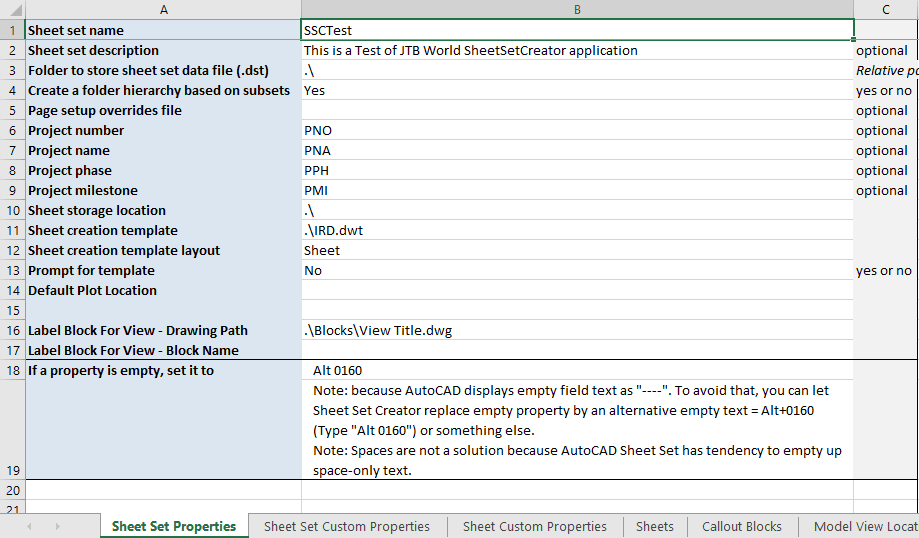
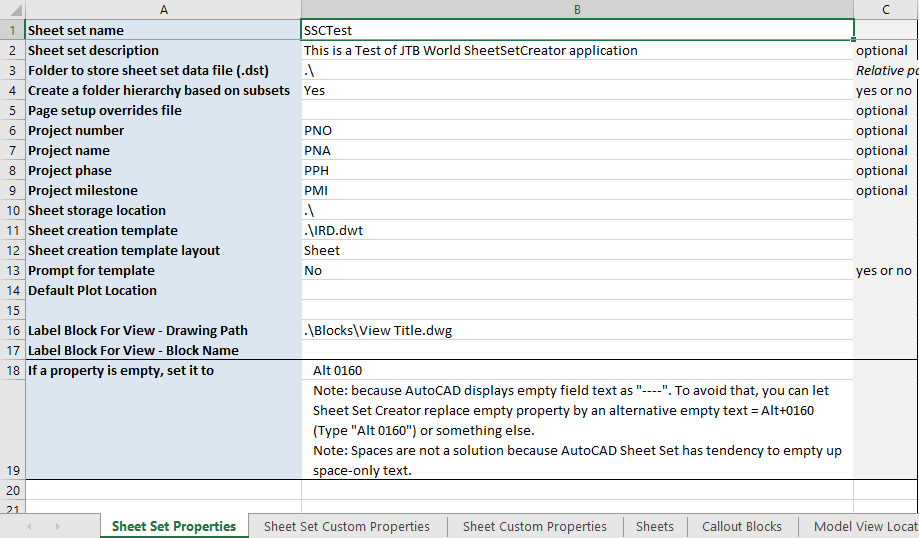
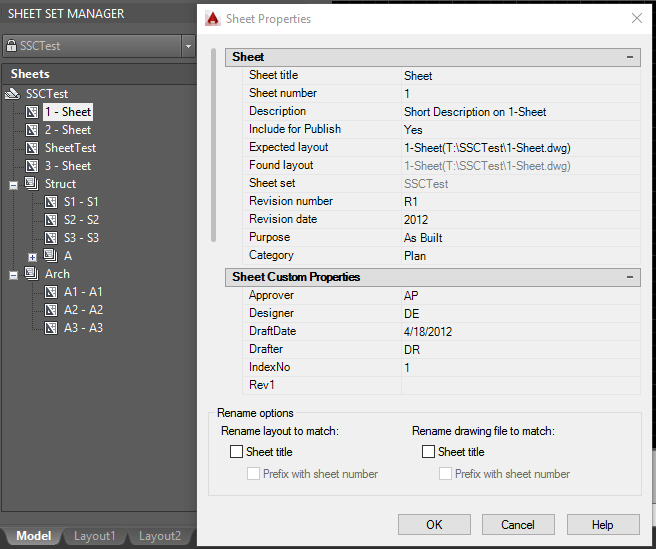
JTB Sheet Set Creator 3.1.0 is released and lately we added support for adding sheet and custom properties to existing Sheet Sets with a merging functionality. It is also a command line interface available.
JTB Sheet Set Creator is an app for AutoCAD that creates new Sheet Sets and Sheets with all properties based on an Excel template.
Don’t know what the Sheet Set Manager is? The Sheet Set Manager in AutoCAD is a great tool for organizing and managing large sets of drawings, particularly in the architecture, engineering, and construction (AEC) industry. It allows users to create a logical and structured organization of their drawings, making it easier to find and access specific drawings when needed.
One of the key benefits of the Sheet Set Manager is its ability to create a sheet index, which serves as a table of contents for the entire set of drawings. This index can be customized to include information such as the drawing title, sheet number, and revision status, making it easy to quickly identify and access the desired drawing.
In addition to the sheet index, the Sheet Set Manager also allows users to create drawing lists, which are essentially sub-sets of drawings that are organized based on specific criteria, such as discipline or phase. This can be particularly useful for project managers who need to quickly access a specific group of drawings for a particular task or for team members who need to focus on a specific aspect of the project.
Overall, the Sheet Set Manager is a valuable tool for anyone working with large sets of drawings in AutoCAD, as it helps to streamline the organization and management of these drawings, saving time and reducing the risk of errors.
If you are using the Sheet Set Manager you can make batch edits of properties with JTB SSMPropEditor or make merge, purge and convert with JTB DST Tool or publish with JTB Batch Publish.
Elden Ring: Shadow of the Erdtree will send players on a new journey this summer to the Land of Shadow, where they will learn more about one of the game’s most mysterious demigods, Miquella of the Haligtree.
Game director Hidetaka Miyazaki says that players will track Miquella on their journey through the Land of Shadow, “tracing his path and following in his footsteps, trying to see what he’s going to do there,” similar to how players followed the light of grace in the base game. Players will also discover what compelled Queen Marika, who shattered the Elden Ring in the game’s story, to visit the Land of Shadow.
Elden Ring players who haven’t pored over the bits of lore scattered throughout the game’s dialogue and item descriptions may not know much about Miquella, and about his role in the game’s story. We’re here to tell you what you need to know so you don’t have to watch an hourlong lore video that unpacks it all.
Who is Miquella in Elden Ring?
A statue depicting Malenia and MiquellaImage: FromSoftware/Bandai Namco via Polygon
Miquella of the Haligtree is a demigod in the world of Elden Ring and a being known as an Empyrean. That means he is a candidate to succeed Queen Marika as the vessel for the Elden Ring.
We don’t really see Miquella in the game, but he’s the older twin brother of Malenia, the fearsome, rot-afflicted boss who resides at the base of the Haligtree. An offspring of the game’s penultimate boss, Radagon, and Marika (who are, uh, the same person), Miquella only appears in withered cocoon form in the main game’s story. As teased in Shadow of the Erdtree’s reveal trailer, Miquella’s cocoon will be the doorway to the Land of Shadow when the DLC launches.
Malenia and Miquella were both born with terrible afflictions: Malenia with rot that would consume her limbs and sight, and Miquella with eternal childhood. Statues of the brother-sister duo are scattered throughout the Haligtree, showing full-grown Malenia embracing her twin, who is stuck in the body of a young boy. Other statues show the twins at a younger age being embraced by their older sibling, Godwyn the Golden.
Malenia calls Miqeulla “the most fearsome Empyrean of all,” with the wisdom and the allure of a god. Miquella is also said to be beloved by many, and can compel the affections of others.
What’s Miquella’s relationship to Malenia? And Mohg?
Image: FromSoftware/Bandai Namco via Polygon
Malenia and Miquella were close. The former fought to protect her brother, earning her the name Malenia, Blade of Miquella. Miquella was similarly protective, and worked unsuccessfully to develop a remedy for Malenia’s rot affliction. One of Miquella’s inventions was an unalloyed golden needle, which players can use to undo the Flame of Frenzy. (Miquella strived to “ward away the meddling of Outer Gods,” according to the description of Miquella’s Needle; an Outer God appears to be responsible for the spread of rot, too.)
As part of his work to cure his sister and after leaving the faith known as the Golden Order, Miquella sought to create a new Erdtree, nurturing a sapling with his own blood. This endeavor would fail and produce the Haligtree, which would become a haven for the meek and afflicted. Miquella ultimately embedded himself within the Haligtree to grow it, residing in the cocoon, but he was kidnapped by Mohg, the Lord of Blood, who sought to become Miquella’s consort.
That’s why Mohg has Miquella’s cocoon in his chambers. Mohg essentially stole Miquella from his Haligtree womb, in which the Empyrean now appears to have grown older compared to his previous boylike form.
If Miquella’s stuck in that cocoon, how is he also in the Land of Shadow?
Miquella’s arm juts from his cracked cocoon in Mohg’s palaceImage: FromSoftware/Bandai Namco via Polygon
Miquella is said to have “divest[ed] himself of his flesh, his strength, and his lineage,” according to Shadow of the Erdtree’s official description. Miquella may not be a purely physical being in the DLC, and the Land of Shadow may not be a purely physical space; FromSoftware has a history of sending players to alternate time periods and dreamlike spaces in its expansions for games like Dark Souls and Bloodborne.
Furthermore, there’s well-supported speculation that Miquella is connected to a character named St. Trina, who is also unseen in Elden Ring. Trina is said to be a mysterious character of ambiguous gender who has close associations with sleep and dreams, according to a few in-game item descriptions. Followers of St. Trina are said to look for her while they sleep, and we know that Miquella has been slumbering for some time.
Both Trina and Miquella are also associated with nearly identical in-game items — Trina’s Lily and Miquella’s Lilly — that may connect them in still-unclear ways. However, in content that was discovered to have been cut from Elden Ring, it’s hinted that Miquella and St. Trina are actually the same person. That connection could be explained or confirmed in Shadow of the Erdtree, insofar as things ever get “explained” in FromSoftware games.













:format(webp):no_upscale()/cdn.vox-cdn.com/uploads/chorus_asset/file/25403202/ELDEN_RING__20240416143228.jpg)
:format(webp):no_upscale()/cdn.vox-cdn.com/uploads/chorus_asset/file/25403184/ELDEN_RING__20220426193630.jpg)
:format(webp):no_upscale()/cdn.vox-cdn.com/uploads/chorus_asset/file/25313318/ELDEN_RING__20240228210528.jpg)