It’s still May, which means it’s still Google time. After showing off Android’s new look at The Android Show, the company still has its developer conference to check off the list. Google I/O 2025 is scheduled to start on May 20 at 1PM ET / 10AM PT, and Engadget will be covering it live, via a liveblog and on-the-ground reporting from our very own Karissa Bell.
To view this content, you’ll need to update your privacy settings. Please click here and view the “Content and social-media partners” setting to do so.
The company made it clear during its Android showcase that Android XR, its mixed reality platform, will also be featured during I/O. That could include the mixed reality headset Google and Samsung are collaborating on, or, as teased at the end of The Android Show, smart glasses with Google’s Project Astra built-in.
To find out for yourself, you can watch Google’s keynote in the embedded livestream above or on the company’s YouTube channel. The event starts at 1PM ET on May 20 and the company plans to hold breakout sessions through May 21 on a variety of different topics relevant to developers.
It’s that time again—Microsoft Build is just around the corner! Microsoft Build 2025 kicks off next week (May 19–22)—and now’s the perfect time to get your plan in place. The best part? You don’t have to be in Seattle to experience it.
This year, Build is more accessible than ever. Every keynote, breakout session, demo theater, and even our hands-on labs are available to stream—live or on-demand—completely free. No travel. No ticket. Just you, your browser, and some of the best developer content of the year.
I’ve had the privilege of working alongside our Product Managers and Engineering teams to help bring these new experiences to life. And I can confidently say—this year’s lineup is comprehensive, with something for every Visual Studio user. From deep dives into .NET and GitHub Copilot in Visual Studio, to lightning-fast demo theaters and hands-on labs powered by the Microsoft Skillable platform, there’s truly something for everyone.
Step 1: Customize Your Schedule
If you do just one thing today, head over to build.microsoft.com and use the free Schedule Builder. It’s the easiest way to:
Add Must Watch sessions from Satya Nadella, Kevin Scott, Amanda Silver, and Scott Guthrie and friends.
Pick breakouts tailored to your interests—Visual Studio, AI agents, .NET 9, GitHub Copilot, Azure, and more.
Queue up on-demand sessions you can catch later, even after the event ends.
💡 And this year, keep an eye out for “AI Agents” and “Agentic” —a new way to think about how AI works with you, not just for you. Visual Studio is evolving, and the sessions hinting at this shift are worth flagging.
Step 2: Prioritize Live Viewing (and Must-Watch Sessions)
Many sessions—especially keynotes—feature live Q&A and real-time demos you won’t want to miss. And with 133 sessions focused on Developer Tools and .NET, there’s truly something for everyone.
I encourage you to use the schedule builder and find the topics you’re interested in. Here are just a few I’ll be attending in person to help get you started:
Must Watch!
More to add to your watch list:
Top GitHub Copilot Features You Missed in Visual Studio 2022 – Visual Studio now delivers its most AI-powered experience yet—with GitHub Copilot deeply integrated into your daily workflow. In this session, we’ll walk through the latest Copilot features lighting up in Visual Studio, including Agent Mode (Preview), which brings goal-driven, multi-step assistance right into the IDE.
The Future of .NET App Modernization Streamlined with AI – GitHub Copilot and Agents are transforming how developers modernize their applications and get them cloud ready. Come see how GitHub Copilot Upgrade for .NET helps you upgrade your .NET applications directly from Visual Studio. From project and dependency analysis, plan execution, automatic self-healing, detailed reporting, and more. Hear from industry experts who are transforming their .NET app modernization with GitHub Copilot.
Yet “Another Highly Technical Talk” with Hanselman and Toub – Following from their “Highly Technical Talk” at Build 2024, join Scott Hanselman and partner software engineer Stephen Toub for another talk that is 100% LIVE demo. Zero slides, just code. In this “highly technical talk” on the internals of .NET, they’ll look for performance issues and fix them live on stage. In this talk, you’ll learn debugging, performance, and optimization skills. If you are super advanced, level up, and let’s see how deep you can go!
Unleash Developer Potential with AI and Dev Box – Microsoft Dev Box is reimagining the developer environment. See how this customizable, project-focused platform supports AI development with flexible compute, seamless integration with Visual Studio and VS Code, and team-specific setups that go beyond traditional VDI. Learn how Dev Box is enabling the next generation of productivity.
Demo Theaters and Labs:
Demo Theaters and Labs give you two great ways to explore what’s new. Demos are quick, 15-minute lightning sessions—perfect for discovering new features and getting inspired fast. Labs go deeper with guided, hands-on experiences you can follow step-by-step, right in your browser. Whether you join live or watch later, both formats are available online and designed to fit your pace.
Lab: Hands-on with GitHub Copilot in Visual Studio – Want to go from curious to confident with Copilot in Visual Studio? This lab walks you through real scenarios that show just how integrated and helpful Copilot has become.
Get guided, interactive practice using AI inside the IDE.
Demo: Build, Deploy & Use Your First Model Context Protocol (MCP) Server – Curious about what MCP really is? This lightning-fast session will walk you through building your very first Model Context Protocol server from scratch. You’ll create it in VS Code, test it live, and deploy it—learning why this matters for agent-based development along the way.
Can’t catch them all live? No worries—everything is available on-demand after Build so you can watch at your own pace.
Step 3: Stay Connected
Follow the conversation on #MSBuild, #VisualStudio and #dotNET on X. Ask questions, share what you’re learning, and connect with other developers from around the world. You’ll find inspiration in the comments—and maybe even a new collaborator.
Use the Schedule Builder today.
Start building your watchlist now at build.microsoft.com, and I’ll see you—virtually—next week.
Let’s code the future together.
….Jim
Check out the new Visual Studio Hub
Stay connected with everything Visual Studio in one place! Visit the Visual Studio Hub for the latest release notes, YouTube videos, social updates, and community discussions.
Appreciation for your feedback
Your feedback helps us improve Visual Studio, making it an even more powerful tool for developers. We are immensely grateful for your contributions and look forward to your continued support. By sharing your thoughts, ideas, and any issues you encounter through Developer Community, you help us improve and shape the future of Visual Studio.
Welcome back to TechCrunch Mobility — your central hub for news and insights on the future of transportation. Sign up here for free — just click TechCrunch Mobility!
OK, who placed their bet on General Motors being the landing spot for Aurora co-founder and chief product officer Sterling Anderson? Not me. But here we are. A few days after Anderson announced his resignation from his position and the board at Aurora, he spoke to me about his next gig as chief product officer at GM. In short, he will oversee the entire product line of GM’s gas-powered and electric vehicles — a position that will cover the entire life cycle of GM’s portfolio and include hardware, software, services, and user experience.
Anderson couldn’t say too much; plus, he hasn’t started the job yet. Anderson did say he wouldn’t have taken the new job if Aurora had yet to launch its commercial self-driving truck service in Texas.
Let’s jump into the rest of the news.
A little bird
Image Credits:Bryce Durbin
In an absolutely wild turn of events, Luminar’s founder Austin Russell appears to have been pushed out as CEO and board chair. You can read my coverage here, which provides a bit of an overview of how this unfolded, but I know there is so much more to this story. TL;DR: If you were to only read Luminar’s Q1 earnings report, you would assume Russell was still at the helm. A separate press release, released as the company’s earnings went out, announced a leadership change and that Russell had resigned following an ethics inquiry from the board’s audit committee.
Here’s what I’m hearing from a few little birds. The word “blindsided” came up more than once, and the chaos isn’t over. Luminar board member Jun Hong Heng, who is founder and chief investment officer at Crescent Cove Advisors and a mentor of Russell’s, resigned a day later. Heng was also on the audit committee.
Aurora has had an odd couple of weeks filled with highs — driverless commercial service woohoo! — and twists — whoops, there goes a co-founder. To cap things off, Uber announced plans to offer $1 billion in exchangeable senior notes due in 2028 in private placement. As you might expect, stocks dropped after investors got spooked about potential dilution and what this might mean for the value of Aurora’s stock.
Other deals that got my attention …
AutoUnify, the latest startup that has launched out of the Up.Labs-Porsche partnership, raised $5 million in seed money. The Santa Monica, California-based startup, which built an API to allow dealerships and service shops to communicate in real time with the manufacturers and software vendors that power their operations, has been operating quietly for about nine months.
Chinese battery manufacturer CATL is far from a startup. But it’s worth noting this bananas IPO plan. The company wants to raise at least HK$31.01 billion — that’s just shy of $4 billion — in its Hong Kong listing. This is the largest listing globally in 2025.
Here’s a potential deal that has raised some eyebrows. Federal railroad regulators are in talks with Elon Musk’stunneling firm, The Boring Company, over a multibillion-dollar Amtrak project.
Flock Freight, the shared truckload freight brokerage based in California, raised $60 million in a Series E funding round led by O’Neil Strategic Capital. Susquehanna Private Equity Investments, SignalFire, GLP Capital Partners, and Bracket Capital also participated.
Notable reads and other tidbits
Image Credits:Bryce Durbin
Autonomous vehicles
Tesla’s plan to launch a robotaxi service in Austin next month has caught the attention of federal safety investigators. The National Highway Traffic Safety Administration’s Office of Defects Investigation sent the company a detailed list of questions on its upcoming robotaxi service as part of an investigation into how the company’s “Full Self-Driving (Supervised)” software operates in low-visibility conditions.
Recalls are starting to pop up more in the AV sector. Last week it was Zoox. Now Waymo has issued a software recall on 1,200 self-driving vehicles after some of its robotaxis were involved in minor collisions with gates, chains, and other gate-like roadway objects.
WeRide seems to be trying to ramp in Guangzhou. The Chinese company said it has introduced eight autonomous robotaxi pilot operation routes in the central part of the city. The company has also started trialing fully driverless robotaxis in Abu Dhabi.
Electric vehicles, charging, & batteries
General Motors has been working on a new battery chemistry called lithium manganese-rich, which it says should slash costs while delivering driving range. Notably, these LMR batteries dramatically reduce the amount of nickel and cobalt compared with GM’s most advanced cells, two critical minerals that aren’t readily available from domestic sources in the United States.
A footnote in Lucid’s recent Q1 regulatory filing gives a bit more insight into its sales numbers. The EV maker’s record quarter got a lift from rental sales and company leases.
Everyone, let’s give a slow clap to Toyota for redesigning — and more importantly, renaming — its sole all-electric vehicle for the U.S. market. The EV, once called the bZ4X, will now simply be bZ. The original bZ4X was not well received. I’m looking forward to getting behind the wheel to see what improvements Toyota has made. Meanwhile, Toyota has brought back the C-HR nameplate, but this time as an EV. Hopefully this time it’s more successful. It arrives in the U.S. in 2026.
Gig economy
Three years ago, reporter Rebecca Bellan noted that Uber was going through an Amazonification. Her pitch was that the company, like Amazon, had created a closed business loop to feed customers back into other Uber channels. The second part of that evolution has started, she reported this week. Uber appears to be moving beyond its focus on transportation and working to become a convenient super app, an aggregator of services, a daily-use lifestyle platform with its best offerings tucked behind a paywall.
Future of flight
U.S. lawmakers introduced the Supersonic Aviation Modernization Act in a bid to revise the FAA’s 52-year ban on supersonic flight over U.S. soil. The timing could be crucial for startup Boom Supersonic, which has made progress in developing next-generation supersonic aircraft
Vertical Aerospace announced a plan to develop a hybrid-electric variant of its VX4, suggesting the company is pursuing opportunities in defense and logistics.
In-car tech
Apple’s next generation of its popular CarPlay infotainment software is finally launching. Reminder: It was first announced three years ago. The new version, called CarPlay Ultra, will make its debut on new Aston Martin vehicles in the U.S. and Canada.
Google is bringing Gemini, its generative AI, to all cars that support Android Auto in the next few months. Patrick Brady, VP of Android for Cars, said Gemini will surface in the Android Auto experience in two main ways.
One of the causes of this slump has been persistently high mortgage rates. The Fed has held its target interest rate in the 4.25 to 4.50 percent range since December 18, 2024, which has made buying a home more expensive.
However, where others see risk, Dutch Mendenhall — a visionary investor, serial entrepreneur, best-selling author, and founder of Omnico Golf — sees opportunities.
“Real estate is still king in 2025,” Mendenhall says. “While high mortgage rates might dissuade some, smart investors can still make a lot of money in this sector.”
The Need to Diversify with Alternative Investments like Real Estate
To understand why it still makes sense to invest in real estate, Mendenhall points to the larger U.S. economy.
“The past few months have been characterized by erratic fluctuations in the stock market,” Mendenhall says. “Major corrections have been followed by sudden upswings, and this kind of volatility is unnerving for investors for good reason — thousands of dollars can be lost in a single day.”
In addition, the Trump administration’s ever-changing trade policy means that additional gyrations will likely appear in the future. “Even after the administration’s trade agreement with China reduced the tariff from 145 percent to 30 percent, many experts agree that the tariffs are still high and will likely have a negative effect on the American economy,” Mendenhall says. “Plus, the agreement is only temporary. Again, there’s a lot of uncertainty.”
For these reasons, Mendenhall says many investors he knows seek to diversify their portfolios with alternative investments. “Alternative options offer a great hedge against volatility in the stock market,” he explains.
Real Estate is a Hard Asset that Rises with Inflation
According to Mendenhall, real estate in particular is an attractive alternative investment because it’s a hard asset.
“Real estate is a physical thing you can buy,” Mendenhall says. “You can touch the land and the building. There’s also a relatively limited supply of it — right now, the number of properties available for sale is still quite low. All this means a real estate investment often has a financial solidity and stability that stocks lack.”
Another important thing about real estate is that it provides a wide range of options for making money. “Of course, you can use the space yourself,” Mendenhall says. “Considering the rising price of housing, this can be a great advantage. Real estate also gives you a lot of control — you can increase its value by doing strategic renovations, for instance.”
Another option is to rent the property out. “Right now, lots of aspiring homeowners are priced out of the market, so vacancy rates for rentals are historically low,” Mendenhall says. “The upshot is that there’s a high demand for rental properties. Many landlords find they can charge a premium. Investors can create substantial cash flow despite today’s elevated borrowing costs.”
Real estate can also be used as collateral for a loan. “Real estate investors can use it to borrow money they can then leverage to build wealth,” Mendenhall says. “A mortgage can give you a long-term fixed rate for your payments that you can depend on in your calculations. In contrast, other asset classes can be highly variable.”
Finally, investing in real estate brings tax advantages. “There’s depreciation, first of all,” Mendenhall says. “You can also deduct many expenses. Don’t forget 1031 exchanges — you can substitute one property for another and defer your capital gains taxes.”
REITs Enable Ordinary People to get a Piece of the Action
Many investors might protest that they don’t have hundreds of thousands, if not millions, of dollars to spend on a real estate deal.
“That’s where real estate investment trusts (REITs) come in,” Mendenhall says. “Basically, these investment vehicles enable ordinary people to pool their resources and invest in real estate projects together.”
Many REITs have the added benefit of being managed by financial and real estate experts, relieving investors from having to find, vet, and manage potential real estate projects themselves.
“For a long time, only the wealthy were able to take advantage of this kind of deal,” Mendenhall says. “That was just unfair. Now everyone can get a piece of the action.”
The Hidden Opportunities in Real Estate
For Mendenhall, making money isn’t about waiting for the perfect economy. Instead, it’s about perceiving the opportunities hiding within less-than-perfect conditions. Greater trends throughout the American economy currently make investments in real estate a good bet.
“You’ve got to be strategic and take the long view,” Mendenhall says. “Real estate has long demonstrated its resilience and value, and that’s why it’s still king.”
Get up to 70% off select male sex toys plus FREE access to FeelXVideos with purchase of any Kiiroo interactive masturbator
It’s Masturbation May, and I’ve scoured the net to find the absolute best deals on vibrators, dildos, masturbation sleeves, and more. And, honestly, I’m pretty impressed with what I’ve found — there are some serious savings out there on some great stuff!
Whether you want to add a new toy to your collection, surprise your partner with a sweet little something, or try a sex toy for the first time, finding the right deal can make it even better. You’re in good hands here because I’ve been doing this for a long time, and I’ve tried a lot of different sex toys. So, trust me when I say the deals I’ve pulled together mean there really is something here for everyone, no matter what you’re looking for.
Best deal overall
Why we like it
It was difficult to find one singular “best” deal because there are just so many sales going on right now. Plus, everyone’s different, and choosing a sex toy for yourself is already subjective, and adding a “deal” on top of that makes it even harder to recommend things for other people.
Mashable Trend Report: Coming Soon!
But, if I had to pick just one, it’d have to be the Satisfyer Marvelous Four Air Pulse Vibrator Set at Adam & Eve. I don’t know where else you’ll be able to get four high-end, name-brand vibes for less than $100.
This set includes four attachments that fit onto a controller base with an easy 90-degree click and rotation movement. You can experience air pulsation, vibration, or a combination of both with this set, and the attachments will stimulate your clit, g-spot, or nipples.
There’s also a 15-year manufacturer’s guarantee with this set (which is wild).
Size Five Games’ Dan Marshall has been making games for around 20 years, and was one of the early indie adopters of Steam when he released the excellent Time Gentlemen, Please! on the platform back in 2009. He’s been around the block, then, and he’s seen it change dramatically.
Trying to figure out the secret to blowing up on Steam as an indie is an impossible task. There are so many variables you could obsess over, but at the same time it almost seems random. Yes, the game actually needs to be good, but countless good games get completely overlooked on Steam every single day.
“Why did Balatro take off? You could write a million fucking essays about why that took off, and none of them will be definitely right,” Marshall says. “Blind fucking luck. Is it because of the little jaunty pixel jester man? I first picked up on it when it got banned for gambling. Was that helpful to them? Probably, that’s why I knew about it. Until then, I’d ignored it because it’s not my sort of thing. I don’t like card games, but I picked it up after that to see what it’s all about.”
One thing that has become clear, though, is that the old methods of making an indie hit are no longer working.
(Image credit: Playstack)
“I remember Notch mentioning one of my games back in the day, and making five grand that hour. It was astonishing,” he recalls. “Now you can have people with 20 million followers on Twitter mentioning your game or doing a YouTube video about your game, providing all the links they need, discount if you like. It won’t budge the needle. It’ll barely do anything.”
The relationship people have with the accounts they follow is a big part of the change, he reckons. “They would do anything for the person with the popular account. That wore off pretty quick, I think, to the point where now, people don’t click through. People don’t do anything with any information they’re given. They see it, they scroll past it, and it’s gone.”
It was always tough to get attention, but “there’s so many more people shouting now,” he says. “Everything has changed. Everything is harder work.” There was a period where developers could at least rely on Steam wishlists, but that’s all in the past too.
Keep up to date with the most important stories and the best deals, as picked by the PC Gamer team.
“The wishlist thing was your basic measure of how good a game is going to do, five years ago,” he says. “On the day of launch, you got an email saying this game you’ve wishlisted is available. It was basically a mailing list. And five years ago, that was the metric. Your Develop talk was why wishlists are your secret to success. Here we are, five years later, I don’t think it makes a fucking difference anymore. Same problem as Twitter, right? You get an email in your inbox saying Size Five’s latest game is out now. And you look at it and go, ‘Well, fuck it, that’s one of 20 games I’ve got wishlisted that comes out this week.’ It’s water off a duck’s back. It just goes past you, and then that moment’s gone.”
From the other side, here in the land of games journalism, it also used to be a lot easier to predict what was going to blow up. And some of the games that would have been massive a decade ago are still enjoying that kind of fortune today. But when you’ve got a barrage of new releases every minute, it’s increasingly hard to tell if this random, ugly game that lies about the existence of vampires is going to drift off into obscurity or become a global obsession.
(Image credit: poncle)
“Vampire Survivors is really interesting to me, because everything about Vampire Survivors has the air of just, some bloke made a shitty little game,” Marshall says. “Vampire Survivors, being polite, looked bad when it first launched, right? But obviously struck gold with a vibe that worked with people and they found it interesting and passed it on through word of mouth. And now every fucking third trailer I see for an indie game is functionally Vampire Survivors. It’s an entire genre that people have run with, and the game itself has done incredibly well.”
What’s the secret sauce? Nobody seems to know. “You could drive yourself mad trying to recreate it—you never will,” he says. “There’s no point going, ‘Oh, let’s just do what Vampire Survivors did’, and put up a bad-looking game in early access for a quid and see what happens. Because whatever that zeitgeist was, it’s gone.
“The core of it was a good game that people enjoyed playing. If it wasn’t, it would have died on its arse. But ‘It’s a good game that people enjoy playing’ is not the solution to that. Because, as you know, there are plenty of good games that are fun to play that have had nothing near Vampire Survivors’ success.”
Maybe the solution is just to make a good game and then wing it. Hope for the best. Pray that Steam’s impossible-to-understand discoverability works in your favour. But that sounds like a daunting way to run a business.
Marshall’s pretty sanguine about the whole thing. “Size Five has always just plodded along without a colossal success, which is fine by me. I’m still here after 20 years, which I consider to be a success. The weird thing is, would I be happier if any of those games had done Vampire Survivors numbers? Probably not, because the spotlight and the money hose brings its whole own list of problems, right? You’ve suddenly got angry people demanding updates. You’ve got a product out that’s got bugs in it. That’s not how I like to operate at all.”
This blog post focuses on new features and improvements. For a comprehensive list, including bug fixes, please see the release notes.
A new Python-based method for model uploading and inference
We have completely revamped the way models are uploaded and used for inference with a new Python-based method that prioritizes simplicity, speed, and developer experience.
Built with a Python-first, user-centric design, this flexible approach simplifies the process of working with models. It allows users to focus more on building and iterating, and less on navigating API mechanics. The new method streamlines inference, accelerates development, and significantly improves overall usability.
Model Upload
The Clarifai Python SDK now makes it even easier to upload custom models. Whether you’re using a pre-trained model from Hugging Face or OpenAI, or one you’ve developed from scratch, integration is seamless. Once uploaded, your model can immediately take advantage of Clarifai’s robust platform features.
After import, your model is automatically deployed and ready for use. You can evaluate it, connect it with other models and agent operators in a workflow, or serve inference requests directly.
As part of this release, we’ve significantly simplified how you define the model.py file for custom model uploads. The new ModelClass pattern allows you to implement predict, generate, and streaming methods without the need for extra abstraction or boilerplate. You can get started in just a few lines of code.
Here’s a quick example: a simple method that appends “Hello World” to any input text, with built-in support for different types of streaming responses. Check out the full documentation here.
Inference
The new inference approach offers an efficient, scalable, and simplified way to run predictions with your models.
Designed with a Python-first, developer-friendly focus, it reduces complexity so you can spend more time building and iterating, and less time dealing with low-level API details.
Below is an example of how to make a client-side predict call that corresponds to the predict method defined in the previous section. Checkout the docs here.
New Published Models
Published Llama-4-Scout-17B-16E-Instruct, a powerful model in the Llama 4 series featuring 17 billion parameters and 16 experts for advanced instruction tuning. It supports a native 10 million-token context window (currently 8k supported on Clarifai), making it ideal for multi-document analysis, complex codebase understanding, and personalized, intelligent workflows.
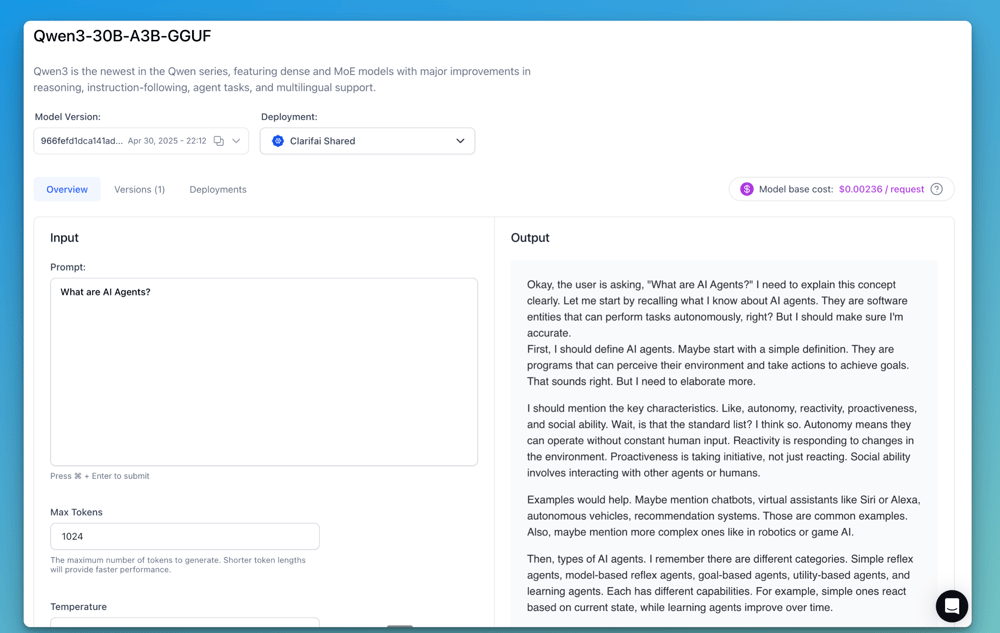
Published Qwen3-30B-A3B-GGUF, the latest addition to the Qwen series. This new release features both dense and mixture-of-experts (MoE) models, with significant improvements in reasoning, instruction-following, agent-based tasks, and multilingual capabilities. The Qwen3-30B-A3B outperforms larger models like QwQ-32B, leveraging fewer active parameters while maintaining strong performance across coding and reasoning benchmarks.
Published OpenAI’s latest o3 model, a powerful and well-rounded LLM that sets a new standard for performance across math, science, coding, and visual reasoning tasks. It is built for complex, multi-step thinking and excels at technical problem-solving, interpreting visual data such as charts and diagrams, high-stakes decision-making, and creative ideation.
Published o4-mini, a smaller model optimized for fast, cost-efficient reasoning. Despite its compact size, o4-mini delivers impressive accuracy on math and coding benchmarks like AIME 2025. It is ideal for use cases that require strong reasoning capabilities while keeping latency and cost low. Both the models are also available on the Playground, Try them out here.
Enhanced the Playground experience
Added automatic mode detection based on the selected model — now intelligently switches between Chat and Vision modes for predictions.
Improved model search and identification for a faster, more accurate selection experience.
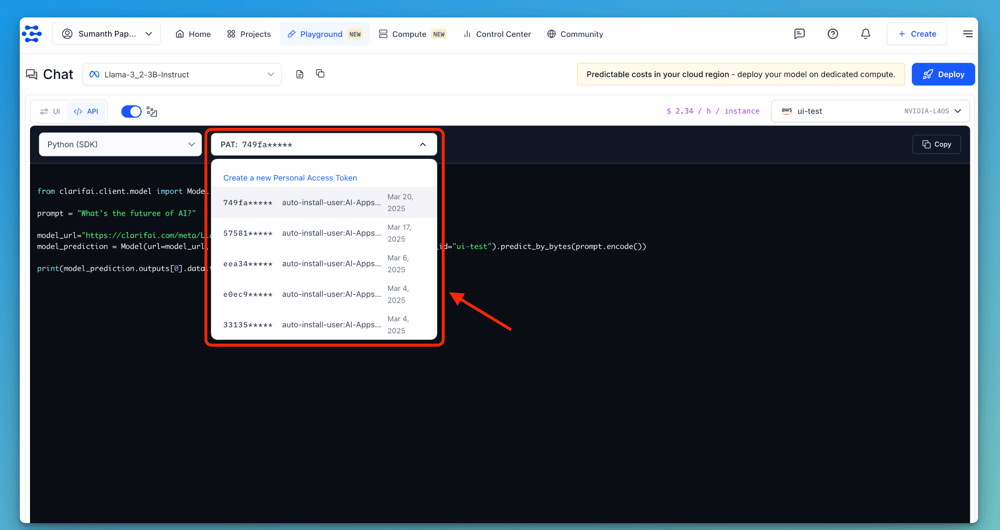
Introduced a Personal Access Token (PAT) dropdown, enabling users to easily insert their PAT keys into code snippets.
Implemented dynamic pricing display that updates based on the selected deployment.
The selected deployment ID is now automatically injected into the inference code.
Enhanced the Control Center
Improved the Community platform
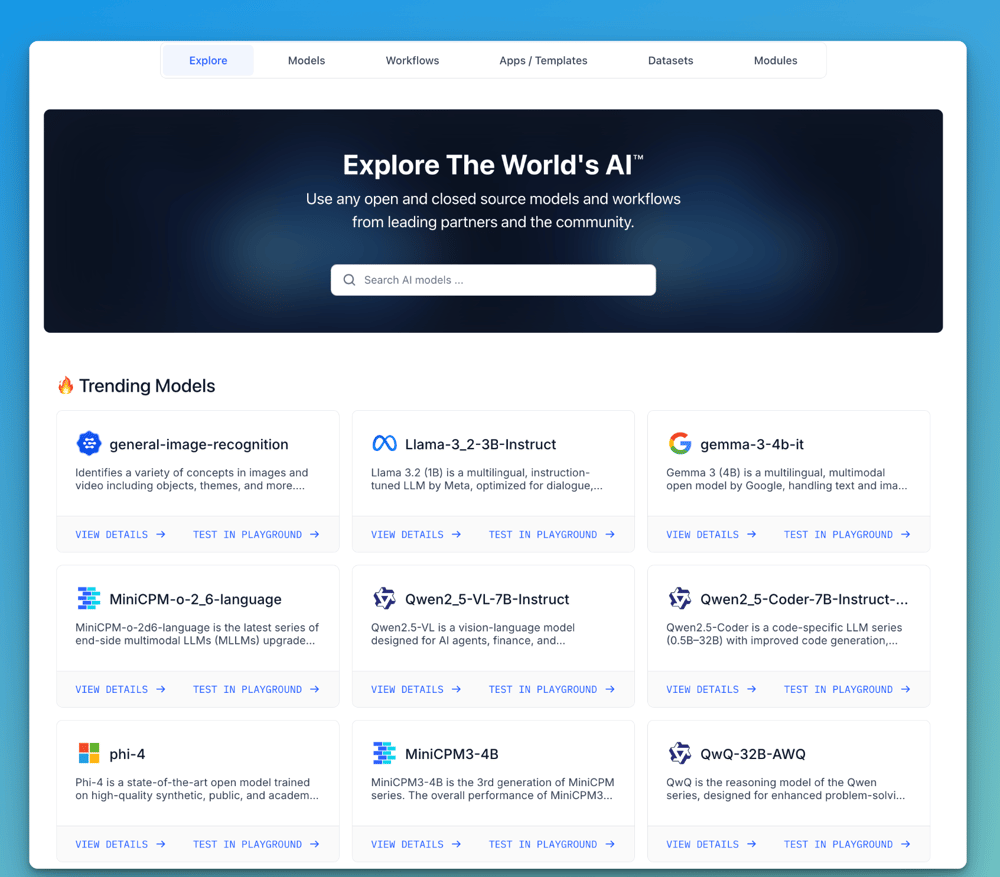
Revamped the Explore page with refreshed visual designs, a featured models showcase, and categorized use cases such as LLMs and VLMs.
Updated the individual model viewer page with an improved UI, direct access to the Playground, deployment listings, and additional enhancements.
Additional Changes
The Home page is now accessible to all users, with sections requiring login automatically hidden for non-logged-in users. A new “Recent Activity” section shows users their most recent actions and operations. We also made improvements to usability, performance, and overall user experience.
New organization accounts now start on the Community plan by default, instead of inheriting the user’s personal plan. This change applies to users on the Community, Essential, and Professional plans. Enterprise users are not affected. The “Member Since” column now shows when a member joined the organization, and Settings pages are hidden from users without the required permissions.
The billing section has been redesigned for a more intuitive credit card management experience. We’ve added validation to prevent duplicate card entries and support for setting or changing the default credit card.
The Python SDK now supports Pythonic models for a more native experience. We fixed failing tests to improve stability. The CLI is now ~20x faster for most operations, includes config contexts, improved error messages, and corrected return arguments in the model builder. Learn more here.
Ready to start building?
With this Python-first release, uploading and running inference on your custom models is now faster, simpler, and more intuitive than ever. Whether you’re integrating a pre-trained model or deploying one you’ve built from scratch, the Clarifai Python SDK gives you the tools to move from prototype to production with minimal overhead.
GameSpot may receive revenue from affiliate and advertising partnerships for sharing this content and from purchases through links.
Like many other companies, PlayStation pushed into the very popular, potentially lucrative, and very competitive, live-service market by making a number of bets, and not all of them have paid off. Most recently, Sony confirmed that it canceled multiple projects, including a live-service God of War and another live-service title from Bend.
There have been successes, too, mostly notably Helldivers 2. The game sold more than 12 million copies, ranking as the No. 3 best-selling game of 2024 in the US. Sony’s multiplayer game Concord, on the other hand, failed to find an audience and was quickly taken offline, with its studio shuttered.
In this post, we’re rounding up all the multiplayer/live-service games PlayStation has in development and providing a status report on them. This was inspired by Radec on social media, who was first to compile a rundown of Sony’s live-service projects and their status.
The latest update to this gallery focuses on Bungie’s Marathon, which was shown off for the first time in mid-April.
It was reported in 2023 that PlayStation boss Jim Ryan, who left Sony in 2024, had a mandate that Sony’s teams should make more games-as-a-service titles. A number of PlayStation developers were reportedly upset with this, and the blame was said to have fallen not on Ryan but Connie Booth, one of the most important and veteran PlayStation developers, leading to her eventual departure.
Another former PlayStation boss, Shuhei Yoshida, recently said the chance of finding success in the competitive live-service market was “small,” but his replacement, Hermen Hulst, was given the resources to fund both single-player games and live-service titles at the same time. However, had Yoshida stayed in that role, he said he would have “tried to resist” the push into the live-service market. He joked, “That’s one of the reasons they removed me.”
Prior to the cancellation of The Last of Us Online and the live-service God of War most recently, Sony indicated it was pulling back from its ambitious live-service strategy. Back in 2023, Sony management said it would only go ahead with six live-service games in the near future, down from a dozen. At the time, management said it was attempting to focus on quality over quantity. But that’s not the end of PlayStation’s foray into live-service, so let’s take a look at how things have gone so far and where future projects stand.
Silicon-carbon batteries are gaining significant momentum, with all Chinese brands utilizing the tech in their 2025 flagships. It’s easy to see why manufacturers are rushing to utilize these batteries in their phones; switching to silicon provides better energy density — allowing brands to squeeze bigger batteries — alongside increased durability, and it holds up much better in cold weather.
Hardwired
(Image credit: Nicholas Sutrich / Android Central)
In Hardwired, AC Senior Editor Harish Jonnalagadda delves into all things hardware, including phones, audio products, storage servers, and networking gear.
That’s why the likes of the Xiaomi 15 Ultra, Find X8 Ultra, Vivo X200 Pro, and Honor Magic 7 Pro have considerably bigger batteries than their predecessors without adding too much bulk or weight. These batteries still use a lithium cathode, but the anode sees a mixture of silicon-carbon alongside the usual graphite, and this results in greater density.
Group14 is at the front lines of this push, with the brand’s SCC55 silicon-carbon composite used widely in the industry — Honor’s Magic 7 Pro uses the custom material in its battery. Group14 is now partnering with German industrial giant BASF to deliver a “drop-in-ready solution” that predominantly uses silicon-dominant anodes.
Group14 says this move has the potential to unlock a whole host of new use cases, and I talked to the brand’s VP of Global Market Strategy, Grant Ray, to get a better understanding of the tech.
As a high-level overview, Group14 is using its SCC55 material with BASF’s Licity 2698 X F binder, a custom polymer made of styrene-butadiene rubber (SBR) with high stress-strain and elasticity that’s designed for silicon-rich anodes. Without getting in the weeds too much, this collaboration makes it easier for phone brands to make the switch to silicon-rich batteries without overhauling their existing manufacturing lines.
This is important, because the current generation of silicon carbon batteries used in phones have just 10% silicon in their anode. While silicon has greater energy density of 4200mAh/g — graphite has 372mAh/g — it expands considerably during charging and discharging. Mixing silicon with carbon — as Group14 is doing with SCC55 — increases the material’s mechanical integrity (thereby reducing swelling) while providing better conductivity.
ay said the next iteration of batteries will see a greater mixture of silicon-carbon in the anode, with work underway on “full displacement” — completely switching to a silicon-carbon anode. While full displacement is still some time away, the advances in mixing higher ratios of silicon-carbon anode should deliver batteries with significantly greater density and faster charging.
Get the latest news from Android Central, your trusted companion in the world of Android
It’s not unfathomable to imagine next-gen phones delivering 10,000mAh batteries in roughly the same size as today’s devices, and Ray said that phone manufacturers are not as risk-averse to trying out increasing silicon mixtures. While this tech is being pioneered by Chinese brands, Ray says we may see bigger brands like Samsung switch to silicon-carbon batteries in the near future; the Galaxy S26 is touted to feature the battery next year.
A limitation in this area is availability; Ray says that the demand for the SCC55 material is significantly higher than supply, and the manufacturer is aiming to get its U.S. plant online in 2026 to cater to global demand. The current situation with tariffs is a new hurdle that’s leading to plenty of uncertainty, but Ray notes that Group14 is pushing ahead with its plans.
Using flagships this year made me realize the potential of silicon-carbon batteries, and I’m excited to see how this tech evolves in 2026 and beyond. Most phones these days last at least a day and a half between charges, and I can’t wait until the time comes when I’ll only need to charge my phones twice or thrice a week.
Active listening is a crucial skill that can significantly enhance your job search process. It involves fully concentrating, understanding, responding, and remembering what is being said. Here’s how you can effectively use active listening while job searching:
During Networking Events:
Engage Fully: When speaking with professionals at networking events, give them your full attention. Make eye contact, nod to show understanding, and avoid distractions.
Ask Open-Ended Questions: Encourage detailed responses by asking open-ended questions. For example, “Can you tell me more about your role at [Company]?” or “What do you find most rewarding about your job?”
Reflect and Summarize: Reflect on what the other person has said by summarizing their points. This shows that you are actively listening and helps reinforce your understanding.
In Informational Interviews:
Prepare Thoughtful Questions: Before the interview, prepare a list of questions that show you’ve done your homework and are genuinely interested in the other person’s insights.
Listen More Than You Speak: Allow the other person to do most of the talking. Your goal is to gather information and insights, so focus on listening and understanding their perspective.
Take Notes: Jot down key points and insights during the conversation. This not only helps you remember important details but also shows that you value the information being shared.
During Job Interviews:
Pay Attention to Details: Listen carefully to the interviewer’s questions and comments. This will help you provide relevant and thoughtful responses.
Clarify When Needed: If you’re unsure about a question or need more information, don’t hesitate to ask for clarification. This shows that you are attentive and want to provide the best possible answer.
Use Reflective Listening: Paraphrase or summarize what the interviewer has said to confirm your understanding. For example, “So, if I understand correctly, you’re looking for someone who can improve your social media strategy?”
In Follow-Up Communications:
Reference Key Points: When sending follow-up emails or thank-you notes, reference specific points discussed during the interview or conversation. This demonstrates that you were actively listening and are genuinely interested in the role.
Personalize Your Message: Tailor your follow-up communications based on the information you gathered through active listening. This makes your messages more relevant and impactful.
When Researching Companies:
Listen to Webinars and Podcasts: Many companies share valuable insights through webinars, podcasts, and other media. Actively listen to these resources to gain a deeper understanding of the company’s culture, values, and goals.
Read Between the Lines: Pay attention to the language and tone used in company communications, such as blog posts, press releases, and social media. This can provide clues about the company’s priorities and work environment.
During Peer Discussions:
Engage in Job Search Groups: Participate in job search support groups or forums where you can share experiences and advice with peers. Actively listen to others’ stories and suggestions to gain new insights and strategies.
Offer Constructive Feedback: When others share their experiences, listen attentively and offer thoughtful feedback or advice. This fosters a supportive community and can lead to valuable connections.
Conclusion
Active listening is a powerful tool that can enhance every aspect of your job search, from networking and informational interviews to job interviews and follow-up communications.
By fully engaging with others, asking thoughtful questions, and reflecting on the information shared, you can build stronger connections, gain valuable insights, and present yourself as a thoughtful and attentive candidate. Implement these active listening strategies to elevate your job search and increase your chances of success.
If you are looking for remote jobs, there’s no better place to start than DailyRemote. So, what are you waiting for? Get started today, find the remote job of your dreams, start applying today. Join like-minded people in our




![The best Masturbation May deals we could find [2025]](https://www.fazb.com.sa/wp-content/uploads/2025/05/The-best-Masturbation-May-deals-we-could-find-2025.png)