CNC Machining vs. 3D Printing Costs for Precision Prototype Development Insights


You’ve got the breakthrough product that could change everything. Maybe it’s a revolutionary gear housing that solves an industry-wide problem. Maybe it’s a sleek, modern bottle opener that reinvents a timeless tool. Whatever your innovation, you’re ready to move from concept to prototype, and you need it done right, done fast, and done within budget.

Now comes the critical decision that could make or break your project’s success. CNC machining and 3D printing both promise to transform your digital design into a physical reality, but they couldn’t be more different in their approach, costs, and capabilities. One offers unmatched precision and durability, while the other delivers speed and design flexibility. The choice you make here will determine not just your prototype quality and timeline, but your entire project’s trajectory. Because getting it wrong doesn’t just drain your budget, but it kills momentum, erodes stakeholder confidence, and can derail even the most promising innovations before they ever reach the market.

If you want to know more, for your project or firm, the leading agency Cad Crowd, is the best choice for you. They have 94,000 experts and professionals you can choose from at a very reasonable price with excellent service.


🚀 Table of contents


Difference between CNC vs. 3D printing

Let’s count costs, but before that, let’s make one thing clear: CNC machining design and 3D printing design aren’t two iterations of the same animal. They’re two distinct monsters in the realm of manufacturing, each with their own flair, positives, and attitude.

CNC machining? That’s the classic heavyweight titleholder. It’s a subtractive process, which means you start with a solid block of material, generally metal or plastic, then scrape away everything else that doesn’t fit. As a mission-focused sculptor, CNC machines are experts at precision cutting. Got something that requires heat, stress, or merely the tough demands of being out in industry? CNC’s your guy. And when tolerances must be tighter than last December’s holiday tight jeans, CNC is where it’s at.

3D printing is an additive manufacturing process, where rather than cutting things out, it adds your part piece by piece from the ground up, layer by layer. Whether spooled filament, liquid resin, or microscopic metal powder, 3D printers are masters of complexity. Want a prototype quickly? Need crazy-curved shapes and internal voids? 3D printing has that for breakfast. It’s perfect for rapid iterations, innovative designs, and tasks where speed and flexibility are more valuable than raw power.

RELATED: How 3D Printing for Rapid Manufacturing Is Pushing Boundaries at Product Design Services Firms 

Both CNC and 3D printing are revolutionary. CNC provides muscle and accuracy; 3D printing provides imagination and quickness. Which one is correct? That’s entirely dependent on what you’re producing, how quickly you need it, and how much abuse your part will endure. Understand the difference, and you’re already halfway to making the intelligent (and budget-friendly) decision.

The cost breakdown: it’s not always what you think

Let’s speak in numbers, because when you’re dealing with prototyping or small-batch production, what you believe an item will cost and what it really costs can be two completely disparate tales. CNC machining, for example, will make your wallet quiver at first sight. That is because CNC takes a lot of setup before the first part itself is cut. You have CAM (Computer-Aided Manufacturing) programming, tooling, and fixturing services to keep you awake. It’s an entire production just to clamp down on your raw material. So, if you are placing a single aluminum prototype order, don’t be surprised to pay anywhere between $75 and $300. Ouch, isn’t it?

RELATED: Benefits of Outsourcing CNC Machining Services for Your Company’s Prototype Design

Enter 3D printing as a cost-effective hero now. There’s almost no setup fee. You’ve got your electronic file, you choose your material, and you’re racing off. Need simple thermoplastic component services? You could have it done for as little as $20 to $60, and less if it’s a small or hollow design.

But here’s the twist: CNC machining begins to excel with volume. The more you increase the products from 50 or 100 pieces, the setup fees are amortized. That $300 in tooling is now just a few dollars per piece, and CNC’s unit cost falls dramatically. With 3D printing, however, how many pieces you’re printing is irrelevant. The unit cost remains roughly the same, so it’s not very good for scaling.

So what’s the real takeaway? If you’re prototyping or making just a few units, 3D printing often wins on price. But for higher-volume production runs, CNC can sneak up and steal the cost-efficiency crown. It all depends on your goals and your quantities.

Manufacturing Service Hourly Rate Per Project
3D Printing $2–$15 $20–$150 per item
CNC Machining $40–$150 $75–$500 per item

RELATED: The Advantages and Disadvantages of CNC Machining for Prototype Design

Speed and flexibility: the hidden costs

In the early stages, your concept is rarely perfect right out of the gate. You’ll tweak it. Then tweak it again and again. This is where 3D printing services become the MVP of prototyping without fanfare. Why? Because altering a design is as easy as revising a digital file. No production overhaul required. You send it to “print” before you head out for the day, and by the time you return to the office with your coffee cup in hand, the new prototype is ready to test. You can make another alteration before lunch and keep that creative momentum going.

Now compare that to CNC machining. Each design tweak usually means retooling, literally. You’ll have to reprogram the toolpaths, adjust the fixtures, and sometimes even swap out materials or cutting tools. It’s precise, yes, but every change adds time. And in this game, time is money.

But here’s the thing: whereas 3D printing excels at speed and adaptability, it may not always take home the endurance competition. If your working prototype has to endure high stress, support heavy loads, or survive heat, those plastic prints may not cut it. That’s when CNC machining takes the lead. It might take longer to change direction, but when performance is paramount, CNC still reigns supreme.

RELATED: How to Design 3D Models for 3D Printing & New Prototypes

So what’s the lesson? In today’s world of prototyping, 3D printing allows you to go fast and repeat frequently. But when the piece has to be as durable as possible, CNC’s your ticket. Finding the right time to use each is the key to staying within budget and on deadline.

From CAD file to physical prototype overnight

Product development services follow a strategic prototyping journey that matches the right technology to each stage. In early development, when you need quick visual prototypes for investor presentations or stakeholder buy-in, 3D printing delivers overnight results from your CAD files. It handles complex geometries effortlessly and provides affordable proof-of-concept models that demonstrate form and fit without significant upfront investment.
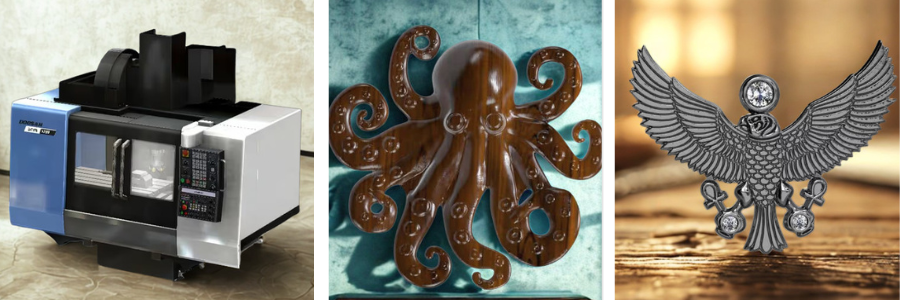
CNC-machining-prototype-precision-workshop-manufacturingpng

As your design matures and performance testing becomes critical, CNC machining takes over the prototyping process. Working with actual production materials like aluminum, stainless steel, or engineered plastics, CNC creates prototypes that can withstand real-world stress testing, temperature variations, and mechanical loads. This stage validates not just appearance but actual functionality, providing the performance data needed before moving to production. For small batch manufacturing and beta testing, CNC offers excellent per-unit economics with professional finish quality and tight tolerances.

The key to successful prototyping lies in understanding when each technology excels. When designs feature complex internal channels, organic shapes, or intricate geometries that challenge traditional machining, 3D printing returns as the optimal solution. It builds the most complex forms layer by layer without special tooling, setup costs, or geometry limitations. Rather than competing technologies, 3D printing and CNC machining work as complementary partners throughout the product lifecycle, ensuring faster time to market, reduced development costs, and more robust final products.

RELATED: 3D Printing Technologies for Modeling and Prototyping

The materials game

Let’s discuss materials, because when it comes to prototyping or production, your project’s success can depend on what it’s made of. Selecting the proper material isn’t just a checkbox, it can make or break your entire design.

CNC machining is the clear winner in terms of diversity. Imagine a buffet of metal and plastic: aluminum, brass, stainless steel, titanium; name it. You can even opt for carbon fiber-reinforced nylon if you want to get fancy. And the best part? You’re working with real-world materials, so you can test your design in the real world. Will it bend? Will it break? CNC provides you with real answers, not approximations.

On the other side of the ring, we’ve got 3D printing. And yes, it’s come a long way. Entry-level FDM printers work with familiar thermoplastics like PLA, ABS, PETG, and nylon. SLA printers offer amazing surface finishes, though their resins tend to be more fragile. Step up to industrial 3D printing like SLS (Selective Laser Sintering) or MJF (Multi Jet Fusion), and you’ll get stronger, more usable parts. Metal 3D printing design is also a thing, and it’s jaw-droppingly cool but be warned: it’ll burn through your budget fast.
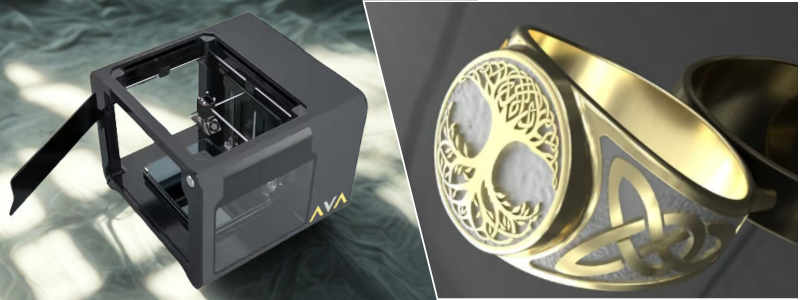
3d-printing-rapid-prototype-additive-manufacturing processpng

Here’s the bottom line: if you’re building a complex internal structure that would make a machinist cry, metal 3D printing might be worth it. But if your goal is to create a strong, functional metal bracket or housing? CNC is still the smarter, faster, and more cost-effective option.

In the game of materials, it’s not only what you can do, it’s also about what you can afford. Pick wisely.

Post-processing and finishing

Now let’s discuss a cost that enjoys catching you off guard: post-processing and finishing. It’s not the most glamorous aspect of production, but if you neglect it, it will creepily eat into your wallet. Let’s say you’ve just 3D printed a prototype. Awesome, right? Wait, before you can put it to any kind of useful work, you’re not really finished. That raw part could require support structure removal, sanding, curing, or coating for strength or cosmetic purposes. And if you’re getting ready to shoot some product photos or make an investor presentation, you’ll likely want it to be showroom material. That kind of polish isn’t quick work, nor easy work, and often requires other materials or tools. Translation: more money.

And what about CNC-machined parts services? They tend to look much cleaner coming off the machine than their 3D-printed equivalents. But even so, there are usually deburred edges, surface finish, or anodizing to factor in, if the part is going to be handled by a client, at least. That smooth, professional finish you’re expecting? It doesn’t magically occur. Incorporate it into your budget upfront, even if you’re only prototyping. The time you invest in polishing and refining could very well be the difference between something that “works” and something that really blows away. Precision Matters- So Does Purpose!

Let’s cut to the chase, if your design depends on sheer precision, CNC machining remains the champion. This is no marketing rhetoric. We’re speaking of tolerances as tight as ±0.001 inches or tighter. That’s the accuracy you require when parts need to fit each other exactly, as in mechanical assemblies, sliding parts, or press-fit components that cannot risk shifting.

Yes, 3D printing is catching up and some high-end printers are surprisingly precise, but your typical print will fall somewhere in the range of ±0.005 to 0.01 inches. That’s fine for a rapid concept model or a snap-fit plastic enclosure. But if you’re making a part for a jet engine or a medical device, “good enough” won’t do.

RELATED: 3D Printing Technologies for Modeling and Prototyping

So, how do you decide? It all depends on your purpose. If you are at the early stage of prototyping design and only require something tangible to hold in your hand or present to the team, 3D printing is quick, adaptable, and affordable. You can experiment rapidly and check form and fit without burning through your budget.

But when you’re beyond the napkin sketch and require actual, testable, engineering-grade parts? CNC is your best bet. You’ll have the accuracy, ruggedness, and material selection that high-performance components require. Long story short, each tool has its application. The key is recognizing which phase you’re at and what your design really requires. Because in product development, precision is important. But so is purpose.

The freelancer factor: getting help on Cad Crowd

Now here’s the good news, you don’t have to do it all alone. If you’re not sure whether your prototype would be better suited to be 3D printed or CNC machined, Cad Crowd’s got you covered. Seriously. You’ve got choices, and more importantly, you’ve got specialists who know just how to assist.

RELATED: How to Improve Product Development For Your Company with Engineering Firms & Design Consultants

Need CAD files design perfectly optimized for CNC machining? No sweat. Need a designer familiar with the nitty-gritty of SLS printing and how to modify your model in response? No big deal. Need someone to do the actual printing or machining so you can work on the grand scheme? Done and done.

Cad Crowd makes it ridiculously simple to reach out to seasoned designers and engineers who’ve done it all and who can assist you with striking the right balance of quality, budget, and tight deadlines without sweating a drop. If you’re still brainstorming or you already have a prototype that only requires a little tweaking, Cad Crowd has someone who can take your concept and get it moving in the right direction. It’s like having your own dream product development team, waiting to pounce when you need them most. So smart build, don’t hard build.

Final takeaway: use the right tool for the right job

The choice between CNC machining and 3D printing isn’t about finding a winner, it’s about selecting the right tool for your specific stage of development. 3D printing excels in early prototyping with its speed, flexibility, and low setup costs, making it perfect for rapid iterations and complex geometries. CNC machining dominates when precision, durability, and real-world materials are critical for functional testing and production-ready parts. Smart product developers leverage both technologies strategically throughout their development cycle, using 3D printing for concept validation and CNC for performance testing. The true cost of precision lies not just in dollars, but in making informed decisions that accelerate your path to market success.

RELATED: How CAD Modernizes Product Concept Design at Industrial Design Services Companies

Ready to build your perfect prototype: Cad Crowd can help

Stop second-guessing your manufacturing choices and start building with confidence. Whether you need rapid 3D printing for early concepts or precision CNC machining for functional testing, expert help is just a click away. Connect with experienced professionals who understand exactly when and how to use each technology for maximum impact. Contact Cad Crowd today for your free quote and transform your ideas into reality; smartly and efficiently.

author avatar

MacKenzie Brown is the founder and CEO of Cad Crowd. With over 18 years of experience in launching and scaling platforms specializing in CAD services, product design, manufacturing, hardware, and software development, MacKenzie is a recognized authority in the engineering industry. Under his leadership, Cad Crowd serves esteemed clients like NASA, JPL, the U.S. Navy, and Fortune 500 companies, empowering innovators with access to high-quality design and engineering talent.

Connect with me: LinkedInXCad Crowd

How Can Accurate 3D CAD Modeling Benefit to the Design Process of Your Firm


It appears that product development is at a stage and at a time that is so image and so technologically driven that it would appear that the napkin sketch would be worth so much less than it once would have. Yet it would appear that it is at precisely this stage that the next generation designs would have so much more definition, so much more precision, so much more sophistication, so much more detailed work that there would be no room for error. It would be here that a 3D CAD modeling solution would want to have so much confidence and so much enthusiasm that they could develop an idea, no matter if it were fuzzy, into something your whole organization would be happy with.

How you carry out 3D CAD modeling effectively is definitely not an “oh wow” thing that your competitors would be so envious they would be itching to demonstrate at a business presentation as if they are on the precipice. A 3D CAD model, on the contrary, signifies exactly the spine of an optimized process itself. It will enable your project members to conceptualize with a clear intention and communicate without being caught up in understanding discrepancies created using scribbled-out sketches on a piece of paper. That, my friend, clearly signifies an effortless glide from conceptualizing to completion without a hitch.

Give it a chance, and it will soon turn out to be your new best pal if your project serves as a productivity supercharger and astonishes your client before they might have even posed an inquiry. Sites like Cad Crowd are there so that you can get your own freelance 3D CAD modeling artists who not only have a great knowledge base about things they are talking about with regards to accuracy. These people will bring their own knowledge base with them into your own projects without your having to hire an entire staff. Companies will no doubt let out a collective breath at this alone.

So, let us start an exploration on how the proper 3D CAD modeling software solution can help your business succeed with your designs within today’s competitive market.


🚀 Table of contents


Intelligence-assisted visualization for all phases of development improvement

Nevertheless, there is something magical about seeing an idea develop out of a conception on a piece of paper and develop into something three-dimensional and optimal. It somehow becomes more feasible and possible with unlimited opportunities waiting to be discovered. The accuracy and precision that you receive with 3D CAD design services enable your design team to have designs conceived at a size scale that might have been impractical with conventional designs. You have perspective, size, scale, proportion, and even a sense.

Just consider having an idea for the very first time for a client or some executives at your own organization. You might be standing there with some 2D sketches on a board and hoping that everyone who understands it would be viewing it exactly the same as you. But with a 3D model with exactly what you want to build and giving you the functionality to pan, zoom, and rotate it from any side, you’re answering questions before people even have a chance to ask. That helps people who have to sign things off because they’re viewing it and having to picture what it might look like.

The reward for this will be enormous and will be achieved as you develop your designs. Your whole team will be aware of what needs to be done. You will be able to mess around with designs without having to rip apart your prototypes or even focus on designs that are brand new. It will be easier and more collaborative, as everyone will be viewing things from the same perspective, making your designs appear convenient.

3D modeling of various products by Cad Crowd design engineering experts

RELATED: Tips for product design firms: Validate new product ideas & squash launch failures

Improve accuracy and prevent costly guesswork

But then again, if your business has ever had to deal with the presence of error measurement or with the sly short hoodlum named Misunderstanding lurking about, then it will all be up to 3D CAD modeling with its accuracy. The accuracy that is required and necessary for your business, and that your business can put stock in and trust and believe with regard to precision, will be there with 3D CAD modeling. There are no guesses as to anything being too general.

Accuracy will be your basis for designs. The error will be so small. The unexpected surprises will never be a surprise for production. Production will never be caught off guard. Prototypes will never be distorted or incompatible with systems. Engineering design experts will never be put into a position to have to hold everything back because they’re correcting something they could have very well prevented.

And all these with precision on this scale will be the challenge for industries as complex as your auto, aerospace, robotics, medical, and architectural industries. It will be your products with detailed components with specific safety needs that will make up your 3D CAD models. You will no longer have to wait on tenterhooks as you make your submissions for production because you will be aware that all the minute details were stipulated.

But if it’s not something your business already has an area for and designs with CAD skills commensurate with your industry, then Cad Crowd will be providing your business with extremely skilled professionals competent enough to provide your models with accuracy levels commensurate with your industry.

All departments will work seamlessly

A design will never be solo. It requires multiple teams for something as elementary as an article or an object. Engineering requires an approval check on feasibility, Marketing requires an approval check on designs, Production requires an approval check on production, and then an approval check on cost at the management level; it becomes a Telephone game without an instrument that can amplify all requests.

A correct 3D CAD model does not have these hurdles because there is a common goal that everyone can relate to. All communications are done within a universal language and without misunderstandings between 3D modeling design services. You will not be writing an email about changes and your colleagues pointing at a correct 3D model and talking about changes with reference to some components.

It will remove friction with communications so that collaboration will be an even better experience. The reviews for designs will occur within shorter periods because, believe it or not, there will be a better communications tool that will replace a document with pages and pages. The engineers will be able to spot regions with problems with structures. The designers will be able to create surfaces without creating problems with functionality.

The more your business requires specific 3D CAD modeling, the easier collaboration becomes. The feelings of understanding that result from a smooth workflow make it possible for a much higher level of collaboration and tension release that arises with completing a difficult project.

Enable quicker iteration and save time with a focus on encouraging innovation

Speed is a trait that truly requires a lot and is very necessary for competitive business. Those who will be able to sustain an extremely high speed from conceptual stages to approval will certainly have an edge. However, then every stage will be an enormous task, and it might be quite tough. You will be able to attain rapid product cycles with the proper 3D CAD modeling because your group will be working on a copy and making changes to something that already exists, instead of doing everything again and again.

Regarding things like some form of change on the client’s side, there are some changes that occur effortlessly. Due to some form of error noticed within some designs by 3D modeling design experts, some changes will be incorporated without having to start from scratch. Assuming your employees are interested in some designs, then accuracy within 3D CAD modeling will have you testing some routes without excessive investment in your schedules.

It promotes creativity

The justification for this is that, because it would be easy to modify, there would be confidence in making statements about very large designs. Even without physically prototyping, it would be possible for engineers to analyze various performances. It would make everyone in the community inventive because it would be cheaper to research designs.

However, things escalate even more into higher gear within an uninterrupted iteration process among various companies that have engaged with freelance professionals on relevant 3D CAD modeling. Cad Crowd helps you source experts with knowledge on rapid iteration and executing changes at an unimaginably fast rate. Productivity will increase as your company will be capable of producing results out of this world at unbelievably short times.

RELATED: Prototype cost Vs. production cost: Prototyping services rates and R&D pricing for firms

The cost of production process

Evidently, amongst perhaps some of the most encouraging benefits of an exact 3D CAD modeling process would be its economy. It truly is an undeniable fact that problems discovered at an early stage cost less compared to problems detected at a production stage. A tiny miscalculation made at an unnoticed modeling stage can turn out to be an economic headache at the ordering and production stage. It will allow your project participants, even engineering design services, to identify problems before they turn into disasters. You will be able to concentrate on your project and review it if necessary before checking for compatibility.

It will be your first line of defense against project failures because you employ 3D CAD modeling software. Both industries are pleased with the exact model due to its immense benefits. The industry will be able to check at once if it suits them. A disadvantage will be removed because they will have an easier chance of finding an approximate cost estimate. A timetable with high accuracy will be created. It would be very useful and advantageous for your business budgeting if there were a model that would enable verification of information, so that your business budgeting would be more efficient, even if your organization were doing the production.

It does not have to be pointed out that the more information your organization receives about budgeting, the better it would be, because then there would be no surprises. The more efficient your budgeting is, the more money an organization will3D CAD modeling and skills provided at Cad Crowd will make your production chain smooth and cost-effective. 3D CAD modeling and skills provided at Cad Crowd have already justified itself on visualization, accuracy, collaboration, rapid iteration, and cost savings.

But there’s more, as your business adopts this giant as a step within your production chain, you will reap more and more benefits. Your overall production chain will be smooth and cost-effective, and your entire staff will benefit. And as your creative staff people will no longer be working on guesses and old ways, creativity will bloom and surprise even the most seasoned and experienced executives.

A source of competitive advantage in turbulent markets

Fast-tracking business operations promotes value innovation and productivity. Delays caused by developments will be missed opportunities. Unproductive business operations will result in frustrated customers. At some point, there will be no business growth. Accuracy obtained from 3D rendering design services and modeling translates to good business as it boosts productivity and accuracy.

When your business presents clean graphics at an early stage, they appreciate it. When your models fit and work as they should, they appreciate it. When your employees express an idea not only clearly but also professionally, they appreciate it. It is because of these factors that your reputation will be made and your business will be honored among your competitors who engage in taking corners with wrong methods.

Effective 3D CAD modeling brings enormous opportunities for you, and you can be bolder without fear. Those designs that were hard for you to do are accomplished with the help of efficient modeling tools. It will be easy for you to get creative. It will be easy for you to enter new markets without taking any risk. Your business will be able to undertake projects that were hard for you.

This advantage will be made even better as your company will make use of freelance modelers from Cad Crowd. You will eventually get talent from all around the world without any commitment to be made. You will be more flexible and will scale at a very rapid rate as opportunities arise for you, and, hence, make sure your business is ready and up-to-date.

3d model of electronic products by Cad Crowd design experts and freelancers

RELATED: 13 reasons why companies outsource IoT design & development to product design firms

Higher accuracy levels in prototyping, thus fewer trial and error experiments

And then, of course, there’s the entertaining bit: your idea realized as a three-dimensional model. But it can be frustrating if there are discrepancies in your designs or if your designs aren’t assembled properly. A small mistake on your three-dimensional model, and before you know it, you have an issue on your hands with your prototype and need to fix it with the product engineering expert. It becomes a defect, and an error becomes a costly correction.

By using 3D CAD modeling, all these problems are removed and maintained at as low a level as possible. It allows creating a prototype that is similar to the actual thing. All specifications relating to size are correct. Components are in the correct places. So, it becomes an exact representation of an actual product.

It will result in an efficient process as regards two parameters: first, there will be fewer prototypes because error correction will be carried out digitally and not physically, and second, there will be more relevant testing on these prototypes because they will no longer be restricted to geometry testing. You will be able to test functionality as opposed to correcting errors.

These are some processes that require very detailed digital modeling. These processes are 3D printing, CNC machining, vacuum forming, and injection molding. The more detailed the design of a product, the easier it becomes to turn it into a product. It truly becomes an extremely critical stage requiring very detailed 3D CAD modeling. Freelance CAD technologists on Cad Crowd will mostly have designs for making prototypes. The experts will make sure that your prototype will be successfully realized as an actual product, either as an idea model or as a functional unit. 

Unlock the full potential of your design process

Among the most necessary technologies that should be implemented within any business at the current stage will be the implementation of accurate 3D CAD modeling. It will enhance visualization, accuracy, collaboration, rates of iteration, and simulation and prototyping design engineering services. It will also be extremely useful and apt for the minimization of production costs. It will prepare your business for success and will provide a foundation for your growth. 

All phases and stages of your business will be extremely efficient and delightful as soon as accuracy becomes your core business activity. You don’t have to employ an entire CAD staff on a full-time basis. It has become extremely easy and effortless for you to be introduced to highly skilled freelance 3D CAD model artists who will prove an unwavering level of accuracy and professionalism in what they do, thanks to Cad Crowd. 

How Cad Crowd can help

So, if you are interested in taking your process of designs and products to the next level and making your products have an increased backbone and achieve an unparalleled breakthrough from conceptualization to completion, then it’s about time you explored your options. You should check out Cad Crowd and check out highly skilled freelance 3D CAD model artists that will assist you in actualizing your vision. be able to spend on R and D. Request a quote today.

author avatar

MacKenzie Brown is the founder and CEO of Cad Crowd. With over 18 years of experience in launching and scaling platforms specializing in CAD services, product design, manufacturing, hardware, and software development, MacKenzie is a recognized authority in the engineering industry. Under his leadership, Cad Crowd serves esteemed clients like NASA, JPL, the U.S. Navy, and Fortune 500 companies, empowering innovators with access to high-quality design and engineering talent.

Connect with me: LinkedInXCad Crowd