As tensions between President Donald Trump and Europe continue to simmer, the continent is accelerating its moves to reduce its addiction to US technology. Cities and governments are ditching Microsoft Office for open-source alternatives, shifting to European cloud hosting for local AI, and moving defense data to systems without American involvement. Nowhere has this been more clear than in France.
Over the last few months, the French government has sped up its efforts to develop and deploy its own technology for government officials. The country has, arguably, emerged at the head of Europe’s growing digital sovereignty push, which aims to cut some reliance on US-based technology over concerns around data security, the Trump administration’s unpredictability, and changing prices. French budget minister David Amiel recently called for the state to “break free” from American systems and use those it can control.
“We are not just explaining what we want to do,” Stéphanie Schaer, the head of DINUM, France’s digital transformation ministry, tells WIRED over a call on the nation’s video-calling platform Visio. “We already did it in a few matters.” So far, more than 40,000 French government staff have started using the home-grown video platform, while the rest will move away from Zoom, Microsoft Teams, and others by 2027. “We are confident enough to use it every day and we are not dependent on just one actor that will tell us you have to use my video conference,” Schaer says.
Across France’s central government agencies and vast civil service, officials plan to shift to as many French, European, and open source technology alternatives as possible in the coming years. Schaer says it is important for the French government to be in control of the technology that it is using, with data being stored locally in the country, not abroad.
As part of this, DINUM has been developing a set of productivity tools, collectively called “LaSuite,” since at least 2023. As well as Visio, it includes instant messaging app Tchap, Messagerie instead of Gmail or Outlook, Fichiers for documents and file sharing, plus text editing software Docs, and Grist for spreadsheets. Some of the software is still in beta and has not been fully rolled out to French officials yet. However, Tchap already has 420,000 active users, Schaer says, with 20,000 civil servants adopting it each month.
“We are based on open source software. So we don’t develop all the code,” Schaer says. There are public plans for newfeatures, although code is published on Microsoft-owned Github. All data handled by the alternatives has to be processed in France and stored with providers who have approval from the country’s cybersecurity agency ANSSI. Earlier this month, the Dutch government moved its open-source code off of GitHub and onto a Forgejo instance hosted on government-owned servers.
While open source is key, the French government is also working with other countries and private firms on the development of its tools. “We can reuse what has been developed by the community and we contribute to this community,” Schaer says. For instance, Visio, which can host calls of up to 150 people and has AI transcription of calls, is built on technology from French firms Outscale and Pyannote.
While Schaer’s department is aiming to lead by example, all of France’s central government agencies have to come up with plans to move away from US tech—across office software, antivirus, AI, databases, and more—by this fall. On April 23, French officials also announced the country will move its health data platform away from Microsoft to local cloud provider Scaleway, after a years-long decision process.
BIM has transformed the way AEC teams design, but the documentation process still lags behind. As Niknaz Aftahi puts it, “BIM is smarter than ever. So why are we still doing so much manually?” Despite highly intelligent models, teams continue to spend a disproportionate amount of time on producing drawings—often up to “30 to 40% of a project’s total time.” This disconnect highlights a persistent gap between design intelligence and deliverable output.
The issue isn’t just inefficiency—it’s a structural bottleneck. Skilled BIM professionals are still tied up with repetitive 2D tasks like labeling, dimensioning, and formatting. As the article notes, “BIM has transformed how we design. It hasn’t yet transformed how we document.” This reliance on manual workflows not only slows projects down but also increases the risk of errors and inconsistencies in final deliverables.
Graebert’s ARES Trinity 2027 aims to close this gap by automating BIM-to-DWG documentation workflows. By leveraging the data already embedded in BIM models, it generates coordinated, annotated drawings with minimal manual intervention. The result is a more streamlined pipeline that connects design, documentation, and collaboration—freeing teams to focus on higher-value work instead of repetitive drafting tasks.
Ultimately, the promise of automation goes beyond speed. As Aftahi emphasizes, “The most valuable thing automation gives you isn’t just speed. It’s your time back.” With solutions like ARES Trinity, AEC teams can finally start realizing BIM’s full potential—not just in design, but in delivering accurate, high-quality documentation at scale.
Warhammer Skulls 2026 is imminent, bringing us the yearly roundup of Warhammer videogame reveals in both the Grimdark far future, plus Age of Sigmar and the Old World. Though these showcases usually include a few too many mobile games for my liking, this year, the tenth anniversary, is properly stacked.
We’ve got Total War: Warhammer 40k, Dawn of War 4, and Dark Heresy all on the horizon, plus Mechanicus 2 and Total War: Warhammer 3’s Bhashiva character pack both releasing the same day as the showcase. We’ve also got Total War: Warhammer’s Lord of the End Times expansion set for this summer.
That’s not even mentioning the Warhammer games already out that might have reveals in-store, such as Space Marine 2, Darktide, or Rogue Trader. So, if you’re a Warhammer fan, it’s definitely a good year to tune in to the stream.
Latest Videos From
Warhammer Skulls 2026 watch times
The Warhammer Skulls 2026 showcase takes place on Thursday, May 21st, though this will be the 22nd in some timezones, like if you choose to tune in at 2 am from Australia (I salute your commitment). Here are the times to watch the showcase:
West Coast North America: 9 am PDT (May 21)
East Coast North America 12 pm EDT (May 21)
United Kingdom: 5 pm BST (May 21)
Europe: 6 pm CEST (May 21)
Japan: 1 am JST (May 22)
Australia: 2 am AEST (May 22)
You can watch it on both the official YouTube or Twitch channels, or you could even watch it right here with us, since the stream is embedded at the top of the article.
What to expect from Warhammer Skulls 2026?
As mentioned in the intro, there are a lot of big Warhammer games on the way, but the week of Warhammer Skulls (May 21st – 28th) also features all sorts of deals on Warhammer videogames, so it’s well worth buying any you’ve had your eye on then. The promo image features:
Space Marine 2
Battlesector
Dark Heresy
Darktide
Boltgun 2
Survivors
Total War: Warhammer 3
Rogue Trader
Dawn of War 4
And I wouldn’t be surprised if there are even more secret announcements in the stream, too. Sadly, I don’t think we’ll get to see anything more of Total War: Warhammer 40k, though, since in the last stream it was mentioned that there wouldn’t be any more news until June. Fingers crossed, though.
Keep up to date with the most important stories and the best deals, as picked by the PC Gamer team.
SpaceX, the aerospace company founded by Elon Musk 24 years ago, has finally made its IPO filing public.
The hefty filing, posted after markets closed Wednesday, shows a company that has developed far beyond its initial pursuit of reusable rockets — although its long-term mission to create a multi-planetary species remains intact. SpaceX is now a technology conglomerate working on satellites and AI, and has become one of the world’s most valuable private companies.
When it goes public later this year on the Nasdaq exchange, it will become one of the most valuable publicly-traded companies. (Nvidia currently holds the crown with a market cap of $5.4 trillion.) SpaceX has chosen the ticker “SPCX” for the listing.
The regulatory filing, known as an S-1, offers the most vivid and financially illuminating public dissection of SpaceX’s business to date. And it comes just weeks ahead of what’s expected to be the largest IPO ever, both in terms of potential money raised (expected to be around $75 billion) and overall valuation (reportedly $1.75 trillion).
Many of the headline details have been reported in the weeks since SpaceX first submitted a confidential version of its S-1 filing to the Securities and Exchange Commission on April 1. The company lost about $4.9 billion in 2025on revenue of more than $18 billion, as Reuters reported last month.
The filing details a business that is currently dominated by SpaceX’s Starlink satellite internet offering, which generated more than half of the company’s revenue last year. It also shows how much SpaceX has burned to get to this point: more than $37 billion lost since inception, according to the S-1.
XAI, the artificial intelligence company Elon Musk created and recently merged into SpaceX, is not helping on that front. The filing shows SpaceX directed around 60% of its capital spending in 2025 to its AI division, or around $20 billion. And yet that division — which houses the chatbot Grok — lost billions last year, and only grew revenue by about 22%. That’s far below the reported revenue growth rates at frontier AI labs.
Despite SpaceX’s complex business, much of its future is pegged to the success of Starship, the fully-reusable heavy lift rocket that has had a series of explosions and technical revamps over the past several years. The company is expected to conduct the 12th launch of Starship as early as this week.
S-1 filings are hundreds of pages long, and this one in particular is likely to be stuffed with interesting numbers, risk factors to SpaceX’s business, and other previously private information. TechCrunch will be pulling out the most interesting details all day, so stay tuned.
This story is developing…
When you purchase through links in our articles, we may earn a small commission. This doesn’t affect our editorial independence.
Worried that the ongoing embrace of artificial intelligence and the acceleration of late-stage capitalism will continue to leave people isolated from each other? Don’t worry, you can talk to ads now! According to a report from Search Engine Land, at this year’s Google Marketing Live event, the company announced a new generation of “conversational” advertisements that will soon start to populate search results.
Google will be rolling out several new ad experiences that will pair with the company’s re-imagined and AI-centric search. That includes “Conversational Discovery” ads, which Search Engine Land reports are sponsored results that are designed to look like an answer to a person’s query. It’ll appear in AI Mode within Google Search and will produce tailored responses with the company’s Gemini AI model. So if you’ve ever found yourself wanting to talk to an advertisement, congratulations, because your strange, specific desire is about to be fulfilled.
In addition to the chatty ads, Google will also introduce “Highlighted Answers,” which will offer highly relevant promotions that will be displayed in a recommendation list. That, too, will be powered by Gemini and will reportedly appear in Google’s standard Search experience. On the consumer side, it’s probably just going to feel like more ads. On the business side, Search Engine Land reports that it’ll make advertisements more dynamic and targeted instead of static and locked to specific keywords and pre-made copy.
While Google is actively trashing its flagship Search product in pursuit of pumping as much AI slop into it as possible, the Wall Street Journal reported that Gemini itself will remain ad-free for the time being. But you’d have to be pretty naive to think that’ll remain the case. We’re already seeing other companies trying to slip ads into their chatbot interfaces.
OpenAI did it, though the results of that experiment would generously be described as mixed and more accurately described as a failure. Turns out corporations are thrilled to pay high rates for ad placements that don’t actually seem to get any attention. Of course, Google has been in the ad game for much longer and has a lot of dark arts to tap into that an upstart like OpenAI can’t—like, say, a digital advertising monopoly.
Search Engine Land said that Conversational Discovery ads and Highlighted Answers are already being tested on users in the United States and will appear on both mobile and desktop. More AI-powered features for advertisers are expected to roll out later this year. So get ready for the web to get even worse.
Before we sing the praises of EPYC PC workstations, let’s take a quick step back. Oftentimes, the title of “workstation” is donned upon a computer for the programs it runs rather than the contents of its case. For some, it could be a beefed-up desktop processor, a professional-grade GPU, and some ECC memory. However, the explosion of artificial intelligence, complex computational fluid dynamics (CFD), and large-scale 3D rendering has pushed traditional hardware to its limits. To keep up with these massive data pipelines, professionals are increasingly turning to server-grade infrastructure packed into a workstation chassis.
At the forefront of this shift is the AMD EPYC processor. While Intel’s Xeon and AMD’s own Threadripper Pro have long been the go-to solutions for heavy enterprise workloads, EPYC PC workstations offer a distinct set of advantages in memory bandwidth, core density, and multi-GPU scalability that leave the competition in the dust.
Here is a closer look at the specific benefits an EPYC workstation can offer your pipeline.
AMD EPYC PCs: Dominating Core Density and Efficiency
When squaring off against Intel Xeon workstations (such as the Xeon W-3400 series), AMD EPYC dominates in raw scale and parallel processing capabilities.
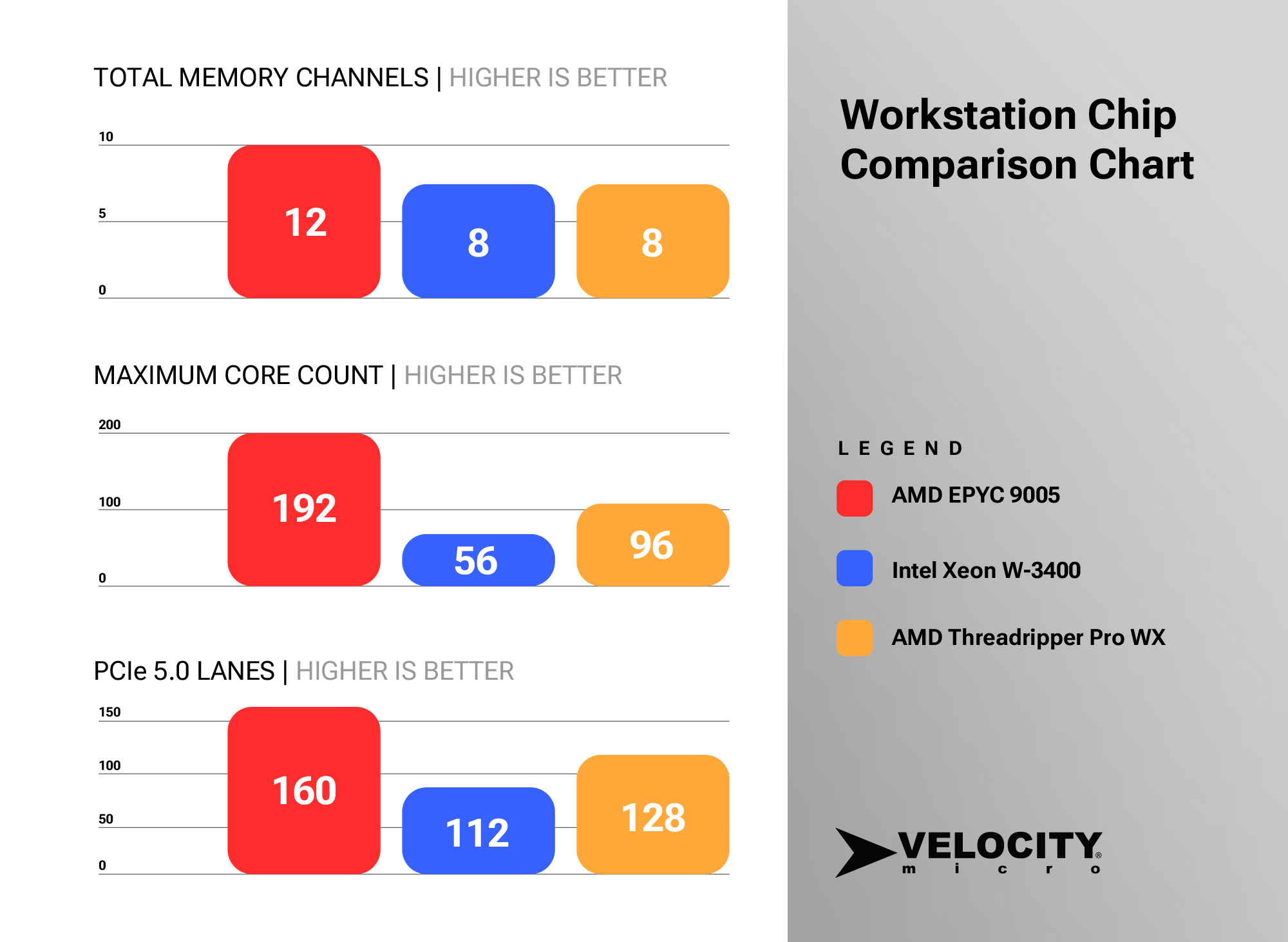
Unmatched Core Density: AMD’s latest EPYC processors (like the 9005 Turin series) boast up to a staggering 192 cores and 384 threads per socket. By comparison, Intel’s highest-end workstation and server offerings consistently trail behind in raw core count. For workloads that scale linearly with cores, such as CPU-based rendering or large-scale virtualization, EPYC handles massively parallel operations with significantly less bottlenecking.
Superior PCIe Lane Availability: Modern workloads often require massive I/O pipelines to feed NVMe storage arrays and multi-GPU setups.EPYC processors offer up to 160 PCIe 5.0 lanes (in single or dual-socket configurations).By contrast, Intel’s flagship W-3400 workstation CPUs cap out at 112 PCIe 5.0 lanes.This massive I/O advantage means EPYC users don’t have to compromise on bandwidth when running multiple high-end AI accelerators or network cards.
Power Efficiency: Built on advanced chiplet architecture (Zen 4/Zen 5) and smaller manufacturing nodes, EPYC processors provide incredibly high performance-per-watt. In sustained, compute-heavy server/workstation workloads, EPYC uses less energy for equivalent or superior performance, making it highly cost-effective over its lifecycle.
AMD EPYC vs. Threadripper Pro: Server-Grade Scale at the Desk
AMD’s Threadripper Pro is arguably the best traditional workstation processor on the market, offering incredible single-core boost clocks for interactive 3D modeling and engineering software. However, when the workload transitions from content creation to massive computation and data processing, EPYC clearly takes the lead.
Massive Memory Bandwidth and Capacity: The memory controller is where EPYC truly separates itself. Threadripper Pro (9000 WX-Series) features an impressive 8-channel DDR5 memory architecture supporting up to 2TB of RAM.EPYC, however, is a true server platform.It features a 12-channel DDR5 memory architecture, delivering 50% more bandwidth (up to 576 GB/s) and supporting up to a massive 6TB of RAM per socket.For memory-bound tasks like training large language models (LLMs) or genomics sequencing, EPYC keeps the GPU pipelines fed where Threadripper Pro might bottleneck.
Dual-Socket Scalability: Threadripper Pro is strictly a single-socket platform. EPYC motherboards are built to scale. You can configure a dual-socket EPYC PC workstation to wield massive core counts (up to 384 physical cores and 24 memory channels in a single system), offering computing density that Threadripper Pro physically cannot match.
4-to-8 GPU Configurations: While Threadripper Pro’s 128 PCIe 5.0 lanes can technically support four GPUs, the WRX90 motherboard ecosystem is heavily restrictive for full 4+ GPU setups. EPYC platforms are native to high-density accelerator layouts. If you are building a deep learning workstation with 4 to 8 GPUs, EPYC is the required platform to ensure that PCIe lane sharing does not cripple your bandwidth.
Is an EPYC PC the Right Choice for You?
If your daily workflow relies on high-frequency, single-threaded responsiveness (like active CAD design or interactive VFX workspaces), Threadripper Pro or a high-clocked Intel CPU remains a stellar choice.But if you are building an AI training node, processing massive datasets, or rendering complex fluid dynamics, you need the unrestricted memory bandwidth, high PCIe lane counts, and core density of AMD EPYC.
For organizations ready to bring data-center-level power directly into the office environment, deploying an enterprise-ready system is a must. The Velocity Micro ProMagix HD360A EPYC PC Workstation is a phenomenal option, expertly engineered to leverage EPYC’s incredible parallel performance, massive memory limits, and robust PCIe arrays inside a reliable, quiet, and premium chassis.
Kevin Roose is an award-winning technology columnist for The New York Times and the best-selling author of three books, “Futureproof,” “Young Money,” and “The Unlikely Disciple.” His column, The Shift, examines the intersection of tech, business, and culture.Continue reading “The AGI Chronicles [MAICON 2026]”
Turning off Forza Horizon 6 car damage can be done through the game’s settings menu and means your car won’t look or drive like you’ve just crashed through a bamboo forest. By default, crashing and damaging your cars in Forza Horizon 6 will only affect their appearance with dents, scrapes, and cracked windows. But you can turn this option off entirely to keep your cars pristine or switch it to Simulation if you want a slightly more realistic approach to crash damage. Here’s everything you need to know about car damage in Forza Horizon 6 and how to turn it off.
How to turn off Forza Horizon 6 car damage
(Image credit: Xbox Game Studios)
To turn off all car damage in Forza Horizon 6, you need to open the Settings menu, then open the Difficulty tab. You’ll then find the Damage & Tyre Wear option near the bottom of the list of Forza Horizon 6 assists and difficulty options and can switch it to ‘None’. This means crashes and scrapes will not affect the appearance or performance of your cars.
There are also no real downsides to having damage switch off either, as it doesn’t affect your difficulty bonus when it comes to Credits, so you can get Forza Horizon 6 money like normal.
For those sticking to the Cosmetic or Simulation options for car damage in FH6, there are a couple of ways you can reset damage to get your car looking and driving like it’s brand new. In free-roam mode, you can open Photo Mode, press LB to Reset Cosmetic Damage, the close Photo Mode. Despite the wording, this button fully repairs your cars, including any component damage that affects its driving capabilities. Additionally, entering any of your houses or the Horizon Festival site main garage will fully repair your car too.
However, there is no way to repair your car or reset any damage it has taken during a race. Your only option is to use the Rewind feature to go back to before you took damage and then take avoiding action. This works well in races against the AI Drivatars but not so much in online races as you end up losing a lot of time to other players. Turning off the Damage & Tyre Wear option entirely is by far the best option, realism be damned!
Google I/O is currently underway, and after sitting through a monotonous an exciting keynote address, I got the chance to demo some upcoming Android XR glasses and prototypes. Samsung and Xreal are seemingly two of the most dedicated players in the space, and I got to try both Xreal’s glasses and the latest Google prototype, which the Samsung glasses are no doubt based on, giving us a look at how Android XR will span different types of eyewear.
Samsung was set to launch Android XR hardware last year with the Galaxy XR, but it’s a large, bulky device you wouldn’t want to wear around. This time around, the focus is on more compact glasses for everyday wear. These are the ones I got to play with, and while I can’t wait for audio-only glasses to come around, I’m more excited about what Samsung and Xreal have in store when it comes to display glasses.
Xreal is unreal
(Image credit: Derrek Lee / Android Central)
The first demo I got to try was arguably the more interesting one. Xreal teased its Project Aura glasses last year, and I was able to give them a spin ahead of the launch later this year. These are display glasses sporting two OLED displays behind the lenses, one for each eye.
Latest Videos From
If you’re familiar with Xreal products, the design here shouldn’t surprise you. They’re thick glasses that sit a little further from your face than usual, in order to give you room for the displays. It’s a design I’m not a fan of from the outside looking in, but when they’re on your face, you don’t notice the difference.
(Image credit: Derrek Lee / Android Central)
The Project Aura glasses have two cameras on either side of the lenses for perception and tracking, while the middle is for taking photos and videos. One stem holds all the buttons: volume rocker, Home/Gemini, and a dimming button to control the electrochromic dimming of the lenses.
There’s also a separate puck that connects to the glasses, which houses the battery and compute (it’s powered by Snapdragon). I wasn’t able to get solid figures on battery life, but you can probably get through a full movie while wearing them.
The puck also has a touch panel to control the glasses, which I thought was pretty clever. And in true Xreal form, you can plug in other devices like laptops and phones to display your windows and apps.
Get the latest news from Android Central, your trusted companion in the world of Android
Image 1 of 4
(Image credit: Derrek Lee / Android Central)
(Image credit: Derrek Lee / Android Central)
(Image credit: Derrek Lee / Android Central)
(Image credit: Derrek Lee / Android Central)
So, what was it like to use the glasses? Pretty cool actually! The visuals are better than I expected; text is legible, colors feel plenty vibrant, and everything is super responsive. Aside from the puck, you can use gestures to control the glasses, similar to Galaxy XR. You pinch and drag to select, move, and resize objects.
Interacting with the Android XR UI feels intuitive and reminds me of the Quest 3, so I was able to pick it up quickly, swiping through and resizing apps.
Image 1 of 2
(Image credit: Derrek Lee / Android Central)
(Image credit: Derrek Lee / Android Central)
I first opened a trailer for the Spider-Man 2 video game, and at first, the video looked a bit washed out, which worried me. Then, I adjusted the electrochromic dimming, which supports five levels. Eventually, the video looked super crisp and vibrant, as if I was watching it on my laptop’s OLED display. I was thoroughly surprised at how good it was, and it even stayed in place against a wall as I moved around.
Second, I was able to play with an app created for the glasses using Antigravity. I basically used my hands to paint shapes in a 3D space by pinching my fingers together. I could change the colors of the “paint” and even alter the thickness by twisting my wrist. And again, it stayed in place as I moved around the space. I admit, this left me very impressed.
(Image credit: Derrek Lee / Android Central)
According to Xreal, Project Aura is a sort of in-between device, aiming to give us the power and utility of the Galaxy XR (hence, the external power puck), but in a more compact form factor like the Meta Ray-Ban Display Glasses. I never got to use Galaxy XR, but I was left more excited about display glasses than I ever was before.
Making a case for monocular display glasses
(Image credit: Derrek Lee / Android Central)
I also got to try Google’s prototype monocular display glasses, which are used as a reference model for Samsung’s upcoming glasses. This isn’t my first time using them, but there were some new tricks I was able to try this time around. For instance, there are new widgets you can access and scroll through by swiping on the touch panel.
One widget is the Translate widget, which I opened with a tap and used to translate what someone was saying to me in Korean. And even as the person paused before continuing to speak, the glasses kept translating, which felt like a small but really useful component.
Additionally, I was able to take advantage of Nano Banana on the glasses—which feels a little crazy to do on glasses—but given their visual nature, I guess it makes sense. I was able to take a photo of myself with the glasses, then tell Gemini to put me in space with Neptune in the background. It took some time to generate (everyone was on the Wi-Fi), but a preview appeared on the glasses and on the paired Pixel.
Image 1 of 4
(Image credit: Derrek Lee / Android Central)
(Image credit: Derrek Lee / Android Central)
(Image credit: Derrek Lee / Android Central)
(Image credit: Derrek Lee / Android Central)
But even previously announced features like Google Maps integration is still impressive on monocular displays like this. It’s cool to see a simple directions in your line of sight as you’re walking, but tilt your head downwards, and the glasses will display a section of map so you can actually visualize where you’re going as you go. I can see this being much more useful than glasses just barking directions at you.
Image 1 of 3
(Image credit: Derrek Lee / Android Central)
(Image credit: Derrek Lee / Android Central)
(Image credit: Derrek Lee / Android Central)
It may take some time to get used to the single display, which sits on the right lens, but your eyes adjust fairly quickly. And unlike dual-display glasses like Project Aura, information is displayed in a much simpler way so as not to overwhelm you.
The singular display option feels like a nice medium between audio glasses and full-on XR glasses, and I’m really excited to see how Samsung and others incorporate them into various designs. I still feel like audio glasses are more my speed, but my experience at Google I/O left me much more open to display glasses.
Both Xreal and Samsung are expected to launch their glasses later this year. Let’s just hope they’re not priced out of reach.
I never pay for my children’s clothes and I want to share with you how to get kids clothes free! It’s a cardinal sin in my home to pay for clothing. Kids clothes are SO expensive. A new shirt can run you $10. A new pair of jeans, $18. If I were to clothe my kids with brand new clothes, I’d be broke! Shoot, I’m be homeless again! Nope, that’s not for me.
Here’s why.
Kids grow so quickly. Infant clothes last only 3 months! As children get older, even then, we have to replace the clothes every year. If the child has a growth spurt, forget it! You’re looking at 6 months. That’s not even counting seasons. Winter clothes, the kids wear 3-6 months, summer 3-6 months, depending on where you live. So, for me to invest a ton of money into something like that, it’s just not in my vocabulary.
But, as you know, I’m a quality girl. I love kids clothing stores such as Children’s Place, Gymboree, GAP, Old Navy. I’m not talking Walmart brands here, no offense, okay a little. 😉 I want to make sure my kids clothes last them the 3-6 months they wear them, you know. So, they have to hold up to a rambunctious 5 year old boy and an equally rough girl.
There are three ways in knowing how to get kids clothes free…
How to Get Kids Clothes Free
1) Join free Facebook groups to get FREE STUFF!!!
You heard me right. There are free Facebook groups, most likely in your area, that give away TONS of free stuff (INCLUDING free kids and adult clothing). I actually do not EVER pay for my OWN clothing either. Why? Because I snag free clothing in my size ALL THE TIME and go through what fits me and what doesn’t fit me, I regift it back into the group to others. It’s a really cool system you HAVE to check out! 🎉
Here’s some tips of how to find these groups in your local area:
👉 Search these keywords to find them:
Buy Nothing
Gifting with Grace
Gifting
Neighbor to Neighbor
Your subdivision name (sometimes groups will be in just your subdivision)
Your city name (sometimes there will be free groups that are tagged with your city name. Some groups say “Free 208” for example that has your area code, some may say something like, “I love Boise” for your city, but do some searching with your city and surrounding cities
Next Door (check out apps like Next Door)
👉 If there’s NOT a group in your area, start one!!! You can start a group within just your church, or locally on Facebook. I have one on Facebook and here’s a post about how I run my Facebook group and all the details so you know exactly what to do! You will literally, never buy anything again, not just kids clothing, once you start one, because so many people are so generous and want to help and give!! 🥰 The more bigger items I’ve gotten are a free Google mesh system, DVD player, surround sound system, but tons of smaller things too like school supplies for my kids, toys, patio furniture, and so much more!
If you don’t have any groups in your area and don’t want to start one, here’s another solution for you…
2) I buy all the kids clothes at yard sales, garage sales, off Craigslist, Facebook groups, etc.
This means shoes too. The most I will pay for a pair of shoes, if they are super nice is $2. My max for each clothing item is $1, only if they are brand names and super fabulous. The reason is because I KNOW that after the kids are done wearing them, I can resell them in a large lot for the same price, thus getting them free! 🎁 You see people LOVE to buy at those prices and Craigslist is the perfect place. I take all their clothes of the whole year, 1 size, and sell all together and price them at the same price I purchased them. Many people use these for their own kids, but I’ve had several purchase to put in their yard sales to make money, or brand names they sell on eBay, etc.
Listen, I don’t have time to sell all these clothes on eBay. If I did, I’m sure I could make a small fortune. But, I’m just happy to buy them at the same price I sell them for, thus providing for my family and getting them FREE. 🙂 Occasionally, I’ll get an item that I have to throw out, it’ll get paint all over it or something. If the knees get blown out, I cut them off, roll up the bottoms, and the kids have shorts the following season!
2) Kids consignment stores
I want to add this to a whole new section because it’s that DARN good! There is a kid’s consignment shop in my area that sells only twice a year. I go to every one of the sales. I wait until the last day, a few hours before it’s closed, as they mark down a lot of the prices of good stuff to only $1, which is my price point. They have them all hung up, nice and neat, so I go through every single one of them, with my kids. They think it’s fun. My oldest daughter likes to pick out the clothes. I usually spend a good $100 for 100 pieces of clothes and shoes are usually $1 each pair as well. Most are brand names and this has become one of my favorite ways to shop for kids clothing.
THE SECRET TRICK:
You absolutely must save up for clothes a few years in advance! So, if your child is 8, you want to have up to size 10/12. If your child is 5, you want to have stored up until size 8. Just keep saving in advance each year, buy them when you come across them, and you’ll always have a nice stock of children’s clothes. We always have an abundance, and I keep a short list of what I’m looking for, so I don’t get TOO many duplicates for each season. I like to have at least 3 pairs of shoes for each size, each child, because they are in P.E. now and hard on shoes. I don’t want to be stuck paying $20 for a pair of shoes, when I can pay $1 if I plan ahead.
Jackets are the same, I like to have at least 2 of each size, for each child. I do NOT buy used unmentionables for my kids. I get those usually at Ross or on clearance. Socks I don’t usually buy used either, more because I can’t find them. They are fairly cheap at Old Navy, Children’s Place, and stores like Fred Meyer on sale. Even Amazon has them on sale. I don’t pay over $1 per pair of socks, so if it’s a package of 6 pairs of socks, my total should be $6. Since my son likes to tie his socks in knots and make ropes all the time (UGH!) I have to buy extras, in which case, when I come across the deals, I stock ahead as well.
These ideas may not work when the kids become teenagers, as I’m sure they will be more picky, but I will cross that bridge when I get there. I’ve got plenty of time. 🙂
My favorite score was a really nice brand name snow jacket (2 in 1) with cell phone holder, etc. like top of the line $120 jacket, at a yard sale for $2!!!!! For something like that, I would even pay up to $5-$10 depending on how good condition, brand, etc. It is my daughters’ favorite jacket and she’s worn it all year. It’s super cute. Wish it was my size. 😉
3) Children’s Place
Children’s Place has a wonderful, wonderful website to utilize for getting kids clothes online super cheap. They run a lot of kids clothing sales, where they offer huge discounts on already clearanced items, free shipping for any purchase amount, the whole 9 yards. I love to buy from them on such sales because I know that I can get that same amount for the items after the kids are done with them. Mostly for my daughter. I’ve scored mittens and headbands for $1, those were my favorite scores, but even pants and shoes for a couple bucks.
Tips:
Be responsible and generous with your finds. I usually like to help others if they need a certain item in a pinch from our church. It has become somewhat of a ‘store house’ for others and a blessing used by God in which I can give to others and bless their lives as God blesses ours.
Be a smart shopper. It’s amazing what you can do with ANY size budget. Our family lives WELL on $18k/year and you can too!
Update:Some people like to send me their physical mailing address, asking me to ship them free kids clothes. That’s not what this article is about. I do not ship clothing. It would be too expensive to do so.
Want to get everything else you buy free? Here’s how to do it!!!
The more you implement all these tricks and tips, the further your money will stretch and so much of what you already are buying, you CAN get absolutely FREE!! 🙂











![The AGI Chronicles [MAICON 2026]](https://www.fazb.com.sa/wp-content/uploads/2026/05/The-AGI-Chronicles-MAICON-2026.png)