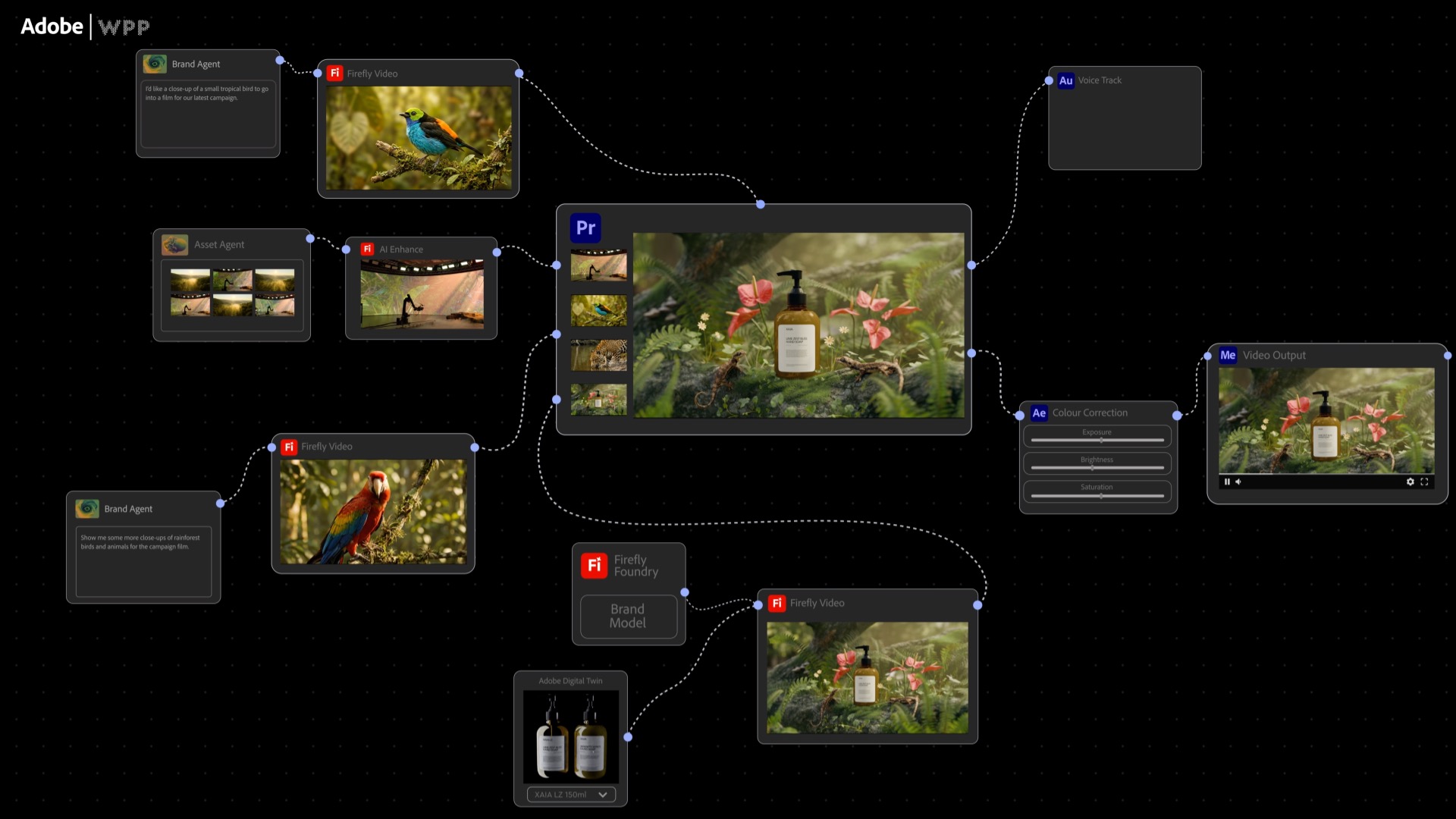
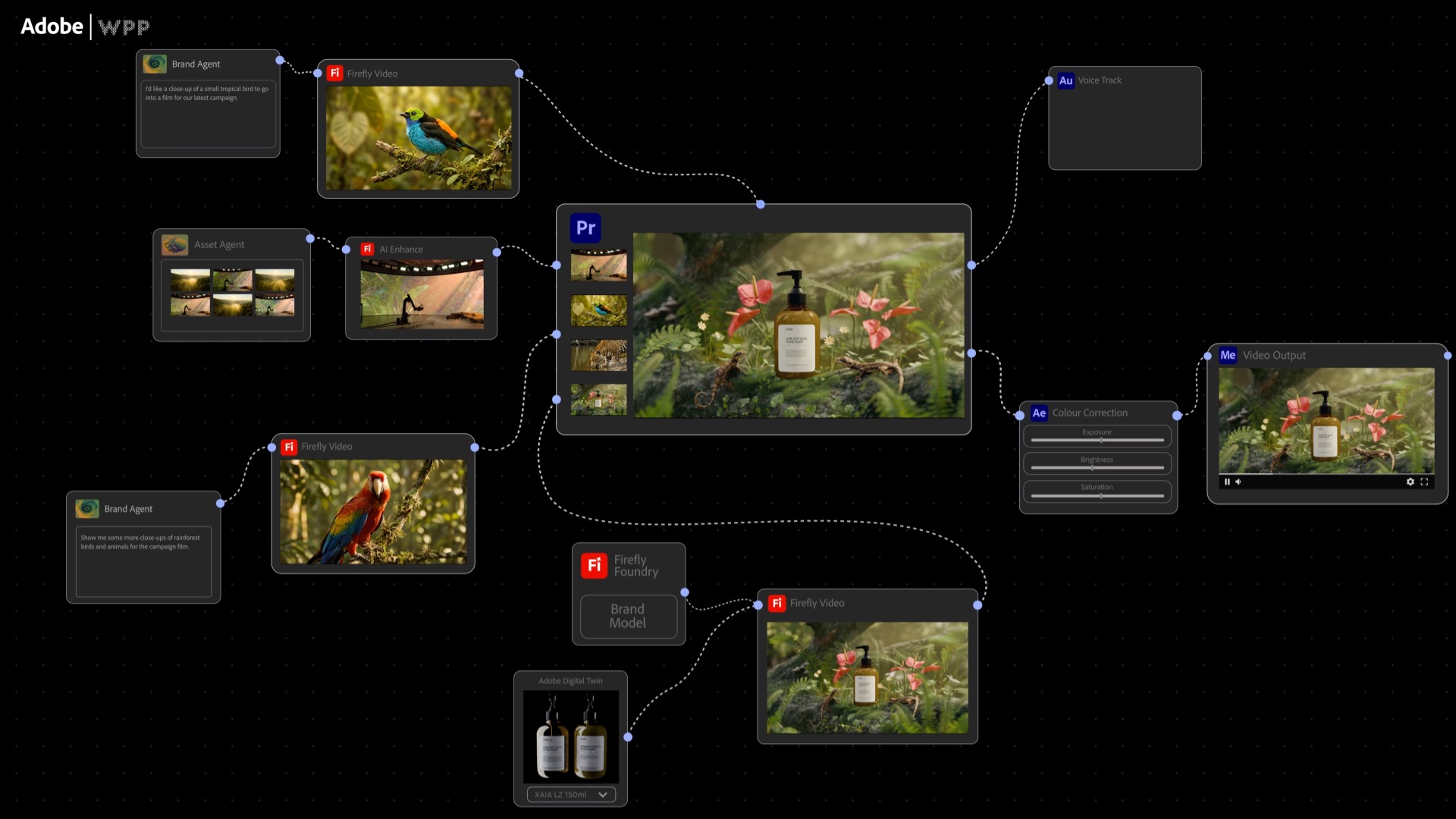
As demand for personalized customer experiences surges, brands require intelligent systems that can plan, create, produce and activate content continuously — without compromising control, governance or brand integrity.
Consider a global retailer delivering the right offer, image, copy and price, across millions of product, audience and channel combinations — updated in minutes instead of months.
For marketing and creative teams, that means moving from one-size-fits-all campaigns to tailored experiences that are always on, always relevant and on brand. All of it is powered by intelligent systems that continuously generate and deliver content without sacrificing control, governance or brand integrity.
The expanded collaborations bring together three complementary strengths: Adobe’s creative and customer experience platforms and the new Adobe CX Enterprise Coworker, WPP’s global media and marketing expertise, and NVIDIA’s accelerated computing and software stack, including NVIDIA Nemotron open models, NVIDIA Agent Toolkit and the NVIDIA OpenShell secure runtime for building and running secure agentic AI systems.
As these agents begin orchestrating multistep workflows, tapping sensitive data and triggering actions across marketing stacks, enterprises need a way to enforce clear rules of engagement so every operation remains compliant, on brand and within defined risk boundaries.
Powered by the NVIDIA OpenShell runtime, every agent operates within a secure, isolated environment, delivering enterprise-grade control, consistency and auditability across the entire marketing lifecycle, with verifiable policy management, answering the question, “What can the agent do?” and not just, “What policy is in place?”
In governed environments, enterprises can also keep key workflows and intelligence services inside their trust boundary, including securely invoking Adobe CX Intelligence as part of customer experience agents.
A live demo of CX Enterprise Coworker — powered by NVIDIA Agent Toolkit, including the OpenShell runtime and Nemotron models — will be featured during Adobe Summit’s day-two keynote taking place Tuesday, April 21, at 9 a.m. PT.
The collaboration enables:
End-to-end agentic workflows: Adobe is developing creative and marketing agents that can generate, adapt and version on-brand assets. Adobe’s CX Enterprise Coworker orchestrates downstream customer experience workflows from personalization to activation, closing the loop between content creation and customer engagement.
Controlled execution with NVIDIA OpenShell: Agents run in a policy-based, containerized sandbox designed to keep execution governed, observable and auditable, helping enterprises safely deploy long-running agentic workflows on premises or in the cloud.
Commercially safe content at scale: Adobe Firefly Foundry, accelerated by NVIDIA AI infrastructure, can help organizations deeply tune custom models on their proprietary assets, enabling agents to generate commercially safe content at scale and aligned to brand identity.
A 3D digital twins solution for scalable marketing production: Adobe’s cloud-native 3D digital twin solution is now generally available, built on NVIDIA Omniverse libraries and OpenUSD. 3D digital twins serve as persistent product identities that agents use to automate and scale high-fidelity content creation across formats, markets and configurations.
Creative Intelligence Meets Performance Intelligence With Policy-Governed Agents
Governed environments such as the ones enabled by this collaboration act as a set of “guardrails” that keep AI operations observable and auditable, preventing the system from acting outside of a company’s specific data boundaries or brand rules.
By combining Adobe’s creative platforms, WPP’s media and marketing expertise and NVIDIA’s secure infrastructure with CX Enterprise Coworker, brands no longer have to choose between speed and safety. Autonomous agents can now generate, adapt and activate content at scale while operating within governed, policy-driven environments.
The result is a new foundation for agentic marketing — where creative intelligence, performance and trust are built in from the start and delivered at global scale.
Watch NVIDIA founder and CEO Jensen Huang’s Adobe Summit fireside chat with Adobe CEO Shantanu Narayen below.
Open models are driving a new wave of on-device AI, extending innovation beyond the cloud to everyday devices. As these models advance, their value increasingly depends on access to local, real-time context that can turn meaningful insights into action.
Designed for this shift, Google’s latest additions to the Gemma 4 family introduce a class of small, fast and omni-capable models built for efficient local execution across a wide range of devices.
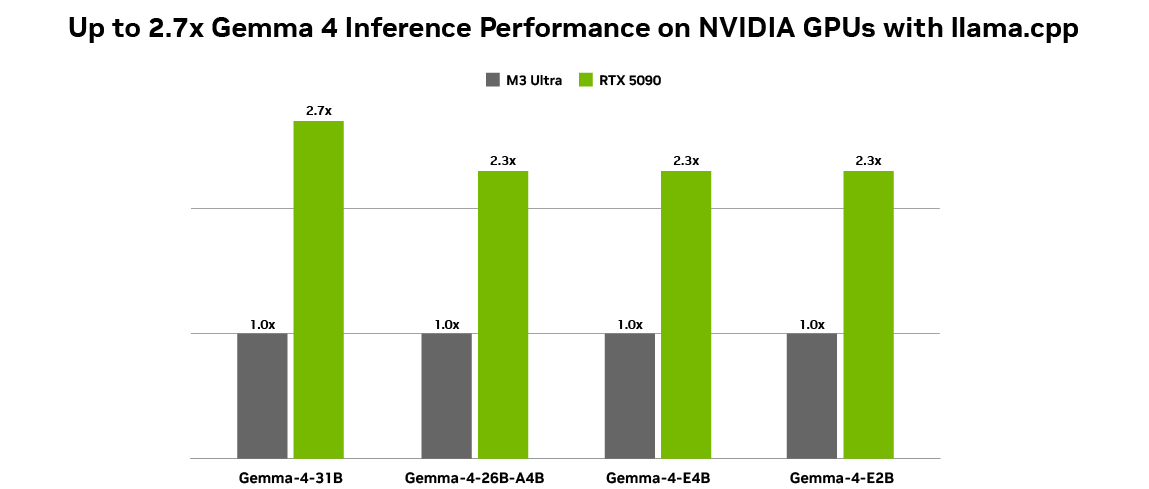
Google and NVIDIA have collaborated to optimize Gemma 4for NVIDIA GPUs, enabling efficient performance across a range of systems — from data center deployments to NVIDIA RTX-powered PCs and workstations, the NVIDIA DGX Spark personal AI supercomputer and NVIDIA Jetson Orin Nano edge AI modules.
Gemma 4: Compact Models Optimized for NVIDIA GPUs
The latest additions to the Gemma 4 family of open models— spanning E2B, E4B, 26B and 31B variants — are designed for efficient deployment from edge devices to high-performance GPUs.
All configurations measured using Q4_K_M quantizations BS = 1, ISL = 4096 and OSL = 128 on NVIDIA GeForce RTX 5090 and Mac M3 Ultra desktops. Token generation throughput measured on llama.cpp b7789, using the llama-bench tool.
This new generation of compact models supports a range of tasks, including:
Reasoning: Strong performance on complex problem-solving tasks.
Coding: Code generation and debugging for developer workflows.
Agents: Native support for structured tool use (function calling).
Vision, Video and Audio Capabilities: Enables rich multimodal interactions for object recognition, automated speech recognition, and document or video intelligence.
Interleaved Multimodal Input: Mix text and images in any order within a single prompt.
Multilingual: Out-of-the-box support for 35+ languages, pretrained on 140+ languages.
The E2B and E4B models are built for ultraefficient, low-latency inference at the edge, running completely offline with near-zero latency across many devices including Jetson Nano modules.
The 26B and 31B modelsare designed for high-performance reasoning and developer-centric workflows, making them well suited for agentic AI. Optimized to deliver state-of-the-art, accessible reasoning, these models run efficiently on NVIDIA RTX GPUs and DGX Spark — powering development environments, coding assistants and agent-driven workflows.
As local agentic AI continues to gain momentum, applications like OpenClaw are enabling always-on AI assistants on RTX PCs, workstations and DGX Spark. The latest Gemma 4 models are compatible with OpenClaw, allowing users to build capable local agents that draw context from personal files, applications and workflows to automate tasks. Learn how to run OpenClaw for free on RTX GPUs and DGX Spark or using the DGX Spark OpenClaw playbook.
Getting Started: Gemma 4 on RTX GPUs and DGX Spark
NVIDIA has collaborated with Ollama and llama.cpp to provide the best local deployment experience for each of the Gemma 4 models.
To use Gemma 4 locally, users can download Ollama to run Gemma 4 models or install llama.cpp and pair it with the Gemma 4 GGUF Hugging Face checkpoint. Additionally, Unsloth provides day-one support with optimized and quantized models for efficient local fine-tuning and deployment via Unsloth Studio. Start running and fine-tuning Gemma 4 in Unsloth Studio today.
Running open models like the Gemma 4 family on NVIDIA GPUs achieves optimal performance because NVIDIA Tensor Cores accelerate AI inference workloads to deliver higher throughput and lower latency for local execution. Plus, the CUDA software stack ensures broad compatibility across leading frameworks and tools, enabling new models to run efficiently from day one.
This combination allows open models like Gemma 4 to scale across a wide range of systems — from Jetson Orin Nano at the edge to RTX PCs, workstations and DGX Spark — without requiring extensive optimization.
Check out the NVIDIA technical blogfor more details on how to get started with Gemma 4 on NVIDIA GPUs and learn more about NVIDIA’s work on open models.
#ICYMI: The Latest Updates for RTX AI PCs
✨ Catch up on RTX AI Garage blogs for a host of agentic AI announcements from NVIDIA GTC, such as new open models for local agents. These models include NVIDIA Nemotron 3 Nano 4B and Nemotron 3 Super 120B, and optimizations for Qwen 3.5 and Mistral Small 4.
NVIDIA recently introduced NVIDIA NemoClaw, an open source stack that optimizes OpenClaw experiences on NVIDIA devices by increasing security and supporting local models.
🚀Accomplish.ai announced Accomplish FREE, a no-cost version of its open source desktop AI agent with built-in models. It harnesses NVIDIA GPUs to run open weight models locally, while a hybrid router dynamically balances workloads between local RTX hardware and the cloud — enabling fast, private, zero-configuration execution without requiring an application programming interface key.
Autonomous agents mark a new inflection point in AI. Systems are no longer limited to generating responses or reasoning through tasks. They can take action: Agents can read files, use tools, write and run code, and execute workflows across enterprise systems, all while expanding their own capabilities.
Application-layer risk grows exponentially when agents continuously improve and evolve. The NVIDIA OpenShell runtime is being built to address this.
Part of NVIDIA Agent Toolkit, OpenShell is an open source, secure-by-design runtime for running autonomous agents such as claws. It works by ensuring each agent runs inside its own sandbox, separating application-layer operations from infrastructure-layer policy enforcement.
This means security policies are out of reach of the agent — they’re applied at the system level. Instead of relying on behavioral prompts, OpenShell enforces constraints on the environment the agent runs in — meaning the agent cannot override policies, or leak credentials or private data, even if compromised.
With OpenShell, enterprises can separate agent behavior, policy definition and policy enforcement. Organizations gain a single, unified policy layer to define and monitor how autonomous systems operate. Coding agents, research assistants and agentic workflows all run under the same runtime policies regardless of host operating system, simplifying compliance and operational oversight.
This is the “browser tab” model applied to agents: Sessions are isolated, resources are controlled and permissions are verified by the runtime before any action takes place.
Securing autonomous systems requires an integrated ecosystem. OpenShell is designed to add privacy and security controls for AI agents. NVIDIA is collaborating with security partners, including Cisco, CrowdStrike, Google Cloud, Microsoft Securityand TrendAI, to align runtime policy management and enforcement for agents across the enterprise stack.
OpenShell Provides an Enterprise-Grade Sandbox for Building Personal AI Assistants
NVIDIA NemoClaw is an open source reference stack that simplifies installing OpenClaw always-on assistants with the OpenShell runtime and NVIDIA Nemotron models in a single command.
NemoClaw provides enthusiasts with an open reference for building self-evolving personal AI agents, or claws. Since security needs vary, NemoClaw provides a reference example for policy-based privacy and security guardrails to give users more control over their agents’ behavior and data-handling. Users can customize it for their specific use cases — much like adjusting security preferences for applications on a phone.
NemoClaw includes an example configuration of OpenShell that defines how the agent should interact with systems. NemoClaw uses open source models like NVIDIA Nemotron alongside OpenShell.
Both OpenShell and NemoClaw are in early preview. NVIDIA is building in the open with the community and its partners to enable enterprises to scale self-evolving, long-running autonomous agents safely, confidently and in compliance with global security standards.
Get started with NVIDIA OpenShell and launch a ready‑to‑use environment on NVIDIA Brev, or explore the open source project on GitHub.
Launched today, NVIDIA Nemotron 3 Super is a 120‑billion‑parameter open model with 12 billion active parameters designed to run complex agentic AI systems at scale.
Available now, the model combines advanced reasoning capabilities to efficiently complete tasks with high accuracy for autonomous agents.
AI-Native Companies: Perplexity offers its users access to Nemotron 3 Super for search and as one of 20 orchestrated models in Computer. Companies offering software development agents like CodeRabbit, Factory and Greptile are integrating the model into their AI agents along with proprietary models to achieve higher accuracy at lower cost. And life sciences and frontier AI organizations like Edison Scientific and Lila Sciences will power their agents for deep literature search, data science and molecular understanding.
Enterprise Software Platforms: Industry leaders such as Amdocs, Palantir, Cadence, Dassault Systèmes and Siemens are deploying and customizing the model to automate workflows in telecom, cybersecurity, semiconductor design and manufacturing.
As companies move beyond chatbots and into multi‑agent applications, they encounter two constraints.
The first is context explosion. Multi‑agent workflows generate up to 15x more tokens than standard chat because each interaction requires resending full histories, including tool outputs and intermediate reasoning.
Over long tasks, this volume of context increases costs and can lead to goal drift, where agents lose alignment with the original objective.
The second is the thinking tax. Complex agents must reason at every step, but using large models for every subtask makes multi-agent applications too expensive and sluggish for practical applications.
Nemotron 3 Super has a 1‑million‑token context window, allowing agents to retain full workflow state in memory and preventing goal drift. Nemotron 3 Super has set new standards, claiming the top spot on Artificial Analysis for efficiency and openness with leading accuracy among models of the same size.
The model also powers the NVIDIA AI-Q research agent to the No. 1 position on DeepResearch Bench and DeepResearch Bench II leaderboards, benchmarks that measure an AI system’s ability to conduct thorough, multistep research across large document sets while maintaining reasoning coherence.
Hybrid Architecture
Nemotron 3 Super uses a hybrid mixture‑of‑experts (MoE) architecture that combines three major innovations to deliver up to 5x higher throughput and up to 2x higher accuracy than the previous Nemotron Super model.
Hybrid Architecture: Mamba layers deliver 4x higher memory and compute efficiency, while transformer layers drive advanced reasoning.
MoE: Only 12 billion of its 120 billion parameters are active at inference.
Latent MoE: A new technique that improves accuracy by activating four expert specialists for the cost of one to generate the next token at inference.
Multi-Token Prediction: Predicts multiple future words simultaneously, resulting in 3x faster inference.
On the NVIDIA Blackwell platform, the model runs in NVFP4 precision. That cuts memory requirements and pushes inference up to 4x faster than FP8 on NVIDIA Hopper, with no loss in accuracy.
Open Weights, Data and Recipes
NVIDIA is releasing Nemotron 3 Super with open weights under a permissive license. Developers can deploy and customize it on workstations, in data centers or in the cloud.
The model was trained on synthetic data generated using frontier reasoning models. NVIDIA is publishing the complete methodology, including over 10 trillion tokens of pre- and post-training datasets, 15 training environments for reinforcement learning and evaluation recipes. Researchers can further use the NVIDIA NeMo platform to fine-tune the model or build their own.
Use in Agentic Systems
Nemotron 3 Super is designed to handle complex subtasks inside a multi-agent system.
A software development agent can load an entire codebase into context at once, enabling end-to-end code generation and debugging without document segmentation.
In financial analysis it can load thousands of pages of reports into memory, eliminating the need to re-reason across long conversations, which improves efficiency.
Nemotron 3 Super has high-accuracy tool calling that ensures autonomous agents reliably navigate massive function libraries to prevent execution errors in high-stakes environments, like autonomous security orchestration in cybersecurity.
Availability
NVIDIA Nemotron 3 Super, part of the Nemotron 3 family, can be accessed at build.nvidia.com, Perplexity, OpenRouterand Hugging Face. Dell Technologies is bringing the model to the Dell Enterprise Hub on Hugging Face, optimized for on-premise deployment on the Dell AI Factory, advancing multi-agent AI workflows. HPE is also bringing NVIDIA Nemotron to its agents hub to help ensure scalable enterprise adoption of agentic AI.
Enterprises and developers can deploy the model through several partners:
Cloud Service Providers: Google Cloud’s Vertex AI and Oracle Cloud Infrastructure, and coming soon to Amazon Web Services through Amazon Bedrock as well as Microsoft Azure.
Stripe on Monday released a preview of a new feature that could help AI startups (and other companies) solve the problem of passing through the underlying costs of AI model usage to their customers.
Stripe’s feature, however, goes even further than just passing through the costs of the tokens. It allows startups to charge a markup percentage on token usage. So a company can, for instance, charge an automatic 30% above the cost of the tokens that the startup will pay the model maker.
As Stripe described it, “Say you’re building an AI app: you want a consistent 30% margin over raw LLM token costs across providers. Billing automates the process.”
The billing feature lets the startup pick the AI models it uses. It tracks the API prices of those models. It then records the customers’ token usage and applies the profit-margin markup automatically.
As we’ve previously reported, there are a variety of ways that AI startups are charging for their wares. Many of them charge tiered monthly subscriptions that have usage-rate caps; once those are hit, the subscriber may be charged more for exceeding the limit.
For instance, Cursor last year changed the pricing on some of its tiers from unlimited use to rate-limited usage, with fees for extra consumption on top.
Without a usage cap, users could run up big bills for a startup with the model makers, and force the startup to operate in the red. This is especially acute for agentic startups. The more their customers use their agents, the more tokens they consume from the underlying model provider, be that OpenAI, Google Gemini, Anthropic or others — making pricing and business model decisions especially critical.
Techcrunch event
San Francisco, CA | October 13-15, 2026
Stripe has also introduced its own AI gateway, a tool that give users access to multiple models, letting them choose the best one for the job. But the billing tool also works with third-party gateways that are already popular, like those offered by Vercel and OpenRouter, according to a tweet by a Stripe product manager,
There are, of course, other startups offering AI model cost management features with their own gateways. OpenRouter, for instance, which grants access to over 300 models, charges a flat 5.5% markup over the token fees for its first-tier plan, and offers budget controls, too.
Stripe is not currently charging its own markup on the gateway, its product manager said on Twitter. The feature, however, is still in waitlist mode. Either way, if Stripe can help startups easily turn tracking and billing for this expense into a profit-maker, it could be a game-changer. Stripe did not immediately respond to a request for comment on when the feature may be generally available.
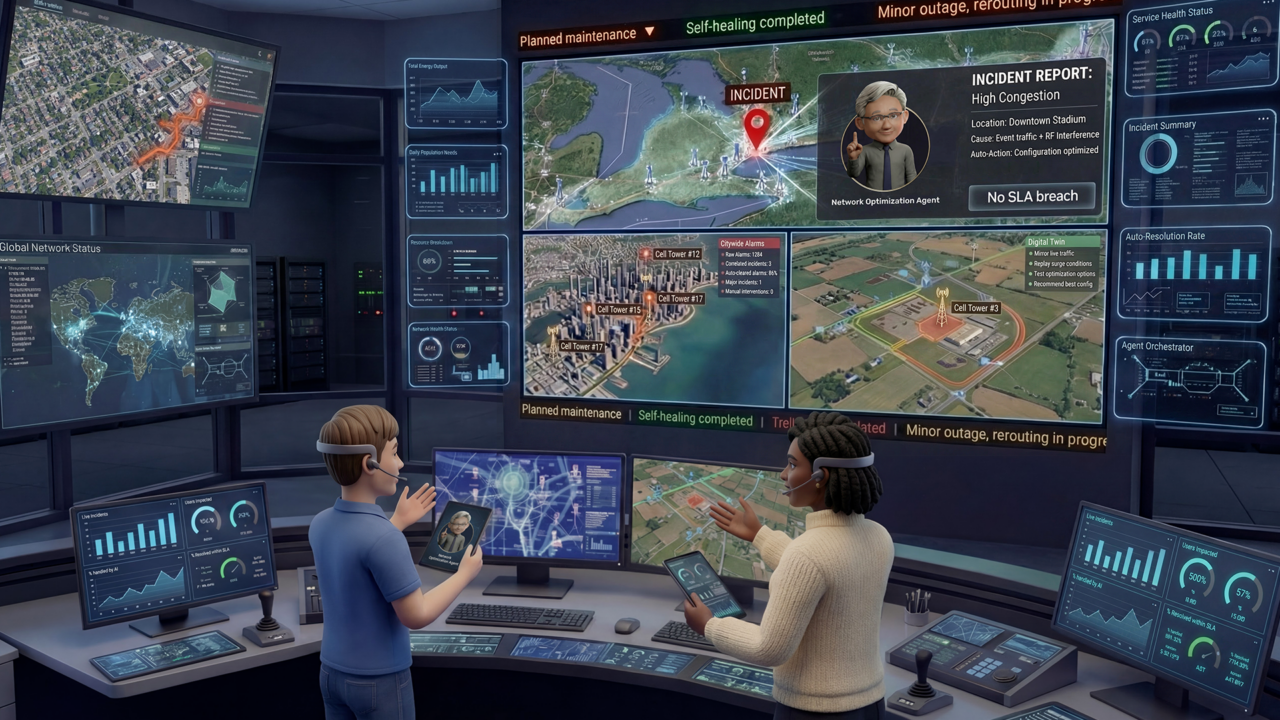
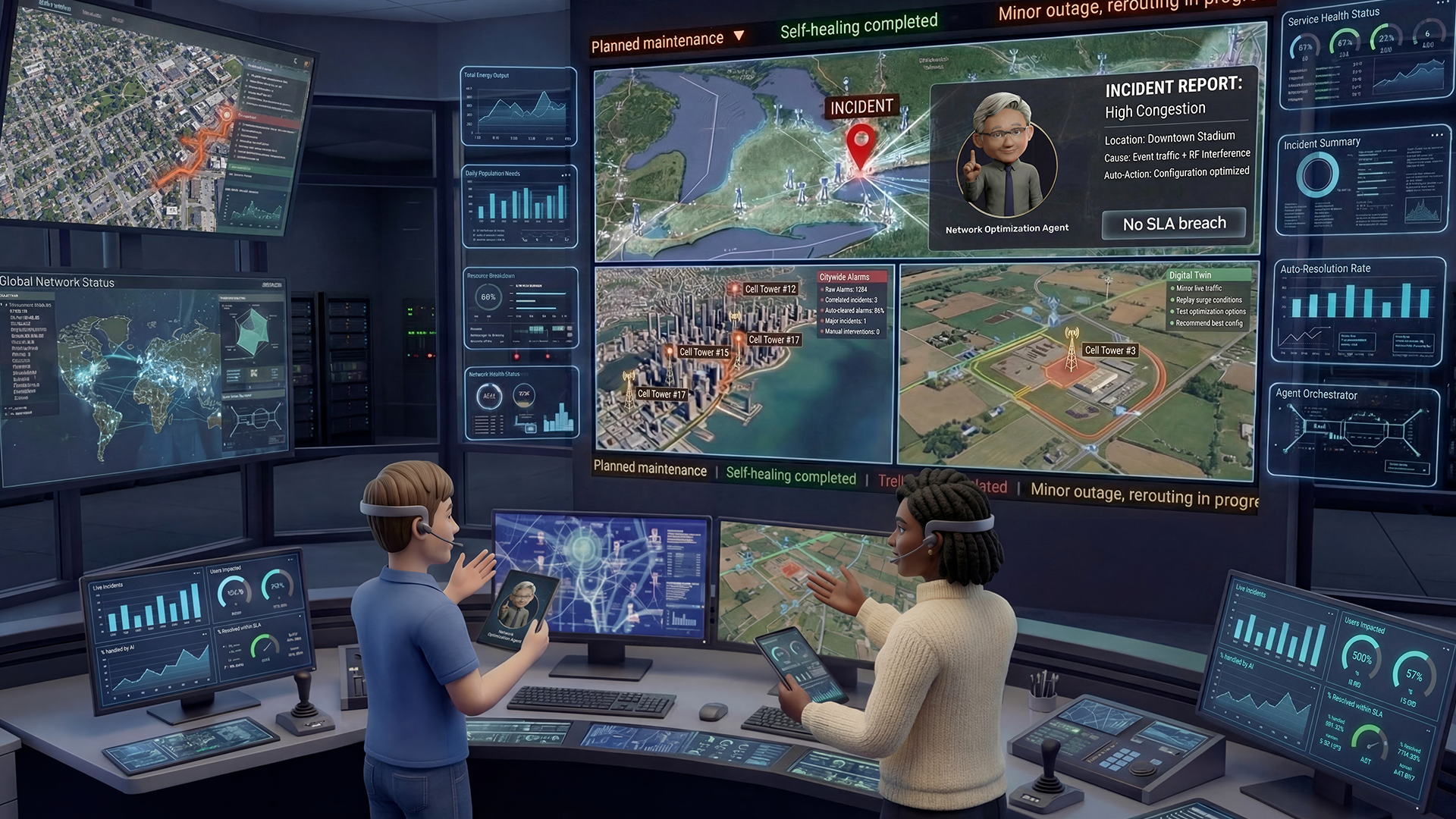
Autonomous networks — intelligent, self-managing telecommunications operations — are moving from a future vision to a current priority for telecom operators. In the latest NVIDIA State of AI in Telecommunications report, network automation emerged as the top AI use case for investment and return on investment.
Automation is different from autonomy. Beyond executing predefined workflows, autonomous networks must understand operator intent, reason over tradeoffs and decide what actions to take. Reasoning models and AI agents fine-tuned on telecom data are key to enabling this shift.
For networks to become autonomous, there’s a need for an end-to-end agentic system that includes key components like telco network models and AI agents that talk to each other and use network simulation tools to validate actions.
Ahead of Mobile World Congress Barcelona, NVIDIA unveiled an open NVIDIA Nemotron-based large telco model (LTM), a comprehensive guide for building reasoning agents for network operations, and new NVIDIA Blueprints for energy saving and network configuration with multi-agent orchestration to help operators advance toward autonomy.
And as part of GSMA’s new Open Telco AI initiative — launching tomorrow — NVIDIA is releasing the new open source LTM, implementation guide and agentic AI blueprints as open resources through GSMA, an organization for the mobile communications industry.
Open Nemotron 3 Large Telco Model Brings Reasoning to Telecom
For telcos to successfully operationalize generative and agentic AI across their operations, AI models must have the ability to understand the language of telecom and reason through complex workflows. NVIDIA has collaborated with AdaptKey AI to release a new open source, 30-billion-parameter NVIDIA Nemotron LTM that operators around the world can use to build autonomous networks.
Built on the NVIDIA Nemotron 3 family of foundation models and fine-tuned by AdaptKey AI using open telecom datasets including industry standards and synthetic logs, the LTM is optimized to understand telecom industry terminology and reason through workflows such as fault isolation, remediation planning and change validation.
As an open model, the Nemotron LTM gives telcos full transparency into how it was trained and what data was used, enabling secure and fast on‑premises deployment within their networks, where they can build and run agents directly. It also lets telcos safely adapt and extend telecom‑tuned reasoning with their own network and operational data, so they can move toward autonomous operations without sacrificing control over data or security.
Teaching AI Agents to Reason Like Network Engineers
NVIDIA and Tech Mahindra have published an open source guide that shows telecom operators how to fine-tune domain-specific reasoning models and build agents that can safely execute network operations center (NOC) workflows.
The guide outlines a framework for teaching models to reason like NOC engineers: focus on high‑impact, high‑frequency incident categories, translate expert resolutions into step‑by‑step procedures and turn those into structured reasoning traces that capture each action, tool call, outcome and decision. These traces become the “thinking examples” the model learns from, so it understands not just what to do, but why a particular sequence of checks and fixes is safe and effective.
Using the NVIDIA NeMo-Skills pipeline, operators can fine-tune a reasoning model on these traces, laying the foundation for telco-specialized AI agents that can reason and solve problems like a network engineer.
Maximizing Energy Efficiency With New Intent-Driven Energy Saving Blueprint
Autonomous networks rely on closed‑loop operation: models that understand the network, agents that act on intent and simulation that feeds results back into the system to validate and refine decisions. The new NVIDIA Blueprint for intent-driven RAN energy efficiency brings these pieces together, helping operators systematically reduce power consumption in 5G radio access networks (RAN) while maintaining quality of service.
The blueprint integrates network test and measurement leader VIAVI’s TeraVM AI RAN Scenario Generator (AI RSG) platform to generate synthetic network data — including cell utilization, user throughput and other traffic patterns — and convert it into a simple, queryable format.
An energy planning agent then reasons over the synthetic data to generate energy-saving policies that can be simulated in AI RSG, allowing operators to safely validate energy-saving policies in a closed loop to meet their intent without changing live configurations or impacting subscribers.
Telcos Put the NVIDIA Blueprint for Network Configuration to Work
Cassava Technologies is using the blueprint to build Cassava Autonomous Network, an agentic platform designed to optimize Africa’s diverse, multi-vendor mobile network environment. The platform implements three agents: one to monitor the network and recommend configuration changes, one to apply changes with documentation and governance, and one to assess the impact of changes made and safely roll them back if they have unintended effects.
NTT DATA is implementing the blueprint to bring intelligence to traffic regulation, helping the network manage surges when users reconnect after an outage, and is deploying it with a tier 1 operator in Japan.
An AI agent looks at real-time demand across the network and then decides when and how to admit new users on specific cells. As conditions stabilize, the agent adapts its decisions, turning what used to be manual configurations into a data-driven optimization cycle for more resilient mobile networks.
Evolving Network Configuration With Multi-Agent Orchestration
BubbleRAN is integrating NAT and BAT into its Opti-Sphere platform to manage network monitoring, configuration and validation agents more flexibly across containers and workloads, and connect them to tools that report network metrics and traffic status so they can continuously propose and validate configuration changes.
Telenor Group will be the first telco to adopt the blueprint with BubbleRAN to enhance its 5G network for Telenor Maritime, the group’s global connectivity provider at sea.
Learn more about the latest advancements in agentic AI for telecommunications at Mobile World Congress, taking place in Barcelona from March 2-5.
See notice regarding software product information.
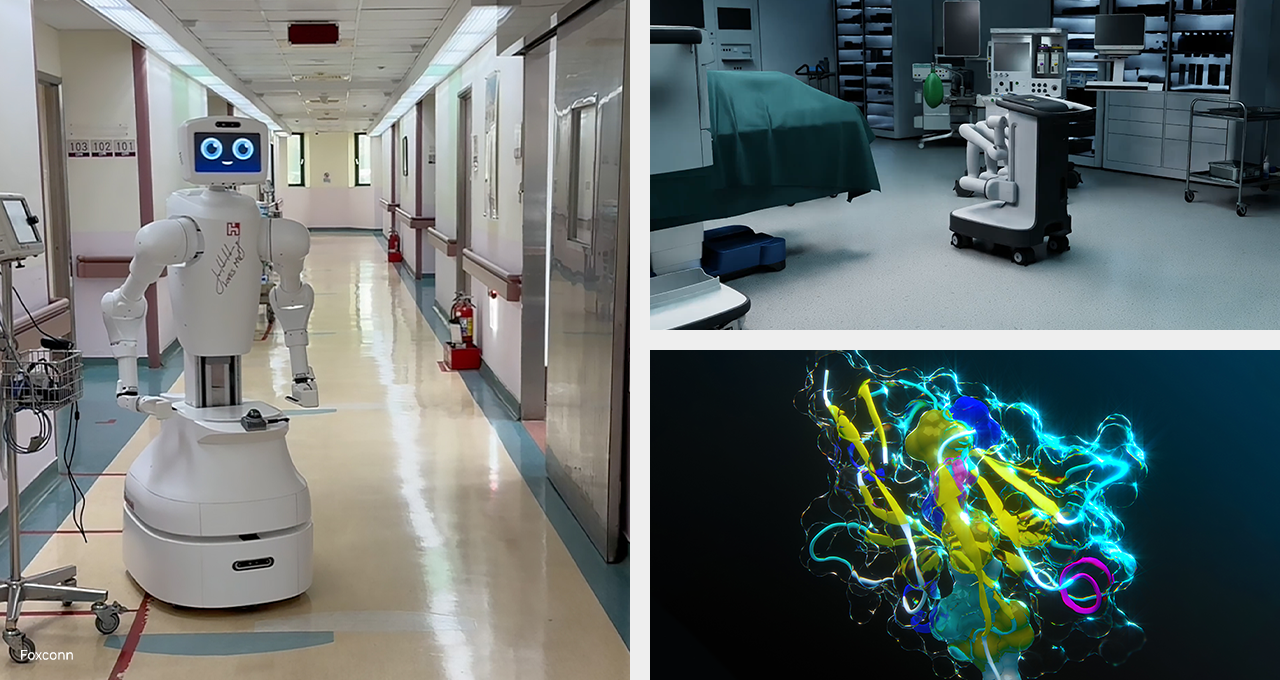
AI is accelerating every aspect of healthcare — from radiology and drug discovery to medical device manufacturing and new treatment methods enabled by digital twins of the human body.
NVIDIA’s second annual “State of AI in Healthcare and Life Sciences” survey report reveals how the industry is moving from AI experimentation to execution, reaping return on investment (ROI) on core applications like medical imaging and drug discovery.
The industry is also embracing open source software and AI models to tackle specific use cases, as well as exploring using agentic AI to speed knowledge retrieval and research paper analysis.
Highlights from this year’s report include:
70% of respondents said their organizations are actively using AI, up from 63% in 2024.
69% said they’re using generative AI and large language models, up from 54%.
82% said open source software and models are moderately to extremely important to their organizations’ AI strategy.
47% said they’re using or assessing agentic AI.
85% of executives said AI is helping increase revenue, and 80% said it’s helping reduce costs.
“Over the next 12-18 months, the most visible and scalable impact of AI will come from logistics and administrative streamlining,” said John Nosta, president of NostaLab, a healthcare think tank. “That’s where adoption curves are already steep — scheduling, documentation, coding, utilization management and care coordination.”
Read more below on some of the report’s key findings.
AI Adoption Ramps Up Across Healthcare and Life Sciences
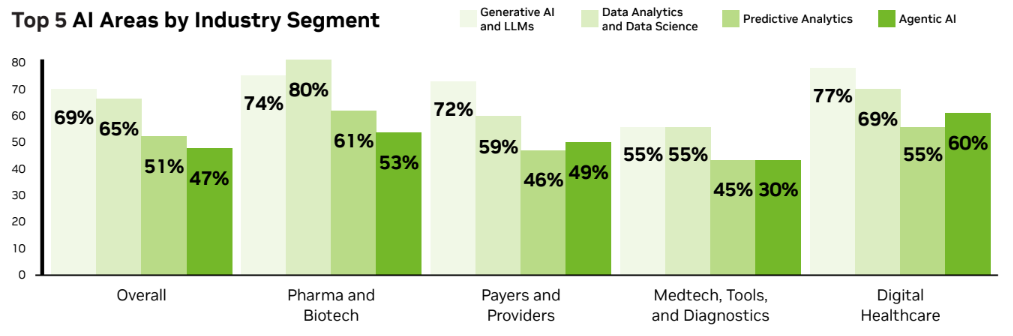
AI adoption is up across every industry segment in this year’s survey — spanning digital healthcare, pharmaceutical and biotechnology, payers and providers, and medical technology and tools — with digital healthcare leading at 78%, followed by medical technology at 74%.
The top industry workload was generative AI and large language models, according to 69% of respondents. AI for data analytics and data science was the second most-used workload, followed by predictive analytics. New to the survey, agentic AI ranked fourth, with 47% of respondents saying they’re using or assessing AI agents.
“Scaling generative AI in healthcare starts with focusing on real clinical and operational problems, rather than the technology itself,” said Dr. Annabelle Painter, clinical AI strategy lead at Visiba U.K. “The organizations seeing impact are those that embed AI into existing workflows instead of layering AI on top as a separate tool.”
Healthcare and life sciences organizations are deploying these AI workloads across a variety of use cases, each specific to their primary functions. For example, 61% of respondents from medical technology said they’re using AI for medical imaging, such as radiologists using it to work more quickly and efficiently, while 57% from pharmaceutical and biotechnology said drug discovery is being driven by AI.
For the entire industry, the top AI use cases were clinical decision support (such as radiologists highlighting areas of concern on a scan), medical imaging and workflow optimization.
AI Budgets to Increase With Strong ROI
AI is helping healthcare and life sciences organizations become even better at their core competencies — underscoring strong ROI.
In addition to increasing annual revenue and reducing annual costs, AI is boosting back-office productivity through workflow optimization and is scaling across other key business operations such as patient interaction and administrative tasks.
For example, 57% of respondents from the medical technology segment reported seeing ROI from deploying AI for medical imaging. Nearly half (46%) of pharmaceutical and biotechnology respondents said AI for drug discovery and development was among their top ROI use cases.
The top ROI use case for digital healthcare providers was virtual health assistants and chatbots, according to 37%, while 39% of respondents from payers and providers (which include hospitals, primary care providers and insurance companies) cited administrative tasks and workflow optimization as their top area of ROI.
As a result of AI’s positive impact, 85% of respondents said their AI budgets would increase this year, with another 12% saying budgets would stay the same. For almost half of respondents (46%), AI spending will increase significantly, by more than 10%.
“Healthcare organizations that successfully integrate AI are those that explicitly fund and prioritize evaluation as a core operational function, ensuring AI delivers measurable improvements in safety, quality and patient care over time,” said Painter.
Using Open Source for Domain-Specific AI Deployment
Leaning into open source models and software allows enterprises to build domain-specific applications, lending them greater flexibility and efficiency while boosting business returns.
The healthcare industry has embraced open source, with 82% of survey respondents stating it’s moderately to extremely important to their AI strategy.
“Open models will shape the intellectual field,” said Nosta. “They are essential for exploration and for keeping the field honest. But in clinical environments where safety, liability and accountability are nonnegotiable, proprietary systems will remain necessary for validation, integration and trust. The key insight here is that discovery will be open, and deployment will demand stewardship.”
AI is accelerating the telecommunications industry’s transformation, becoming the backbone of autonomous networks and AI-native wireless infrastructure. At the same time, the technology is unlocking new business and revenue opportunities, as telecom operators accelerate AI adoption across consumers, enterprises and nations.
NVIDIA’s fourth annual “State of AI in Telecommunications” survey report unpacks these trends, underscoring strong AI adoption, impact and investment in the industry.
Highlights from the report include:
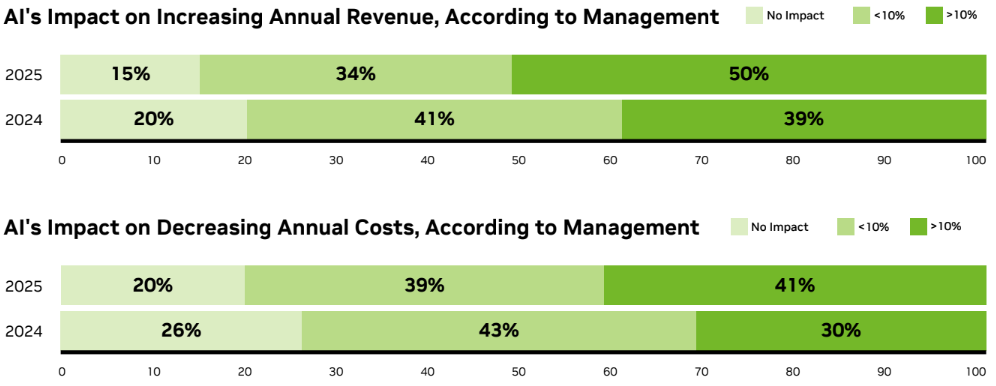
90% said AI is helping increase annual revenue and drive down costs.
77% said they expect to see AI-native networks launch before the deployment of 6G.
65% of telecom operators said network automation is being driven by AI.
60% said their organization is using or assessing generative AI, up from 49% in 2024.
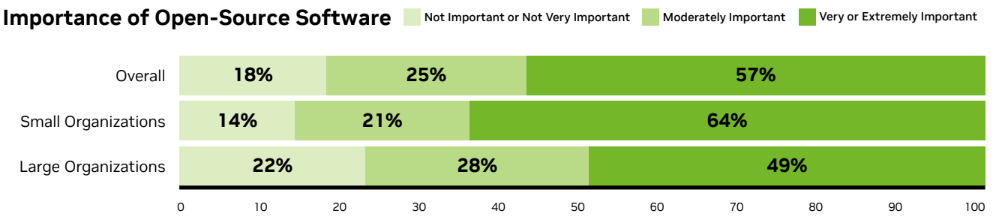
89% said open source models and software are important to their AI strategy.
89% of telcos plan to boost AI spending in 2026, up from 65% a year ago.
“There is a seismic shift underway in the telecom industry driven by AI,” said Sebastian Barros, managing director of Circles, a Singapore-based telecommunications provider. “Communication service providers are converging on a new realization. Their role in society extends beyond moving bits across networks toward moving intelligence across local and regulated infrastructure. That transition defines the move from telco to ‘AICO’ — AI infrastructure companies operating at network proximity, not application vendors riding on top.”
Here are some more key findings from the report.
Tangible Revenue Impact and Return on Investment
The telecommunications industry is seeing a definitive revenue impact from the use of AI. Overall, about nine out of 10 respondents said AI is helping to increase revenue and reduce costs. Telecommunications operators, which represent about a quarter of the 1,000 responses in the survey, are also seeing the benefit, with 90% saying AI has had a positive impact on revenue and costs.
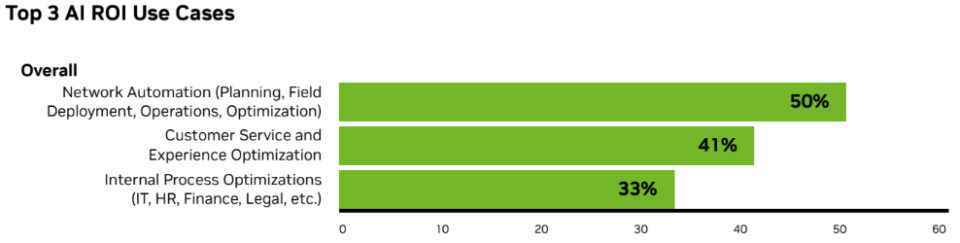
The top AI use cases cited for return on investment (ROI) were AI for autonomous networks (50%), followed by improved customer service (41%) and internal process optimization (33%).
“Autonomous networks deliver immediate ROI by eliminating human effort from repetitive, reactive workflows,” said Barros. “The fastest impact areas are energy management, fault prediction, configuration drift correction and capacity planning.”
This strong impact on revenue and ROI is leading telecommunications companies to increase their AI budgets in 2026. Overall, 89% of respondents said their AI budget will increase in the next 12 months, up from 65% in last year’s survey, with 35% saying their budgets would increase more than 10% from this year.
Focus on AI-Native Networks and Autonomous Operations
Network automation has overtaken customer experience as the leading use case for investment, deployment and ROI impact. This signals a bold step toward autonomous networks — AI-driven, self-managing systems that can self-configure, self-heal and self-optimize with minimal human intervention. Eighty-eight percent of organizations report being between levels 1-3 of autonomy, as defined by the TM Forum, and the use of generative AI and agentic AI is expected to accelerate the shift to level 5 autonomous networks.
“Autonomous networks are delivering return on investment faster than any other AI use case because they directly reduce outages, energy consumption and manual intervention,” said Chetan Sharma, CEO of Chetan Sharma Consulting. “Agentic AI accelerates this by coordinating decisions across domains in real time.”
A surge in edge computing investment is reshaping telecom network architectures, bringing AI inferencing closer to users through a distributed computing infrastructure. Telcos are stepping up investments in AI-native RAN and 6G — signaling a major industry intercept ahead of the traditional 6G deployment cycle, with 77% of respondents anticipating a much faster time to deployment of this new AI-native wireless network architecture.
The top drivers of investment are using AI to enhance spectral efficiency, improving the performance of the radio access network supporting edge AI applications and accelerating the research and development of 6G.
A Universal Boost in Productivity
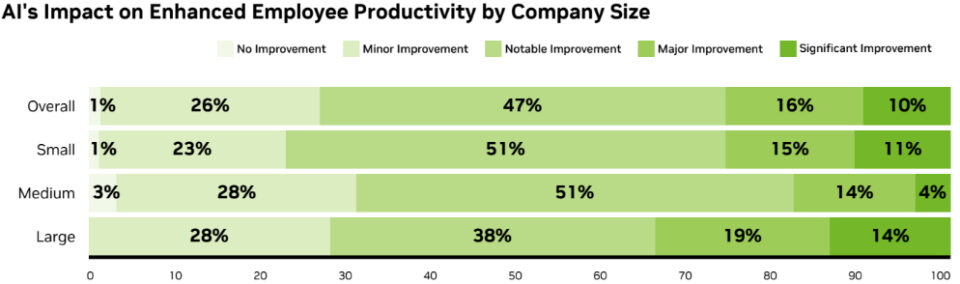
AI in telecommunications is advancing autonomous networks and business opportunities as well as improving internal operations. Nearly every respondent in the survey said AI is boosting employee productivity, with 26% citing major to significant improvements to their ability to complete more tasks with higher quality in less time.
The productivity gains are coming from generative and agentic AI solutions deployed across operations, from the back office to networks.
“Generative AI delivered fast productivity gains, but agentic AI is where telecoms begin to see structural ROI,” Sharma said. “Autonomous agents can act across networks, IT and customer journeys, turning insights into decisions without human delay.”
Editor’s note: This post is part of the Nemotron Labs blog series, which explores how the latest open models, datasets and training techniques help businesses build specialized AI systems and applications on NVIDIA platforms. Each post highlights practical ways to use an open stack to deliver value in production — from transparent research copilots to scalable AI agents.
Businesses today face the challenge of uncovering valuable insights buried within a wide variety of documents — including reports, presentations, PDFs, web pages and spreadsheets.
Often, teams piece together insights by manually reviewing files, copying data into spreadsheets, building dashboards and using basic search or template-based optical character recognition (OCR) tools that often miss important details in complex media.
Intelligent document processing is an AI-powered workflow that automatically reads, understands and extracts insights from documents. It interprets rich formats inside those documents — including tables, charts, images and text — using AI agents and techniques like retrieval-augmented generation (RAG) to turn the multimodal content into insights that other multi-agent systems and people can easily use.
With NVIDIA Nemotron open models and GPU-accelerated libraries, organizations can build AI-powered document intelligence systems for research, financial services, legal workflows and more.
These open models, datasets and training recipes have powered strong results on leaderboards such as MTEB, MMTEB and ViDoRe V3, benchmarks for evaluating multilingual and multimodal retrieval models. Teams can choose from among the best models for tasks like search and question answering.
How Document Processing Streamlines Business Intelligence
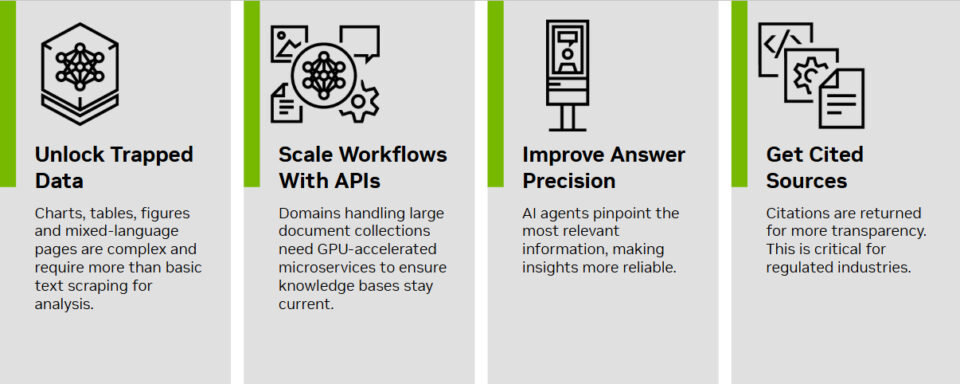
Document intelligence systems that can pull meaning from complex layouts, scale to huge file libraries and show exactly where an answer came from are incredibly useful in high-stakes environments. These systems:
Understand rich document content, moving beyond simple text scraping to capture information from charts, tables, figures and mixed-language pages and treating documents as a human would by recognizing structure, relationships and context.
Handle large quantities of shifting data, ingesting and processing massive collections of documents in parallel, and keeping knowledge bases continuously up to date.
Find exactly what users need, helping AI agents pinpoint the most relevant passages, tables or paragraphs to a query so they can respond with precision and accuracy.
Show the evidence behind answers by providing citations to specific pages or charts so teams can gain transparency and auditability, which is critical in regulated industries.
The result is a shift from static document archives to living knowledge systems that directly power business intelligence, customer experiences and operational workflows.
Document Intelligence at Work
Intelligent document processing systems built on NVIDIA Nemotron RAG models, Nemotron Parse and accelerated computing are already reshaping how organizations across industries gain insights from their documents.
Justt: AI-Native Chargeback Management and Dispute Optimization
In financial services, payment disputes create significant revenue loss and operational complexity for merchants, largely because the evidence needed to handle them lives in unstructured formats. Transaction logs, customer communications and policy documents are often fragmented across systems and difficult to process at scale, making dispute handling slow, manual and costly.
Justt.ai provides an AI-driven platform that automates the full chargeback lifecycle at scale. The platform connects directly to payment service providers and merchant data sources to ingest transaction data, customer interactions and policies, then automatically assembles dispute-specific evidence that aligns with card network and issuer requirements.
The platform’s AI-powered dispute optimization, powered by Nemotron Parse, applies predictive analytics to determine which chargebacks to fight or accept, and how to optimize each response for maximum net recovery. Leading hospitality operators like HEI Hotels & Resorts use the platform to automate dispute handling across their properties, recapturing revenue while maintaining guest relationships.
By pairing document-centric intelligence with decision automation, merchants can recapture a significant portion of revenue lost to illegitimate chargebacks while reducing manual review effort.
Docusign is the global leader in Intelligent Agreement Management, handling millions of transactions every day for more than 1.8 million customers and over 1 billion users.
Agreements are the foundation of every business, but the critical information they contain are often buried inside pages of documents. To surface the information, Docusign needed high-fidelity extraction of tables, text and metadata from complex documents like PDFs so organizations could understand and act on obligations, risks and opportunities faster.
Docusign is evaluating Nemotron Parse for deeper contract understanding at scale. Running on NVIDIA GPUs, the model combines advanced AI with layout detection and OCR. The system can reliably interpret complex tables and reconstruct tables with required information. This reduces the need for manual corrections and helps ensure that even the most complex contracts are processed with the speed and accuracy their customers expect.
With this foundation, Docusign will transform agreement repositories into structured data that powers contract search, analysis and AI-driven workflows — turning agreements into business assets that help organizations and their teams improve visibility, reduce risk and make faster decisions.
Edison Scientific: Research Across Massive Literature Scale
Edison Scientific’s Kosmos AI Scientist helps researchers navigate complex scientific landscapes to synthesize literature, identify connections and surface evidence.
Edison needed a way to rapidly and accurately extract structured information from large volumes of PDFs, including equations, tables and figures that traditional information parsing methods often mishandle.
By integrating the NVIDIA Nemotron Parse model into its PaperQA pipeline, Edison can decompose research papers, index key concepts and ground responses in specific passages, improving both throughput and answer quality for scientists. This approach turns a sprawling research corpus into an interactive, queryable knowledge engine that accelerates hypothesis generation and literature review.
The high efficiency of Nemotron Parse enables cost-efficient serving at scale, allowing Edison’s team to unlock the whole multimodal pipeline.
Designing an Intelligent Document Processing Application With NVIDIA Technologies
A robust, domain-specific document intelligence pipeline requires technologies that can handle data extraction, embedding and reranking, while keeping the data secure and compliant with regulations.
Extraction:Nemotron extraction and OCR models rapidly ingest multimodal PDFs, text, tables, graphs and images to convert them into structured, machine-readable content while preserving layout and semantics.
Reranking:Nemotron reranking models evaluate candidate passages to ensure the most relevant content is surfaced as context for large language models (LLMs), improving answer fidelity and reducing hallucinations.
Parsing: Nemotron Parse models decipher document semantics to extract text and tables with precise spatial grounding and correct reading flow. Overcoming layout variability, they turn unstructured documents into actionable data that enhances the accuracy of LLMs and agentic workflows.
These capabilities are packaged as NVIDIA NIM microservices and foundation models that run efficiently on NVIDIA GPUs, allowing teams to scale from proof of concept to production while keeping sensitive data within their chosen cloud or data center environment.
The most effective AI systems use a mix of frontier models and open source models like NVIDIA Nemotron, with an LLM router analyzing each task and automatically selecting the model best suited for it. This approach keeps performance strong while managing computing costs and improving efficiency.
Plus, experiment with Nemotron RAG models and the NVIDIA NeMo Retriever open library, available on GitHub and Hugging Face, as well as Nemotron Parse on Hugging Face.
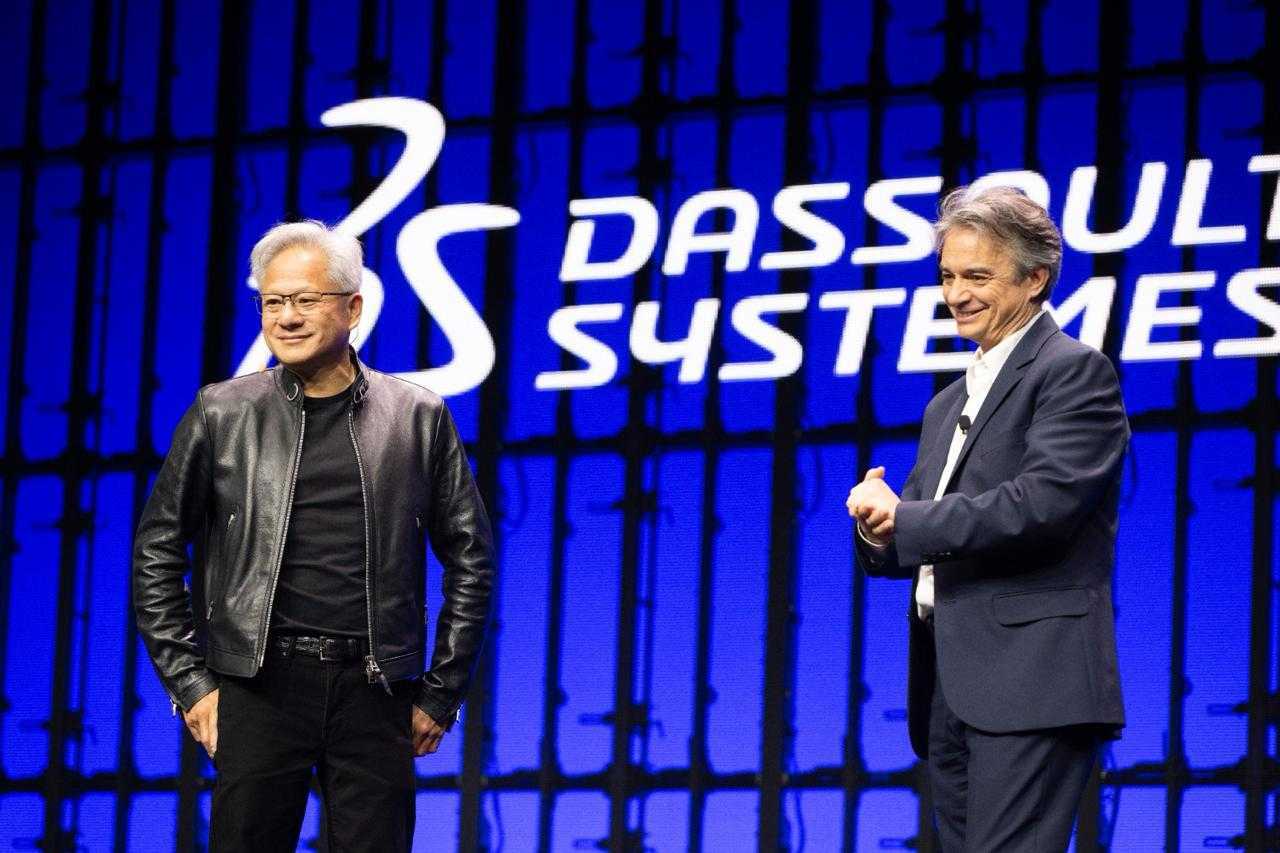
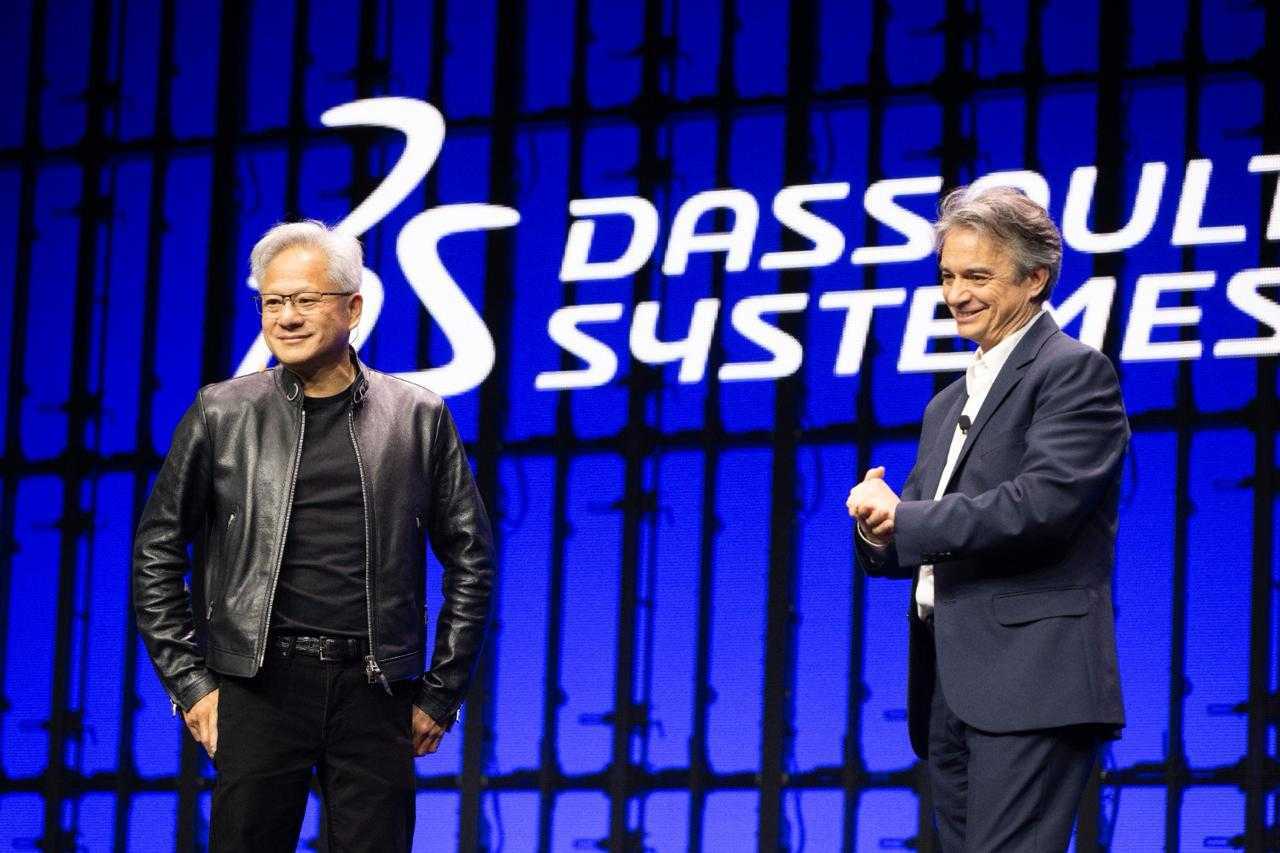
At 3DEXPERIENCE World in Houston, NVIDIA founder and CEO Jensen Huang and Dassault Systèmes CEO Pascal Daloz laid out a blueprint for industrial AI rooted in physics-based “world models” — systems designed to simulate products, factories and even biological systems before they’re built.
“Artificial intelligence will be infrastructure,” like water, electricity, and the internet Huang told the crowd, playfully referring to the engineering-heavy audience as “Solid Workers,” a nod to Dassault Systèmes’ SolidWorks platform.
The announcement continues a collaboration spanning more than a quarter century between NVIDIA and Dassault Systèmes.
“This is the largest collaboration our two companies have ever had in over a quarter century,” Huang said. “We’re going to fuse these technologies so engineers can work at a scale that’s 100 times, 1,000 times — and eventually a million times greater than before.”
Huang framed the shift as a reinvention of the computing stack: moving from hand-specified, structured digital designs to systems that can generate, simulate and optimize in software — at industrial scale.
From Digital Models to Industry World Models
Virtual twins are not applications, “they are knowledge factories,” Daloz said.
The partnership aims to establish industry world models — science-validated AI systems grounded in physics that can serve as mission-critical platforms across biology, materials science, engineering and manufacturing.
In Daloz’s framing, the value moves upstream: virtual twins become the place where knowledge is created, tested, and trusted — before anything is built in the physical world.
Dassault Systèmes, whose 3DEXPERIENCE platform serves more than 45 million users and 400,000 customers globally, has long been a leader in virtual twin technology — digital replicas that let engineers simulate products and processes before building them physically.
The collaboration brings together accelerated computing, AI and digital twin technologies so engineers can design not only geometry, but behavior — and explore radically larger design spaces earlier in development.
Together, the companies outlined how this shared architecture will show up across science, engineering and manufacturing workflows:
Advancing Biology and Materials Research: The NVIDIA BioNeMo platform and BIOVIA science-validated world models accelerate the discovery of new molecules and next-generation materials.
AI-Driven Design and Engineering: SIMULIA AI-based Virtual Twin Physics Behavior leveraging NVIDIA CUDA-X libraries and AI physics libraries empowers designers and engineers to accurately and instantly predict outcomes.
Virtual Twins for Every Factory: NVIDIA Omniversephysical AI libraries integrated into the DELMIA Virtual Twin enable autonomous, software-defined production systems.
Virtual Companions Supercharge Dassault Systèmes’ Users: The 3DEXPERIENCE agentic platform, combining NVIDIA AI technologies and NVIDIA Nemotron open models with Dassault Systèmes’ Industry World Models, powers Virtual Companions to tap into deep industrial context, delivering trusted, actionable intelligence.
Huang said that in domains like biology and materials, the frontier is learning the underlying “language” of complex systems and then generating new options that can be evaluated and validated in simulation.
Designing and Operating the Factory in Software
A central theme of the discussion was how factories themselves are changing — from static physical assets to living systems that are designed, simulated and operated as virtual twins.
As part of the partnership, Dassault Systèmes is deploying NVIDIA-powered AI factories on three continents through its OUTSCALE sovereign cloud, enabling customers to run AI workloads while maintaining data residency and security requirements.
Both executives emphasized that the goal isn’t to replace engineers — it’s to amplify them. As AI agent companions take on more exploratory and repetitive tasks, designers and engineers gain leverage and creativity, not redundancy.
AI Companions That Expand Human Creativity
Every designer will have a “team of companions,” Huang said — a shift he described as fundamentally positive for engineers, software platforms and the broader ecosystem built on them.
For the tens of millions of engineers who use Dassault Systèmes tools to design everything from aircraft to consumer packaged goods, the shift isn’t about replacing human creativity — it’s about expanding it.
“Success is not about automation,” Daloz said. “[Engineers] don’t want to automate the past — they want to invent the future.”
Looking ahead, Daloz framed the partnership as about more than performance gains – it’s an effort to open new possibilities, help companies eliminate bad choices before they become expensive mistakes, and create entirely new categories of products.
“Virtual twins and the 3D Universes are not applications,” Daloz said. “They are knowledge factories.”
The fireside conversation between Huang and Daloz was broadcast live from 3DEXPERIENCE World.