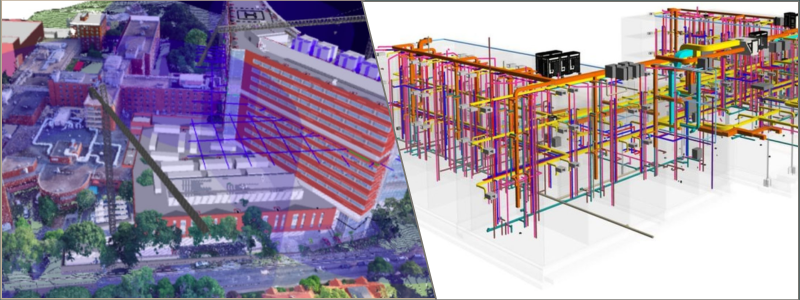
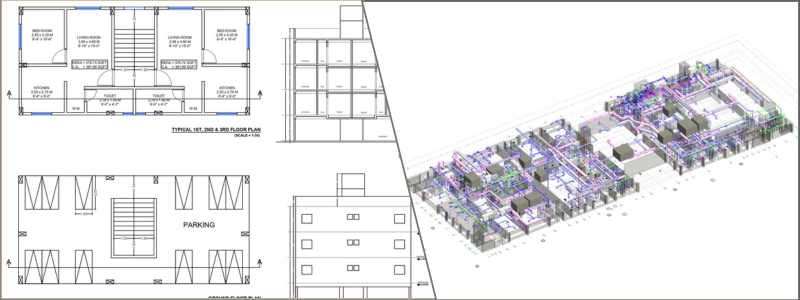
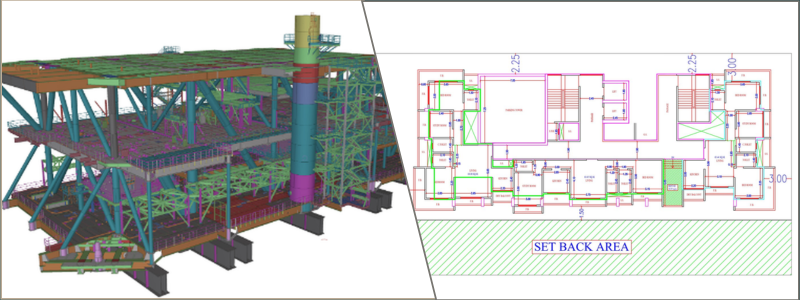
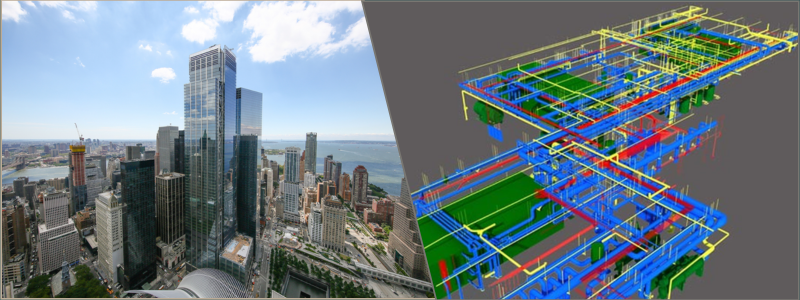
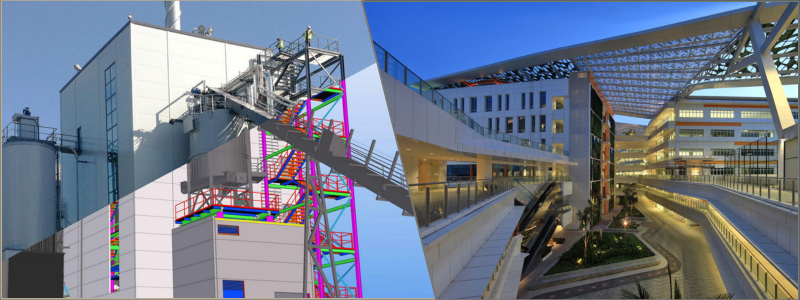
Building Information Modeling, or BIM, revolutionized the construction and building industry by enhancing the design process as well as better management of the projects. Scan to BIM, a specific application of architectural BIM services, takes the process one notch higher by integrating 3D laser scanning and building information models to provide accurate digital models of existing facilities.
This solution is most useful to architects, engineers, and builders involved in renovation or retrofitting work because it will enable correct as-built models and improve project delivery. For architectural design service companies from Cad Crowd’s leading industry platform, adding a scan to BIM to their workflow can be useful, but it comes with its own set of issues. Here is a step-by-step guide on how to work efficiently with architectural design services companies utilizing Scan to BIM technology.
🚀 Table of contents
Understanding the scan to BIM technology
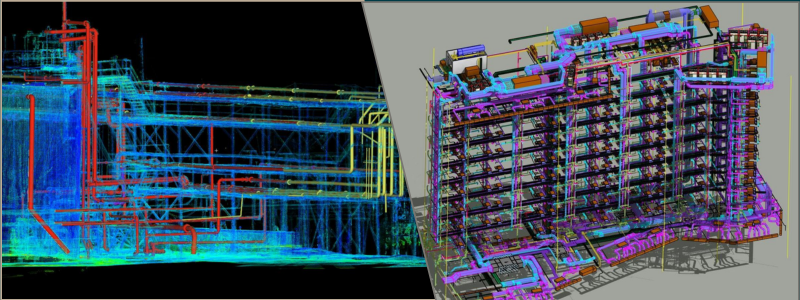
Scan to BIM (Building Information Modeling) represents a revolutionary process that seamlessly bridges the gap between physical structures and digital design workflows. The technology begins with advanced 3D laser scanning, which captures high-resolution, millimeter-accurate scans of existing buildings or construction sites. This comprehensive scanning process collects millions of precise data points, creating what professionals call a “point cloud”—an incredibly detailed digital representation of the physical space.
These point clouds serve as the foundation for generating accurate 3D modeling design services that integrate directly into BIM platforms used by architects, engineers, and construction professionals. The result is a data-rich digital twin that reflects real-world conditions with unprecedented precision.
Primary applications and advantages: Scan to BIM proves especially valuable for retrofit, renovation, and restoration projects where existing building conditions must be captured with absolute accuracy. Traditional measurement methods often prove slow, inaccurate, and labor-intensive, particularly in complex or inaccessible areas. Scan to BIM technology eliminates measurement guesswork by generating highly detailed models that precisely mirror actual site conditions.
Strategic benefits for design practices: Architectural firms adopting this approach experience significant operational improvements:
Dramatic reduction in documentation errors and measurement inaccuracies
Enhanced project planning capabilities and streamlined decision-making processes
Substantial cost savings through the elimination of expensive rework scenarios
Improved collaboration across disciplines and construction phases
Whether working with historic structures, large commercial complexes, or constrained urban environments, Scan to BIM ensures all design decisions are grounded in reliable, data-driven models that reflect true building conditions.
Why architectural firms should embrace scan to BIM
Architecture firms embracing Scan to BIM technology unlock transformative advantages that fundamentally enhance design accuracy and operational efficiency. This innovative approach enables architects to work from highly detailed, data-rich 3D models generated through precise laser scanning of existing structures, eliminating traditional measurement guesswork and dramatically reducing errors from outdated building documentation for architectural design firms.
Enhanced accuracy and efficiency: Scan to BIM virtually eliminates costly on-site rework by providing architects with precise as-built conditions from the project’s inception. Traditional site surveys—historically time-consuming and labor-intensive processes—are replaced by rapid laser scanning technology that captures comprehensive building data in hours rather than days. This efficiency gain liberates architects to focus on creative problem-solving and strategic design development rather than tedious measurement tasks.
Seamless collaboration: The technology’s collaborative impact proves equally significant through real-time accessible BIM models that create a unified information platform. Engineers, contractors, and stakeholders work from identical, continuously updated data, eliminating communication gaps and reducing coordination conflicts. This shared digital foundation ensures all project participants operate with consistent, accurate information throughout the entire project lifecycle.
Superior project outcomes: The result is seamless project delivery characterized by enhanced interdisciplinary communication, reduced design conflicts, and accelerated construction timelines. Scan to BIM transforms complex renovation and retrofit projects from error-prone endeavors into precision-driven, collaborative processes that consistently deliver superior outcomes while maximizing both time and cost efficiency.
Key considerations when working with architectural firms using scan to BIM
When you hire an architectural design and drafting firm for a project involving Scan to BIM, there are a few key things that you need to take into account. No, you don’t simply go out and hope to find the best firm you ought to be dealing with. You don’t want to just take anyone, either. You do need to make sure that the firm has experience with Scan to BIM technology and that they can efficiently incorporate it into their design workflow. But apart from technical knowledge, there are a couple of other things to bear in mind.
Assess the firm’s technical capability
It is not possible for all architecture companies to be efficient when it comes to utilizing Scan to BIM technology. While certain companies are able to perform this process for a very long duration, there are companies that are working towards activating it. Prior to recruiting an architectural firm to handle a Scan to BIM job, make it a point to consider their technical capability. Inquire about their experience using 3D laser scanning, BIM software, and whether they have worked with bringing Scan to BIM into their operation.
Also, it’s important to assess the software and machines the company uses for Scan to BIM. Different companies may utilize different BIM platforms (e.g., Revit, ArchiCAD), and they may not necessarily be all compatible with your needs. Make sure the company is utilizing the latest technology and software releases, as this will ensure that the models generated by them are accurate, up to date, and compatible with other tools used on the project.
Understand their approach to handling data
Scan to BIM involves the acquisition of huge amounts of data, and handling the data in an effective way is a crucial part of the process. The architectural design expert you hire should have a clear approach to handling the point cloud data, converting it into a usable BIM model, and providing the final product that best meets your project requirements.
Ask the company how they treat point cloud data. For example, do they use automated programs to automate, or do they use manual methodologies to clean? How do they ensure the correctness of the output BIM model? Understanding their data management procedure can help you decide whether or not they have the ability to handle the complexity of your job.
Communication and collaboration
Communication is essential in any architectural project, but particularly so when using Scan to BIM technology. Because there are several stages to the process, from gathering data to creating the model to implementing the design, strong lines of communication must exist among the architectural firm, contractors, and other stakeholders.
Make sure that the architectural firm you employ is committed to open communication and problem-solving as a team. Do they hold regular meetings to keep all staff members informed about project progress? Are they open to suggestion and ready to change if something needs to be adjusted? Communication is the key to preventing misunderstandings and keeping the project on track.
Before hiring an architecture practice on a Scan to BIM project, ensure that you confirm they receive what you are looking for. Do you need the BIM modeling services for energy analysis, fit-out, or future expansion if the need arises? The quality of data and amount of detail required will rely on the nature of the work.
Describe your aims to the company and make them aware of how Scan to BIM can help you achieve them. For example, if you are carrying out a full transformation, it is necessary to have a correct as-built model that can assist during the design. The architectural firm should be in a position to generate a detailed and accurate model that indicates the building as it is at the moment, including structural features, HVAC systems, and other major components.
Manage the project timeline
Scan to BIM projects can be complex and time-consuming, so it’s essential to work with a firm that understands the importance of managing the project timeline effectively. Request the company to provide a clear timetable that describes the different phases of the Scan to BIM process, from data capturing to point cloud processing, and finally, the creation of the BIM model. They should be able to provide you with realistic time schedules for each phase in the project and notify you of any delay or problem that arises.
It’s also important to know how long it will take to complete the BIM model and when you’ll be able to begin the design phase. Slowness in the Scan to BIM procedure will slow down the entire project timeline, so it’s necessary that the firm is efficient enough to meet your deadline on time.
Budget and cost estimates
Scan to BIM technology can be costly, particularly if you must acquire special hardware and software to gather the data and create the model. When hiring an architectural planning and design firm, ensure you understand the expenses of the Scan to BIM process beforehand. Ask for in-depth cost estimates with itemizations for the various expenditures, including data gathering, software licensing, model creation, and any additional expenditures.
While Scan to BIM may reap rewards in the long run by reducing errors and making projects more efficient, ensure that the cost is within your project budget. Demand that the company be transparent with you regarding their charges and how changes to the scope of the project may influence the overall cost.
Transforming architectural design through precision technology
Scan to BIM technology represents a transformative shift in architectural design and 3D architectural visualization services, bridging the gap between physical reality and digital precision. By integrating 3D laser scanning with Building Information Modeling, architectural firms can deliver unprecedented accuracy in renovation and retrofit projects while eliminating costly measurement errors. Success depends on partnering with experienced firms that demonstrate technical expertise, clear data management processes, and collaborative communication approaches.
When properly implemented, Scan to BIM streamlines project timelines, enhances cross-disciplinary coordination, and provides the data-rich foundation necessary for informed design decisions. This technology isn’t just an advantage—it’s becoming essential for competitive architectural practice in today’s market.
Take action: Partner with scan to BIM experts today
Don’t let outdated measurement methods compromise your next renovation or retrofit project. Partner with experienced architectural firms who have proven expertise in Scan to BIM technology and can deliver accurate, data-driven results. Evaluate potential firms based on their technical capabilities, communication processes, and project management track record before making your selection. Cad Crowd is a leading company that provides impeccable BIM scanning, architectural design, and engineering services to top AEC companies.
Contact qualified scan-to-BIM specialists today to transform your project accuracy and streamline your design process from day one. Request a quote today.
MacKenzie Brown is the founder and CEO of Cad Crowd. With over 18 years of experience in launching and scaling platforms specializing in CAD services, product design, manufacturing, hardware, and software development, MacKenzie is a recognized authority in the engineering industry. Under his leadership, Cad Crowd serves esteemed clients like NASA, JPL, the U.S. Navy, and Fortune 500 companies, empowering innovators with access to high-quality design and engineering talent.
Visualize a building’s layout without computer-aided design (CAD) files. It’s like trying to build something complicated using just rough sketches: you’d end up with a huge undertaking but no clear plan. Cad Crowd is an excellent service that helps companies find freelancers with the necessary skills to produce high-quality CAD design services. These digital blueprints transform abstract concepts into practical building plans; they are more than just drawings.
For what reasons has this technology grown so important in contemporary construction? In a nutshell, it merges imagination, precision, and velocity. There are a plethora of choices and details to keep track of from the time an architect is inspired until the day the last beam is installed. With CAD designs, there is no room for disarray or miscommunication.
You might think of computer-aided design (CAD) as the link between architects’ ideas and the built environment. Before building even begins, engineers and designers can examine their work in fine detail, try out various methods, and resolve any issues that may arise. They can digitally model something first rather than guessing how it might work. As a result, the whole building process will be more streamlined, with fewer unexpected obstacles and more efficient use of materials.
🚀 Table of contents
Breathing life into imagination
At the center of each great building or environment is imagination, by utilizing shapes, proper arrangement, and how individuals will experience the world around them. But having something incredible in mind is only the beginning. To bring those visions to life, architects require a strong method for expressing that vision clearly. That’s when 3D CAD design services, through computer-aided design software, enter the picture.
Those days are gone when it used to take a lot of effort to make hand-drawn sketches, which could be difficult to read or lack crucial details. With CAD, each line, angle, and curve is recorded exactly on a digital canvas. Not only does it make designs more visible, but also more accurate and easier to share.
What truly makes CAD magic is how it sparks imagination. Architects are free to experiment with various iterations of a design, changing sizes, materials, or configurations in a matter of seconds. Rather than deleting and redrawing whole blueprints, they simply click some buttons to experiment with new ideas. Such on-the-spot agility inspires a lively design process in which innovation happens. All at once, ideas that previously appeared impossible are suddenly completely possible, bringing life to imagination in the most useful and thrilling manner.
Ever gazed in amazement at a giant skyscraper or a complex museum and marveled at how they got it all done so perfectly? The key is in the remarkable accuracy of architectural CAD drawings services. In contrast to freehand sketches, CAD provides layers of detail that remove guesswork. From plumbing and electrical systems to the structural support, these are carefully mapped out ahead of time before construction even begins.
Why does this amount of accuracy matter? Imagine building a sophisticated edifice with cryptic or divergent blueprints. It’s a formula for pricey errors, annoying delays, and costly redoing. CAD blueprints get around this by being one simple, trusted plan that involves engineers, contractors, and suppliers who are certain about. One coherent truth cuts through misunderstanding, keeps the entire team moving as one unit, and avoids errors, conserving precious time and money through the entire course of construction.
A visual language for all parties involved
Constructing a new building without trying to use a blueprint or any definitive blueprint would result in total chaos. That’s where architectural CAD drawings truly excel. They serve as a common visual language that all parties to the project can comprehend, regardless of their function. Whether you’re the architect dreaming up the design, the structural engineer making sure it stands strong, the interior designer picking the perfect finishes, or the contractor bringing it all to life onsite, CAD drawings lay it all out clearly.
By translating complicated ideas into precise visuals, CAD eliminates those frustrating misunderstandings that can lead to costly mistakes. Detailed annotations, 3D modeling design services, and cross-sectional views break down even the trickiest parts, making sure nothing is lost in translation. This shared clarity keeps the whole team in sync, turning a complicated project into a smoothly coordinated effort where collaboration thrives and confusion fades away.
Supercharging project management
Let’s discuss how CAD drawings are powering project management in construction and architecture. Not only does CAD make designs appear snappy, but it also merges seamlessly with project management software and BIM platforms, revolutionizing the manner in which teams manage complex projects. Think of this: without a single brick being laid, the whole construction process can be virtually simulated. This enables companies to identify problems such as a duct interfering with a beam long before they happen, saving expensive on-site drama.
Businesses, enterprises, or clients may now accurately and in real-time monitor every aspect using CAD and BIM. This covers logistics, supply chain management, and cost tracking data. As a result, service providers and clients alike gain from streamlined operations and more efficient methods of operation. In addition to keeping tabs on time and money, this can help them spot issues that may develop as the project progresses. Computer-aided design (CAD) is more than just a lovely picture; it’s a strong mechanism that keeps projects running smoothly.
Now let’s discuss the magic of 3D design and why it’s a game-changer for architectural design experts, builders, and clients. Sure, flat blueprints have worked for decades, but today, CAD technology takes it way beyond mere drawings. Imagine not only viewing a floor plan, but actually walking around a fully rendered 3D model of your future space from all sides. You actually get a sense of scale, volume, and even the appearance and texture of various materials.
Incentivizing sustainability and efficiency
Let’s discuss how architectural CAD drawings are gradually transforming sustainable building design. You may consider CAD to be some sort of posh drafting technology, but it’s more of a secret advantage for designing environmentally friendly buildings. By modeling every minute detail, CAD allows architects to mimic the way sunlight passes through a building or air circulates before the ground is even broken. That way, they can create buildings that automatically remain cooler or lighter, reducing the amount of artificial light and air conditioning needed.
Not only does this conserve energy and lower the bill, but it also minimizes the building’s carbon footprint. And because CAD’s accuracy makes it possible to measure materials precisely, builders use less and remain cost-effective. All these benefits make projects more likely to achieve green building certifications, leading the construction industry toward a brighter, greener future—one CAD drawing at a time.
Adaptability in a rapidly changing industry
It’s said that the defining factor of industrial design services is the fixation on mass production. Think of it as product design infused with DFM. Also, remember that you can only mass produce physical products. For instance, a manufacturing facility might be able to make millions of smartphones in a year, but it doesn’t actually create an operating system for every single device. The operating system itself is a digital product distributed by the developer.
Suppose the smartphone in question runs a version of Windows Mobile; does this mean Microsoft has to develop millions of the same operating system, too? No, the company only needs to build one and then distribute it to the devices. What about in the old days when Microsoft sold physical copies of the Windows OS? The media (CD or DVD) were mass-produced, but not the operating system they carried.
The construction industry is always evolving, with new materials, technologies, and building codes popping up constantly. Architectural CAD drawings provide a flexible foundation that adapts quickly to these changes. Instead of scrapping entire sets of plans, architects and engineers can update digital files rapidly to comply with the latest standards or incorporate new innovations.
This flexibility isn’t simply a luxury; it’s critical. The potential to react with speed to alterations guarantees projects are completed without delay and expense, making businesses competitive and resilient. And because of the combination of CAD with cloud technology, dispersed teams across the globe can instantly collaborate, converting the world into one giant creative workshop.
Training the next generation of Architects and Builders
In particular, computer-aided design (CAD) is revolutionizing the training of future building tradespeople as well as the construction and architectural design industries. It is currently considered a vital talent for the trade, and as a result, CAD capabilities are being prioritized in architecture schools and construction training programs.
Students and apprentices learn to navigate complex software systems, improve their technical correctness, and develop three-dimensional spatial thinking skills. They are more equipped with the digital literacy needed by a tech-centric sector and are ready for real tasks faster, thanks to this first exposure.
The human side: Creativity meets technology
Let’s discuss the human aspect of CAD, where technology and creativity come together. Yes, CAD software is robust. It can perform intricate calculations, draw accurate lines, and accelerate the design process like no other. But at the center of every CAD drawing is a genuine human being: an architect or designer who invests his or her passion and vision into the project.
Imagine CAD as a reliable sidekick that handles the drudgery and technical work. That allows architects to step back and think big, concerned with how their designs can make people’s lives better, celebrate cultures, and inspire. It’s that delicate balance between human imagination and machine accuracy that makes contemporary architecture so thrilling.
Except for digital products, there’s not much of a difference between product design services and industrial design services, especially considering the fact that nearly all modern product design services implement DFM principles.
Architectural CAD plans are much more than technical documents. They’re the unsung heroes of successful modern design and construction. They translate concepts into accurate plans, reduce mistakes, encourage teamwork, accelerate project completion, and define what buildings can be.
For design and construction firms looking to remain at the forefront of an increasingly fast-paced, sophisticated industry, adopting architectural CAD is not a choice—it’s essential. Whether designing signature skyscrapers, eco-friendly homes, or groundbreaking public spaces, CAD designs offer the clarity, precision, and freedom to create the future today.
Let Cad Crowd’s freelancers elevate your project
If you’ve ever admired the beauty and complexity of a well-designed building, know that architectural CAD drawings were probably at the heart of bringing that vision to life, until the dream stood tall in reality. Cad Crowd is at the heart of architectural design and engineering as the utmost freelance platform providing vetted design and engineering services.
Ready to transform your architectural ideas into a stunning reality? Contact us now for a free quote and start your journey with our expert team today!
MacKenzie Brown is the founder and CEO of Cad Crowd. With over 18 years of experience in launching and scaling platforms specializing in CAD services, product design, manufacturing, hardware, and software development, MacKenzie is a recognized authority in the engineering industry. Under his leadership, Cad Crowd serves esteemed clients like NASA, JPL, the U.S. Navy, and Fortune 500 companies, empowering innovators with access to high-quality design and engineering talent.
Outsourcing architectural drafting services that form part of the industry leader Cad Crowd can seem a little like giving your beloved secret recipe to a stranger halfway around the world. You want to receive exactly the flavor, texture, and presentation, but there’s always this creeping fear: What if the end dish is not right? Or worse, what if the mistakes creep in and ruin your whole project timeline? Whilst outsourcing has proved to be a useful leverage for architecture firms to expand, economize, and access specialized expertise, it’s also full of pitfalls if not carefully managed.
But let’s get one thing straight: mishaps in outsourcing architectural drafting are not a given. They are problems waiting to be addressed with the right attitude, approach, and communication. If you’ve ever been stuck in the frustration of lost details, misaligned plans, or expensive reworks from outsourced drafting services, buckle up. We’re going deep on how you can outwit these mistakes and make outsourcing a winning proposition.
🚀 Table of contents
The allure and difficulty of outsourcing architectural drafting
Offshoring architectural drafting work presents a tempting combination of benefits: specialized skill, faster turnarounds, and usually a less costly financial impact than your own staff. You have access to worldwide talent pools where CAD coordinators and BIM experts provide innovative ideas and usually more current technical expertise. And, it releases your key architects to concentrate on design creativity instead of the drudgery of line work and documentation.
But here’s where it gets interesting. In contrast to working side by side, outsourcing introduces layers of complexity, distance, cultural subtleties, communication barriers, and time zone variations that can misplace or distort information. A misplaced dimension here, a misnamed layer there, and what was originally a simple drawing can turn into a mess.
So, what is the secret ingredient to getting past mistakes? Spoiler: It has nothing to do with eliminating outsourcing in general, but doing it right.
If there’s one word that can rescue your outsourcing endeavor, that word would be communication. Not mere communication, but clear-as-day, regular, and collective communication. Without it, even the most skilled drafting group will struggle.
Think of it as a handoff in a relay race. If the hand is sloppy, the team trips. When you outsource drafting, you’re handing over key architectural information to another team, usually at a distance. You have to be clear about what you expect, what you require, and what your goals are.
Most architectural design companies err by believing the drafting team ‘just knows’ what they need. In fact, assumptions are the source of all errors. A misplaced wall thickness or an ambiguous note on structural support can snowball into costly reworks.
Instead, create detailed briefs that do not leave any scope for assumption. Add annotated sketches, 3D models, reference standards, and even video, if necessary. Be prepared to answer queries in a timely manner, and arrange frequent check-ins to monitor progress. Video conferencing or screen-sharing sessions can establish rapport and clarify details more quickly than round-the-clock emails.
Choosing the right architectural drafting partner
Not all outsourcing companies are the same, and selecting a good drafting service provider is deciding upon a co-pilot for your project flight. Experience is important, but so are processes, technology competence, and cultural alignment.
Be cautious of companies that offer low prices but lack strong quality control or industry expertise. A drafting company that is familiar with your area’s building codes, design requirements, and software applications (such as AutoCAD, Revit, and ArchiCAD) will provide fewer mistakes and quicker revisions.
Ask future partners about their quality control processes. Do they use multi-layered review procedures? Double-check drawings versus original specs? How do they manage revisions and client comments? These questions speak volumes about how seriously they take accuracy.
Also, think about their communication responsiveness and style. The best architectural planning and design partner is proactive, open about issues, and accommodating enough to work with as your project changes.
Clear standards and documentation: The architect’s shield against errors
One such underestimated aspect of outsourcing mistakes is that there are no clear drafting standards and documentation. Picture every project as a rich language, and without a common dictionary, the misunderstandings accumulate.
Having a complete drafting standards manual for your outsourcing partner is a game-changer. This manual should define layer naming conventions, rules for dimensioning, line weights, symbols, annotation styles, and file formats.
In addition to that, specify examples of desired deliverables, timelines, and revision procedures. The aim is to ensure your architectural vision flows smoothly into the drafting language.
When everyone is literally on the same page, the likelihood of mistakes diminishes significantly, including those that might affect collaborators such as mechanical engineering experts. It also accelerates onboarding new drafting crews or rotating personnel in the outsourcing company.
Using technology to overcome distance
Technology is your friend when it comes to working remotely with architectural drafting. Real-time file sharing, change tracking, and version control are available through cloud-based collaboration platforms such as Autodesk Docs, Trimble Connect, or BIM 360.
No more emailing huge CAD files between each other, with the possibility of working with old versions. Everyone has the latest model, and comments or markups appear on the screen instantly.
Moreover, most companies have project management software like Asana or Trello to manage tasks and deadlines and create transparency regarding project status.
Using Building Information Modeling (BIM) software, where the model combines architectural, structural, and MEP services, allows clashes to be detected early, before any drafting starts. This minimizes mistakes downstream and keeps all the stakeholders aligned.
Training and relationship building: Outsourcing as a partnership, not a transaction
Too often, outsourcing is treated as a cost-cutting transactional activity and not as a co-operative relationship. This approach will plant seeds of neglect, poor communication, and ultimately mistakes.
Rather, view your outsourcing company as an extension of your very own staff. Take the time to train them on your business culture, project details, and feedback system.
This could mean virtual workshops or sharing recorded sessions on your design philosophy and quality expectations. The more aligned your partner is with your vision, the fewer surprises you’ll face.
Building relationships takes effort, but it pays dividends in trust and reliability. A trusted drafting partner will flag potential errors early, suggest improvements, and champion your project’s success.
Vigilant quality control: Catching errors before they catch you
Despite the best communication and standards, errors still do get through. The best way to deal with this is by catching them early through strong quality control procedures.
Before signing off on any outsourced drawing, have your internal team thoroughly review it against the original design documents. Utilize checklists that are specific to your project complexity, involving dimensions, annotations, layer compliance, and regulatory needs.
Some architectural design experts also have third-party reviewers or use computer programs that automatically review for drafting errors or code compliance.
Don’t hurry this process. A slight holdup here may save weeks of expensive rework on-site. Get your drafting partner to provide iterative review drafts instead of waiting till the last minute.
Managing time zones without losing time
One significant challenge in outsourcing architectural drafting services abroad is managing time zones. While your staff is waking up, your drafting firm might be closing down, and this window can hamper communication.
The key is astute scheduling and overlapping times. Determine periods in the day when both staff are working and make the most of that time for live communications.
Also, utilize asynchronous communication using emails, recorded video walkthroughs, and shared documents that enable every team to work effectively according to their schedule without relying on instant response.
You will find a rhythm over time that makes time zones a strength rather than a weakness, basically making your project a 24-hour shop.
Embracing flexibility and continuous improvement
Architectural projects are living things. Requirements evolve, regulations change, and design tweaks happen frequently. Outsourcing drafting services needs to embrace this flexibility.
Avoid rigid contracts that punish changes or revisions. Instead, build in scope flexibility and encourage ongoing feedback loops.
After each project phase, conduct post-mortems with your outsourcing firm. What worked? What errors crept in? What processes can be improved?
Sustained improvement is a hallmark of high-performing partnerships, resulting in fewer errors over the long term.
Real-world stories: Learning from outsourcing mishaps
The best lessons sometimes result from real-world anecdotes. One small architectural design and planning firm outsourced its drawings to a low-cost provider who was unfamiliar with local fire safety standards. The plans omitted necessary escape routes, leading to significant project delays and redesign expenses.
Conversely, another company spent big on ramping up their outsourcing partner, exchanging detailed CAD standards, having weekly video conferences, and creating a collaborative digital workspace. The payoff? Smooth drafting deliveries, negligible revisions, and an 18% quicker project cycle.
These anecdotes highlight the value of selecting the proper partner and spending in communication and standards from the outset.
Outsourcing architectural drawing services doesn’t have to be a gamble filled with errors and headaches. It’s about approach, seeing your outsourcing partner as a collaborator, investing in clear communication and standards, leveraging technology, and rigorously managing quality.
Imagine it as cultivating a garden. You can’t simply sow seeds and wait for things to happen. You water, trim, and pamper the plants so they grow well. Likewise, by caring for your outsourcing relationships, you’ll reap precision, effectiveness, and success in your architecture projects.
Partner with Cad Crowd now!
So the next time you are inclined to turn away from outsourcing drafting due to tales of woe about mistakes, keep in mind, it’s not the tool that breaks, it’s how it is used. At Cad Crowd, the leading platform for freelance engineering and design services, we’re here to help you. With these tactics under your belt, you’re better than equipped to use them like a pro.
MacKenzie Brown is the founder and CEO of Cad Crowd. With over 18 years of experience in launching and scaling platforms specializing in CAD services, product design, manufacturing, hardware, and software development, MacKenzie is a recognized authority in the engineering industry. Under his leadership, Cad Crowd serves esteemed clients like NASA, JPL, the U.S. Navy, and Fortune 500 companies, empowering innovators with access to high-quality design and engineering talent.
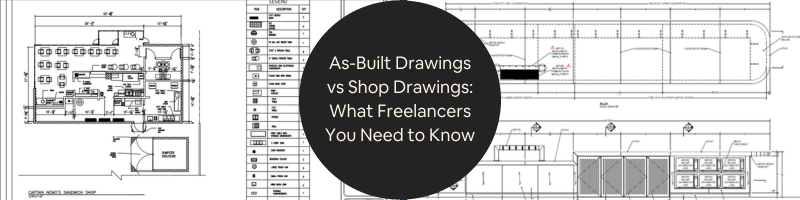
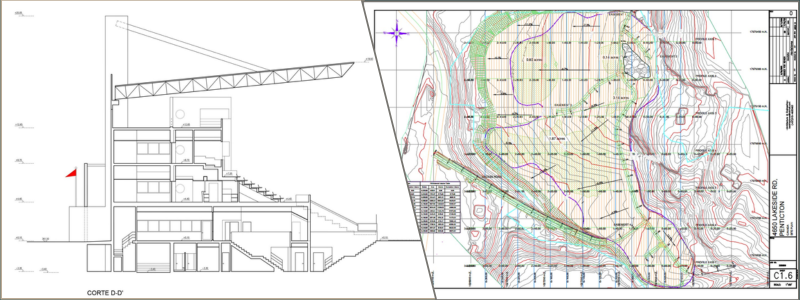
In the world of design and construction, accuracy is an important quality. Technical drawings are what architects, engineers, component fabricators, and builders rely on to ensure accuracy and precision throughout any project. It also serves as a tool to help architects, engineers,and other professionals in the design and construction to help them visualize design concepts and communicate,and reconstruct design ideas efficiently. One of many construction documents required and produced in an architectural project are shop drawings and as-built drawings. These drawings play a big role in the component fabrication process and for project review purposes.
Cad Crowd is a leading platform providing the best architectural design companies with vetted and highly experienced shop and as-built drawing services. Let’s take a look at their differences.
🚀 Table of contents
Shop drawings
Shop drawings are technical documents that describe and define the design of pre-fabricated components in a project, such as buildings. It is usually encountered in architectural projects that are dedicated to the construction and installation of MEP (mechanical, electrical, and plumbing) systems. The key term “prefabricated” indicates that the components to be used are of a mass-produced kind, such as piping, precast concrete, trusses, fire protection, metal ductwork, appliances, and so forth.
MEP components need shop drawings, but you might encounter similar documents referring to some furniture products. This is true, but only if the clients want their furniture pieces constructed from prefabricated parts. In case they specifically ask for custom furniture built from milled components, what you need is a millwork drawing instead. Shop drawings are among the “must-haves” in most architectural projects, both residential and commercial, and now with the rise of prefab and modular construction technology, chances are you’ll see quite an increase in the shop drawing services sector, too.
One of the main points of shop drawings is to provide specifications and detailed illustrations of how the prefabricated components should be procured and assembled to build a specific component. Architects, designers, and engineers provide the design intent as a general visualization of the final product, but the actual shop drawings must be produced by the person in charge of sourcing and assembly. In a typical architectural design firm, this person could be the general contractor, subcontractor, or supplier. Shop drawings are not general blueprints; they’re tailored to highly specific systems, designs, or structures in a project. You’d have a better guarantee of accuracy when the drawings are produced by someone who actually understands the ins and outs of the components.
Shop drawing isn’t an artistic drawing; it is a visual representation of a construction plan proposed by either an architect or a designer. It’s pretty technical, filled with information on materials, dimensions, assembly instructions, etc. A shop drawing is practically a communication tool to bridge the gap between the design plan and the actual build. To minimize the possibility of miscommunication, a shop drawing needs to include important points as follows.
Points
Purposes
Sections and elevations
Every single component must be attached with dimension information, including height, length, width, diameter, and all other relevant measurements. It goes without saying that all the prefab components must fit precisely within the structure. A shop drawing also has to provide a view of the final product with the correct dimensions.
Dimensions
A shop drawing service must specify the materials used for the prefabricated components. Additional details may include material grade, finish, type, and characteristics if needed.
Materials
Certain prefabricated components may require further processing, such as cutting and shaping to match the defined design specifications, so you should be able to find the instructions in the shop drawings as well. In case the design uses a lot of raw materials that need some more elaborate treatments, you can use another document (fabrication drawing) to provide the instructions.
Detailed views
When the design is complex enough that it requires small mechanisms or intricate details, the shop drawing provides enlarged views of those specific parts for clarity. Fabricators and installers refer to these “detailed views” to understand how the parts must be assembled.
Shaping
Certain prefabricated components may require further processing, such as cutting and shaping to match the defined design specifications, so you should be able to find the instructions in the shop drawings as well. In case the design uses a lot of raw materials that need some more elaborate treatments, you can use another document (fabrication drawing) to provide the instruction.
Bill of materials (BOM)
`Every single part and component you need for the design is listed in the BOM. Details include quantities, part numbers, specifications, and descriptions, and are essential for architectural planning and design companies.
Symbols
Symbols are used to indicate welding locations, sizes, and types. In many cases, you can omit these symbols entirely if you have a separate fabrication drawing. Usually, this is used in a design where metal components need welding.
Assembly information
An illustration of how the various components are assembled together. Some assemblies require different fasteners and connections, so you should make sure that all those details are clearly specified.
Finishing
An instruction on how to apply the specific types of coating, textures, or colors.
As mentioned earlier, shop drawings are custom blueprints for specific designs. They’re quite elaborate, for they must convey all the information you need to fabricate components and build the assembly correctly.
Note about metal components: depending on the design, some metal components must be welded together or fabricated in a particular fashion before you can assemble them with all the other parts, for example, in piping or plumbing installation.
Some welding jobs are simple enough that you can actually include the instructions for them in the shop drawing. For anything more complex than the simplest kind of MIG welding, you’ll need to provide instructions in a separate technical document known as a fabrication drawing through metal design and fabrication services. The design drawing, especially between the shop drawing and fabrication drawing, can be different depending on the level of detail pertaining to the fabrication technique. Fabrication drawing provides details even up to the smallest information, welding tasks, and provides symbols and measurements for every section.
Not every construction project needs shop drawings, but it doesn’t change the fact that they’re important to ensure design accuracy and speed up project completion. Here are some key aspects in an architectural project where you might find shop drawings invaluable:
Coordination: Shop drawings are technical construction documents. As such, they function as a means of communication between all parties involved in the project, including but not limited to the architect, engineers, designers, contractors, subcontractors, fabricators, builders, and clients. Shop drawings are the points of reference when you’re coordinating the construction, keeping everyone on the same page.
Design visualization: architects, engineers, or designers produce the design intent – sketches that represent the basic geometry and dimensions of a design. Contractors or suppliers interpret those sketches and transform them into a much more detailed visualization, albeit a two-dimensional one.
Shop drawings provide a more detailed view that consists of specific dimensions, construction methods, materials, etc, compared to sketches. After finalizing shop drawings, the architectural design expert reviews for approval and checks if the interpretation is exactly as needed. In case there are inconsistencies between the drawings and the original plan, it must be revised. From there, it can only proceed to the construction/fabrication when all details are correct.
Guidance: If an architectural project involves a lot of designs, objects, or products constructed from prefab components, shop drawings must be treated as the only fabrication guidance. So long as the drawings have been approved by the architect or engineers in charge of the project, there’s almost no need to look for any other references.
There’s also quality control. Because shop drawings provide detailed fabrication guidance, you should be able to identify any mistakes in the finished work by cross-referencing it with the drawings, too. Assuming the project is large enough that the construction requires permits, shop drawings are also part of the documents to ensure compliance with local building codes; as in, you can’t acquire the permit or even apply for it without having shop drawings.
As-built drawings
A construction “as-built” drawing (also known as red-line drawing or record drawing) is the technical document that offers an overview of the final design. It might be used as a comparison tool to verify whether the end product comes out exactly as planned. Think of it as a blueprint compiled after the project concludes. Of course, the point is to showcase, in detail, how the project is actually built.
In an ideal world, every architectural project goes exactly as planned. But this is rarely, if ever, the case at all. An as-built drawing is submitted upon the completion of a project to reflect all the changes made during the construction process.
Such changes might include alterations in specifications, design geometry, locations of components, and basically all other works completed over the duration of the project and under the contract. Even the changes in shop drawings, for example, when prefab components need further treatments to fit the desired specifications, are also included in the as-built documents. Keep in mind that none of those modifications are made without approval from the architectural design and drafting firm and the clients.
But just because the drawings are submitted upon completion, it doesn’t necessarily mean they’re created as soon as the project ends. If you can allocate the time and budget, it’s best to schedule as-built surveys throughout the duration of the project. The surveys track how the construction progresses over time and create “partial” as-built drawings as they go. As long as there are no further modifications to the already “surveyed” sections of the project, you can simply compile the partial maps into one single drawing in the end. This makes the process much easier and quicker than having to retrace everything all over again.
To make an as-built drawing as clear as possible, so that it may serve its purpose well as a review tool, you must include quite a lot of documents containing a lot of details. At the very least, these are the things you should see:
Record of changes in scale, but ideally, this should not be a problem as long as you use the same scale as the original blueprint.
Clear labels to identify changes, instead of vague phrases like similar to, equal to, taller, bigger, or any potentially ambiguous terms, without mentioning additional details.
All records of changes in sizing, dimensions, locations, fabrications, installations, assemblies, materials, textures, and so on.
Specific dates when every single one of those changes occurs.
Notes on unexpected challenges encountered during the project, and the solutions implemented to solve them.
Notes about changes proposed during the final inspection.
Shop drawings, original blueprints, and appendices.
As-built drawings are usually signed by the architect associated with the original blueprint, and shop drawings are created by contractors and suppliers during their contract with the project. In case you hire your own architect, their role is to record all the changes made to the design, as they are the most qualified to do the task because of their familiarity with the intended design.
If you’re running a small architectural firm without in-house drafters, you can always outsource the task to third-party CAD service providers or freelancers. However, since the architects have the final say to approve the design, it doesn’t really matter who actually produces it. In case there are mistakes in the drawings, you’re allowed to ask for revisions, too. The same thing applies to shop drawings.
Why should contractors care about as-built drawings?
Although submitting as-built drawings is not always mandatory in every project, the documents serve as important components of any finished project. They’re the most accurate representation of what was actually built in the first place, and will be indispensable references when you need to modify, expand, renovate, and build on top of the old work.
If you’re a general contractor, you might be wondering why you should prioritize producing and submitting an as-built at the end of a project. As a matter of fact, you shouldn’t be focusing on creating an as-built throughout the project at all; instead, you should strive to maintain or improve your work and quality to be reflected in the as-built.
The truth of the matter is that as-built drawings can’t really affect the construction at all. But it can do wonders for your reputation as a company and bring more businesses in the future. As for subcontractors, as-built drawings are especially important if you’re hired to do a renovation and a maintenance project. Once again, the as-built will be your most dependable document of reference to improve your chances of completing the job with great success.
Finally, as-built drawings are proof that the architects, contractors, engineering design firms, designers, subcontractors, and fabricators have moved on from the project. They’ve done what they’re hired to do, and you can always take a closer look at what they made from the submitted and approved as-built drawings.
Whether you need a shop drawing for specific building components, an as-built drawing after the completion of a big project, or as-built surveys to help you compile the final document, Cad Crowd has just the right professionals to get the job done. We are home to some of the most experienced drafters in the country, offering services to companies and individual clients alike at affordable rates. Contact Cad Crowd now to get your free quote.
MacKenzie Brown is the founder and CEO of Cad Crowd. With over 18 years of experience in launching and scaling platforms specializing in CAD services, product design, manufacturing, hardware, and software development, MacKenzie is a recognized authority in the engineering industry. Under his leadership, Cad Crowd serves esteemed clients like NASA, JPL, the U.S. Navy, and Fortune 500 companies, empowering innovators with access to high-quality design and engineering talent.
The architecture, engineering, and construction (AEC) sector is experiencing a technological revolution, and this is quite clearly reflected in the increasing number of AEC service firms on top platforms such as Cad Crowd. With AEC companies struggling to design, plan, and deliver intricate projects, the convergence of building information modeling (BIM) services and Geographic Information Systems (GIS) has become a game-changer.
Blending the benefits of both systems introduces the possibility of more precise, streamlined, and coordinated project delivery. For AEC services firms, knowing how BIM and GIS integration works—and how it affects their business—is fundamental to competitiveness in a progressively data-centric industry.
🚀 Table of contents
BIM and GIS: A quick overview
Before delving into the influence of BIM and GIS integration on the AEC industry, it’s imperative to identify what each system does and how they work as stand-alone entities.
Building Information Modeling (BIM): Building information modeling (BIM) is a digital representation of a building’s design, construction, and operational details. This is more than just a 3D model; it includes helpful information about the design’s materials, structural qualities, budget, and schedule. Preliminary design optimization, collaboration, and simulation can take place thanks to this tool, which is useful for architects, engineers, and contractors.
Geographic Information Systems (GIS): GIS is an application that captures, stores, manipulates, analyzes, manages, and displays geographic or spatial data. GIS allows experts to map and analyze terrain, land use, zoning regulations, weather, and other location-relevant factors, frequently essential when handling large-scale infrastructure or urban planning projects.
When integrated, GIS and BIM enable AEC firms to control both the micro-level specifics of building construction (via BIM) and the macro-level issues of geography and environmental conditions (via GIS). The combination of these systems provides an extensive toolset for planning and implementing projects in ways otherwise hard or impossible to achieve for architectural design firms.
The Role of BIM and GIS Integration in AEC Services
BIM and GIS integration are revolutionizing the way Architecture, Engineering, and Construction (AEC) services plan and execute projects. BIM centers on precise details of a building’s design, construction, and lifecycle, including structural and material information. GIS provides a wider geographic and environmental picture—charting terrain, infrastructure, climate, and so on.
Together, BIM and GIS present a complete picture that improves each phase of a project, from initial planning to upkeep. This combination allows AEC professionals to compare spatial and structural information at the same time, making optimal site selection, sustainability, and urban planning decisions. It leads to better collaboration between stakeholders, faster delivery schedules through data-driven processes, and less risk through early identification of problems.
Finally, BIM-GIS convergence enables companies to design more intelligently, build quicker, and operate more cost-effectively, producing projects that are not just technically excellent but also socially and environmentally responsible.
Here’s a look at how this integration enhances AEC services:
Better planning and site selection
When starting any new building project, location and site conditions take precedence. GIS facilitates AEC companies in determining the readiness of a site by offering information regarding land characteristics, environmental factors, zoning regulations, and existing infrastructure in the area. For instance, GIS may be applied to examine soil quality, flood exposure, traffic flow, or distance from utility networks. This information is critical in the determination of the most suitable location for a building or infrastructure development.
Through the integration of BIM, architects and engineering design firms are able to simulate how a proposed design would interact with the site’s geographic conditions. For example, a BIM model can simulate how a building’s foundation would perform under various soil conditions determined by GIS data. This type of simulation minimizes the chances of expensive surprises during construction and provides a more sustainable, site-suited design.
Better decision-making through visualization
The combination of BIM and GIS provides a versatile decision-making visual tool. GIS provides a topographic, spatially correct map of the project location, with BIM contributing precise 3D models of the building or structure. Merging these models, AEC firms can visualize how the building will interlink with its physical and environmental context.
For instance, architects can apply the combined models to model the effect of natural light on the building façade during the year. They can also model the air circulation or water runoff relative to the local topography. Having both building and geographic data in one place assists teams in making improved design decisions that lower energy usage, enhance user experience, and enhance the building’s resilience to environmental conditions.
Collaboration is the lifeblood of the AEC industry. In conventional workflows, architects, engineers, and contractors tend to work in separate silos and use different systems that may or may not speak to each other. This has the potential for misunderstandings, mistakes, and delays. Introducing BIM and GIS eliminates these communication problems.
When GIS data and BIM models are combined, all stakeholders—from construction workers to civil engineers—can view and update the same real-time information. For instance, an engineer can update a BIM model according to new GIS data on local zoning laws, while an architectural design expert can make adjustments to the building design to accommodate the environmental context. The outcome is a more coordinated and integrated workflow that results in fewer changes and delays later on.
Efficient resource management
Successful resource management is key to finishing any project on schedule and within budget. Using BIM’s accurate data and GIS’s spatial context, AEC firms can enhance the management of resources, including materials, labor, and equipment, throughout the project’s life cycle.
With the help of GIS, project managers can analyze the materials’ location compared to the site location, guaranteeing that logistics are optimized. BIM, however, ensures accurate quantities and material specifications, guaranteeing correct material delivery at the correct time. This coordination eliminates waste, reduces transportation expenditure, and guarantees that construction activities operate smoothly.
Increased sustainability and environmental impact analysis
Sustainability is a key focus in contemporary architecture and construction. AEC firms are being called upon more and more to adhere to environmental standards, conserve energy, and reduce their carbon footprint. Combining GIS and BIM enables companies to address sustainability in a more comprehensive manner.
Unlike BIM, which allows for comprehensive energy modeling and simulation, GIS provides a wealth of data pertaining to environmental factors, such as climatic trends, water consumption, and energy consumption. By combining the two programs, architectural planning and design companies can simulate the possible influence of different design elements on sustainability, water usage, and energy efficiency, allowing for more comprehensive evaluations of a building’s carbon footprint. Such research can make a huge difference to the efficiency and sustainability of a building over time.
The benefit of combining BIM and GIS doesn’t end when the construction process is finished. Once a building or infrastructure project is completed, these systems are still useful in the operation and maintenance phases. BIM can be utilized to monitor the status of building components over time, while GIS can track the environmental conditions that impact the building.
A facility management team, for instance, can keep track of when critical systems are due for repair or replacement with the help of an integrated GIS/BIM system. Building operations can be tracked in relation to external factors like weather and traffic patterns. By using this data, proactive maintenance can be implemented, resulting in cost savings and an extended building life.
The most common challenges of BIM and GIS integration
Though there are numerous advantages of the integration of BIM modeling services and GIS, there exist some challenges AEC companies need to address. The complexity involved in integrating two dissimilar systems with different data structures and formats is one of the major barriers. BIM and GIS solutions tend to be built by dissimilar software companies, and as such, compatibility issues may occur.
The other challenge is the accuracy and consistency of the data. GIS depends a great deal on geospatial data that is available in real time, which is prone to inaccuracies or obsolescence. Likewise, the BIM models will need to be constantly updated to accurately portray the state of the construction project as it is now. It will take great diligence to have both systems harmonized and updated.
Moreover, there is a need for training and expertise. AEC practitioners must be familiar with both BIM and GIS technologies to be able to take advantage of their full potential. This will involve investment in training courses and perhaps the recruitment of specialists to oversee the integration process.
Conclusion
The convergence of BIM and GIS is transforming the way AEC services firms tackle design, planning, and execution of projects. By merging the precise, model-based methodology of BIM with the spatial, context-aware insights of GIS, companies can make more informed decisions, enhance collaboration, increase sustainability, and streamline resource management. The potential for greater efficiency, cost reduction, and risk mitigation is vast, but achieving these benefits involves surmounting technical and organizational hurdles.
For AEC companies wanting to remain competitive in today’s cutthroat world, BIM and GIS integration investment is not merely about being up to speed with industry developments; it’s an essential tactic for producing superior projects in fewer resources, achieving client expectations, and helping build a more sustainable built environment. If you think you’re ready to take this trend, Cad Crowd is where you should start looking for specialists in BIM and GIS. Get a free quote today!
MacKenzie Brown is the founder and CEO of Cad Crowd. With over 18 years of experience in launching and scaling platforms specializing in CAD services, product design, manufacturing, hardware, and software development, MacKenzie is a recognized authority in the engineering industry. Under his leadership, Cad Crowd serves esteemed clients like NASA, JPL, the U.S. Navy, and Fortune 500 companies, empowering innovators with access to high-quality design and engineering talent.
When you’re wading through a product concept, trying to decide if that sexy swooping handle or that clever folding action is going to cut it in the real world, the individuals bringing your ideas to life aren’t necessarily designers. They’re drafters. They’re CAD experts. They’re the ones taking your sketch on a napkin and turning it into dimensioned drawings, production-ready 3D models, and stunningly rendered prototypes. And in the US, where concepts get fired around quickly and technology requires accuracy, there’s an entire brigade of fantastic CAD design services and drafting businesses waiting in the wings to assist.
So here it is, a tour-de-force of more than 50 of the most impressive drafting businesses and CAD design services firms in America (with a few from other expensive hotspots such as Canada, the UK, and the Netherlands to provide some global diversity if necessary). Whether you are an entrepreneur trying out a new device, a builder requiring floor plans, or a manufacturer subcontracting product drawings, this list is your one-stop reference to the experts who can make imagination concrete.
🚀 Table of contents
Cad Crowd (United States)
If there were a drafting Olympics, Cad Crowd would be igniting the flame. This behemoth provides you with pre-screened freelance CAD designers, product engineers, drafters, and 3D modelers from all over the U.S. It’s not some random gig site — it’s a handpicked community where the work is actual, the talent is extensive, and the outputs are always pro-level. You can have a freelancer do your work or get Cad Crowd to handle your entire design project from inception to delivery. They have experience in mechanical design, patent drawings, architectural drafting, 3D modeling, and even full product development.
TriMech is a SOLIDWORKS design and engineering solutions powerhouse in the United States. It is a CAD service company, but more than that, it caters to businesses through engineering staffing, product development, automation services, and even addictive manufacturing design services. With their expertise, they are the right partner for those companies that intend to grow effectively and innovate with assurance. With offices throughout the country, TriMech provides the level of national reach and expertise that industrial and tech businesses want. If your organization is growing and needs reliable, full-service support, TriMech provides a systematic solution for engineering and design issues.
Portland, Oregon-based Pacific CAD is focused on precision. They specialize in AutoCAD and Revit drafting, supporting architects, construction firms, and real estate developers across the United States. Whether it’s a detailed 2D site plan or a 3D model for client presentations, they know how to bring designs to life. Their work is crucial for permitting, construction coordination, and project visualization. From home remodels to large-scale developments and industrial builds, they’ve built a reputation for accuracy and reliability. When you need top-tier drafting services that hit every detail, Pacific CAD is a name worth knowing.
BlackHägen Design, headquartered in Florida, brings a unique blend of expertise to the CAD world. Far beyond standard drafting services, this firm specializes in human factors engineering and usability design. They don’t just focus on form and function—they dive into how real people interact with products. Whether it’s a medical device, a fashionable wearable, or intelligent consumer technology, they examine every click, every grip, and every user interaction with meticulous precision. Their process ensures that what gets created not only functions flawlessly but is intuitive and effortless. When it comes to user-centered product design, BlackHägen stands as an industry-leading name.
Design Presentation Associates, based in New York, brings serious skill to the table with CAD conversion, architectural drafting services, and digitization services. They’ve earned a strong reputation among architectural firms, engineers, and contractors alike. If you’ve got stacks of legacy blueprints collecting dust, DPA can turn them into crisp, accurate digital files in no time. Their business is renowned for fast turnaround times, reasonable rates, and reliable service—three aspects that every working professional would love. Whether it’s revising your archive or assisting with an ongoing project, DPA provides results you can rely on, making them a recommended collaboration partner in the architectural industry.
CAMcad Technologies in sunny Miami brings you premier CAD/CAM solutions designed specifically for the manufacturing industry. With expertise in CNC programming, tooling design, and mechanical drafting, they’re a first-call partner for both machinists and OEM suppliers. They understand precisely how to treat high-tolerance parts, making sure everything fits and works with perfect accuracy. Whether creating a custom part or streamlining a machining process, CAMcad provides expert knowledge. For those involved with intricate assemblies or close specs, this is the type of assistance that makes the difference in manufacturing velocity, consistency, and final product functionality.
Outsource Drafting USA may be a small Florida company, but they bring a big hit to architectural and construction drafting. From sharp 2D site plans and elevations to precise plumbing schematics and 3D MEP coordination drawings, they’ve established themselves as a go-to for reliable assistance. Their services are designed for residential and commercial jobs alike, with an efficient workflow that gets things flowing. Clients love that they get clear, upfront pricing—no surprises. Communication is surprisingly uncomplicated, making it easy to collaborate. For companies requiring capable, high-quality drafting services without the trouble, this group excels throughout the U.S. drafting industry.
Astoria Design Group, based in warm and sunny Southern California, is a company that offers drafting services for both residential and commercial projects. Their strength is most radiantly displayed in the production of custom home design services and specific renovation blueprints. The team works closely with a diverse range of clients, from developers and builders to homeowners eager to transform their Pinterest inspirations into practical, build-ready plans. Known for blending creativity with precision, Astoria Design Group ensures every detail meets the client’s vision while adhering to technical standards. Their approach makes complex projects feel manageable and exciting for everyone involved.
Technical Drawings Inc., located just outside of Seattle, provides a wide variety of CAD services, from initial conceptual drawings to highly detailed mechanical prints. Their staff possesses extensive experience in many industries, such as aerospace, automotive, and industrial equipment. No matter what your project entails, whether complicated gears, sophisticated moving components, or needs sophisticated finite element analysis (FEA) simulations, this company is qualified to meet your needs. Renowned for their precision and technical detail, Technical Drawings Inc. is a go-to partner for firms wishing to transform creative designs into precise, buildable plans.
Infinity Design & Drafting, headquartered in the United States, offers a comprehensive range of drafting services tailored to meet the needs of builders and engineers nationwide. They are experts at producing precise, detailed construction documents that guarantee accuracy and clarity at all stages of a project. What really distinguishes Infinity is their striking 3D rendering capacity, which not only brings their designs to life but does so in strikingly clear detail. Such natural-looking visuals are ideal for client presentations and virtual tours, enabling stakeholders to fully comprehend and connect with a project before any construction has begun. With Infinity, all the steps from drafting to visualization are taken care of professionally.
Allegion Design Services in the United States is a company that excels at secure design, with a specialization in door and hardware solutions for big buildings like hospitals and schools. It may not sound exciting, but what they do is totally necessary and very complicated. They provide architectural design and drafting services that guarantee safety and security in situations where it is most important. From controlling access to coordinating hardware specifications, Allegion’s skill keeps critical buildings operating efficiently and securely. Their work might go unnoticed, but without their attention to detail and expertise, the security of thousands of structures would be compromised.
Blue Drafting and Design, a boutique firm located in the Midwest, has built a strong reputation over the past decade. Specializing in architectural drafting and MEP plans, they consistently deliver clean and detail-oriented drawings that clients rely on. Their expertise spans both residential and light commercial projects, ensuring each design meets precise standards. In addition to drafting services, Blue Drafting and Design also offers CAD training, enabling professionals to refine their technical skills. Dedicated to quality and clarity, this company is still a valued collaborator for architects and builders looking for sound design assistance.
Wiersholm Drafting & Design (United States)
Wiersholm Drafting & Design, from Idaho, is a reputable company that excels at custom home design and residential drafting. They’ve designed a varied portfolio, from rustic cabin-style homes to opulent suburban homes and even hip barndominiums. What sets Wiersholm truly apart, however, is their intimate local knowledge; every drawing reflects a strong familiarity with regional building codes and construction details particular to the region. This inside knowledge ensures that each project not only appears excellent but also meets all required standards, making Wiersholm a go-to partner for Idaho homeowners seeking customized designs.
Plan B Drafting (United States)
Plan B Drafting, an Arizona-based company, is an excellent option for contractors looking for reliable and flexible drafting solutions. Whether you’re working on a remodel or building a brand-new one, they’ve got you covered. The proficiency of their AutoCAD design experts and Chief Architect guarantees accurate and professional work suited to your project’s requirements. The most impressive thing about them, however, is their easy communication, which makes the entire process hassle-free and seamless. And with their fast turnaround times, you won’t be left twiddling your thumbs waiting to get your project moving. For trusted drafting assistance, Plan B Drafting is a top choice in the U.S. market.
Drafting Concepts (United States)
Drafting Concepts, founded in North Carolina, is a trusted partner for engineering companies, developers, and manufacturers requiring accurate shop drawings, steel detailing, and 3D visualizations. Where they truly excel, however, is in the ability to convert scanned drawings into precise CAD files—a finicky process that requires both skill and focus. Whether you’re refining complex steel structures or visualizing a new project in 3D, Drafting Concepts makes the transition from old-school paper plans to modern digital designs seamless and reliable. Their work helps bring ideas to life with clarity and precision.
USA Drafting & Design (United States)
USA Drafting & Design, based in California, specializes in drafting and engineering support tailored for both residential and commercial construction projects. Whether you’re planning a new home or managing a commercial build, their services cover the entire spectrum. From detailed as-built surveys that capture existing structures accurately to permit-ready drawings designed to meet local regulations, they handle it all with expertise. Their comprehensive approach ensures smooth project progress, saving clients time and stress by providing precise, reliable documentation every step of the way.
Spire Drafting (United States)
Spire Drafting, based in Colorado, specializes in servicing real estate agents, builders and contractors, and designers with accurate as-builts, CAD drawings, and 3D floor plans. Their staff is particularly flexible, easily shifting to various project requirements while still keeping their keen focus on the details. This quality makes them a reliable ally, particularly with clients who keep coming back for repeat orders. Whether it’s editing current plans or designing new drawings, Spire Drafting adds consistency and dependability to each project, allowing for complicated drafting procedures to be simplified for their clients nationwide.
Superior Drafting, a Massachusetts-based company, is an exceptional firm that combines architectural drafting with innovative 3D design and architectural visualization services. Since the early 2000s, they have established a solid reputation for working closely with homeowners and small builders to provide personalized and detailed project assistance. Their experience enables clients to visualize their ideas through accurate drawings and realistic 3D renderings. This personal touch makes Superior Drafting a reliable option for individuals looking for quality drafting service with a personal touch. Their extensive experience has a long history that sets them apart in the industry.
Design Everest (United States)
United States-based Design Everest specializes in the area of structural engineering. Apart from that, they also offer complete CAD drafting services specifically designed to suit residential and commercial projects across California. What differentiates them is their in-depth engineering experience, which gives an added level of credibility and trustworthiness to their draft work. This skill also streamlines the approval process by fostering relationships with clients. From the home to the commercial building, Design Everest’s combination of drafting and engineering provides accuracy and dependability every step of the way.
Accurate Drafting Solutions, Texas-based, offers architectural and MEP drafting services to meet code compliance and provide constructability. Their skills enable them to become a go-to business partner for small builders and designers who need reliable, detail-driven drafting assistance. Whatever type of residential or commercial projects they are working on, Accurate Drafting Solutions is committed to precision and usefulness, enabling clients to execute their designs without complications. Anyone in search of a trustworthy drafting company that can grasp both the technical and artistic aspects of construction is a good candidate to choose from this Texas-based service.
Pennsylvania-based CAD Pro Systems is a reliable group offering end-to-end CAD design services. They focus on CAD drafting and are skilled at providing highly detailed patent drawings, making them a great option for inventors submitting to the USPTO. In addition to drafting, they offer useful prototyping assistance, assisting in bringing ideas to life. Their combination of technical proficiency and industry expertise ensures that clients receive accurate, professional drawings created to patent office specifications. For anyone seeking trustworthy and professional help with patent documentation and design, CAD Pro Systems is the place to go.
Axiom Design Solutions of the United States is a well-established partner for product engineers and manufacturers, particularly from the Midwest. They offer end-to-end CAD services designed with product design, tooling, and sheet metal components in mind. Axiom is unique because it comprehensively understands the detailed specifications that make parts functional and easy to produce. Its technical know-how fills the gap between production and design, and with that, it becomes a sound option for organizations seeking to simplify development and increase efficiency in manufacturing operations.
The Engineering Design Group, Tennessee-based, is a full-service company that provides a variety of services, ranging from mechanical drafting to prototype testing. Their manufacturing background provides them with an edge, particularly for clients looking to create working, usable products instead of mere aesthetics. This down-to-earth background ensures every project is constructed with practical application in mind. Regardless of whether you require exacting engineering drawings or detailed prototype testing, this team brings technical knowledge together with practical manufacturing experience to provide solutions that actually function.
Keystone Drafting (United States)
Keystone Drafting is an industry-respected name that is renowned particularly in the United States. They work primarily with new residential design services and remodelers, offering professionally prepared blueprints and detailed elevation drawings. Their work is recognized for its construction-readiness, which simplifies the process of building in general. By providing accurate and easy-to-understand plans, Keystone makes job sites run more smoothly, eliminating delays and miscommunications. For anyone considering residential construction or remodeling, Keystone Drafting provides trustworthy assistance that moves projects along uninterruptedly from start to completion.
GDS Engineering & Drafting, based in Georgia, is renowned for its diverse drafting solutions in various fields. From architectural blueprints and structural designs to civil engineering works, their experienced CAD experts deliver the job with utmost accuracy. They specialize in developing elaborate site grading plans, making land the right shape and ready for building. In addition to this, their services also include intricate HVAC duct designs and optimization of building ventilation systems. With so many capabilities to his name, GDS Engineering & Drafting is a trusted companion for varied engineering requirements.
Creative Drafting Services (United States)
Texas-based Creative Drafting Services is recognized for its distinctive residential drafting services. Their portfolio is diverse and includes everything from quaint ranches to contemporary urban infill, demonstrating their ability to cater to a wide range of clients. Clients love their straightforward, innovative designs that still hold up to building code compliance. This small company combines precision engineering with innovative solutions, ensuring that each detail meets regulations while also aligning with the homeowner’s dream. It’s this union of creativity and precision that makes them stand out from the crowded US drafting market.
SolidCAD (Canada)
Toronto-based SolidCAD is a leading Autodesk Platinum Partner, offering top-notch CAD drafting and design services. Operational in North America, serving clients, they have specialty areas in architecture, engineering, and manufacturing. What makes SolidCAD stand out the most is its unparalleled Revit expertise, giving intricate design problems an air of ease. From developing accurate architectural drawings or aiding complex engineering projects, their team provides stable and innovative solutions. For businesses seeking to upgrade their CAD processes, SolidCAD’s synergy of experience and state-of-the-art technology makes it the partner of choice in the industry.
Canadian-based DesignFusion is the partner of choice for industrial and manufacturing companies seeking quality CAD and PLM solutions. Their focus on Siemens NX and Solid Edge software makes it possible for them to provide extremely accurate designs. When your project requires parts with tolerances so precise they could rival a Swiss watch, DesignFusion is the ideal partner. Their expert team ensures every element meets the highest standards, making them a go-to option for intricate engineering design services and product development requirements. Precision and quality truly characterise their work.
Cadline, based in the United Kingdom, is recognized for providing professional BIM support in addition to mechanical CAD and architectural drafting services. Organizations value Cadline not just for their professional skills but also for their extensive online training services. These training solutions enable businesses to develop their internal skills cost-effectively. Whether. A company needs assistance managing complicated projects or wishes to upgrade the skill set of its team. Cadline’s combination of software capabilities and on-the-ground support makes it a trusted partner for organizations looking to expand and grow their CAD operations.
GID Development Corporation (Canada)
GID Development Corporation, a Canadian-based company, is an innovation hub centered on research and development. With a specialization in product engineering, prototyping, and industrial design, they take on challenging problems to produce innovative solutions. Their experienced CAD engineers work closely with manufacturers and startups alike, guaranteeing each detail is refined from initial concept through production. From these hands-on experiences, they are capable of taking even the most ambitious product visions and bringing them into reality, which makes them a go-to partner for those looking to innovate beyond limits in terms of design and technology.
Tesla Mechanical Design, Leeds, UK, is an exceptional engineering consultancy, not at all to be confused with Elon Musk’s Tesla. CAD modeling experts, FEA simulation specialists, and draft support providers, they focus predominantly on aerospace and mechanical clients. They stand out because of their precision image and responsive, reliable communication. Clients appreciate how the team combines technical expertise with responsiveness, ensuring projects move smoothly from concept to completion. If you’re in need of detailed mechanical design work with a focus on quality and timely delivery, Tesla Mechanical Design is a solid choice to consider.
Tetra Design, located in vibrant Sydney, Australia, specializes in industrial CAD drafting and modeling. They specialize in tooling, consumer products, and enclosures, providing clean and extremely efficient designs. They make each project production-ready, balancing precision with creativity. From creating complex tooling parts to sophisticated consumer products, Tetra Design’s experience is evident in every aspect. Their efficient process enables the company to bring projects to fruition seamlessly, establishing them as a reliable partner for industries looking for high-end CAD solutions in Australia.
TBI – The BIM Initiative (Netherlands)
TBI – The BIM Initiative, founded in Rotterdam, stands out as a European BIM exception. Being a distinct gem in the European BIM market, this pioneering firm specializes in architectural drafting, 3D scanning, and Revit modeling and provides innovative solutions that make projects come alive with precision and high detail. Their high-quality work makes it possible to collaborate with clients not just within the European Union but also within the United States. TBI’s commitment to quality and technology makes them a trusted partner for anyone looking to elevate their building information modeling experience to the next level.
KIM CAD Solutions (Germany)
KIM CAD Solutions stands out by delivering the renowned German precision in both architectural and mechanical drawing services. Their expertise covers powerful software like AutoCAD, Inventor, and PTC Creo, ensuring top-quality designs tailored to each project. Servicing customers in the DACH region—Germany, Austria, and Switzerland, as well as the United States, they pair technical expertise with effective communication. From intricate mechanical components to intricate architectural schematics, KIM CAD Solutions delivers high-quality results consistently, making them a reliable partner for accurate and dependable CAD services.
DraftSight Services (United Kingdom)
DraftSight Services, headquartered in the United Kingdom, deals with the production of intricate CAD designs for architects and retail centers. This boutique company is particularly skilled at designing high-impact layouts that bring branded spaces to life. From creating vibrant pop-up boutiques to elegant corporate headquarters, DraftSight makes every detail as accurate and customized as possible to the client’s vision. Their skill allows companies to reimagine spaces as active, operational areas that communicate their brand message. With emphasis on high-quality documentation and creative design, DraftSight Services is a standout in the highly competitive market for architectural CAD solutions.
NovaCAD Design (United States)
NovaCAD Design in California is a full-service giant with expertise in mechanical drafting, as well as 3D modeling. They excel in CAD work related to consumer products, plastics, and injection molding and casting design services. NovaCAD is what makes it so reliable because they take a holistic approach—they do it all from conceptual design right through manufacturing support. No matter if you’re creating a new product or enhancing an existing one, their staff keeps precision and creativity going at every step. For businesses looking for smooth product development with a robust CAD foundation, NovaCAD Design stands as a top option.
Headquartered in Texas, Eagle Drafting Services is unique in its ability to specialize in architectural drafting and providing permit-ready plans. They have a varied clientele, which ranges from residential homeowners to commercial builders. What really differentiates Eagle Drafting is its emphasis on producing code-compliant layouts, where every plan is designed to meet current regulations. Their detailed and concise construction documents simplify the building process for both contractors and clients. For anyone seeking trusted and accurate drafting services in the United States, Eagle Drafting is the reliable option.
Archidata Services of the United States is an excellent option for architectural BIM modeling services and CAD documentation. Known to assist large architectural and engineering teams, they are experts at reducing production time without compromising quality. Their skills cover renowned platforms such as Revit, AutoCAD, and Navisworks, facilitating seamless collaboration using various software. Archidata can confidently handle massive projects, ranging from intricate hospitals to vast stadiums, making them a trusted partner when working on challenging and massive construction blueprints. Their skill and efficiency ensure that scaling projects is easy and hassle-free.
Allied Drafting & Design, which is located in Michigan, is a company that specializes in precise CAD services for mechanical parts and assemblies. They have earned a strong reputation, particularly in the automotive sector, where precision and accuracy are necessary. Their services extend far beyond drafting—Geometric Dimensioning and Tolerancing (GD&T), Bill of Materials (BOMs), and full product lifecycle documentation are all covered. The combination guarantees clients access to complete, quality designs that cater to all phases of product development, hence making Allied Drafting & Design a reliable companion for engineers and manufacturers alike.
QuickDraft CAD (United States)
QuickDraft CAD, established in Florida, lives up to its name by providing timely and accurate CAD drawings specific to builders, remodelers, and developers. Their staff understands the importance of speed without compromising precision, making them a reliable ally in the construction and development industry. With both 2D and 3D drafting, QuickDraft strikes a balance between affordable prices and top-notch results, enabling projects to move forward with ease and efficiency. For detailed drawings or intricate 3D models, QuickDraft is dedicated to quality without compromise.
Charlotte-based Redline Design Group is an award-winning agency renowned for its innovative spirit in commercial design. Grounded in a solid architectural background, they offer a refreshing combination of creativity and technical skill to every project. Their services go beyond design, also including accurate CAD and Revit design services specifically designed for interior designers and architects. This blend of creative foresight and precise drawing guarantees each project is enhanced through refined completion and insightful consideration, making Redline Design Group a valued member of the design community.
Illinois-based TekCad Design specializes in serving manufacturing clients with sophisticated parametric modeling and tooling design. Their staff is proficient in working through legacy CAD conversion so that aging designs are easily converted to contemporary formats. TekCad’s deep knowledge of software like SolidWorks and Inventor allows them to deliver precise, high-quality components tailored to exact specifications. For manufacturers seeking reliable CAD services with a strong technical edge, TekCad offers the expertise needed to streamline design processes and bring complex projects to life efficiently.
Onshape Freelancers at Cad Crowd (United States)
Cad Crowd is worthy of another mention for its skilled Onshape freelancers in the United States. These professionals specialize in cloud-based CAD, enabling teams to collaborate online in real-time, regardless of their location. The inherent version control of the platform ensures that all participants remain on the same page, with revisions being smooth and trouble-free. For remotely or geographically dispersed teams, this method of drafting is not only easy to use, but it’s also revolutionizing the way design projects are completed. It’s really the future of CAD work.
British Columbia, Canada-based ProCAD Design Services is renowned for architectural and structural drafting with an emphasis on timber frame and hybrid construction projects. Their specialty is developing accurate, detailed drawings that are optimized for the specific needs of these types of building systems. What makes ProCAD unique is its extensive work with engineers and permit officials to ensure that every design meets regulatory standards and structural demands. This collaboration simplifies the process of approval and makes it smoother and efficient to bring complex projects into reality.
InterCAD Services from Ontario, Canada, specializes in CAD conversion, mechanical detailing, and fabrication drawings. Their staff is filled with experienced AutoCAD and SolidWorks professionals willing to undertake a variety of projects. From industrial equipment to consumer goods, InterCAD’s flexible approach guarantees quality and precision. Clients value their technical drawing skills and ease of accommodating intricate details, making them an ideal business associate for businesses looking for accurate and detailed CAD services in diverse industries.
Design Rule, headquartered in the Midlands, is a respected partner to manufacturing design experts. Their specialty is CAD training, SolidWorks design, and producing well-presented technical documentation. Startups and medium-sized manufacturers particularly value their quick, reliable method, which streamlines production processes and turns concepts into reality effectively. Whether you’re new to CAD or need advanced design support, this team delivers tailored solutions that keep projects moving smoothly. Their reputation for dependable service makes them a go-to choice across the UK manufacturing sector.
Witteveen+Bos (Netherlands)
Witteveen+Bos, based in the Netherlands, is known mainly as an engineering consultancy. However, their expertise goes beyond traditional engineering—they also provide top-notch BIM and CAD services. Their projects tend to back major infrastructure programs such as highways and tunnels, in addition to revolutionary green solutions like intelligent water management systems. This combination of engineering expertise and sophisticated digital design software enables Witteveen+Bos to address intricate challenges with accuracy and effectiveness, making them a go-to partner in creating sustainable infrastructure.
AVEVA CAD Services in the United Kingdom is a gem among the AVEVA industrial software family. Their skilled CAD professionals are experts in plant design, 3D piping, and marine systems, providing accurate and innovative solutions. This makes them a prime option for oil, gas, and heavy manufacturing sectors, where advanced and intricate CAD layouts are necessary. Their extensive industry experience guarantees smooth-running projects, marrying the latest technology with the real-world engineering demands required to deliver stringent specifications effectively.
Texas-based Studio RED Architects is distinguished by its specialist expertise in church, theater, and public building architecture. Their in-house CAD and Revit teams provide precision and innovation for each and every project. What actually distinguishes them is their masterful focus on acoustics, lighting design services, and crowd circulation, important factors that make spaces functional and welcoming. Whether creating a worship area or performance venue, Studio RED makes sure each aspect contributes to an outstanding experience for guests and communities as well.
Boston-based Inventive CAD differentiates itself through its experience in patent drawings, 3D concept design, and early-stage prototyping. Their strong industrial design background gives them a unique edge in transforming product ideas into practical, manufacturable solutions. Whether you’re just starting with a concept or need detailed technical drawings, Inventive CAD helps bridge the gap between creativity and production. Their hands-on approach ensures that your vision is not only innovative but also ready for real-world manufacturing challenges.
Ready to Kickstart Your Design?
If you’ve made it this far, chances are you’re serious about getting your next design off the ground with precision, speed, and expertise. So why not start with the best? Cad Crowd offers a streamlined way to connect with top-tier freelance CAD designers and drafters who can bring your project to life. Whether you’re looking for a quick 2D floor plan, a photorealistic 3D product render, or a full suite of manufacturing-ready drawings, they’ve got you covered.
Browse through their pool of vetted talent or let them match you with the perfect designer for your needs. Best of all, you can request a free quote to get your project rolling — no obligation, just possibilities.
Go to Cad Crowd now and start your journey towards making your ideas come true. Request a free quote today.
MacKenzie Brown is the founder and CEO of Cad Crowd. With over 18 years of experience in launching and scaling platforms specializing in CAD services, product design, manufacturing, hardware, and software development, MacKenzie is a recognized authority in the engineering industry. Under his leadership, Cad Crowd serves esteemed clients like NASA, JPL, the U.S. Navy, and Fortune 500 companies, empowering innovators with access to high-quality design and engineering talent.
Think about how you would build a modern office tower with rooftop gardens, subterranean parking, and systems that use less energy. Using traditional methods can lead to expensive mistakes, such as realizing that the beautiful ceiling design needs to be ripped apart to make room for ductwork that was ignored. Architects, engineers, and designers not working together properly leads to costly delays and sacrifices that could have been avoided.
Building information modeling (BIM) services get rid of these difficulties by making a smart digital copy of your project. BIM is different from regular CAD sketches because it acts as a “brain” for the whole project, coordinating structural analysis, scheduling, and design integration in real time. For top architecture companies and CAD design studios, BIM has gone from a nice-to-have to a must-have standard. It makes sure that all the parts work together perfectly before building starts.
🚀 Table of contents
BIM is not just a tool—it’s a whole way of thinking
Let’s dispel an unfair myth immediately: BIM (Building Information Modeling) is not merely some flash 3D modeling tool. It’s really much more than that—it’s an entire mindset revolution. Consider BIM a digital philosophy that transforms how we design and build structures. Rather than laboring in isolation, the team works together starting day one in a unified digital environment. Each aspect, such as walls and wiring to beams and sensors, is simulated and smartly connected, providing everyone with the complete picture in real time.
For CAD design companies, this transition is enormous. Historically, their value proposition may have been to provide detailed drawings. With BIM, their value expands. They’re now co-creators of something much greater, an integrated process involving architects, MEP engineers, structural consultants, contractors, and even facility managers. Everyone contributes to the same digital model, identifying problems early on and making more informed decisions collectively.
So no, BIM isn’t “just another tool”, it’s a new way of thinking. It transforms isolated design work into coordinated innovation. If any design firm wants to remain relevant and competitive, adopting BIM isn’t a choice—it’s a necessity.
Everything talks to everything else (And actually gets along)
Let’s be real—old-school 2D CAD drawings are moody siblings. They never agree. The floor plan says something, the elevation something else, and the HVAC layout? Freelancing, likely.
BIM brings harmony to the household. Any aspect of the design is linked and parametric. Shift a wall in a view? It shifts everywhere. Install a skylight? It impacts energy analysis, lighting plans, and material quantities instantly. This cohesion results in fewer mistakes, quicker changes, and a sharp reduction in those 3 a.m. “Wait, did we modify that within the section drawings?” freak-outs.
Goodbye to rework and design conflicts
Let’s set the scene: the pipes have been run directly through a beam—again. The client raises an eyebrow, the contractor winces, and suddenly everyone’s discussing change orders and overtime. Ring a bell? Not if you’re working with BIM. With building information modeling, clash detection occurs early, before anything is ever built by architectural design services. BIM software can automatically alert when a duct collides with a beam or when two doors swing into each other in the same cramped hallway.
Instead of scrambling to fix problems on-site, you’re solving them digitally at the design stage. That means fewer delays, less rework, and way fewer headaches. Your firm looks sharp, your budget stays intact, and your project flows smoothly. Plus, let’s be honest—it feels pretty great being the one who catches a $20,000 mistake before it ever hits the job site. BIM doesn’t just build better—it builds smarter.
Data-rich models that go beyond pretty pictures
Yes, old-fashioned CAD drawings can be beautiful. But BIM models are more than that. They’re full of information about materials, thermal efficiency, cost, sustainability ratings, and fire resistance.
For architectural planning and design firms working with product libraries or prefab elements, this is a game-changer. Components in BIM can carry manufacturer specs, pricing, lead times, and even maintenance schedules. Suddenly, you’re not just delivering design. You’re delivering insight. And clients love insight.
BIM doesn’t just design your dream building; it keeps an accountant’s eye on the budget. Because every object in the model is data-rich and tagged by category, running quantitative takeoffs is nearly automatic. Need to know how many square meters of glass you’re using? Done. Wondering about the volume of concrete for your foundation? Two clicks.
For companies that competitively bid or desire more control over project margins, this type of real-time cost monitoring is as good as discovering gold in the utility closet.
Real-time collaboration? Yes, please.
Here’s a twist: several designers collaborating on the same model simultaneously, from various locations, without sending 57 versions of “finalFINAL.dwg.”
BIM tools such as Revit, ArchiCAD, and cloud-based CDEs (Common Data Environments) enable real-time collaboration, version tracking, and user-specific access. The structural engineer in Berlin can insert reinforcements while the interior designer in Tokyo makes changes to lighting layouts. No lag. No confusion. Pure, digital harmony.
Client presentations that wow (and convert)
Clients tend to struggle to read 2D plans. But drop them into a flythrough of their new hotel, with daylight simulations and interior finishes? Suddenly, they’re convinced.
BIM’s ability to export to visualization software, VR/AR environments, and even gamified walkthroughs puts firms ahead in presentations. It’s not merely pretty, it’s immersive, informative, and crazily persuasive.
BIM-enabled designers and architectural design experts are able to express intent confidently, prevent misinterpretation, and speed up sign-off. It’s Netflix for housing aspirations.
Sustainability objectives embedded from the ground up
Green architecture is not a nice-to-have—it’s mandatory. Performance analysis software gets integrated with BIM tools to assess energy efficiency, solar exposure, thermal comfort, and even carbon footprint prior to breaking ground.
Want to compare two HVAC systems on a lifecycle carbon emission basis? You can do that. Need to model water usage to qualify for a LEED rating? Go ahead.
For companies committed to sustainable design leadership, BIM is an unbeatable friend—and a convincing sell to green-conscious clients.
BIM doesn’t disappear after the ribbon-cutting ceremony. It remains the best project manager in the world, pumping data into FM systems (facility management), asset tracking, maintenance planning, and future refurbishments.
When CAD companies deliver BIM models that last long after the building is built, they transition from project collaborators to long-term solution providers. And that unlocks recurring revenue streams in digital twins, smart buildings, and IoT integration.
This is for the boutique studios, engineering design freelancers, and young design renegades: BIM implementation is no longer a choice if you’re looking to play ball in the major leagues.
More and more tenders are making BIM mandatory. Governments, infrastructure builders, and global architecture competitions increasingly require BIM submissions. Being behind here is closing doors before you’ve even knocked.
Embracing BIM keeps your company lean, technologically advanced, and appealing to partners. And it simplifies hiring—young professionals anticipate using BIM, not tracing paper and spreadsheets.
Making the mundane automatic
Come on, let’s face it: nobody gets into architecture to manually label hundreds of toilets. BIM takes over tedious documentation work—schedules, door tags, keynotes, legends—so you can get on with designing, daydreaming, and ordering overpriced cappuccinos.
Automation via BIM also eliminates human error, ensures standardization, and facilitates easy updates. Your team no longer becomes a bottleneck but becomes a creative dynamo.
A huge boost for remote and outsourced teams
With worldwide workforces and blended teams, the new standard, BIM, facilitates easy outsourcing of CAD and architectural work. A lighting specialist in Dublin or a CAD drafting company in the Philippines—anyone can work from a common digital reality—the BIM model.
This makes access equal, permits 24-hour design cycles, and decreases overhead for companies collaborating with off-site contributors.
The BIM universe doesn’t just exist in 3D. We now also have 4D BIM (time/scheduling), 5D (cost), 6D (sustainability), and 7D (facility management). Every additional dimension brings intelligence and planning capability to the project life cycle.
Want to model how long a phase will last? Monitor budget changes between different versions of the design? Streamline maintenance procedures in the future? It’s all within the extended BIM universe.
CAD companies that access these dimensions become high-value partners able to direct whole building lifecycles, not merely drawings.
Final thoughts: Is BIM worth the investment?
Yes, absolutely, BIM design is more than a trend, but it’s a tectonic shift in the way we envision, design, construct, and maintain the spaces we occupy. From magnificent skyscrapers to home design services, BIM empowers architectural and CAD design companies with an arsenal that meshes creativity, lucidity, and control.
Yes, there is a learning curve. Yes, it will take some software investment and training of teams. But the ROI is huge—fewer mistakes, quicker timelines, more collaborative successes, and buildings that don’t just look good but perform better from day one.
Cad Crowd is here to help!
Ready to eliminate costly design conflicts and deliver projects that wow your clients? Transform your architectural workflow with intelligent BIM design from Cad Crowd’s expert professionals. Stop losing money on rework and change orders. Start building smarter with real-time collaboration and clash detection technology. Connect with our BIM specialists today and discover how leading firms are staying competitive in the digital age. Get your free quote now and join the future of architecture and design.
MacKenzie Brown is the founder and CEO of Cad Crowd. With over 18 years of experience in launching and scaling platforms specializing in CAD services, product design, manufacturing, hardware, and software development, MacKenzie is a recognized authority in the engineering industry. Under his leadership, Cad Crowd serves esteemed clients like NASA, JPL, the U.S. Navy, and Fortune 500 companies, empowering innovators with access to high-quality design and engineering talent.
Designing a custom home shouldn’t feel like solving a puzzle with missing pieces. Traditional methods leave homeowners flipping through magazines and squinting at complex blueprints, struggling to visualize how different design elements will work together in their future space. The gap between imagination and reality creates uncertainty, costly changes, and disappointment when the final result doesn’t match expectations.
3D architectural rendering services bridge this visualization gap by transforming abstract ideas into photorealistic images you can actually experience. Instead of guessing how that farmhouse kitchen will flow into your Scandinavian living room, you can virtually walk through every space before construction begins. By partnering with Cad Crowd, you can achieve anything through its wide pool of 3D rendering professionals.
Cad Crowd can help you connect with 94,000 and have the freedom to choose and build your team depending on your budget and standards. With the right experts using this technology, homeowners, architects, and builders are empowered to make confident design decisions, catch potential issues early, and ensure the final home matches the original vision perfectly.
🚀 Table of contents
From confusion to crystal clear vision
Custom home design demands precision that traditional tools simply cannot deliver. Flat floor plans and technical blueprints leave homeowners struggling to visualize how spaces will actually feel and function in real life. 3D architectural rendering eliminates this guesswork by providing photorealistic previews of your home before construction begins.
You can experience morning sunlight streaming through east-facing windows, experiment with roofline curves and ceiling heights, and fine-tune finishes like countertop materials and textures. This visual clarity transforms abstract concepts into tangible decisions, ensuring your custom home fits your lifestyle perfectly without costly construction surprises.
Ever try to explain “I want the feel to be cozy but not too cozy, with a touch of modern but also keep the tradition” out loud? Yeah. Contractors and architects hear requests like that all day. Translating emotive beauty into building terms isn’t easy. With a 3D architectural design firm, you can skip the words entirely.
All stakeholders involved in a project, including homeowners, architects, interior designers, builders, and contractors, are able to communicate effectively through these digital representations. No room for confusion exists when all parties involved have access to the same images. There is effective communication. Making a decision is a breeze. Farewell, misunderstandings, and costly project revisions in the middle of development.
Customization goes from wild wish to realistic reality
You may have a Pinterest board or mood folder filled with your top design picks—glass staircases, skylight bathrooms, hidden bookcase doors. The beauty of a custom home is the ability to make these dreams a reality. The caveat? Making sure they actually work in your house, your budget, and your contractor’s capabilities.
That’s where 3D design services enter the picture.
A good rendering company doesn’t just make pretty pictures—they blend design intent with structural possibility. Want a floor-to-ceiling aquarium wall in your dining room? They’ll render it. Want a swooping curved mezzanine with floating steps? Done. You can try out how your wildest ideas will look and behave, all without lifting a solitary hammer.
Design iterations without the drama
Everyone who’s ever done a custom build can verify the law of the universe that there will be changes. There will be some, and then there will be a whole bunch of some. 3D rendering services allow for smooth, hassle-free revisions. Don’t like that exterior material? Fix it. Want to view what a flat roof will look like as a gable? Tap. Want to view how your living room flows with dark hardwood instead of light oak? Boop—up to date, just moments ago.
This fluidity is where you get to experiment with all the details, test all the iterations, and adore your finished design before you ever sign anything on the dotted line. It’s liberating, empowering, and somehow habit-forming.
Spending smart and saving money
Yeah, it’s no secret that custom home construction can be quite pricey. What about errors? Those might be quite pricey. Spending less money is a very practical argument to use a 3D rendering company. By finishing everything in advance, you lessen the chances of having to make adjustments while the project is in progress; adjustments made during construction are notoriously costly.
After the framing is finished, would you like to move a wall six feet to the left? That will be really expensive. After you pour the concrete, would you like to alter the window design? However, finding these problems throughout the design process? Almost costless. A short search. A brief assessment. An updated rendering. The kind of savings that really add up are those.
Some 3D rendering firms go one step further, offering virtual staging for your new home. This isn’t just about aesthetics, it’s about spatial intelligence. With virtual staging, you can experiment with furniture layouts, lighting schemes, artwork, and accessories months before your moving truck comes up the driveway. That way, your interior design experts will be more productive. You’ll get to test that giant sectional to see if it will actually fit in your media room. You’ll see how a pendant light will look in your dining area.
It’s like doing a dress rehearsal for the entire look and feel of your house.
Environmental awareness: Let the light in
Sustainability and smart energy use aren’t buzzwords. It’s what today’s homeowners demand. Daylight simulations, solar studies, and energy modeling are now integrated into 3D architectural renderings to help you design smarter from day one.
Want to reduce your energy bills? Position your home so bedrooms stay cooler in summer. Want that otherworldly morning light in your breakfast nook? Shift a window or adjust the roof overhang. A skilled 3D firm doesn’t just make your home look good—they make it live better as well.
Emotional buy-in: Fall in love before it’s built
There’s something so satisfying about seeing your potential house come to life in realistic detail. The shadows are just right. The path curves just the way you pictured. The front porch is inviting. You can almost hear birds singing. That emotional investment is a game-changer.
For building couples, it helps align visions. For families, it creates excitement and togetherness. And for architects selling custom concepts, it is a tool for telling their story, building trust, and excitement from the beginning. House building, after all, is a rational process buried in emotional decision-making. 3D architectural rendering services add soul and heart to blueprints.
A competitive advantage for builders and architects
For the pros, designers, builders, and boutique builders, 3D renderings present a serious advantage. Picture approaching your client to present your proposal with a dramatic, high-res flythrough of their new home. How is that compared to some floor plans and a narrative description? Which one does that sound more like?
Rendering services help businesses land more bids, close deals faster, and become known as creative and customer-focused. Some even offer live rendering walkthroughs through VR headsets—immersion level: expert. The benefit? Happier clients. Smarter portfolios. More word-of-mouth marketing.
Remote collaboration for the win
No matter whether you’re working with an architectural planning and design firm in another city or with a global team of consultants, 3D renderings make remote collaboration easier. Drawings can be swapped, criticized, marked up, and redone in real time, across time zones, geography, and even language. Do you need an Oregon landscaping expert to offer feedback on your Arizona home’s xeriscaping plan? Send the 3D file. Done. Such flexibility is essential in a time when design teams are more decentralized than ever.
Marketing your custom home before it’s built
Suppose you’re not just building for yourself. Maybe you’re a builder who builds high-end custom houses to resell. Maybe you’re reselling a house. Or maybe you’re planning a second home that could eventually be turned into an Airbnb. 3D renderings enable you to start marketing before the time construction ever begins.
From real estate site teaser shots to full 3D walk-throughs on listings, these photographs build interest, anticipation, and yes, serious purchasing leads. And because renderings can so quickly be remixed with a few different furnishings, finishes, or landscape choices, you can tailor the photographs for multiple sets of buyer demographics. Making the first impression unforgettable. These renderings help it happen.
Let’s not forget that 3D architectural rendering is more than software and settings. It’s an art form.
The best rendering firms combine technical accuracy with visual storytelling. They know how to balance textures, contrast, perspective, and composition to bring your home to life. They don’t render rooms. They build ambiance.
Collaborating with a talented 3D CAD designer is akin to commissioning a cinematographer for your home. They stage your vision, illuminate it beautifully, and provide a scene that’s like the first page of a wonderful book.
Is it worth it?
Yes. Partnering with a 3D architectural rendering firm isn’t a luxury anymore—it’s an investment in smarter decision-making, smoother workflows, and a better final outcome. For homeowners building custom, it reduces stress, boosts creativity, and ensures you’re not walking blind into one of the biggest financial decisions of your life. For architects and builders, it sharpens your pitch, strengthens your brand, and transforms your client experience. Custom home design no longer exists on flat paper. It’s alive, interactive, and crazy exciting—and 3D renderings are leading the way.
Final thought: If you can see it, you can build it
3D architectural rendering has revolutionized custom home design by transforming abstract concepts into vivid, experiential realities. This technology eliminates costly construction surprises, enhances communication between all project stakeholders, and enables unlimited design experimentation without physical constraints.
From virtual staging services and environmental analysis to emotional engagement and marketing advantages, 3D rendering services provide comprehensive solutions that benefit homeowners, architects, and builders alike. The ability to visualize, modify, and perfect every detail before breaking ground ensures that your dream home becomes exactly what you envisioned. In today’s competitive construction landscape, 3D architectural rendering isn’t just a luxury tool but an essential investment in smarter decision making, reduced costs, and guaranteed satisfaction.
Bring your dream home vision to life
Stop struggling with flat blueprints and uncertain guesswork about your custom home design. Experience the power of photorealistic 3D rendering that lets you walk through your future home before construction begins. Partner with skilled professionals at Cad Crowd, who combine technical precision with artistic vision to create stunning, accurate visualizations. Contact Cad Crowd today for your free quote and transform your home-building journey from stressful to spectacular.
MacKenzie Brown is the founder and CEO of Cad Crowd. With over 18 years of experience in launching and scaling platforms specializing in CAD services, product design, manufacturing, hardware, and software development, MacKenzie is a recognized authority in the engineering industry. Under his leadership, Cad Crowd serves esteemed clients like NASA, JPL, the U.S. Navy, and Fortune 500 companies, empowering innovators with access to high-quality design and engineering talent.
The distinction between drafting and design in interior projects, from the point of view of CAD design companies from industry powerhouse Cad Crowd, is an important one. It may sound technical, but it is really the foundation of many beautiful interiors you see in magazines, on Instagram, or even in your daily life. Anybody interested in home improvement, students with an eye for design who aspire to work in the field, or those who work in construction or real estate would benefit from knowing this distinction. It’s like having the magic formula for turning a concept into a real, livable space.
🚀 Table of contents
Picture this: The blueprint of a dream
Suppose you’re finally going to redecorate your living room. You want it to be warm but modern—tons of natural light streaming in, but still some space for your funky vintage sofa. You sit down with the experts, and lo and behold, you start to see the terms “drafting” and “design” start to surface. Are they interchangeable? Spoiler alert: nope!
Design is more about the aesthetic vision—the mood, colors, furniture appearance, and how they all tie together. It’s that overall image that makes your living room feel like you. Architectural drafting services, on the other hand, are the technical side. It’s creating the precise blueprints and measurements that contractors use to actually construct the design.
Imagine design as the dream and drafting as the map. They both bring your visions to reality, making sure your living room not only looks gorgeous but is also perfectly functional. Nice, huh?
The creative spark: What interior design really means
Interior design is an outlet for purposeful creativity. It creates spaces that are both aesthetically pleasing and emotionally engaging, going beyond just choosing trendy furniture and bright colors. Lighting, textures, and the way people move through spaces are all aspects of spatial psychology that designers investigate. While meeting functional requirements, each option reveals something about the resident’s personality. Drawings, mood boards, material choices, and placement decisions are all interwoven throughout the process. Important questions like “What kind of vibe do you think should prevail here?” arise in every project. Is there a way this area could inspire regular activities or serve as a haven? When done well, design can elevate even the most mundane spaces into something special.
In CAD design companies, the process of design is typically computerized—designers use computer programs for 3D modeling design services, and rendering software to visualize things in progress before anything is built. This allows clients to visualize the space, try things out, and understand how it will all function. Design is pliable, iterative, and requires enormous understanding of aesthetics and usability.
The backbone of precision: What drafting actually is
If design is the creative brainchild, drafting is the precise hand that converts those ideas into technical facts. Drafting is about getting down to specifics, the “how” of the “what.” It’s the meticulous art of creating technical drawings, floor plans, elevations, and sections that contractors, engineers, and builders use to construct the design.
Draftsmen translate the artistic ideas and turn them into standardized, detailed blueprints. These include accurate measurements, material requirements, electrical layout, plumbing, HVAC details, and structural features. Accurate drafting is required, without which excellent design ideas would be mere pretty pictures with no real-world application.
CAD design companies have drafting as a highly technical skill, most often done on specialized CAD software that instructs each line to be to scale and every detail to be easily inspectable and readily modifiable. It’s the language architects, interior design experts, and construction teams use to speak and build without costly errors or an educated guess.
The dance between design and drafting: Why both matter
Think of design and drafting as the yin and yang of interior work. One without the other? Trouble. Design without drafting is no way to create the space. Drafting without design? Yes, you can have a perfect technical drawing, but with no vision or life behind it.
In a CAD design company, these two disciplines often overlap, sometimes handled by different specialists and sometimes by hybrid experts who are familiar with both. The design stage starts the project, creating the overall concept and ambiance, and drafting follows, creating the blueprints to build it properly.
For instance, a designer might see a stunning curved wall or a floating staircase, but the drafter is the one who does the calculations for the exact radius, the support structure, and the materials needed to construct it to be safe and feasible.
Why this matters for CAD design companies
Things start to heat up for CAD design firms at that point. By bridging the gap between imaginative design and meticulous construction, these companies serve as the Swiss army knives of interior design firms. How these businesses handle teams, workflow, and software expenditure is determined by the line that separates drafting from design.
If you want your interior design project to be a success, you need drafters and designers who can communicate effectively. A top-tier CAD firm knows this. Drafters need designers’ clear design intent to avoid costly redesigns or confusion, and designers rely on drafters to accurately and meticulously bring their vision into the computer world.
This is the reason why integrated workflows are used by most CAD companies. Designers at the beginning of the project create initial 3D models and conceptual sketches. Drafters then enter to create detailed sketches with layers of technical data such as lighting circuits or HVAC ducts, typically in CAD programs like AutoCAD, Revit, or ArchiCAD. This collaboration shortens approval procedures for clients and contractors and reduces errors during construction.
Let’s cut to the chase. You want to redo your kitchen, the space where form and function meet every day. Your interior designer designs the vision plan: a sleek, open-plan kitchen with an island, hidden appliances, and ambient lighting. They use 3D rendering services to show you how quartz countertops will sparkle under LED strips, where the dining nook will soak up morning sun, and how the color scheme is cohesive.
After you shout, “Yes, this is it!” the drafting team gets to work. They draw up accurate drawings with correct cabinet measurements, plumbing layouts for the sink and dishwasher, electrical outlets for your smart devices, and range hood ventilation ducts. They do all they can to leave the load-bearing walls in place and all materials to local building codes.
With the drafting requirements, the contractors know exactly what to build and how, with no surprises or costly mistakes. Your ideal kitchen becomes a reality, not just a pleasant drawing.
The skills behind the scenes: Designers vs. drafters
The drafter and designer skill sets intersect but vary. Interior designers will usually learn subjects like human factors, materials science, space planning, and color theory. Interior designers need creativity, good communication skills, and good insight into the psychology of clients.
Drafters are technically accurate, however. They become proficient in using CAD software, know about building codes, and have a keen eye for measurements and structure. They must work exceedingly carefully and typically have to work with engineers, architects, and contractors.
Interestingly, with the newest software applications, the divide between drafting and design is often blurring. Some architectural design experts accomplish both, especially on small projects or businesses, using CAD tools built into one package so that they can draft and design simultaneously. However, for larger, more complex projects, experts are still needed to maintain quality.
The tech evolution: CAD’s role in blending drafting and design
CAD technology is the behind-the-scenes hero that designers and drafters both sing hymns to. It has transformed interior projects by allowing real-time collaboration, error checking, and immersive visualization. Designers apply CAD to test forms, materials, and lighting in 3D space. They can change finishes or furniture instantly and immediately see the effect. Drafters utilize CAD to create precise, standardized documentation that is simple to share and update.
The leading CAD design companies invest in high-powered software and highly educated staff capable of easily switching between design creativity and drafting precision. These companies often include BIM tools that integrate design, drafting, and engineering data into a single coordinated digital model. This integration allows the identification of clashes, like a pipe through a structural beam, before construction.
As a client, having the difference between drafting and design services provides you with the ability to pose more knowledgeable questions and choose the right team for your project. If you only focus on design, you might fall in love with something that’s unbuildable or out of your price range. If you’re only producing drafting, you might be left with a technically sound plan that doesn’t quite sit right or inspire you.
A successful CAD design company will take you through both. They’ll take your concepts, build on them with professional design expertise, and then back those concepts up with precise drafting that can be built on budget and on time.
Wrapping it up: The ideal tag team
Therefore, drafting versus design isn’t a showdown. It’s a tag team. Just as peanut butter and jelly, Batman and Robin, or coffee and cream are the indispensable ingredients to a successful interior project, design supplies the soul, the vision, the “wow” factor, while drafting brings the brain, the framework, the “how” factor. Combined, especially in the hands of skilled CAD design companies from Cad Crowd, they transform empty walls into spaces you love living, working, and playing.
Cad Crowd is here to help!
Ready to transform your space from dream to reality? Here at Cad Crowd, we understand that great interior projects need both creative vision and precise execution. Our experts combine stunning design concepts with technical drafting expertise. Whether you’re reimagining your living room or planning a complete kitchen remodel, I’ll guide you through every step from initial 3D visualization to construction-ready blueprints. Let’s work together to create a space that’s not only beautiful but also perfectly functional and built to last. Don’t wait for tomorrow! Call us now for your free quote!
MacKenzie Brown is the founder and CEO of Cad Crowd. With over 18 years of experience in launching and scaling platforms specializing in CAD services, product design, manufacturing, hardware, and software development, MacKenzie is a recognized authority in the engineering industry. Under his leadership, Cad Crowd serves esteemed clients like NASA, JPL, the U.S. Navy, and Fortune 500 companies, empowering innovators with access to high-quality design and engineering talent.
It began with a pointed pencil, a T-square, and thousands of feet of tracing paper. Architectural design services were a painstaking, agonizingly slow waltz of accuracy and patience, where each line was precious, each erasure a small broken heart.
Cut to the present day, and it’s computer model renderings, 3D tours that transport, and collaboration sites such as Cad Crowd that unite teams on opposite sides of the globe. What did it lead to? Computer-Aided Design and the companies that established enterprises at the edge of expanding their boundaries.
Let us map the history of design in architecture, not of the software application itself, but of the end products and outputs it has made possible. From blueprints, which took weeks to come up with exactly, through to complete visualizations of skyscrapers, eco-villages, and contemporary houses, the process has been nothing short of revolutionary.
🚀 Table of contents
From sketches to schematics: The rise of computer-aided drafting
When Frank Lloyd Wright dreamed of houses melting away into the landscape, he did so on paper by hand to paper, all within ranges of paper mountains and a set of drawing tools. It was a painstaking, very human labor-of-love process. Architectural drawing services in those days were nearly as much about patience as imagination. Reversals were a labor of love, and labor they were. Putting a reversal into effect meant re-drawing the whole thing by hand, often under the pressure of time.
And then came the revolution.
With the onset of the digital era, Computer-Aided Design (CAD) swept into the studio in the 1980s and ’90s unobtrusively. At first, it was simply faster drawing. But eventually, it did more. The architect found that they could experiment, distort, and retouch without trashing it all. A mistake no longer equated to discarding hours’ worth of work; it equated to a mountain of keystrokes.
The revolution not only made work faster; it changed the way businesses communicated. 2D drafting became a stand-alone service, and architects and freelancers sold computer drafting as an outsourced service. No longer would engineers and developers need to do it all in-house; they could outsource the technical heavy lifting and deal with the big picture, such as site planning, design, and client specifications.
After CAD design services, the age of accuracy arrived. Computer graphics were merely edited, resized, and passed back and forth among groups. Design left the drafting table and went to the cloud. What used to be a solitary pencil sketch is now group work, and architecture has never looked back.
Enter 3D modeling: CAD opens a new dimension
When CAD became three-dimensional, the world overnight, in a virtual way, became a different place. Architectural designs were no longer two-dimensional shapes all of a sudden anymore. They were models now, something that you could rotate, walk around, and cut in half.
3D pictures of anything from a Dubai city plaza to a spare kitchen in a Scandinavian mansion were made by design house companies. It was not rough digital sculpture; it was painted with precision. Every railing, every windowsill, every rooftop balcony was detailed.
Architects loved it. Clients, even more so. You didn’t have to wrestle with a floor plan and imagine the room. You could imagine. You could feel. And that process of perception, that ability to see a design before one single brick was laid, was a selling point for marketing in and of itself.
Products grew from simple 2D drawings to give you the following:
In a snap, a villa in Bali appeared already constructed, engulfed in palm trees and blessed with golden hour light.
Rendering services: When architecture became art
With 3D models in place, design firms took things a step further. They started rendering scenes with cinematic quality. What was once a plain gray model became an image you’d mistake for a photo.
This was boom time. Property developers began commissioning visualizations not just to shape their buildings, but to sell them. An architecture design company would render a luxurious apartment building in CAD, and a design services company would render it into a marketing gem: city view from windows, designer furniture artfully placed in precisely the right spot, and mood lighting that’d have you signing the lease form tomorrow.
The product had grown from guidelines to an end-to-start experience. Architectural CAD deliverables were now marketing tools.
And clients caught on. Developers were asking for renderings of every angle. Interior design firms caught the wave. CAD service firms weren’t serving architects anymore. Now they were serving a whole universe of design and marketing folks who wanted to see, display, and sell in style.
BIM: When the model outsmarted you
And while we were getting used to pretty-pretty renders, something else revolutionized the field: Building Information Modeling, or BIM.
CAD models were smart enough in and of themselves, but BIM turned them into geniuses. Every object in a model now came with information. A window was no longer just a rectangle; there were thermal values, manufacturer information, and installation specifications. A wall had thickness, composition, and fire rating.
Design companies began to make intelligent models a reality within their services. Need to raise the floor levels? The entire building is redesigned. Change the type of roof material to something different? Cost estimating is revised automatically.
Architectural BIM services have taken the product so far past a photograph. CAD-based architecture services could now provide:
Automated cost estimating
Automatic detection of mechanical clashes
Construction scheduling integrated (4D)
Environmental performance simulation
Architectural design was anticipating. You weren’t merely drawing out what something was going to look like; you were actually designing it as though it was going to operate in a particular manner, was going to cost a particular amount of money, and was going to evolve with time.
Perhaps the most compelling product design service CAD has made possible is prefabricated and modular design. Using CAD, you can hyper-precisely dimension components to be mass-produced off-site and snap together like Legos.
Architectural service firms designing prefab packages are now available. Fab. Imagine designing a community of tiny houses. A CAD company can create universal modules, kitchen modules, bathroom modules, and stair modules that are modeled separately, tested, and tuned for mass production. The client gets digital packages that factories can read and machines can build.
You’re not just purchasing a blueprint anymore, you’re purchasing a whole living system.
This shift toward productization has commodified architecture as a factory process. No fuss here. It’s efficient, sustainable, and frugal, three consumer buzzwords they can never have too much of.
Virtual reality & immersive design: Walk before you build
With all this 3D modeling design service on the table, it wasn’t long before somebody strapped on a headset and said, “Let’s go inside.” VR building walks, AR-enhanced presentations, and experience design experiences are all offered up by pioneering CAD service companies.
Architecture clients are now able to literally walk through their new structure before they ever lay a brick. Imagine walking through your new hotel lobby or rooftop bar prior to ground being broken on the land itself. You can come around a corner, experience lighting, and test out spatial relationships. Ceiling too low? You’ll know before you dig.
These kinds of interactive products are not new. They resolve genuine problems. They minimize miscommunication, lower design revisions, and synchronize stakeholders on the same page literally and also figuratively.
The collaborative era: Distributed design with centralized vision
The final frontier of CAD open innovation services is the least exciting, but it’s the most rational. With cloud computing and design cultures that play nicely with CAD, companies don’t have to be in the same zip code or hemisphere.
Architecture is an international activity today.
Order a custom steel frame? A Texas CAD firm can provide it. Order a 3D representation of a beach house? A Greek design firm does that. It’s all contained in an updated centralized system. Products aren’t fixed anymore; they’re dynamic, constantly shifting assets.
This decentralized paradigm has spawned a slew of specialty design service providers. Some do facades exclusively. Some landscaping. Some interior millwork or structural analysis. What unites them? CAD.
Your architectural deliverables today may include:
Discrete packages for zoning approval, permitting, and construction
Photorealistic interior renderings from a remote artist
CNC mill-ready 3D files for fabrication
BIM-embedded safety plans for the field crew
The piece is no longer a “plan set.” It’s a dynamic body of intelligent pieces and cross inputs conceived, reviewed, viewed, and refined by individuals you may never get the chance to meet face-to-face.
From vision to virtual reality: The CAD revolution realized
The architectural design revolution through CAD technology has fundamentally transformed how we conceive, create, and communicate built environments. What began as digital drafting has evolved into immersive experiences encompassing 3D modeling, BIM intelligence, VR walkthroughs, and global collaboration networks.
Today’s architectural services deliver not just drawings, but complete experiential packages from photorealistic renderings and automated cost estimates to prefabricated components and virtual reality presentations. This technological evolution has democratized high-quality CAD design services while enabling unprecedented precision, efficiency, and creative possibilities. Modern architecture isn’t just about designing buildings; it’s about crafting intelligent, data-driven experiences that clients can see, feel, and interact with before construction begins.
Don’t settle for outdated design processes that limit your project’s potential. Partner with experienced CAD professionals who deliver comprehensive services from intelligent BIM models to immersive VR experiences.
Cad Crowd leads the industry in providing high-quality architectural design, engineering, and manufacturing design services. Streamline your workflow, reduce costly revisions, and create stunning visualizations that sell your concepts effectively. Contact Cad Crowd specialists today for a free quote and revolutionize your next project.
MacKenzie Brown is the founder and CEO of Cad Crowd. With over 18 years of experience in launching and scaling platforms specializing in CAD services, product design, manufacturing, hardware, and software development, MacKenzie is a recognized authority in the engineering industry. Under his leadership, Cad Crowd serves esteemed clients like NASA, JPL, the U.S. Navy, and Fortune 500 companies, empowering innovators with access to high-quality design and engineering talent.