Meta has released the first two models from its multimodal Llama 4 suite: LLama 4 Scout and Llama 4 Maverick. Maverick is “the workhorse” of the two and excels at image and text understanding for “general assistant and chat use cases,” the company said in a blog post, while the smaller model Scout could tackle things like “multi-document summarization, parsing extensive user activity for personalized tasks, and reasoning over vast codebases.” The company also introduced Llama 4 Behemoth, an upcoming model it says is “among the world’s smartest LLMs” — and CEO Mark Zuckerberg said we’ll be hearing about a fourth model, LLama 4 Reasoning, “in the next month.”
Both Maverick and Scout are available to download now from the LLama website and Hugging Face, and they’ve been added to Meta AI, including for WhatsApp, Messenger and Instagram DMs.
Meta
Scout has 17 billion active parameters with 16 experts, Meta says. According to Zuckerberg, “It’s extremely fast, natively multimodal, and has an industry leading, nearly infinite 10 million token context length, and it is designed to run on a single GPU.” Maverick on the other hand has 17 billion active parameters with 128 experts. The company says it beats competitors like GPT-4o and Gemini 2.0 on coding, reasoning, multilingual, long-context and image benchmarks, and stacks up against DeepSeek v3.1 on reasoning and coding.
Zuckerberg is already calling the upcoming Behemoth model, which is still training, “the highest performing base model in the world,” with 288 billion active parameters, according to the company. It may not be here yet, but it’s likely we’ll be hearing a lot more about that and the Reasoning model soon; Meta’s big AI developer conference, LlamaCon, is just a few weeks away.
The Washington Post that members of the White House’s National Security Council have used personal Gmail accounts to conduct government business. National security advisor Michael Waltz and a senior aide of his both used their own accounts to discuss sensitive information with colleagues, according to the Post‘s review and interviews with government officials who spoke to the newspaper anonymously.
Email is not the best approach for sharing information meant to be kept private. That covers sensitive data for individuals such as social security numbers or passwords, much less confidential or classified government documents. It simply has too many potential paths for a bad actor to access information they shouldn’t. Government departments typically use business-grade email services, rather than relying on consumer email services. The federal government also has its own internal communications systems with additional layers of security, making it all the more baffling that current officials are being so cavalier with how they handle important information.
“Unless you are using GPG, email is not end-to-end encrypted, and the contents of a message can be intercepted and read at many points, including on Google’s email servers,” Eva Galperin, director of cybersecurity at the Electronic Frontier Foundation told the Post.
Additionally, there are regulations requiring that certain official government communications be preserved and archived. Using a personal account could allow some messages to slip through the cracks, accidentally or intentionally.
This latest instance of dubious software use from the executive branch follows the discovery that several high-ranking national security leaders used Signal to discuss planned military actions in Yemen, then added a journalist from The Atlantic to the group chat. And while Signal is a more secure option than a public email client, even the encrypted messaging platform can be exploited, as its own team last week.
As with last week’s Signal debacle, there have been no repercussions thus far for any federal employees taking risky data privacy actions. NSC spokesman Brian Hughes told the Post he hasn’t seen evidence of Waltz using a personal account for government correspondence.
Apple’s Find My feature has finally been enabled in South Korea, translated by. This comes after years of public demand in which the finding network tool was absent from the country. The omission was especially odd when you consider that Apple sold AirTags throughout the region. Without Find My, they are basically just puck-shaped paperweights.
The company never explicitly stated why it limited access to Find My in South Korea, but it that could have allowed the government access to the location data. The service first appeared during a beta test of iOS 18.4, but the makes it available to everyone in the country. Find My has long been functional in South Korea’s outlying territories like Baengnyeongdo and Ulleungdo.
“Find My is an important tool that allows users to grasp the location of the most precious things to them, such as friends, family and personal items, and I am very happy to be able to introduce this function to Korea,” said David Dorn, senior director of Apple’s service products, in a statement on the company’s local website.
The modern iteration of Find My launched in the US in 2019 as part of iOS 13. However, the tool actually dates back to a service called Find My iPhone that started in 2010. Apple to let users share the location of a lost item with other people on the network. This is helpful when negotiating the return of a lost item with a stranger.
If you buy something through a link in this article, we may earn commission.
Today’s the day: A solar eclipse will darken the skies in the northeastern US and Canada in the early hours of Saturday. Unlike the “Great American Eclipse” of 2024, however, this will not be a total eclipse. Instead, this event will be a partial eclipse visible in parts of the northern hemisphere.
While this one will lack the dramatic “totality” of the 2024 event, a partial eclipse is still worth seeing. The sun will not be fully obscured, but with proper eye protection, you will be able to see the moon take a bite out of the sun. And there’s a catch, but it’s also an opportunity: This eclipse will occur at sunrise in North America, meaning the sun will just barely be above the horizon. But that timing offers viewers the chance to see the famed “devil horns” — a crescent of solar light emerging from behind the moon.
When can you watch this partial solar eclipse, and those devil horns? Let’s talk about how to safely watch this eclipse.
What areas will experience the partial solar eclipse, and when?
The partial solar eclipse will be visible in areas of the northern hemisphere. It will be visible at sunrise in eastern North America and sunset in Siberia, Russia on Saturday, March 29. In Europe, it can be viewed around mid-morning. But the event’s footprint will be limited: No eclipse will be visible west of Toronto, Canada, and Washington, DC in North America.
NASA
This global map of the partial solar eclipse from NASA is more than a little confusing, but here’s how to read it. The yellow curve is the path of the partial solar eclipse, moving from west to east. The lighter colored yellow curves give the percent obscuration of the sun. (In other words, how much of the sun is covered by the moon depends on where you are and when you’re looking.)
Most of Europe will only see around a 20 percent obscuration (with the exception of Greenland and Iceland), for example, while the extreme northeastern part of the United States will see up to 89 percent of the sun covered. The Nunavik region of Quebec will see maximum obscuration of 94 percent. The green lines on the map show the eclipse’s progress over time. Times are given in UTC, which is four hours ahead of Eastern Daylight Time.
However, sunrise and sunset makes things more complicated. This is depicted on the map by the orange loop. The left side of the loop (over the Great Lakes in the United States) shows where the eclipse ends at sunrise. Therefore, the eclipse is not visible west of that orange line. The right side of the loop is where the eclipse begins at sunrise.
That means to see the maximum partial solar eclipse at sunrise, it’s best to be along that blue line running down the middle of the orange loop. (It’s worth noting that the eclipse will also be visible across a narrow part of Siberia, but at sunset rather than sunrise — that’s what the other half of the orange loop depicts).
If it seems incredibly confusing, that’s because it is indeed incredibly confusing. Some places with maximum obscuration will have a shorter eclipse duration because the partial eclipse will start before sunrise. The sun will also be low to the horizon in North America, so any viewing location will need to be above tall trees with a clear view of sunrise. In Europe, the viewing locations will be easier because the sun will be higher in the sky — but the sun will not be as obscured.
For example, in Bar Harbor, Maine, the sun will rise at 6:19AM, and the maximum eclipse will be at 6:22AM, with 80 percent of the sun obscured. The partial eclipse will end at 7:11 am. Technically though, the eclipse will begin at 5:26 am ET, but because that’s before sunrise, Mainers will be cheated out of about half their potential eclipse viewing time.
Moving south, the best view will be through coastal New England, then down through Boston, New York City and Philadelphia.The path basically ends in Washington, DC, where just 1.2 percent of the sun will be obscured at 6:59AM ET.
NASA
According to Time and Date, only 44,800 people will see a 90 percent partial eclipse, while 3,820,000 will see an 80 percent. That’s a far cry from the 30 million people in the path of totality for the 2024 total solar eclipse.
Will a total solar eclipse be visible in the middle of the Atlantic Ocean?
No, there is nowhere on Earth that a total solar eclipse will be visible for this event. For any solar eclipse to happen, the sun, the moon and the Earth need to line up. However, because the moon doesn’t orbit in the same plane as the sun and the Earth, eclipses are rare.
A partial solar eclipse, like the one occurring on March 29, occurs when the moon passes between the sun and the Earth, but it’s not perfectly lined up. As a result, the sun will have a crescent shape — as if the moon took a bite out of the sun — but it will never be fully obscured as it is during a total eclipse.
How long will the partial eclipse last?
The visible duration of the eclipse depends on where you are, and what time sunrise (or sunset) is at your location. But globally, the eclipse will begin at 4:50 am ET (8:50AM UTC). The maximum eclipse will occur at 6:47AM ET (10:47AM UTC), and the event will end at 8:43AM ET (12:43PM UTC). Keep in mind, though, that this doesn’t mean the entire partial eclipse will be almost four hours long in any given location because this is just for the extreme edges of the event.
What’s the weather forecast along the viewing line?
It’s spring across the Northern Hemisphere, which generally means unfavorable weather for any sky viewing. The Weather Channel’s senior digital meteorologist Chris Dolce said that cloud cover, and even rain and snow, may be likely in the northeastern United States during the eclipse, so it’s not great news there, unfortunately.
If it’s just a partial eclipse, do I need eye protection?
Anything that involves looking at the sun, even just 5 or 10 percent of the sun, requires eye protection. The sun can damage your retinas quickly, painlessly and often irreversibly.
If you have solar viewers left from the 2024 eclipse, and they are undamaged, they’ll work just fine for this one too. According to the American Astronomical Society (AAS), modern eclipse glasses do not expire. It’s worth checking them out thoroughly, though, making sure there are no rips, tears or scratches across the lenses and that the filters and lenses are still attached to the frame.
Solar eclipse glasses can be difficult to purchase at the last minute, so it’s always good to keep them around. However, if you donated or trashed your previous pair (or didn’t buy them in the first place), you can buy them online — with some caution. Make sure any solar viewers conform to the ISO 12312-2:2015(E) international safety standard, and check the manufacturer against this list of brands from the AAS. Counterfeit eclipse glasses were rampant leading up the 2024 eclipse.
Celestron is a reliable manufacturer of solar viewer equipment, and the company’s eclipse glasses are readily available on Amazon for a low price (though at this point, you’ll be stocking up for the next eclipses, most of which are better viewed from the southern hemisphere).
What are some cool things to look out for during this eclipse?
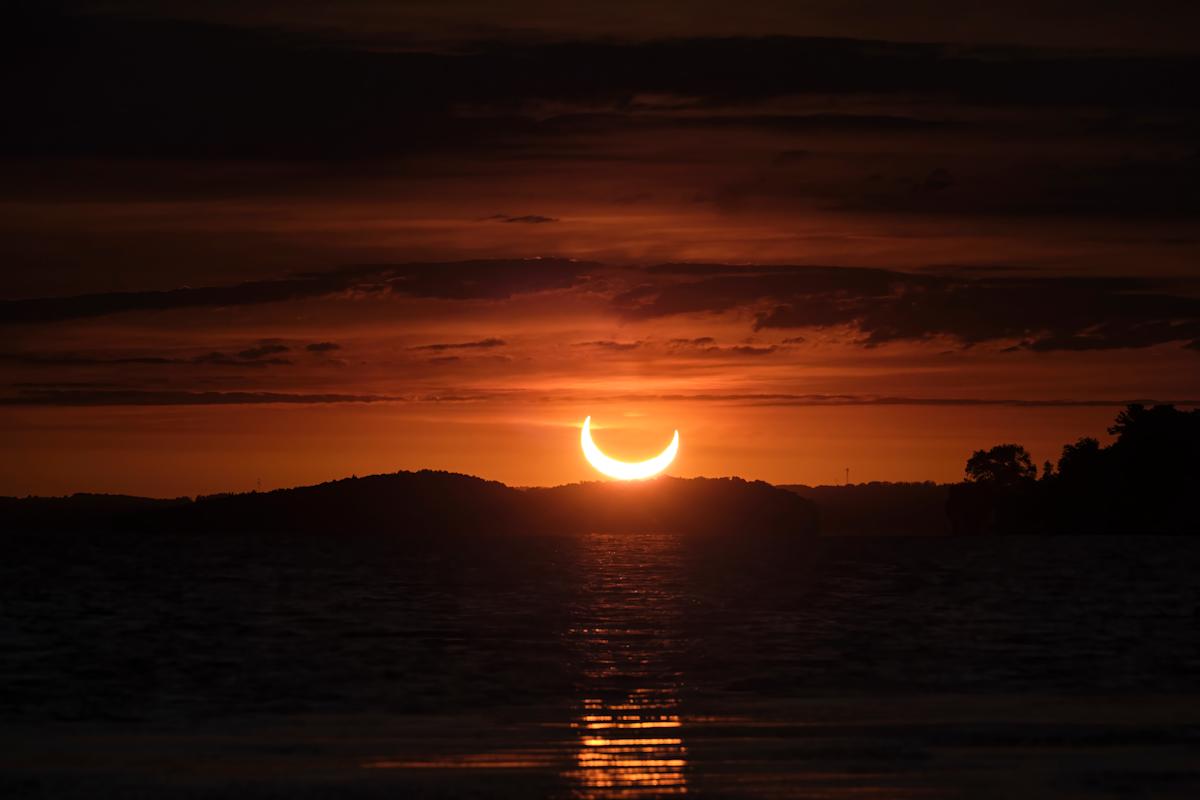
A unique feature of solar eclipses during sunrise is you may be able to see the famed “devil horns,” depending on where you are. When the sun rises during an eclipse (and therefore the sun is low on the horizon), as the crescent sun rises, it can look like devil horns coming up out of the ground.
An earlier sunrise partial eclipse over Rice Lake, Ontario shows the “devil horns” phenomenon. (John Fader via Getty Images)
It’s best to target Maine, New Brunswick, and Quebec (along the blue line in the NASA map) to see this phenomenon.
Additionally, the sun is currently at or near solar maximum, which means that our star is basically at the peak of its 11-year solar cycle. Scientists determined that the sun hit the highest level of solar activity in October 2024, and this will continue for a year or so. This means that there may be sunspots visible on the surface of the sun when the eclipse hits. (For context, here’s what the sun looks like right now, courtesy of NASA’s Solar Dynamics Observatory.) If you have solar binoculars or a solar telescope, this will make them much easier to see.
Can I just point a telescope or camera at the sun?
If you’re asking yourself this question, you probably already know the answer: Nope! Not without a solar filter. Whether it’s a phone camera, binoculars, a telescope or a mirrorless camera, the sun can do extreme damage to this kind of equipment. (On Apollo 12, astronaut Alan Bean accidentally pointed a television camera at the sun, irreparably damaging it. Don’t do this!)
You can pick up solar filters at a camera store or online, or in a pinch, you can just use an extra pair of solar viewers. Simply remove the film and tape it over your smartphone camera, but don’t look at the sun when aiming the camera unless you’re wearing solar viewers as well. If you are interested in looking at the sun regularly, a pair of solar binoculars with a permanently attached filter is a great idea.
If you buy something through a link in this article, we may earn commission.
YouTube Shorts has introduced a change that brings analytics for its bite-sized video option into closer parity with rival services TikTok and Instagram. The video platform will remove the minimum play time requirement it previously had for a user watching a clip to count as a view.
Beginning March 31, a “view” will be added any time a YouTube Short is played or replayed. This will likely mean that creators will see higher view counts after the change takes place. YouTube will continue to track “engaged views,” which measure the number of times a clip was played “for a certain number of seconds.” YouTube clarified that the shift would not impact Creator earnings or their eligibility for the YouTube Partner Program; both will continue to be assessed by the engaged view metric.
Both Instagram and TikTok have defined a “view” as the number of times a video starts playing, although those platforms also offer metrics for tracking time spent watching a piece of content. Considering YouTube Shorts, Instagram and TikTok have each claimed upwards of a billion monthly users, it makes sense that they count views similarly so that creators can better assess how many of those people they are reaching across the services.
Waymo is continuing to expand its foothold across the US, having recently started in more parts of the San Francisco Bay Area. Next up are and , and now the company has to offer its driverless Waymo One service in the nation’s capital in 2026.
Before that can happen, though, Waymo will need to get approval from regulators. The company says it will “continue to work closely with policymakers to formalize the regulations needed to operate without a human behind the wheel in the District.” DC currently requires autonomous vehicles to have a human at the wheel, ready to take control if necessary.
“Our priority remains ensuring that any company operating in the District — such as Waymo — does so in a manner that prioritizes safety, aligns with our regulatory framework, and integrates seamlessly into DC’s unique transportation ecosystem,” German Vigil, a spokesman for the District Department of Transportation, told . He noted that the agency is refining its approach to regulation “based on public input, emerging best practices and lessons learned” from other jurisdictions.
Waymo has tested its vehicles in DC for several years and it plans to “continue introducing ourselves to DC’s communities and emergency responders over the coming months.” Per the Post, if and when Waymo One does become available in the District, the robotaxis would not take riders to any of the region’s airports, as they wouldn’t (at least at the outset) have a permit to cross into Maryland or Virginia.
Amazon is suing the Consumer Product Safety Commission over its decision to hold the company legally responsible for faulty products on its platform, The Associated Pressreports. Amazon’s suit demands that the shipping giant be considered a “third-party logistics provider” instead of a distributor and also calls the CPSC “unconstitutionally constructed.”
The origins of the legal fight can be traced back to 2021, when the CPSC sued Amazon to force it to recall faulty carbon monoxide detectors, unsafe hair dryers and flammable children’s sleepwear. At the time, Amazon had already taken some steps to address the issue, like informing customers who purchased the products that they were hazardous and offering store credit, but the CPSC wanted the company to go further.
The CPSC move to classify Amazon as a distributor in 2024 made the company responsible for issuing recalls and refunds for products sold through its Fulfilled by Amazon (FBA) program. FBA lets sellers send their products to Amazon warehouses, where Amazon then handles picking, packing and shipping those products to customers, along with things like customer service and returns. Amazon takes issue with its classification as a distributor because it doesn’t own or make the faulty products the CPSC is concerned with — it sees itself as more of a hands-on FedEx.
Besides wanting to be reclassified and not held responsible for issuing more refunds, Amazon also has problems with the CPSC itself. The CPSC’s commissioners are appointed by the President, approved by the Senate and serve for seven years, unless they’re removed for “neglect of duty or malfeasance in office.” Amazon feels the commission’s relative invulnerability is unconstitutional and makes them “judge, jury, and prosecutor” in proceedings.
Amazon’s made similar claims about the National Labor Review Board, the organization in charge of protecting workers’ right to unionize. The timing of these complaints is key. The Trump administration is not particularly interested in maintaining any government organization empowered to regulate business, and it seems likely it will side with Amazon in disempowering the CPSC, one way or another.
SpaceX could soon have greater control over the recreational activities of South Texas residents. The Houston Chronicle (viaGizmodo) and San Antonio Express-News report that a pair of state senate bills introduced earlier this month would give officials at the likely Starbase city the authority to decide when a nearby beach shuts down for weekday launch activities. Meanwhile, a third bill floated on Wednesday would take the company’s control a step further, making it a criminal offense for people on the beach not to comply with SpaceX’s evacuation orders.
The bills are possible because of an upcoming election that will almost certainly give SpaceX officials control of the area. On May 3, voters will decide if Starbase becomes a Texas city, something Elon Musk first proposed in 2021. Given that the area near the rocket site is populated mainly by SpaceX employees (after previous homeowners in Boca Chica Village moved, often after being bought out by the company), let’s just say the election’s outcome won’t likely be a toss-up.
Republican state senator Adam Hinojosa’s first bill, SB 2188, would let Starbase city officials (assuming the municipality establishment bill passes) decide when Boca Chica Beach is closed for weekday rocket tests and flights. An identical bill, HB 4660, was introduced in the state house by Republican Janie Lopez. Cameron County officials, who control the closures now, would maintain control on Friday afternoons and weekends.
Texas state senator Adam Hinojosa (Campaign for Adam Hinojosa)
Meanwhile, Hinojosa’s second senate bill (SB 2230) would make it a Class B misdemeanor for people on the beach not to comply with Starbase’s evacuation orders. The freshman state senator said the bill would give the commercial spaceport “real teeth” to “compel people to do the right thing.” (Fittingly, Hinojosa’s election website touts his belief that “we don’t need more government in business — we need more business in government.”)
The Houston Chronicle reports that the FAA’s Environmental Assessment shows that SpaceX has moved much of its testing to a site that doesn’t require the closure of State Highway 4. A SpaceX flight test in April 2023 closed the road for over 24 hours, while another shuttered it for nearly eight hours last June. The company can close State Highway 4 for up to 500 hours each year for standard operations and up to 300 more hours to address incidents like an exploding rocket.
On the other hand, environmental groups have argued that SpaceX’s activities are damaging the area. Last year, the Center for Biological Diversity, American Bird Conservancy and other groups sued the FAA for allegedly rushing SpaceX’s permitting process without a full environmental review. And the Environmental Protection Agency fined the company for allegedly dumping pollutants into Texas wetlands adjacent to the Rio Grande River.
Craig Nazor, conservation chair for the Sierra Club’s Lone Star chapter, testified to the state senate on Wednesday that SB 2188 would “put beach closures directly in the hands of SpaceX.” He also expressed concern that the second senate bill could put folks who are unaware of an upcoming launch into legal trouble. “[SB 2230] could potentially make a criminal out of someone who’s out there and lost track of exactly what may be going on at the launch pad,” he said.
10. Katamari Damacy 9. Undertale 8. Fallout: New Vegas 7. Super Mario World 6. The Curse of Monkey Island 5. The Legend of Zelda: Breath of the Wild 4. Halo 2 3. Final Fantasy X 2. Bloodborne 1. Civilization VI
You can go to Sanderson’s original blog post to read a few of his thoughts on each game, but we have a few thoughts on this list (and how it ties into his work) that you won’t get from Brandon himself.
Before we even get into the individual games, one thing that stands out right away is just how diverse it is. There’s practically a game for every genre in here — 4X strategy, first-person shooters, action games, RPGs, and even Katamari — which, it’s fair to say, is a genre unto itself. No one would have expected Sanderson’s list to stay beholden to his chosen literary genres of fantasy and science fiction, but it’s fun to image the ways that games like Undertale or Super Mario World have seeped into his work.
There are, of course, a few entries on this list that seem a lot more related to his literary work, and even a few that help explain his worlds and writing. Games like Bloodborne and Breath of the Wild seem like natural companions for Sanderson’s fantasy worlds and work, fraternal twins tied together by the thoroughness of vision in their settings and the sense of adventure and experimental challenge they offer players. Meanwhile, games like Curse of Monkey Island and Fallout: New Vegas seem like perfect indicators of Sanderson’s sense of humor and the kind of irreverence he occasionally brings to his books as well.
But the real skeleton keys to his work on this list are Final Fantasy X and Civilization VI. Anyone who’s read Sanderson’s Stormlight Archives series and encountered the way he blends together dozens of cultures and countries in its world should recognize the fact that it comes from someone who’s clearly spent hundreds of hours in Civilization, pushing the borders of their country’s influence through trade, culture, or simple warfare. Meanwhile, the blog post mentions that Sanderson is a lifelong fan of the Final Fantasy series, and it’s clearly shaped the way he views magic in his written worlds. It would take hundreds of pages to fully unpack the relationship between his Cosmere and the worlds of Final Fantasy, but for now, it’s enough to know that X is his favorite entry.
Sanderson has never been particularly private about the art he loves, or the ways it’s influenced his writing. But with this list of favorite games as a starting point, let’s hope he delves more into how these games have influenced him sometime in the future.
According to, Humans writers Jonathan Brackley and Sam Vincent are working on an adaptation of Philip K. Dick’s 1953 novella, The Variable Man. The show is being produced by Motive Pictures in a partnership with Electric Shepherd Productions, which is run by the late author’s daughter, Isa Dick Hackett. The Variable Man follows a tinkerer turned accidental time traveler named Thomas Cole, who is transported from 1913 into the future and suddenly finds himself a reluctant player in an interplanetary conflict.
It’s being written for a UK broadcaster, according to Deadline, but there may be hope for a US release. “When you’ve got Sam and John doing what they did so brilliantly with Humans and exploring the modern world through a genre lens, it is something that can absolutely attract broadcasters in the US,” Motive CEO Simon Maxwell told the publication. I really enjoyed The Variable Man back when I read it and I’ll give any PKD adaptation a chance, so here’s hoping we get another good one in this series.