New study shows AI isn’t ready for office work


It has been nearly two years since Microsoft CEO Satya Nadella predicted that generative AI would take over knowledge work, but if you look around a typical law firm or investment bank today, the human workforce is still very much in charge. Despite all the hype about “reasoning” and “planning,” a new study from training-data company Mercor explains exactly why the robot revolution is stalled: AI just can’t handle the messiness of real work.

A reality check for the “replacement” theory

Mercor released a new benchmark called APEX-Agents, and it is brutal. unlike the usual tests that ask AI to write a poem or solve a math problem, this one uses actual queries from lawyers, consultants, and bankers. It asks the models to do complete, multi-step tasks that require jumping between different types of information.

The results? Even the absolute best models on the market—we are talking about Gemini 3 Flash and GPT-5.2—couldn’t crack a 25% accuracy rate. Gemini led the pack at 24%, with GPT-5.2 right behind it at 23%. Most others were stuck in the teens.

Why AI is failing the “office test”

Mercor CEO Brendan Foody points out that the issue isn’t raw intelligence; it’s context. In the real world, answers aren’t served up on a silver platter. A lawyer has to check a Slack thread, read a PDF policy, look at a spreadsheet, and then synthesize all that to answer a question about GDPR compliance.

Humans do this context-switching naturally. AI, it turns out, is terrible at it. When you force these models to hunt for information across “scattered” sources, they either get confused, give the wrong answer, or just give up entirely.

The “Unreliable Intern”

For anyone worried about their job security, this is a bit of a relief. The study suggests that right now, AI functions less like a seasoned professional and more like an unreliable intern who gets things right about a quarter of the time.

That said, the progress is terrifyingly fast. Foody noted that just a year ago, these models were scoring between 5% and 10%. Now they are hitting 24%. So, while they aren’t ready to take the wheel yet, they are learning to drive much faster than we expected. For now, though, the “knowledge work” revolution is on hold until the bots learn how to multitask p

Document Disclosures Reveal Microsoft’s Influence as OpenAI Became a Revenue-Crazed Behemoth


Way back in March of 2019, this weird thing happened where a relatively insignificant tech nonprofit called OpenAI became a “capped” for-profit company—whatever that is. The month earlier, OpenAI had announced the creation of an uncanny, über-powerful language model called GPT-2 that was supposedly just too dangerous to release. Then in November, OpenAI seemingly changed its mind and GPT-2 was released after all.

OpenAI said in the blog post about the release that it saw, “no strong evidence of misuse so far,” but added that it was impossible to “be aware of all threats.” Most people never used GPT-2, because OpenAI never injected it into a viral chatbot.

As someone who wrote about this at the time, it was puzzling to watch it all play out. OpenAI seemed like small potatoes, but it was also building creepy AI tech, and shifting in public image from being a do-gooder computer lab advertising its trepidation about harming a hair on anyone’s head to an enterprise that needed to ship something asap because it was clearly promising someone, somewhere, that they were going to get rich.

Document discovery from Elon Musk’s lawsuit against OpenAI and Microsoft has provided a tiny window into what was actually happening inside Microsoft during this bizarre time for this bizarre company, and how the transition may have turned OpenAI into the money-hungry beast it is today, with revenues growing tenfold between 2023 and 2025.

GeekWire’s Todd Bishop dug through the cache of emails, memos, texts and the like from Microsoft and OpenAI, and what he found was revealing. Microsoft, and CEO Satya Nadella in particular, had invested heavily in OpenAI by then, and were not quiet during OpenAI’s uneasy transition to for-profit status. Nor were they shy about the need to make money as soon as possible. Absolutely none of this should come as a surprise, but it makes for fascinating reading anyway.

During that gap where GPT-2 was sitting there unreleased and OpenAI had recently become a capped nonprofit, Microsoft’s chief financial officer, Amy Hood, weighed in about the company’s concerns about that “capped” part. She wrote in a July 14 email to a group including Nadella, “Given the cap is actually larger than 90% of public companies, I am not sure it is terribly constraining nor terribly altruistic but that is Sam’s call on his cap.”

GPT-3, which was even more exciting than GPT-2 was released in 2020, and the first version of OpenAI’s language model, Dall-E was released in January 2021. The next month, Microsoft and OpenAI were negotiating an additional injection of money from Microsoft, and Sam Altman wrote an email to Microsoft, saying “We want to do everything we can to make you all commercially successful and are happy to move significantly from the term sheet,” and he added that he wanted “to make you all a bunch of money as quickly as we can and for you to be enthusiastic about making this additional investment soon.”

In November of 2022, ChatGPT was released, and as you know, all hell broke loose. In January of 2023, Nadella sent a text message to Altman, saying “when do you think you will activate your paid subscription for ChatGPT?”

Altman said he was “hoping to be ready by end of jan, but we can be flexible beyond that. the only real reason for rushing it is we are just so out of capacity and delivering a bad user experience,” and asked “any preference on when we do it?”

“Let me think about it and weigh in. Overall getting this in place sooner is best,” Nadella replied. Two weeks later, he followed up and asked “how many subs have you guys added to ChatGPT?”

Three days later, the paid version of ChatGPT launched.

CEOs of NVIDIA and Lilly Share ‘Blueprint for What Is Possible’ in AI and Drug Discovery


NVIDIA and Lilly are putting together “a blueprint for what is possible in the future of drug discovery,” NVIDIA founder and CEO Jensen Huang told attendees at a fireside chat Monday with Dave Ricks, chair and CEO of Lilly.

The conversation — which took place during the annual J.P. Morgan Healthcare Conference in San Francisco — focused on the announcement of a first-of-its-kind AI co-innovation lab by NVIDIA and Lilly.

“We’re systematically bringing together some of the brightest minds in the field of drug discovery and some of the brightest minds in computer science,” Huang said. “We’re going to have a lab where the expertise and the scale of that lab is sufficient to attract people who really want to do their life’s work at that intersection.”

The initiative will bring together Lilly’s world-leading expertise in the pharmaceutical industry with NVIDIA’s leadership in AI to tackle one of humanity’s greatest challenges: modeling the complexities of biology. The two companies will jointly invest up to $1 billion in talent, infrastructure and compute over five years to support the new lab, which will be based in the San Francisco Bay Area.

During the fireside chat, Ricks reflected on the painstaking work of drug discovery and AI’s potential to transform the cycle of pharmaceutical invention.

“Each small molecule discovery is like a work of art,” he said. “If we can make that an engineering problem, versus this sort of discovery, this artisanal drug-making problem, think of the impact on human life.”

The lab will operate under a scientist-in-the-loop framework, where agentic wet labs are tightly connected to computational dry labs in a continuous learning system. This framework aims to enable experiments, data generation and AI model development to continuously inform and improve one another.

“Machines are made to work day and night to solve this problem,” Ricks said.

The co-innovation lab builds on Lilly’s previously announced AI supercomputer — the biopharma industry’s most powerful AI factory, an NVIDIA DGX SuperPOD with DGX B300 systems — which will train large-scale biomedical foundation and frontier models for drug discovery and development.

By integrating AI into drug discovery, Ricks explained, pharmaceutical researchers can rapidly simulate a massive number of possible molecules, test them at scale in silico and filter out promising candidates. The next challenge is to find more biological targets using AI.

“The holy grail is that you put those two things together, and we can model the whole system at once,” Ricks said.

Huang and Ricks also discussed Lilly’s long history of harnessing computing for pharmaceutical research — and how diseases of the aging brain are the next frontier for drug discovery.

“I can’t imagine a more worthy field to apply computer science to,” Huang said. “Hopefully we can bend the arc of history.”

NVIDIA at J.P. Morgan Healthcare

NVIDIA’s full-stack AI platform is accelerating the creation and deployment of leading foundation models across digital biology and drug discovery. To recognize some of the recent advancements, Huang raised a toast at J.P. Morgan Healthcare in honor of about a dozen leaders in the field — and the AI models they’ve pioneered.

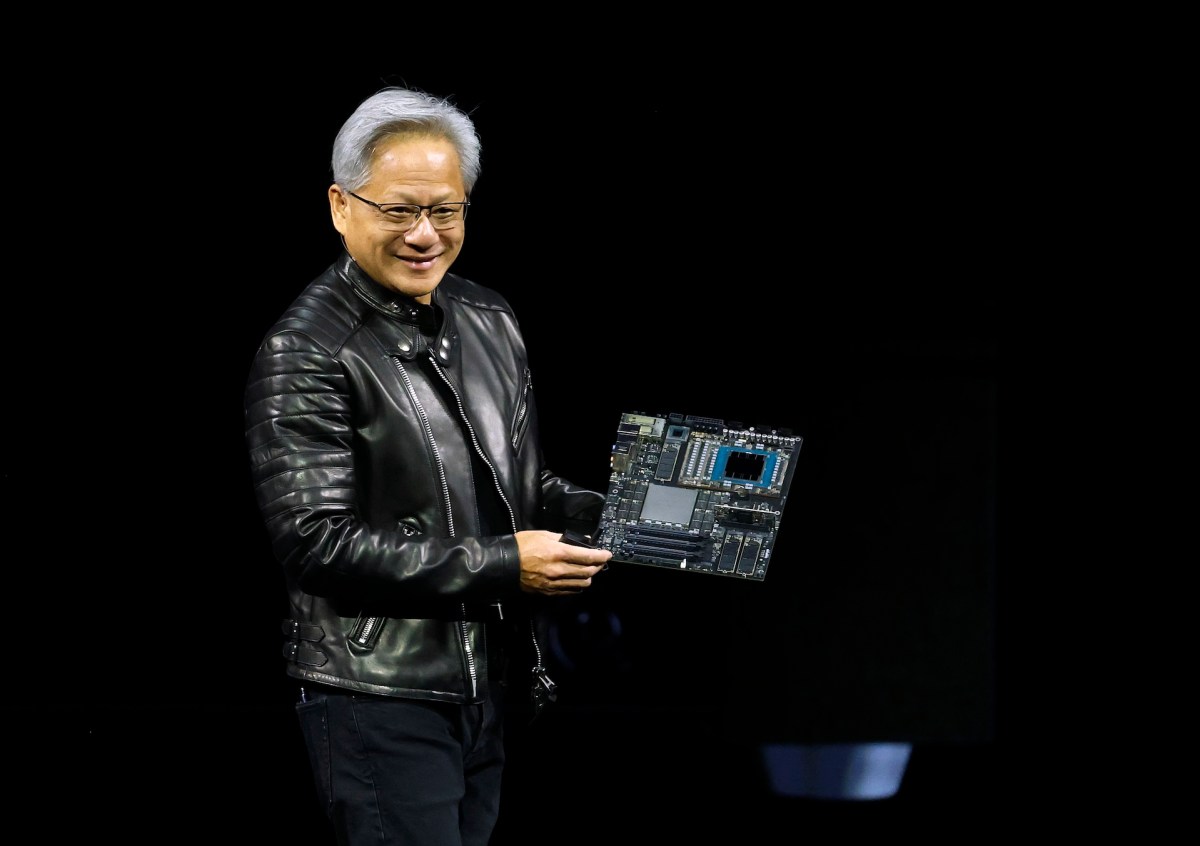
“In the last 10 years, we’ve advanced AI 1 million times,” Huang said. “I believe that over the next 10 years, you will enjoy the same adventure that I’ve enjoyed in our generation … and so for each one of you — for your happy new year present and a thank you for everything that you do for the industry and for the future of humanity — I give to you a DGX Spark.”

Over a dozen leaders in AI and drug discovery received NVIDIA DGX Spark systems signed by NVIDIA founder and CEO Jensen Huang at the J.P. Morgan Healthcare Conference.

The honorees included:

  • Zach Carpenter, CEO of VantAI, developer of the Neo model family for co-folding and design across all biological molecules.
  • Gabriele Corso, CEO of Boltz, creator of one of the most well-established open-source families of biomolecular models.
  • Evan Feinberg, CEO of Genesis Molecular AI, which developed Pearl, a protein and small molecule structure prediction model.
  • Chris Gibson and Najat Khan, chairman and CEO, respectively, of Recursion, which developed the OpenPhenom vision transformer model for microscopy data.
  • Glen Gowers, CEO of Basecamp Research, creator of EDEN, a biodiversity-scale genome language model family.
  • Brian Hie, innovation investigator at the Arc Institute, which was a major collaborator in the development of Evo 2, part of the Evo family of DNA language models.
  • Max Jaderberg, president of Isomorphic, which is extending the capabilities of AlphaFold, the defining family of protein structure and interaction models.
  • Simon Kohl, CEO of Latent Labs, developer of the Latent-X family of generative models for protein sequence and structure.
  • Joshua Meier, CEO of Chai Discovery, which developed the Chai family of generative AI models for molecular structure prediction and design.
  • Tom Miller, cofounder and CEO of Iambic Therapeutics, developer of the NeuralPLexer model family for flexible, accurate and fast structure prediction for proteins and small molecules.
  • Alex Rives, head of science at Biohub, which created the ESM family of leading protein language models.
  • Alex Zhavoronkov, CEO of Insilico Medicine, which built Pharma.AI, an integrated model suite spanning target discovery, generative chemistry and clinical prediction.

At J.P. Morgan Healthcare, NVIDIA also announced a major expansion of the NVIDIA BioNeMo platform for AI-driven biology and drug discovery with tools including:

  • NVIDIA Clara open models for predicting RNA structures and ensuring AI-designed drugs are practical to synthesize.
  • BioNeMo Recipes to accelerate and scale biological foundation model training, customization and deployment.
  • BioNeMo data processing libraries such as nvMolKit, a GPU-accelerated cheminformatics tool for molecular design.

NVIDIA also highlighted a collaboration with instrumentation leader Thermo Fisher to build autonomous lab infrastructure using NVIDIA’s full-stack AI computing — and highlighted the work of Multiply Labs, a San Francisco-based startup that offers end-to-end robotic systems to automate cell therapy manufacturing at scale.

J.P. Morgan Healthcare is the world’s largest healthcare investment symposium, attracting over 8,000 global professionals including investors, policymakers and executives from across the healthcare industry.

For more from the conference, listen to the audio recording and view the presentation deck of a special address by Kimberly Powell, vice president of healthcare at NVIDIA, who discusses AI’s impact across healthcare.

CoreWeave CEO defends AI circular deals as ‘working together’


It’s been quite the year for CoreWeave. In March, the AI cloud infrastructure provider went public in one of the biggest and most anticipated IPOs of the year that didn’t live up to its hype.

Another setback took place in October, when a planned acquisition of the cloud provider’s business partner, Core Scientific, faltered due to skepticism from the acquisition target’s shareholders. 

In the meantime, the firm has acquired a number of different companies, its stock has gone up and down, and it’s been both criticized and lauded for its role in the booming AI data center market. 

In an interview at the Fortune Brainstorm AI summit in San Francisco on Tuesday, CoreWeave’s co-founder and CEO, Michael Intrator, defended his company’s performance from critics, noting that it was in the midst of creating a “new business model” for how cloud computing can be built and run. Their collection of Nvidia GPUs is so valuable, they borrow against it to help finance their business. The executive seemed to imply: If you’re charting a new path, you’re destined to encounter some road bumps along the way.  

“I think people are myopic a lot of times,” Intrator said when questioned about his company’s occasionally unstable stock price. “Yes, it is seesawing,” he admitted, while noting that the CoreWeave IPO took place not long before President Trump’s tariffs went into effect — a notably uncertain moment for the overall economy. 

“We came out into one of the most challenging environments, right around Liberation Day and, in spite of the incredible headwinds, were able to launch a successful IPO,” the CEO told Brainstorm editorial director Andrew Nusca. “I couldn’t be prouder of what the company has accomplished,” he added. 

CoreWeave’s stock may have debuted amid the economic doldrums of March but its price has gone on quite the journey since then. It debuted at $40 and, over the past eight months, has climbed to well over $150, but currently rests at around $90. Its more wary critics have compared it to a meme stock due to its penchant for going up and down. 

Techcrunch event

San Francisco
|
October 13-15, 2026

Some of the uncertainty around CoreWeave’s stock has been credited to the company’s hefty level of debt. Not long after CoreWeave announced a deal on Monday to issue even more debt to finance its data center buildout, its stock dropped some 8%.

Intrator seems to see his company as a disruptor, one whose unconventional tactics may take some getting used to. “When you introduce a new model, when you introduce a new way of doing business, when you disrupt what has been a static environment, it’s going to take some people some time,” he said during his appearance Tuesday. 

CoreWeave actually started its corporate life as a crypto miner but in short order built itself into a pivotal provider of “AI infrastructure” to some of the tech industry’s most major players. In that role, it provides GPUs to AI developers and has made major partnerships with Microsoft, OpenAI, Nvidia, Meta, and other tech titans.  

Another topic broached Tuesday was the notion of “circularity” within the AI industry. “Circular” business deals, in which a small number of powerful AI companies invest in one another, have frequently been criticized and have raised questions about the industry’s long-term economic stability. Perhaps not surprisingly, since Nvidia is one of its investors and its supplier of GPUs, Intrator swatted away such concerns. “Companies are trying to address a violent change in supply and demand,” he said. “You do that by working together.”
 
Since the IPO, CoreWeave has continued to make efforts to expand its business. After it acquired Weights & Biases, an AI developer platform, in March, it went on to acquire OpenPipe, a startup that helps companies create and deploy AI agents through reinforcement learning. In October, it also made deals to acquire Marimo (the creator of an open source notebook) and Monolith, another AI company. It also recently announced an expansion of its cloud partnership with OpenAI and said it has plans to move into the federal market, where it wants to provide cloud infrastructure to U.S. government agencies and the defense industrial base. 

The State of AI 2025: Why Trust Matters More Than Ever


AI’s Growing Pains

The 2025 State of AI Report marks something of a watershed moment. After years of racing to see what AI could accomplish, we’re finally asking the tough questions about whether we should trust it to do those things at all.

Just because something is powerful doesn’t make it trustworthy or reliable. Today’s AI systems are remarkable. They write, they code and they converse, but these are all predictions that don’t come with an explanation as to why they did what they did. And if you’re running a financial institution, an insurance company, or an accounting firm, that’s a big compliance problem.

When you can’t explain how a system reached its conclusion, you can’t defend that decision to regulators, customers, or your own board. The good news is we seem to be moving past the era of taking AI’s word for it and into one where we need answers we can trust.

What’s Changed

This year’s report reveals several trends that all point in the same direction: trust has become the make-or-break factor for enterprise AI adoption.

Regulation is no longer playing catch-up. The EU AI Act and US financial guidelines aren’t suggestions anymore. Boards want to know not just does it work? but can we prove it is correct? For the first time, regulators are getting ahead of the curve, not chasing it.

Highly regulated industries need explainability. Banks, insurers, auditors, healthcare providers, the sectors that need AI most urgently, also face the strictest requirements. They have to demonstrate their automated decisions are fair, consistent, and compliant. Building AI that has these attributes has not been easy, but necessary to close the gap from PoC to production. In short, it’s where the real value lies.

Agentic AI has emerged as the go-to architecture, adopting the principle of breaking down complex problems to be tackled by smaller agents, all with their own specialist function. This has introduced new risks. 

Everyone’s excited about the potential of AI agents that are provided with the “agency” to take action, but rightly remain concerned about the implications. The probabilistic nature of the Large Language Models (LLMs) that power such agents means that the institutional knowledge which is prompting them is not a precise programming instruction. Common approaches like prompting, RAG and Graph-RAG lack engineering precision. So although an agentic approach looks to simulate a logical process, it isn’t. Each agent still suffers the innate limitations, lacking precision, determinism and auditability.

Perhaps the biggest shift is conceptual. 

A knowledge-first approach beats a data-first approach. 

Instead of training models on historical data, which incidentally typically results from a documented human process, we can take knowledge sources and use them to build “world models” that describe the underlying principles of decision-work. The key to quality decisioning is being able to scale institutional knowledge, and make that a “first-class citizen” in AI systems, leverageable with precision. 

The future belongs to AI that can logically reason over the world, not just make predictions based on publicly trained data.

The Fundamental Problem

Current Gen AI systems share one critical flaw: they don’t know when they’re wrong. They generate answers that sound right because they’re statistically probable, not because they’re logically calculated.

For creative work, that’s fine. LLMs are ideal for creating marketing content for example, but not for ensuring that marketing content meets compliance obligations. For high-stakes decisions: loan approvals, insurance claims, tax filings, medical eligibility, it’s unacceptable. In high-stakes applications you need precision, consistency and an audit trail that describes how that decision was reached. 

We founded Rainbird on a simple principle: if a system can’t explain its reasoning, it can’t be trusted where it matters. 

You need systems that reason over what’s important to you, your institutional knowledge, without being knocked off course by publicly trained data. You need to be able to generate the same answer from the same inputs, every single time. Determinism matters! And finally you need to understand the reasoning, not an ad-hoc after-the-event prediction as to what might have happened, but the logic that led to an outcome. This is the difference between believing its the right answer and being able to prove it’s the right answer.

A Different Approach

Our approach combines three elements. 

First, the modelling of knowledge as graph-based world models that represent the rules, regulations, and expertise required for a specific decision domain. 

Second, a powerful symbolic reasoning engine that can process knowledge with the same mathematical precision that Excel processes numbers. A deterministic engine that produces consistent, auditable results with a clear trail showing how each conclusion was reached.

Third, LLMs but only where they are strong: understanding natural language and extracting knowledge, but not as a proxy for reasoning where they are inherently weak.

This gives enterprises what they actually need: Gen AI benefits but with none of the risks. Regulated organisations can deploy it readily in decision-intensive processes that are knowledge-dense and there are commercial or regulatory consequences of error. 

Why Trust Matters for Business

Trust isn’t just about doing the right thing, it’s an economic necessity. Our research shows the next trillion dollars in AI value will come from areas where precision, consistency, and auditability aren’t optional: financial crime prevention, tax and audit automation, insurance underwriting, claims, etc.

In these fields, companies don’t just want faster poor decisions, they want better quality decisions that are fully auditable and therefore justifiable. As the inevitable adoption of AI expands, trust becomes more critical than ever, and as much of a competitive advantage as any feature or price.

That’s why the most regulated institutions have started asking “how certain are you that your model is right?” That question will define the next decade of AI adoption. It’s the question we built Rainbird to answer. We didn’t pivot to trust when it became trendy, we started there.

Looking Forward

Ben Taylor and James Duez founded Rainbird in 2013 on what seemed like a contrarian bet: that AI’s future would depend more on being able to make judgements, not just predictions. Twelve years later, the rest of the world has arrived at the same conclusion.

2025 will be remembered as the year AI matured somewhat, when the industry accepted that with power comes responsibility, and that trust in AI is an unquestionable necessity. 

The choice for enterprises and regulators is straightforward: adopt AI that is trustworthy by design, or risk being audited and fined for AI you can’t explain. 

Our goal has always been to help our customers to scale their organisational knowledge to machine levels to deliver consistent, auditable intelligence-led products and services that customers can rely on. The future won’t belong to whoever generates the most content, but to those who can architect AI to deliver trusted solutions. AI that isn’t just powerful, but provable.

Intel’s chief executive of products departs among other leadership changes


Semiconductor giant Intel continues to shake up its senior leadership since Lip-Bu Tan took the helm as CEO in March.

Intel announced Monday that Michelle Johnston Holthaus will depart the company after more than three decades. Johnston Holthhaus was most recently chief executive officer of Intel products and will remain a strategic adviser.

The company also announced the creation of a central engineering group that will build a new custom silicon business for outside customers, according to Intel. This group will be helmed by Srinivasan “Srini” Iyengar who joined Intel from Cadence Design Systems in July.

Intel also said that Kevok Kechichian, formerly of ARM, will join the company as head of its data center group. Jim Johnson has been appointed senior vice president and general manager of Intel’s client computing group. Naga Chandrasekaran, the chief technology and operations officer of Intel Foundry, the company’s business unit that builds custom chips for outside customers, is also taking on an expanded role.

“With Srini leading Central Engineering, we’re aligning innovation and execution more tightly in service to customers,” Tan said in a company press release. “We are laser-focused on delivering world-class products and empowering our engineering teams to move faster and execute with excellence. Kevork, Jim, and Srini are exceptional leaders whose deep technical acumen and industry relationships will be instrumental as we continue building a new Intel.”

This news comes just a few weeks after the U.S. government announced a plan to convert existing government grants into a 10% stake in Intel. The deal was structured to penalize Intel if the company dropped below 50% ownership of its foundry unit.

These weren’t the only leadership changes at Intel this year.

Techcrunch event

San Francisco
|
October 27-29, 2025

Tan taking over as CEO in March is a notable one. In July the company announced that it hired four new people for sales and engineering roles including Greg Ernst to serve as Intel’s chief revenue officer.

Intel declined to comment.

How Supercomputing Will Evolve, According to Jack Dongarra


Quantum computing is interesting. It’s really a wonderful area for research, but my feeling is we have a long way to go. Today we have examples of quantum computers—hardware always arrives before software—but those examples are very primitive. With a digital computer, we think of doing a computation and getting an answer. The quantum computer is instead going to give us a probability distribution of where the answer is, and you’re going to make a number of, we’ll call it runs on the quantum computer, and it’ll give you a number of potential solutions to the problem, but it’s not going to give you the answer. So it’s going to be different.

With quantum computing, are we caught in a moment of hype?

I think unfortunately it’s been oversold—there’s too much hype associated with quantum. The result of that typically is that people will get all excited about it, and then it doesn’t live up to any of the promises that were made, and then the excitement will collapse.

We’ve seen this before: AI has gone through that cycle and has recovered. And now today AI is a real thing. People use it, it’s productive, and it’s going to serve a purpose for all of us in a very substantial way. I think quantum has to go through that winter, where people will be discouraged by it, they’ll ignore it, and then there’ll be some bright people who figure out how to use it and how to make it so that it is more competitive with traditional things.

There are many issues that have to be worked out. Quantum computers are very easy to disturb. They’re going to have a lot of “faults”—they will break down because of the nature of how fragile the computation is. Until we can make things more resistant to those failures, it’s not going to do quite the job that we hope that it can do. I don’t think we’ll ever have a laptop that’s a quantum laptop. I may be wrong, but certainly I don’t think it’ll happen in my lifetime.

Quantum computers also need quantum algorithms, and today we have very few algorithms that can effectively be run on a quantum computer. So quantum computing is at its infancy, and along with that the infrastructure that will use the quantum computer. So quantum algorithms, quantum software, the techniques that we have, all of those are very primitive.

When can we expect—if ever—the transition from traditional to quantum systems?

So today we have many supercomputing centers around the world, and they have very powerful computers. Those are digital computers. Sometimes the digital computer gets augmented with something to enhance performance—an accelerator. Today those accelerators are GPUs, graphics processing units. The GPU does something very well, and it just does that thing well, it’s been architected to do that. In the old days, that was important for graphics; today we’re refactoring that so that we can use a GPU to satisfy some of the computational needs that we have.

‘Wall-E With a Gun’: Midjourney Generates Videos of Disney Characters Amid Massive Copyright Lawsuit


Midjourney’s new AI-generated video tool will produce animated clips featuring copyrighted characters from Disney and Universal, WIRED has found—including video of the beloved Pixar character Wall-E holding a gun.

It’s been a busy month for Midjourney. This week, the generative AI startup released its sophisticated new video tool, V1, which lets users make short animated clips from images they generate or upload. The current version of Midjourney’s AI video tool requires an image as a starting point; generating videos using text-only prompts is not supported.

The release of V1 comes on the heels of a very different kind of announcement earlier in June: Hollywood behemoths Disney and Universal filed a blockbuster lawsuit against Midjourney, alleging that it violates copyright law by generating images with the studios’ intellectual property.

Midjourney did not immediately respond to requests for comment. Disney and Universal reiterated statements made by its executives about the lawsuit, including Disney’s legal head Horacio Gutierrez alleging that Midjourney’s output amounts to “piracy.”

It appears that Midjourney may have attempted to put up some video-specific guardrails for V1. In our testing, it blocked animations from prompts based on Frozen’s Elsa, Boss Baby, Goofy, and Mickey Mouse, although it would still generate images of these characters. When WIRED asked V1 to animate images of Elsa, an “AI moderator” blocked the prompt from generating videos. “Al Moderation is cautious with realistic videos, especially of people,” read the pop-up message.

These limitations, which appear to be guardrails, are incomplete. WIRED testing shows that V1 will generate animated clips of a wide variety of Universal and Disney characters, including Homer Simpson, Shrek, Minions, Deadpool, and Star Wars’ C-3PO and Darth Vader. For example, when asked for an image of Minions eating a banana, Midjourney generated four outputs with recognizable versions of the cute, yellow characters. Then, when WIRED clicked the “Animate” button on one of the outputs, Midjourney generated a follow-up video with the characters eating a banana—peel and all.

Although Midjourney seems to have blocked some Disney- and Universal-related prompts for videos, WIRED could sometimes circumvent the potential guardrails during tests by using spelling variations or repeating the prompt. Midjourney also lets users provide a prompt to inform the animation; using that feature, WIRED was able to to generate clips of copyrighted characters behaving in adult ways, like Wall-E brandishing a firearm and Yoda smoking a joint.

The Disney and Universal lawsuit poses a major threat to Midjourney, which also faces additional legal challenges from visual artists who allege copyright infringement as well. Although it focused largely on providing examples from Midjourney’s image-generation tools, the complaint alleges that video would “only enhance Midjourney ability to distribute infringing copies, reproductions, and derivatives of Plaintiffs’ Copyrighted Works.”

The complaint includes dozens of alleged Midjourney images showing Universal and Disney characters. The set was initially produced as part of a report on Midjourney’s so-called “visual plagiarism problem” from AI critic and cognitive scientist Gary Marcus and visual artist Reid Southen.

“Reid and I pointed out this problem 18 months ago, and there’s been very little progress and very little change,” says Marcus. “We still have the same situation of unlicensed materials being used, and guardrails that work a little bit but not very well. For all the talk about exponential progress in AI, what we’re getting is better graphics, not a fundamental-principle solution to this problem.”

Artificial Intelligence & AI’s Impact on 3D Rendering Design at 3D Modeling Companies


The platform for 3D modeling and rendering has changed radically and amazingly in recent years because of the advancement and distribution of artificial intelligence (AI) software and their integration step by step within the working process. For the best 3D modeling design firms on the market, giants like Cad Crowd, AI is no longer a word; it is changing their work into unprecedented levels in terms of stages of productivity and creativity.

Whereas traditional 3D rendering once depended so much on human intervention, AI-aided developments now are synchronizing everything from conceptualization to visualization with accuracy, saving time, and even opening new paths of innovation.

Hereafter, we will observe how AI is revolutionizing 3D rendering design, the technology utilized, and the impact on designers and clients both in the constantly changing arenas of architecture, interior design, product modeling, and beyond.

The emergence of AI in 3D rendering

AI’s introduction to 3D rendering started with the increasing necessity for quicker and more streamlined workflows for those industries that were highly reliant on high-fidelity visual output. Conventional 3D rendering was very time-consuming with extensive human intervention at almost every phase—concept and modeling to lighting and texture. Rendering would take hours or days based on the complexity of the model, with each detail being manually adjusted by designers.

Enter artificial intelligence: a game changer for reducing both time and labor-intensive processes while improving results. AI’s core strength in 3D rendering services lies in its ability to automate repetitive tasks, simulate realistic environments, and predict the best visual outcomes based on existing data. With machine learning and neural networks, AI can now help 3D modeling companies create lifelike renders in a fraction of the time.

RELATED: How to hire freelance CAD design talent for your project: Tips for design companies and firms

AI generative design of a bedroom and product packaging for a drink

Speeding up the rendering process

Rendering, in short, is the operation of generating a two-dimensional image from a 3D model by mimicking light, shadow, and texture in a virtual world. Previously, it was a task that demanded copious amounts of computing power and long processing times. A perfect case in point would be rendering photorealistic images of architectural models, which could take a few hours or days to produce, especially when dealing with complicated models or high-definition textures.

AI-driven software like NVIDIA’s DLSS (Deep Learning Super Sampling) or AI-driven real-time rendering software such as Unreal Engine’s MetaHuman can now cut down rendering time by orders of magnitude. They can render lighting, shadows, and textures in real time, and designers receive instant or near-instant feedback. This has enabled 3D modeling firms to deliver high-quality visuals at a quicker speed, while pleasing the clients as well as the designers with quicker project timelines.

For designers and product designers, quicker rendering translates to more iterations, tighter feedback cycles, and overall better design. What used to take days now takes hours, with more time for creative development and refinement.

Increased realism and accuracy

One of the biggest benefits AI contributes to 3D rendering experts is the ability to render scenes more realistically. Machine learning algorithms can be trained with millions of pictures, videos, and patterns of real-world environments and can scan large amounts of information about them to make incredibly realistic models of natural worlds. This translates into product design and architecture as meaning 3D rendering can now reproduce real-world lighting effects, materials, and textures with breathtaking accuracy.

Software such as Chaos V-Ray and Autodesk’s Arnold is a case in point. These render algorithms utilize AI to simulate more accurately how light works, thus creating more textured outputs that are representative of the way light behaves around objects in reality. For instance, light transmitted through glass windows or shading cast on an irregular surface is simulated better now, incorporating yet another level of realism to the resulting render.

In addition, AI can be used to automate material and texture generation. Software such as Adobe’s Substance utilizes AI to automatically recommend the optimum textures for a model’s geometry and environment, saving a significant percentage of time spent on manually creating and applying textures. Apart from accelerating processes, it also gives the optimum quality of textures for a range of materials, adding visual interest to a design.

Enhancing user experience with AI-based solutions

In addition to altering the manner in which designers produce images and render them, AI is also enhancing the manner in which expert CAD designers engage with the creation process. Before, creating and working with 3D models involved learning complicated software and having vast knowledge of 3D geometry. However, AI-based solutions now ease the process through easy interfaces and intelligent assistants that can help designers navigate the process.

Take the case of AI-based design assistants like Autodesk’s AutoCAD and Revit. These aid design elements include auto-completion, auto-error checking, and even auto-tuning of models. These applications use machine learning to detect patterns and suggest design elements most likely to get the desired result. For interior designers and architects, this can substantially reduce the learning curve on 3D modeling software, allowing them to focus on creativity and innovation rather than technical challenges.

The potential of AI to predict user behavior also enhances productivity in the workflow. It can then recommend lighting schemes, camera positions, or even object positions that maximize the overall structure, something that would have required designers to spend many hours experimenting manually. This proactive, predictive method not only streamlines the process but also leads to more evolved and more harmonized visual arrangements.

RELATED: How 3D product design, rendering, and animation services can benefit companies and increase sales

AI and the future of virtual reality and augmented reality integration

The convergence of AI with other technologies, such as virtual reality (VR) and augmented reality (AR), is another space where a gigantic future lies for 3D modeling experts. VR and AR are already revolutionizing industries such as real estate, interior design, and entertainment by virtue of the fact that interactive experiences can be provided to end-users and consumers. If the VR and AR systems are combined with AI, even designers can provide more realistic, personalized, and interactive experiences.

AI-driven VR environments, for example, can adjust lighting or texture in real time automatically based on the user’s interaction, so it becomes an adaptive experience. It is simpler to work through architectural designs or product designs with this integration, providing a more enhanced user experience as well as a better understanding of how a space or product will perform in the real world.

For 3D modeling businesses, having AI available for the creation of quick VR or AR-ready models equips them with smoother presentation and interactive checking capabilities in design. Customers can walk through fully immersed 3D spaces or critique mock-ups of products as if they were really touching actual products, and improved communication and decision-making result from it.

Predictive AI in design innovation

Not only is AI a method of augmenting existing workflows; it’s also opening up new possibilities for innovation in design. With predictive analytics and pattern matching, AI will enable designers to predict future trends and propose substitute design solutions. Through analysis of large sets of data on past designs, customer behavior patterns, and industry trends, AI can propose suggestions for design elements that would otherwise remain hidden, which is especially useful for product design firms.

Artificial intelligence can also be used in 3D modeling to generate generative designs, wherein software goes through an enormous range of design options based on specific parameters. These algorithms generate out-of-the-box and new solutions that may be challenging or time-consuming for humans to accomplish on their own. This generation-based philosophy of design is increasingly popular among product designers and architecture firms when attempting to exceed the bounds of designing, creating new ideas, and operational solutions that integrate form, appearance, and functionality.

The impact of AI on client relations and expectations

AI also benefits 3D modeling firms by enhancing the quality and speed of the design, but also by enhancing client relations. Customers prefer to receive not only static renders but also a sense of how a space or an object will evolve over time, how it will interact with other objects, and how it will behave under different conditions. AI-based tools can make it feasible to facilitate such dynamic vision, with real-time, interactive, and fully immersive experiences for the clients of consumer product design firms.

Additionally, the capability of AI to produce highly accurate and photorealistic renders allows clients to better visualize what the final product would look like without having to be built or created yet. This minimizes the risk of miscommunication and misunderstanding between the clients and designers, resulting in more successful projects and greater client satisfaction.

Generative designs of a hybrid powered plane and mountainside dwelling

RELATED: How AI innovations transform modern consumer product design at agencies & companies

The ethical implications of AI in 3D design

As AI is increasingly incorporated in 3D rendering design, the ethical consequences of deploying it have to be considered. One of the biggest issues is employment loss. As more and more automated work is done by AI in the design process, designers’ and technical experts’ positions may be perilous. But almost all of the experts are sure that AI shall never replace human beings, but assist them so that the designers may use their energy in more strategic and inventive activities, and enable AI to do dull work.

The second issue is the utilisation of AI to enable diversity and inclusion in design. The AI systems are as good as the data with which they have been trained, and if the AI systems are created with biased or restrictive data, then chances are that they might actually end up reinforcing prevalent stereotypes or overlooking underrepresented design viewpoints. There is a need for HDR rendering design services to make sure AI software is used responsibly with blended input and control, not to inject biases into final products.

Conclusion

Artificial intelligence is turning 3D modeling and rendering into a more realistic, quicker, and more innovative process for solving design problems. For 3D modeling businesses, AI can produce higher-quality output in less time, enhance the user experience, and provide clients with more interactive and engaging design experiences. Though there are challenges ahead in the form of ethical issues and job displacement, the future of AI for 3D rendering is bright.

Cad Crowd is here for you

With each step into technology in AI, the applications of AI for design will multiply, offering novel ways of creative design, productivity, and customer satisfaction in 3D modeling. Don’t miss this opportunity to learn Cad Crowd and find your perfect 3D partner for your upcoming projects. Contact us now and request a free quote!

author avatar

MacKenzie Brown is the founder and CEO of Cad Crowd. With over 18 years of experience in launching and scaling platforms specializing in CAD services, product design, manufacturing, hardware, and software development, MacKenzie is a recognized authority in the engineering industry. Under his leadership, Cad Crowd serves esteemed clients like NASA, JPL, the U.S. Navy, and Fortune 500 companies, empowering innovators with access to high-quality design and engineering talent.

Connect with me: LinkedInXCad Crowd

OpenAI’s Big Bet That Jony Ive Can Make AI Hardware Work


OpenAI has fully acquired Io, a joint venture it cocreated last year with Jony Ive, the famed British designer behind the sleek industrial aesthetic that defined the iPhone and more than two decades of Apple products.

In a nearly 10-minute video posted to X Wednesday, Ive and OpenAI CEO Sam Altman said the Apple pioneer’s “creative collective” will “merge with OpenAI to work more intimately with the research, engineering, and product teams in San Francisco.” OpenAI says it’s paying $5 billion dollars in equity to acquire io.

The promotional video included musings on technology from both Ive and Altman, set against the golden-hour backdrop of the streets of San Francisco, but the two never share exactly what it is they’re building. “We look forward to sharing our work next year,” a text statement at the end of the video reads. Given the pair’s emphasis on building a hardware device for the AI era, and Ive’s pedigree at Apple, it’s likely a consumer-facing product.

Io launched last spring as part of a joint project between Ive’s design firm LoveFrom and OpenAI. In the fourth quarter of last year, Io and OpenAI entered into an official agreement for OpenAI to receive a 23 percent stake in io. Now, OpenAI is buying the entity outright.

The merger is a slightly complicated one. The Io team was made up of 55 people prior to this announcement. Now it will expand to include both io and OpenAI employees—hardware and software engineers, physicists, scientists, and “experts in product development and manufacturing,” according to a blog post on OpenAI’s website. Ive and Lovefrom will manage the creative design process. But Ive himself will remain independent, OpenAI says, and his firm LoveFrom will continue to operate as a separate entity. The io team will instead report into Peter Welinder, OpenAI’s vice president of product, who has worked at OpenAI for eight and a half years.

Io’s founding team has major design chops. Beyond Ive, the founders include Evans Hankey and Tang Tan, who both worked at Apple. Those who’ve worked closely with them say they’re known to hire people whom they believe have exceptional taste.

By bringing on Ive, OpenAI is officially embarking on what is likely one of the more ambitious AI hardware project to date. A number of other major tech companies, including Meta and Google, have tried developing AI-powered devices such as smartglasses in recent years, but mainstream adoption of the technology has been slow and some devices have been plagued by glitches.

Humane, another high-profile AI hardware startup founded by former Apple employees, debuted a wearable device in late 2023. Reviewers later found the device, a pin, was susceptible to overheating and a number of other issues. Less than two years later, Humane’s devices were pulled from the market and its operating system software and patents were sold to printer giant HP.

The joint effort between Altman and Ive was spurred by advancements in AI and also compute power. In its blog post, OpenAI wrote that “computers are now seeing, thinking and understanding.”

Altman reportedly has hardware ambitions beyond the generative AI software his company develops and sells, and Ive has seemingly been eager to make new imprints in the design world since he left Apple in 2019. “I have a growing sense that everything I have learned over the past 30 years has led me to this moment,” Ive said in the video. “While I am both anxious and excited about the responsibility of the substantial work ahead, I am so grateful for the opportunity to be a part of such an important collaboration.”