Voice AI company ElevenLabs said today it raised $500 million in a new funding round led by Sequoia Capital, which was an investor in the startup’s last secondary round through a tender. Sequoia partner Andrew Reed is joining the company’s board.
The startup is now valued at $11 billion, more than three times its valuation in its last round in January 2025. Earlier in the year, the Financial Times reported that the startup was looking to raise at that valuation.
The company said that existing investor a16z quadrupled its investment amount, and ICONIQ, which led the last round, tripled it. Some prior investors, like BroadLight, NFDG, Valor Capital, AMP Coalition, and Smash Capital, also joined the round. New investors for the funding included Lightspeed Venture Partners, Evantic Capital, BOND.
ElevenLabs said that it will disclose some investors later in February, which might be strategic partners. The company has raised over $781 million to date. It said that it will use the funding for research and product development, along with expansion in international markets like India, Japan, Singapore, Brazil, and Mexico.
“The intersection of models and products is critical – and our team has proven, time and again, how to translate research into real-world experiences. This funding helps us go beyond voice alone to transform how we interact with technology altogether. We plan to expand our Creative offering – helping creators combine our best-in-class audio with video and Agents – enabling businesses to build agents that can talk, type, and take action,” he said in a statement.
The company has seen good growth momentum as it closed the year at $330 million ARR. In an interview with Bloomberg earlier this year, Staniszewski said that it took ElevenLabs five months to reach from $200 million to $300 million in ARR.
Apple’s second-generation HomePod is now over three years old, with no sign of a refresh or third-generation model on the horizon.
The original HomePod was announced at WWDC in 2017 and launched in 2018 after a heavily delayed release. The device was met with mixed reviews; critics praised its outstanding sound quality but pointed out its high price, missing features, and limited functionality compared to rivals.
Apple dropped its price from $349 to $299 in April 2019 and, in March 2021, the company announced that it was discontinuing the first-generation HomePod, instead shifting its focus to the HomePod mini, which launched the previous year. The decision left a gap in Apple’s product lineup for a full-sized smart speaker until the company introduced the second-generation model via a press release on January 18, 2023. It launched on February 3, 2023.
The second-generation HomePod looks virtually identical to the original, although it is 0.2 inches shorter and has a larger edge-to-edge LED touchscreen on top. It also boasts a range of upgrades and changes compared to its 2018 predecessor, including the S7 chip, a U1 ultra wideband chip, a removable power cable, a temperature and humidity sensor, and sound recognition. However, it features two fewer microphones and horn-loaded tweeters.
Apple is widely rumored to be planning a wave of new smart home devices, including a home security camera, over the next few years, but it is not clear if the HomePod is part of that. Apple appeared to be exploring a new HomePod with a touchscreen display at the top of the device around 2024, ostensibly proven by leaked prototype images, but there have been no further reports of such a device or any third-generation HomePod for over a year.
Rumors about Apple’s plans for the smart home now center on an all-new smart home hub device, which has been described as a HomePod with a square iPad-like 7-inch screen and an A18 chip, with support for the next-generation version of Siri. It is expected to launch this year. A new HomePod mini is also rumored to be released this year.
Stardew Valley is basically the videogame equivalent of Star Wars at this point—even if you’ve never seen a single movie, you probably still know who Darth Vader is. You’d think being an all-encompassing phenomenon would mean that every stone had been turned and every secret discovered.
Well, nope. As Barone tells IGN in a recent interview celebrating the farming sim’s 10-year anniversary, mysteries still lie dormant in Pelican Town. “There’s still a secret that no one has ever found. I don’t think they ever will,” he said. How very tantalising.
“Maybe I’ll reveal it someday,” Barone continued. “But the problem with the secret is that it’s … it’s basically a secret message that’s in the game and it reveals something that actually isn’t even true anymore.”
Of course Barone is too darn tight-lipped and has too much self-control to spill what it is. “It was revealing a thing about– Do I want to reveal it or not? Well, that’s all I’ll say. It was a secret message that was basically announcing something that I actually shifted gears and that thing wasn’t even true anymore, but it’s still in the game. I just don’t know if anyone will ever discover it because it’s so obscure.”
(Image credit: ConcernedApe)
Dang. So close to spilling the beans, and yet. As to how nobody’s managed to discover it even with years of datamining and fans picking out even the tiniest of details from their thousands of hours playing, Barone says it’s because it’s a secret that can’t be uncovered through sifting through the game’s code.
“There’s certain ways to hide messages that can’t really be datamined,” he said. “If you hide something in the code, it’s going to all be found because people decompile the code and look at everything. If you, say, hide it in the art or something—if it’s a secret message that’s hidden in the artwork somehow—then people can’t really discover that as easily. They have to see it.”
Is this going to inspire an influx of players combing through every texture in the game to try and figure out just what the hell Barone is talking about? Maybe. It certainly won’t be me, but I’m sure there are some truly dedicated people out there willing to find out exactly what the message said. “I feel like no one will ever find it,” Barone teases. “But I hope someone does. It’d be interesting.”
Keep up to date with the most important stories and the best deals, as picked by the PC Gamer team.
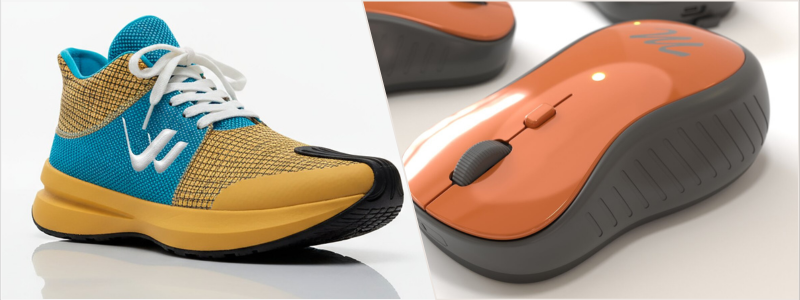
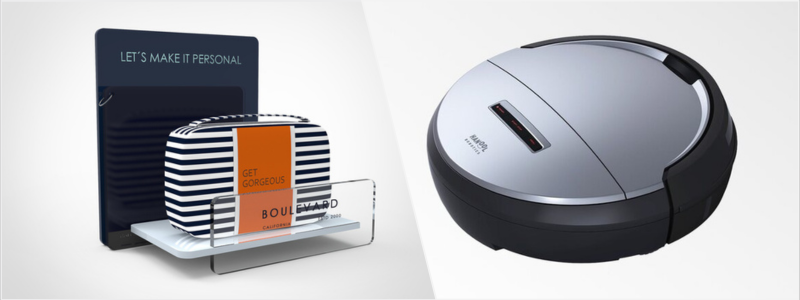
In this post we share the ultimate guide to launching new products people actually want, using 3D design services companies. Product market launch doesn’t just happen. It’s not like you already have a finished product lying around, waiting to be released into the market. As a matter of fact, market launch is the final step in a series of new product development processes. It all begins with an idea, followed by concept development, before stepping into the design work. The product also needs to go through prototyping, testing, refinement, manufacturing, and eventually market release.
There can be many factors that determine the success of a market launch. Chief among them is the actual product itself. Having a good product designed by expert product designers improves your chances of achieving a successful launch a great deal. Combine that with strategic marketing and excellent timing, and the product is on its way to becoming a profitable venture. On the other hand, a poorly-designed product is likely doomed to fail no matter how much money you pour into the marketing budget. Most users don’t really care if the launch is surrounded by a massive fanfare; what they need is a product that’s purposeful, easy-to-use, reliable, and worth the money.
Believe it or not, product launch isn’t actually as challenging as it used to be. Thanks to the proliferation of e-commerce platforms and social media, where you can engage with potential buyers almost anytime, anywhere, it has become easier and more cost-effective to connect with potential consumers. The question is no longer about how to get in touch with buyers to introduce your product, but whether the product is actually good enough that the market launch can immediately trigger signs of success.
A successful product launch can only happen if the product itself is worth launching. You can’t just launch a low-quality product and expect to receive an overwhelmingly positive response from the public following the release. Designing a new product that’s functional, useful, aesthetically pleasing, and good value for the money is a monumental undertaking best left to professionals. Here at Cad Crowd, you can connect to experienced industrial designers with good track records of transforming mere ideas into not only tangible but also marketable and profitable products.
Starts with a vision
The phrase has been thrown around all over the place to the point where it sounds like nothing but a cheap cliché, but it’s a cliché only because it’s true. Just like everything else in life, the result reflects the efforts you put into it. Within the context of product development and launch, the “vision” here refers to the sort that extends beyond a short-term result. It’s a vision for product launch that probably takes about two or three years before you get there; give it six months for ideation, one year for development, another year for prototyping and refinement, and a few more months to get ready for release.
A vision, however, would fail to go anywhere if you don’t care to grow the passion for it. When you have the passion to go along with the vision, you tend to strive to achieve your goals and make a conscious effort to get the job done. But then again, a vision and the passion for it won’t likely get you anywhere closer to product launch without the wisdom to safeguard the two from going off track in terms of project timeline, budget, or even the design itself.
A common example of this lack of wisdom is when new product designers think they can learn what to build from consumers. What appears to be as plain as day, a brilliant idea on the surface, is in fact an outright foolish one. This is especially true in tech products (because everything is advancing so fast these days), but it is applicable to just about everything else. It’s not the consumers’ job to figure out what’s technically possible, even if they think it is. People see and define the world based on everything that already exists in the market. Furthermore, every consumer wants a perfect product, no matter what it is, and trying to make a perfect product for everyone is as fruitful as chasing the end of a rainbow.
Despite all of that, it doesn’t mean you shouldn’t talk to consumers. In fact, the opposite is true. As counterintuitive as it may sound, the most effective way to overcome the issue is to talk to many consumers. The big difference is that you’re not in the mindset of asking customers for the next big idea; you’re testing the ideas on them to see if anything works. In short, you have a bigger chance of creating and launching a successful product when you have the right vision for it, are driven by a passion to persist with the undertaking, and have the knowledge to overcome challenges.
The culture of product discovery
A different concept product design team may implement a different development method. And there are all sorts of methods with emphasis on “sprint” iterations, rapid prototyping, virtual simulations, linear approach, and so forth. Each methodology has its own strengths and weaknesses, but in general, everything is just a big guideline to keep the development process in check and easy to retrace. When you’re talking about “new” product development and launch, however, what matters the most is the culture you’re bringing into the design space.
Suppose an engineer and a designer disagree on a particular feature; the designer likes to see the feature included in the product, whereas the engineer thinks it’s going to cost a lot of money and make the product too expensive for the target consumers at the end of the day. This is a fairly common situation in a product development process. If anything, many instances of disagreement are expected to happen within a good team. They have different opinions and perspectives on what makes a product great, and any compromise born from the situation is the result of well-informed decision-making. In the likely instances of frequent disagreement, the right product development culture doesn’t call for endless discussions and meetings, or worse, terrible escalations; instead, the team should test all the iterations and see which one performs better.
Mindful development
Much of a successful product design is determined by the quality of market research you do. Among the core aspects of market research is being aware of your target audience, meaning you should be able to identify them and see the product from their viewpoints. You need to be mindful of their perspective and understand their expectations, too. A mindful product development carves the path that leads to a product design people actually want. And there’s no better way to understand the consumers than engaging in a direct dialogue with them. Once again, the idea behind this communication is not to formulate an idea of a product but to test whether your concepts are viable.
A practical method to reach as many potential consumers as possible is to first connect with “ambassadors” from outside the design team. Think of the ambassadors as product advocates who can offer fresh perspectives and a valuable partnership during the product development process and market release. Ambassadors serve an important purpose to help you test ideas, discover pain points, and prevent you from setting unrealistic expectations. Coming from outside the 3D design team, biased opinions are highly unlikely. Because you have direct contact with these advocates, it’s easy to invite them to the development facility (or the design space, wherever it is), so you can present the product for criticism and feedback.
For this method to be effective, the ambassadors must consist of multiple individuals who represent each demographic within your target market. The idea behind the process is to expedite the trial-and-error phase, allowing you to focus on improving what works and fixing what doesn’t. One of the fine examples of how product ambassadors could provide useful insights into product design was observable during the development of the ORII smart ring. The design team discovered just the right ambassadors among attendees at an electronics convention. It quickly transformed into a partnership where the designers almost always released an updated version of their product at similar events, so that the ambassadors could be the first to test it.
This kind of interaction happened multiple times, allowing the product development designers to gather valuable user-experience data from reliable sources. For the test results (data) to be accurate, the ORII design team made sure to only pick individuals within the product’s target demographics to be the ambassadors. It turned out that introducing early versions of a product to a smaller yet refined audience could lead to well-informed design decisions that contributed to a successful market launch at a later date. OrangeMonkie, the company behind the Foldio lightbox, also implemented a similar process. Most people behind the brand are Kickstarter veterans, with a great history of launching a number of successful foldable lightboxes through crowdfunding.
The first generation, Foldio1, was backed by more than 3,800 supporters and materialized into a real product. A few years later, the third generation of the same product, simply called the Foldio3, raised at least $800,000 from over 4,500 backers. The company is still going strong today, offering all sorts of mini home studio kits and accessories. OrangeMonkie made the case for how giving a platform for consumers to test your ideas and actually listening to what they have to say could help you stay on track to build and launch a product people actually want.
Product conventions and Kickstarter are excellent platforms to engage in direct communication with consumers, but they’re not the only options available. You also have online communities and forums, as well as social websites like Facebook Groups, to help you discover like-minded people interested in your product ideas. In some cases, even the old-fashioned email surveys still work wonders for this purpose. Any platform that can facilitate a dialogue and provide means to reach a larger audience will do. A potential caveat of using online pages as a channel is that every single word anybody writes about the product will be immediately available to the public. Even in the widely popular crowdfunding platform, Kickstarter, there’s still no guarantee that someone won’t copy or steal your ideas and beat you to the launch. Unless your idea is patented or licensed somehow, it’s a persistent risk, but that’s a discussion for another time.
Keep in mind that no matter the platform, the conversation has to go both ways. The ambassadors offer honest, constructive criticism of the product, followed by tangible improvements based on that feedback. This is active listening in action. You’ve seen many times in crowdfunding platforms how consumers express their appreciation for a product, but they wish it brought more features or that it could do one thing or another in a better way. It’s also pretty common to see someone try to tell the 3D product designers how to do their jobs by giving an ambiguous outline of a process to fix a problem or two.
Not to be repetitive, but you’re not asking the ambassadors to solve any pain point; you’re only expecting them to identify issues. Figuring out how to make the product better is solely the designers’ responsibility. The eventual expectation is that you get a consumer-driven product built by professionals. Based on consumer feedback on the current version of the product, the design team rushes to build an improved iteration that addresses the most concerning pain points. That said, not every problem should take its place as the top priority.
There needs to be a scale of urgency where designers can set aside minor issues to focus on the critical ones. A lot of manufacturing companies, especially startups, are too afraid to fail that they actually put the product development process in complete isolation. In an attempt to create a good product, it’s foolish to dismiss consumers’ opinions and ambassadors’ insights. As a result, they end up presenting an irrelevant product on launch day, sending it to market oblivion.
Consumer-driven product
Companies can say that every single one of their products is consumer-driven just because it’s intended to be an object that consumers may use for any particular purpose. In practice, the term “consumer-driven” refers to a much broader sense of product development approach. A product is consumer-driven not only because it’s available for them to purchase–it also has to be influenced by their perspectives, opinions, demands, and actions. By giving the consumers an opportunity to contribute to the design during the development process, you open the doors to a fruitful relationship with the user base.
As a product rendering and design company, the time you spend and the effort you make to engage in a meaningful dialogue with consumers help establish a sense of trust that ultimately contributes to brand reputation. If the consumers feel that their opinions are heard and properly appreciated (as reflected in the design changes), they’ve quickly associated themselves with the product development journey to materialization and its launch. They want the product to have a successful market launch. Encouraging the involvement of ambassadors and consumers throughout the product development process is an effective way to build something they want.
When profitability is part of the equation, you can’t just have the product built exactly to your specification down to the last detail. You’re creating a product for people to buy, so it’s imperative that the design caters to their preferences. There will be design compromises here and there, but everything is built based on real-world user test data. It’s not always about trying to build the perfect product, but one that resonates with potential buyers at large and is greatly anticipated for market launch.
Most ideas don’t work
Still remember that consumers are almost always right when they say things don’t work? At the early phases of a product prototype design development process, the rule of thumb is to brainstorm and collect as many ideas as you can possibly handle. You will need a lot of ideas simply because most of them are probably terrible. To make things worse, sometimes you don’t know if an idea is bad until you test it on consumers. And for ideas that are actually feasible, you may need at least three or four iterations to make them work as intended. But having a group of objective ambassadors on your side helps speed up the trial process.
There can be many reasons why ideas don’t work. They might be too complex for the average consumer to understand and use, impractical, or outright irrelevant. Sometimes, an idea is technically feasible, but it’s so complicated that it just isn’t worth the time and money to execute. However, ideas don’t work most often because the consumers just cannot care less. This is why you need tons of ideas to start the development; otherwise, you’ll end up creating and launching a product only to find out that it’s not what the consumers want all along. It’s the product modeling design team’s responsibility to separate the good from the bad at the earliest time possible.
There’s a big difference between vision and illusion, in the same way that pivoting to a better idea isn’t synonymous with giving up on the product development as a whole. Professional designers are known to be stubborn when it comes to a product concept, but exceedingly flexible in terms of details. Given enough experience, the ability and willingness to distinguish real product vision and mere illusion should come as second nature to designers. A new product development is all about innovation, invention, and discovery. An idea (of a product) triggers the excitement to create multiple concepts. Designers work to materialize the most feasible concept and iterate until it becomes a tangible, functional, aesthetically pleasing product.
What most people don’t tell you is that there can be many pivoting points along the way. It’s pretty common in a product development process to reach a point where you realize an idea just won’t work. You decide to discard the idea and move on to the next. If the next idea also fails, new product development designers try another until you find the right formula. Apart from giving you the chance to test ideas, maintaining good communication with consumers also earns you a sneak peek into competitors’ products and what other alternatives are available on store shelves from their perspectives.
These insights might loosen the vision a little bit; perhaps there’s a way to try and change the problem you’re trying to solve, maybe it’s possible to either narrow down or broaden up the target demographics, probably replacing a feature with another can speed up progress, and so forth. You don’t pivot to the next idea because it’s easy, but you do it to improve the product’s chances of achieving success in the market.
Every iteration must be followed with a validation, including the final (production-ready) version. You’ve probably done this numerous times throughout the design process with earlier versions of the product. You build an iteration, test ideas on consumers, and refine the product based on the test results. Some features are improved because consumers demonstrate interest, while others are omitted entirely due to the lack of positive responses. The next iteration, based on the feedback, is then validated once again using the same method. The product should go through this process over and over until the final version is ready.
When it comes to rapid prototyping services, never assume that the production-ready prototype has zero issues. Nothing kills a product launch quicker than a product that isn’t 100% working. While it’s true that this version is the result of multiple refinements and improvements, you can’t be really sure that nothing can go wrong. In fact, the consumer test of a production-ready version is of the highest degree of importance because it’s supposed to be the last chance you have prior to market launch. Do not frustrate your consumers with a terrible unboxing experience or a product that fails to deliver what it promises to do.
Takeaway
According to Clayton Christensen, a professor of Business Administration at Harvard Business School, there are nearly 30,000 new products introduced every year, and 95% of them fail. Product quality and price certainly have something to do with the failure, and so does usability and market fit. Even when the product is well-made by any objective measure, it still doesn’t contribute to market success if there’s little demand for it. In other words, you can’t expect to have a successful launch if people don’t want the product in the first place.
You might be able to develop a new product, but whether or not the consumers at large can appreciate its values is another question entirely. It’s therefore important to understand your capabilities as well as limitations, and hire (or more commonly outsource) the additional skills necessary to build a well-rounded design team. Having a wide range of expertise within a single team supplemented by a refined group of ambassadors can improve your chances of designing a great product and allow you to see the development process from a broad perspective. And this is where Cad Crowd comes in; with a heavy emphasis on the engineering and design sectors, the platform connects you with experienced industrial designers of various specializations to help you build a multidisciplinary team for successful product development and launch. Get a quote today!
MacKenzie Brown is the founder and CEO of Cad Crowd. With over 18 years of experience in launching and scaling platforms specializing in CAD services, product design, manufacturing, hardware, and software development, MacKenzie is a recognized authority in the engineering industry. Under his leadership, Cad Crowd serves esteemed clients like NASA, JPL, the U.S. Navy, and Fortune 500 companies, empowering innovators with access to high-quality design and engineering talent.
I am having trouble getting Asan to pick up on heap memory not being freed.
int main() {

    int* arr = new int[10];
    // arr[10] = 5; // Asan will warn me about this invalid access

    // Asan says nothing about the arr I did NOT free
}
I have tried both the Visual Studio UI version of running Asan by running the debugger and the command line version of build the executable and then running it. Neither mention the memory not being freed.
Is it not possible ot get Asan to warn about a memory leak like this?
A Wall Street Journal report on Friday said Nvidia insiders had expressed doubts about the transaction and that Huang had privately criticized what he described as a lack of discipline in OpenAI’s business approach. The Journal also reported that Huang had expressed concern about the competition OpenAI faces from Google and Anthropic. Huang called those claims “nonsense.”
Nvidia shares fell about 1.1 percent on Monday following the reports. Sarah Kunst, managing director at Cleo Capital, told CNBC that the back-and-forth was unusual. “One of the things I did notice about Jensen Huang is that there wasn’t a strong ‘It will be $100 billion.’ It was, ‘It will be big. It will be our biggest investment ever.’ And so I do think there are some question marks there.”
In September, Bryn Talkington, managing partner at Requisite Capital Management, noted the circular nature of such investments to CNBC. “Nvidia invests $100 billion in OpenAI, which then OpenAI turns back and gives it back to Nvidia,” Talkington said. “I feel like this is going to be very virtuous for Jensen.”
Tech critic Ed Zitron has been critical of Nvidia’s circular investments for some time, which touch dozens of tech companies, including major players and startups. They are also all Nvidia customers.
“NVIDIA seeds companies and gives them the guaranteed contracts necessary to raise debt to buy GPUs from NVIDIA,” Zitron wrote on Bluesky last September, “Even though these companies are horribly unprofitable and will eventually die from a lack of any real demand.”
Chips from other places
Outside of sourcing GPUs from Nvidia, OpenAI has reportedly discussed working with startups Cerebras and Groq, both of which build chips designed to reduce inference latency. But in December, Nvidia struck a $20 billion licensing deal with Groq, which Reuters sources say ended OpenAI’s talks with Groq. Nvidia hired Groq’s founder and CEO Jonathan Ross along with other senior leaders as part of the arrangement.
In January, OpenAI announced a $10 billion deal with Cerebras instead, adding 750 megawatts of computing capacity for faster inference through 2028. Sachin Katti, who joined OpenAI from Intel in November to lead compute infrastructure, said the partnership adds “a dedicated low-latency inference solution” to OpenAI’s platform.
But OpenAI has clearly been hedging its bets. Beyond the Cerebras deal, the company struck an agreement with AMD in October for six gigawatts of GPUs and announced plans with Broadcom to develop a custom AI chip to wean itself off of Nvidia dependence. When those chips will be ready, however, is currently unknown.
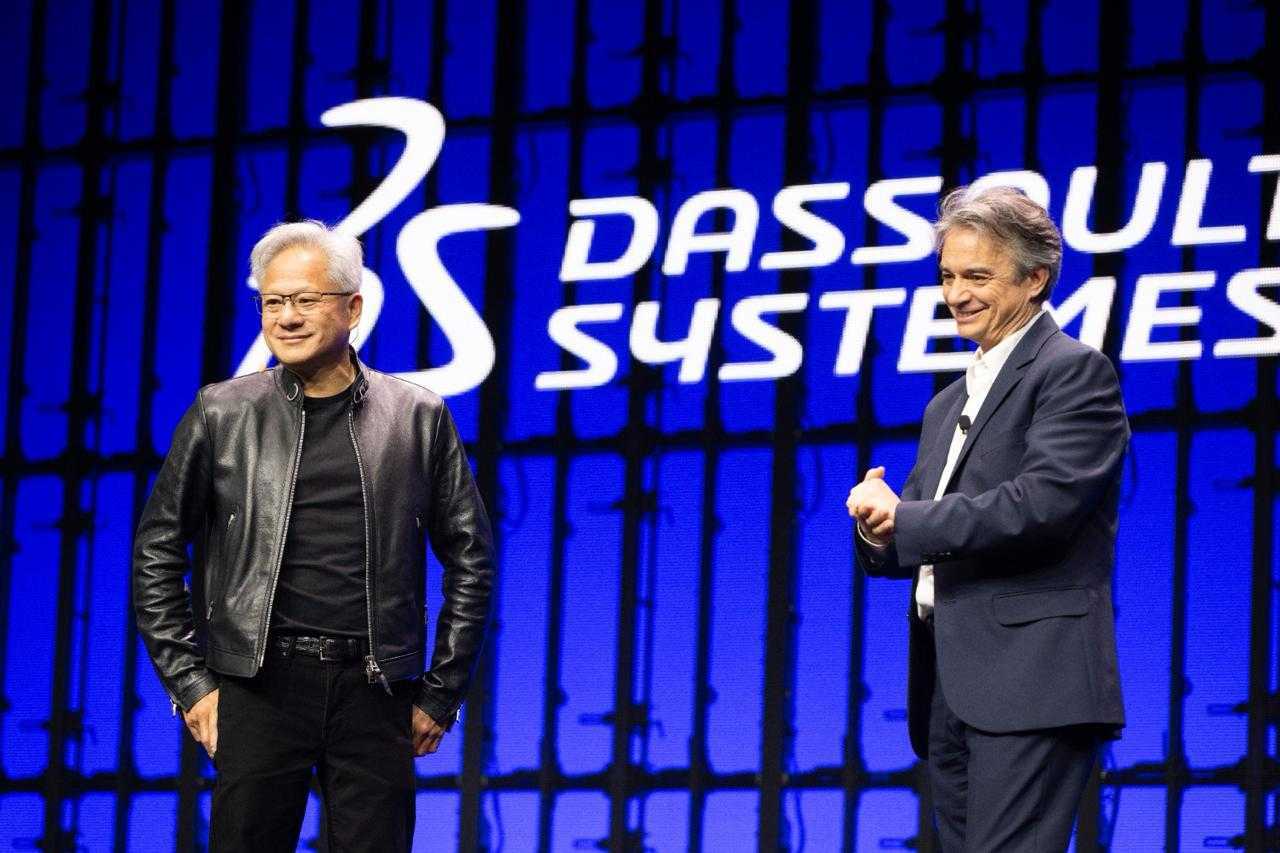
At 3DEXPERIENCE World in Houston, NVIDIA founder and CEO Jensen Huang and Dassault Systèmes CEO Pascal Daloz laid out a blueprint for industrial AI rooted in physics-based “world models” — systems designed to simulate products, factories and even biological systems before they’re built.
“Artificial intelligence will be infrastructure,” like water, electricity, and the internet Huang told the crowd, playfully referring to the engineering-heavy audience as “Solid Workers,” a nod to Dassault Systèmes’ SolidWorks platform.
The announcement continues a collaboration spanning more than a quarter century between NVIDIA and Dassault Systèmes.
“This is the largest collaboration our two companies have ever had in over a quarter century,” Huang said. “We’re going to fuse these technologies so engineers can work at a scale that’s 100 times, 1,000 times — and eventually a million times greater than before.”
Huang framed the shift as a reinvention of the computing stack: moving from hand-specified, structured digital designs to systems that can generate, simulate and optimize in software — at industrial scale.
From Digital Models to Industry World Models
Virtual twins are not applications, “they are knowledge factories,” Daloz said.
The partnership aims to establish industry world models — science-validated AI systems grounded in physics that can serve as mission-critical platforms across biology, materials science, engineering and manufacturing.
In Daloz’s framing, the value moves upstream: virtual twins become the place where knowledge is created, tested, and trusted — before anything is built in the physical world.
Dassault Systèmes, whose 3DEXPERIENCE platform serves more than 45 million users and 400,000 customers globally, has long been a leader in virtual twin technology — digital replicas that let engineers simulate products and processes before building them physically.
The collaboration brings together accelerated computing, AI and digital twin technologies so engineers can design not only geometry, but behavior — and explore radically larger design spaces earlier in development.
Together, the companies outlined how this shared architecture will show up across science, engineering and manufacturing workflows:
Advancing Biology and Materials Research: The NVIDIA BioNeMo platform and BIOVIA science-validated world models accelerate the discovery of new molecules and next-generation materials.
AI-Driven Design and Engineering: SIMULIA AI-based Virtual Twin Physics Behavior leveraging NVIDIA CUDA-X libraries and AI physics libraries empowers designers and engineers to accurately and instantly predict outcomes.
Virtual Twins for Every Factory: NVIDIA Omniversephysical AI libraries integrated into the DELMIA Virtual Twin enable autonomous, software-defined production systems.
Virtual Companions Supercharge Dassault Systèmes’ Users: The 3DEXPERIENCE agentic platform, combining NVIDIA AI technologies and NVIDIA Nemotron open models with Dassault Systèmes’ Industry World Models, powers Virtual Companions to tap into deep industrial context, delivering trusted, actionable intelligence.
Huang said that in domains like biology and materials, the frontier is learning the underlying “language” of complex systems and then generating new options that can be evaluated and validated in simulation.
Designing and Operating the Factory in Software
A central theme of the discussion was how factories themselves are changing — from static physical assets to living systems that are designed, simulated and operated as virtual twins.
As part of the partnership, Dassault Systèmes is deploying NVIDIA-powered AI factories on three continents through its OUTSCALE sovereign cloud, enabling customers to run AI workloads while maintaining data residency and security requirements.
Both executives emphasized that the goal isn’t to replace engineers — it’s to amplify them. As AI agent companions take on more exploratory and repetitive tasks, designers and engineers gain leverage and creativity, not redundancy.
AI Companions That Expand Human Creativity
Every designer will have a “team of companions,” Huang said — a shift he described as fundamentally positive for engineers, software platforms and the broader ecosystem built on them.
For the tens of millions of engineers who use Dassault Systèmes tools to design everything from aircraft to consumer packaged goods, the shift isn’t about replacing human creativity — it’s about expanding it.
“Success is not about automation,” Daloz said. “[Engineers] don’t want to automate the past — they want to invent the future.”
Looking ahead, Daloz framed the partnership as about more than performance gains – it’s an effort to open new possibilities, help companies eliminate bad choices before they become expensive mistakes, and create entirely new categories of products.
“Virtual twins and the 3D Universes are not applications,” Daloz said. “They are knowledge factories.”
The fireside conversation between Huang and Daloz was broadcast live from 3DEXPERIENCE World.
If you use editor productivity extensions for Visual Studio 2026, there’s good news—they can now load faster! Extension developers with existing MEF-based editor productivity extensions should read this blog to learn about recent changes and how they might be affected.
We introduced VisualStudio.Extensibility to simplify the creation of Visual Studio extensions for developers. Previously, handling threads in VSSDK-based extensions was often difficult, requiring knowledge of thread affinity and even the ins and outs of COM just to avoid freezing Visual Studio. The new extensibility model abstracts these technical details away seamlessly.
Despite this advancement, we recognize most Visual Studio extensions still use VSSDK, so we’re striving to make targeted improvements there as well – especially regarding performance. For Visual Studio 2026, we’ve added the ability to load MEF-based editor extensions on a background thread, which significantly speeds up startup times for users. A major highlight of Visual Studio 2026 is its improved performance, and the proposed change we’re making to MEF is just one of many enhancements planned to make it even faster. We hope you’ll be pleased with the results.
What changed?
Visual Studio editor components use the Managed Extensibility Framework (MEF), which requires that objects be constructed in a free-threaded manner. Despite official MEF guidelines, we’ve often loaded components on the UI thread, resulting in many extensions relying on this behavior and limiting our ability to enhance startup performance.
With Visual Studio 2026, we’re shifting to a free-threaded model, loading MEF components on background threads. This means extensions with UI thread dependencies might fail to load. We’ve been rigorously testing this approach in recent Visual Studio 2022 updates, and we are aware that some extensions that expect to load on the UI thread will fail to load with this optimization. To support extension developers through this transition, we’ve provided a setting and an analyzer that allows you to experiment with background loading and detect if your extension could be impacted by this change before we push it out more broadly. This initiative reflects our commitment to reducing disruptive changes and help extenders adapt when updates are necessary for the overall improvement of the product.
Does it impact my extension?
To help extension developers better detect if this change impacts you, we created an analyzer to identify potential issues. We hope that this will give you the opportunity to bring your extension in compliance with MEF rules, so that your extension can also get a startup performance boost like the rest of Visual Studio 2026.
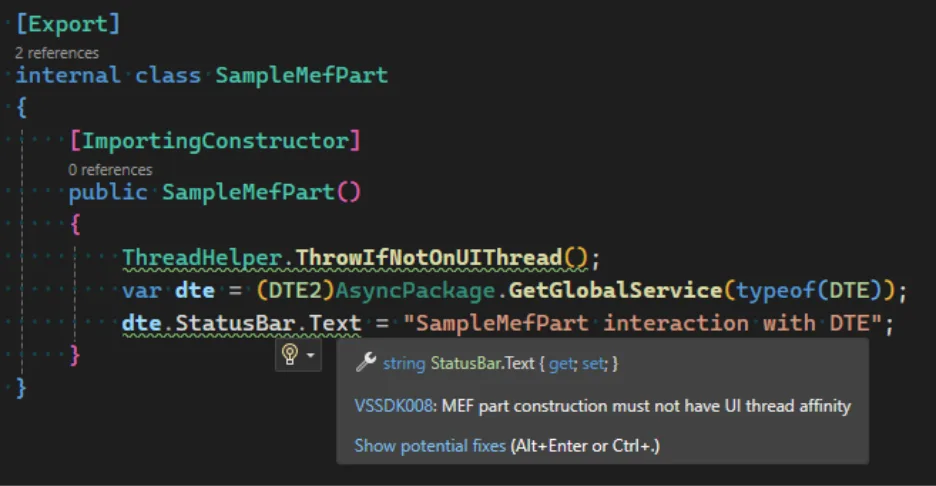
The example below shows the analyzer running and reporting access to the Microsoft.VisualStudio.Shell.ThreadHelper and DTE2.StatusBar require UI thread.
To validate your extension can adapt to this change, enable the Preview Feature flag “Initialize editor parts asynchronously during solution load”.
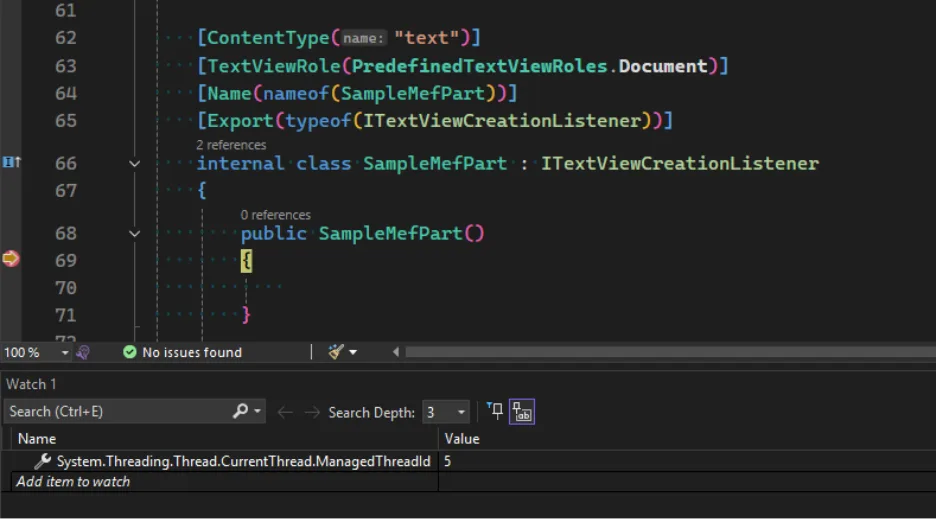
When debugging, you may set a breakpoint in MEF part constructors and evaluate System.Threading.Thread.CurrentThread.ManagedThreadId. If it’s different than 1, then your code executes on the background thread.
Call to action
Loading MEF parts on a background thread is essential for improving Visual Studio’s performance, and we have gradually enabled this change in Visual Studio 2026. We recognize that code changes can be inconvenient, so we’ve made it straightforward to spot and resolve any issues. To see examples of removing UI thread affinity, please see our documentation or a sample PR on how we made this change ourselves.
We want to hear from you!
Thank you for sharing your issues and suggestions with us, and we hope you’ll keep providing feedback about what you like and what we can improve in Visual Studio. For those new and experienced to extending Visual Studio, we invite you to visit our documentation to learn more, or watch the video series on Visual Studio Toolbox where Visual Studio engineers take you through how to build extensions using our samples on GitHub. Feel free to share feedback with us viaDeveloper Community: report any bugs or issues viareport a problemandshare your suggestionsfor new features or improvements to existing ones. If you want a closer engagement with other partners in the ecosystem, please visit our GitHub repo to report issues as well.
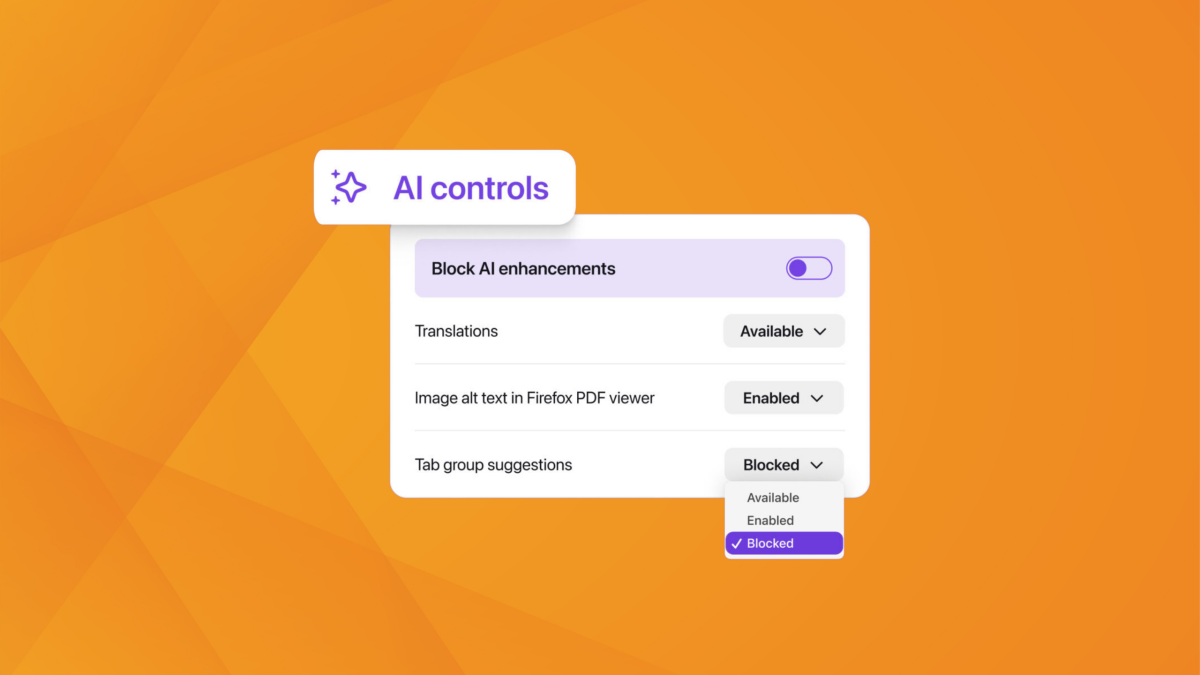
On Feb. 24, Mozilla will release Firefox version 148, which includes a highly sought-after feature: an AI kill switch. The new AI controls section gives users the option to block all current and future generative AI features in the browser, with additional toggles for specific tools.
The AI controls section lets users manage five features individually or disable them all with a “Block AI enhancements” toggle. These features include:
AI-generated translations for browsing in different languages,
automated alt text descriptions for images in PDFs,
AI-enhanced tab grouping that suggests related tabs and names,
link previews that show key points before opening links, and
an AI chatbot sidebar providing access to ChatGPT, Claude, Copilot, Gemini, and Le Chat Mistral.
Users who activate the block toggle won’t see pop-ups or reminders about existing or upcoming AI features. Those who want to use specific tools can enable them individually, even with the master switch on, though future AI features will remain blocked by default unless explicitly enabled. The feature is currently available in Firefox Nightly for early testing.
The update comes after Mozilla faced backlash in November for announcing an AI Window within Firefox. Mozilla developer Jake Archibald announced the “kill switch” in December, explaining that the toggle would disable all AI components and that AI features would be optional by default. Refreshingly, Mozilla fulfilled its promise pretty quickly.
While some people appreciate generative AI’s numerous functionalities, others don’t want anything to do with it. Mozilla’s new CEO, Anthony Enzor-DeMeo, who took the role in December 2025, previously emphasized that “AI should always be a choice—something people can easily turn off,” per Hacker News.
Do you ever feel like an imposter? I certainly have!
If you listen to anything these days you’ll hear the term “imposter syndrome”, and, trust me, I have felt like that at times too. Everyone seems to think I’m so strong, how I can get through everything I’ve been through and they seem to think it’s MY power, ME who’s doing it, but it’s not. It’s ONLY because of God that I’ve been able to survive all that. I try to explain it to them that it’s not my power, but rather God’s, but they don’t understand or believe me, so it makes me feel like an imposter because they praise me for something I can’t take credit for.
I never wanna forget WHY I’ve made it through everything. I never want to take away God’s glory and place the credit upon myself. I never want to steal from God, His glory, His thunder, His power, His majesty.
My entire journey, my whole life, would not exist apart from God. There’s no way I could have accomplished all of the things I’ve done and am doing without Him. But sometimes when I try to explain how I “do everything” (their words, not mine) and I tell them that it’s ONLY by the grace of God that I can even get through some days, some don’t really believe me.
They think the power is in me or something. I assure you, it’s not!
In fact, just last week I was laying on the floor crying because I felt like I couldn’t go on anymore. “I can’t get THROUGH this!” I told the Lord, “It’s too hard. I can’t make it. You HAVE TO do SOMETHING. Take care of this, Lord, please, I can’t do it on my own.”
And He did! 🙌 He gave me strength, He gave me motivation to keep going. But it was all of HIM, not because of something inside of me.
God has given me a very specific focus for this blog and all of the resources I try to provide to everyone. And He keeps expanding that vision and direction as I listen to His leading and promptings in my life. I have come so far and grown so much spiritually, and, yet, He keeps pushing and stretching me to places I never thought I could go, both spiritually and in life. Things I thought I couldn’t do or make it through, but have made it through with HIS help alone!
But don’t think that I don’t have those moments of doubt. “Are you sure you want ME to do that, Lord? Are you sure I can do this?” There are days that I sit back and think, “There is no way I’m capable of doing what He’s asking me to do. He’s asking SO much.”
Right now, He’s asking me to post 2 blog posts a day for 3 months. I thought, “WOW. I can’t even post ONE new blog post a day, much less two!”
You know what?!
During that time period, I posted THREE new blog posts a day for 2 months. I asked Him if I could do it that way instead and He convicted me it was okay and I did it. But the point is that I DID IT!!!
I was able to, but only by the grace of God. Only by His providence in helping me.
At the end of the day, I’m not an imposter because it’s not me doing all of this…it’s HIM! It’s always Him, it’s always BEEN Him and as long as we continually remember where our strength comes from, why we are able to get through the day, and are CONTINUALLY GIVING HIM the glory for that strength (both outwardly and inwardly in our hearts in praise, worship, and thankfulness), He is pleased and we are not living in a fake way.
And that’s the point of living a Christian life to the world, our family, and our friends. To live genuinely, honestly, but also unashamedly because of what Christ did for us on the cross. What He did for everyone. 🙌
He’s my strength and my resource…my every present help…my sole defender. And with Him I can do anything and so can you! All things truly are possible, but only with Christ, our Redeemer. ❤️
With God All Things Are Possible Wallpaper
No matter what we think our limitations are, with God all things are possible.
That’s what we need to remind ourselves…this is His Word and His truth. If you read in Matthew 19, you’ll see that He’s making the point that it’s extremely hard for a rich man to enter the kingdom of heaven.
Why? Because when we are rich, and we are all rich to some degree, we don’t need to rely on Him for whatever riches we possess.
But when something is hard (or we feel like an imposter because people think we’re someone we’re not – whether they think we are better or worse than we truly are), we find that we need Him and rely on Him more to complete what He has called us to do. And that’s when His promise hits home.
When people think we are better than we are, in our humility, we get the opportunity to point them to Christ, thus Christ wins.
And when people think we are worse than we are, they attack us, malign us, say all kinds of lies and evil things about us that were never true about us in the first place, they only bring more people to hear the gospel. As they spout out their lies, others come to try to decide for themselves and Christ is preached to new, listening ears.
So that no matter what, whether we are spoken of as better than we are or worse than we are, in both circumstances, Christ is glorified and the gospel is spread, because as many as don’t believe (and are vocal about it), there are some who DO believe in the power of Christ.
Either way, you see, God wins! 🙏
Do you need this reminder today? I’m here to tell you that whatever that tug is on your heart, whatever He’s impressing on you when you are in prayer, He will make it possible for you to complete that which He is asking you to do because with Him all things are possible!
Download this wallpaper today for your devices to remind you that you are already equipped for His calling. And put it on your social media to spread that good word: With God All Things Are Possible – Matthew 19:26
Need help saving them to your device? Click here for the full tutorial.