Remember in the middle of the COVID-19 pandemic when live audio was suddenly everywhere? The trend was made popular by the briefly Clubhouse before seemingly every other online platform copied the feature for themselves.
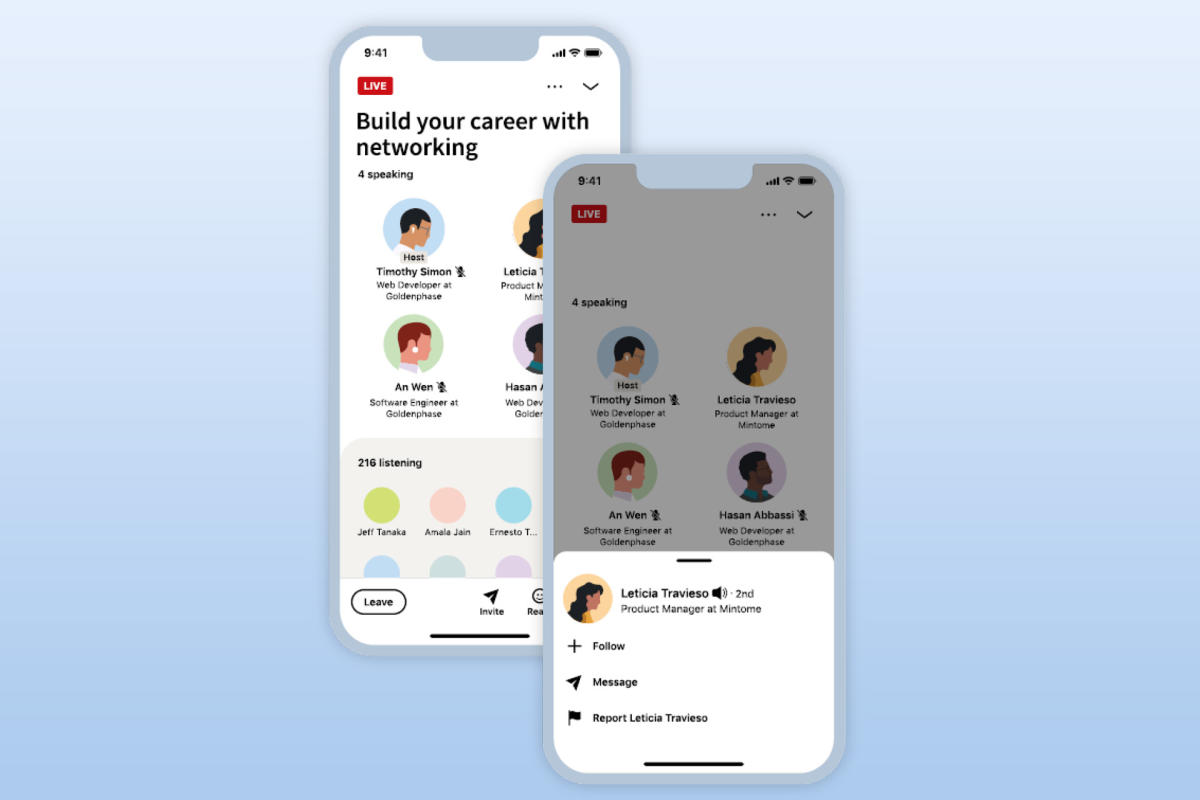
Since then, live audio has become mostly a footnote to a weird time when we were all stuck at home at the same time with nothing to do and listening to hours-long streams of strangers talking to each other passed as entertainment. Now LinkedIn, which was somewhat late to the live audio party , has opted to get rid of its standalone live audio events.
In , the company says it will no longer support native audio events beginning next month. Users will stop being able to create new events as of December 2, and previously scheduled events will no longer work after December 31. Instead, the company is “bringing together” audio events with its live-streaming feature, LinkedIn Live. LinkedIn Live, however, requires creators third-party tools to set up streams. So while audio-only streams will still be able to exist on LinkedIn, they will take a few extra steps.
LinkedIn isn’t the only company to change course on live audio. , , and have all shuttered their pandemic-era live audio products.Even Clubhouse (which, yes, still exists) from the format last year. The feature is, however going strong on X despite a few technical .
Back in October, the FBI and Cybersecurity and Infrastructure Security Agency (CISA) admitted that they were looking into “the unauthorized access to commercial telecommunications infrastructure by actors affiliated with the People’s Republic of China.” These bad actors, collectively called “Salt Typhoon,” allegedly targeted US officials and staffers for the recently concluded presidential elections. A few days later, though, The Wall Street Journal reported that the group had access to a lot more people than originally thought. Basically, the hackers could have accessed the data of any American who’s a customer of AT&T and Verizon. That list of carriers has grown just a bit longer, because according to a new report by The Journal and Reuters, Salt Typhoon had also infiltrated T-Mobile’s network.
The hackers are believed to have exploited various vulnerabilities, such as those plaguing Cisco Systems routers, to get inside the carriers’ network. They also used AI and machine learning, The Journal said, and stayed inside some of the systems they infiltrated for over eight months. That’s enough time to get away with a bunch of sensitive data — they were allegedly able to access the phone lines of US senior national security officials, as well as the call logs and unencrypted texts of their targets. The hackers were also reportedly able to access the information collected by carriers to comply with surveillance requests from the American authorities.
A company spokesperson told The Journal that T-Mobile is “closely monitoring” the attacks and said that its systems and data “have not been impacted in any significant way.” They also said that the carrier didn’t find evidence that its customers’ information has been compromised in the security breach.
President-elect Donald Trump has named Elon Musk as the leader of a new “Department of Government Efficiency,” that will “dismantle Government Bureaucracy, slash excess regulations, cut wasteful expenditures, and restructure Federal Agencies.” The Tesla CEO and owner of X will spearhead the effort along with former presidential candidate Vivek Ramaswamy, Trump in a statement on Truth Social.
The scope of the role isn’t exactly clear. Trump’s press release said that “the Department of Government Efficiency will provide advice and guidance from outside of Government, and will partner with the White House and Office of Management & Budget to drive large scale structural reform, and create an entrepreneurial approach to Government never seen before.” It also stated that “their work will conclude no later than July 4, 2026.”
Musk shared the news on X, but didn’t indicate how the role might impact his obligations at his various other companies. Musk, who poured into Super Pac boosting Trump’s campaign, has previously about his desire to work with Trump to cut government spending. He did, however, joke about potential “merch” for the operation. “Republican politicians have dreamed about the objectives of ‘DOGE’ for a very long time,” Trump’s statement said.
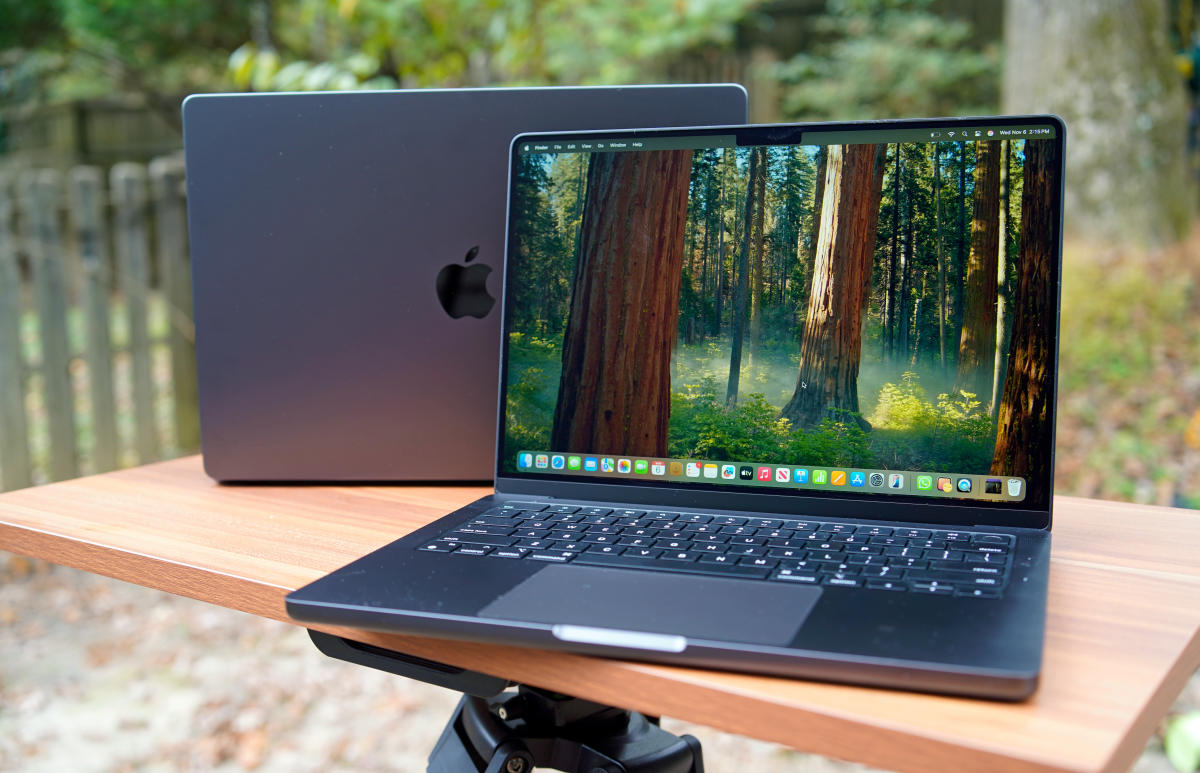
Aside from dramatically better chips, all of the new MacBook Pros feature MiniLED Liquid Retina XDR screens that can reach up to 1,000 nits for SDR (standard dynamic range) content. That’s a 400-nit increase from before, and it should help make content far more visible in daylight or in very bright rooms. (HDR content, as usual, can push the display even further to a peak of 1,600 nits.) There’s also a nano-texture glass option (for a $150 surcharge) that can make the screens more glare resistant, which is useful for working in bright environments. Note, however, that it can also make the screen appear less sharp.
Devindra Hardawar for Engadget
Apple also upgraded the MacBook Pros’ webcams to 12-megapixels, a major leap over the previous 1080p camera. (Apple hasn’t confirmed the megapixel figure for that camera, but it’s likely around 2MP, the bare minimum to reach 1080p). Having a higher resolution camera also opens the door for Center Stage, which can keep you in focus as you move around your room.
Devindra Hardawar for Engadget
I didn’t hate Apple’s previous webcams, but mostly that’s because I remember how mediocre its older 720p webcams used to be. The new models look far sharper with more accurate colors, and the overall image doesn’t look as heavily filtered as the previous cameras. They also support Desk View (above), Apple’s helpful feature for showing off objects below your screen.
If you’re often dealing with large file transfers, you might also appreciate support for Thunderbolt 5 on the M4 Pro and M4 Max chips. It can support up to 120 Gb/s speeds, up from 40 Gb/s in Thunderbolt 4, which the standard M4 chip includes. That could make a huge difference if you’re moving terabytes worth of 4K and 8K videos onto external drives – just note you’ll need to invest in similarly equipped Thunderbolt 5 storage. Thunderbolt 5 could potentially allow for external AI accelerators (unfortunately, Apple Silicon doesn’t support external GPUs).
Devindra Hardawar for Engadget
In use: The best MacBook Pros yet
I didn’t really expect much from the new MacBook Pros, especially since the previous M3 models were already very impressive. But, once again, Apple managed to surprise me with its mobile hardware. The M4 chip, which was in our 14-inch review unit, was a solid performer. But the M4 Pro in our 16-inch MacBook Pro was an astonishing leap ahead of its predecessor, and it’s also faster than every other computer we’ve tested this year (aside from the new Mac mini, which also had a M4 Pro chip).
Unfortunately, we didn’t have an M4 Max-equipped MacBook Pro to test, but given that it’s filled with more M4 CPU and GPU cores, I’d expect another major performance jump.
Computer
Geekbench 6
Geekbench 6 GPU
Cinebench 2024
Apple MacBook Pro 14-inch (M4, 2024)
3,797/14,571
37,869
172/979 GPU: 3770
Apple MacBook Pro 16-inch (M4 Pro, 2024)
3,925/22,456
70,197
178/1,689 GPU 9,295
Surface Laptop 7 (Snapdragon X Elite)
2,797/14,400
19,963
123/969 GPU N/A
Apple MacBook Pro 16-inch (M3 Max, 2024)
3,202/21,312
92,344
143/1,686 GPU 13,182
In Geekbench 6’s CPU benchmark, the 14-inch M4 MacBook Pro scored 1,000 to 1,500 points higher than other recent laptops when it came to single-threaded work. Its multi-threaded performance lead was more slim, but it still beat out Intel’s new Lunar Lake chips and Qualcomm’s Snapdragon X Elite. The M4 Pro 16-inch MacBook Pro scored similarly for single-threaded work, but it blew the competition by 9,000 to 12,500 points. That performance gap alone is equivalent to the multi-threaded Geekbench 6 scores from other laptops this year! (It’s also slightly faster than last year’s M3 Max chip in the 16-inch MacBook Pro, another major achievement.)
Cinebench 2024 scores tell a similar story. Both the 14-inch and 16-inch MacBook Pro scored well above the competition in the single-threaded test. The M4 system was on-par with the best multi-threaded scores we saw from the Surface Laptop 7 (powered by a Snapdragon X Elite chip) and HP Omnibook Ultra 14 (AMD Ryzen AI 9 HX 375). But the M4 Pro 16-inch MacBook Pro, once again, handily outclassed other systems with its multithreaded score, which was nearly double what we’ve been seeing throughout the year.
Cinebench’s GPU benchmark puts the M4 Pro’s graphics performance in line with NVIDIA’s RTX 4070 in Dell’s XPS 16, while the M4 chip is in line with the Framework Laptop 16’s Radeon 7700S. That’s all about what I expected after testing the Mac mini with an M4 Pro chip, and it’s simply astonishing to see that level of performance from a mobile-focused GPU.
Devindra Hardawar for Engadget
When it comes to games, the M4 Pro 16-inch MacBook Pro was able to maintain 60fps in Lies of P, Resident Evil 4 and Myst while playing in 1,440p with the graphics settings cranked to the max. 4K was possible, but typically slowed things down to around 30fps, which isn’t very playable on a computer. The M4 14-inch MacBook Pro, meanwhile, handled those same games in 1080p at 60fps. We typically wouldn’t recommend gaming much on Macs, but Apple’s graphics hardware is hard to ignore at this point, and the company is also working to get more high profile titles in the App Store, like Remedy’s Control.
To put Apple’s Neural Engine to the test, I also used the Whisper Transcription app (AKA MacWhisper) to turn an hour and nine-minute long podcast episode into a transcript. The M4 14-inch MacBook Pro took three minutes and two seconds, while the M4 Pro 16-inch model took two minutes and 11 seconds (similar to what I saw on the M4 Mac mini). In comparison, an M3 14-inch MacBook Pro took three minutes and thirty-seven seconds.
Devindra Hardawar for Engadget
While the speed upgrades are more than welcome, in my testing I noticed that both of the MacBook Pros’ screens were easier to see in bright sunlight. That alone isn’t enough to upgrade for if you’ve already got an M2 or M3 MacBook Pro, but it’s definitely something to look forward to. And even though Apple’s keyboard and enormous trackpad haven’t changed, they’re still among the best in the industry. I also still appreciate having a wide variety of ports on these systems: three USB-C connections (Thunderbolt 4 with the M4, Thunderbolt 5 with the M4 Pro), an HDMI port, a headphone jack, a MagSafe power connector and an SD card reader.
Both MacBook Pros also continue to deliver excellent battery life. The 14-inch lasted for 34 hours and 15 minutes while looping an HD video, whereas the 16-inch went for 30 hours and 16 minutes. That’s the first time we’ve seen our video rundown test go beyond 30 hours. In real-world usage, I could typically use both machines for general productivity work for two days without needing a recharge. That’s the benefit of relying on power-sipping mobile hardware.
Devindra Hardawar for Engadget
Should you buy the new M4 MacBook Pros?
There’s no doubt these new MacBook Pros are compelling, especially if you need the raw power of the M4 Pro (or conceivably, the M4 Max). If you’re running an M1 MacBook Pro, or still trucking along with an Intel model, you’ll definitely see some notable performance gains from these machines. But if you’ve got an M2 or M3 MacBook Pro, the M4 hardware is less of a qualitative leap. You’re probably better off waiting for the eventual OLED refresh, which is rumored to happen in 2026.
Coffee grinders come in all shapes and sizes and with varying degrees of performance. You can get a solid Cuisinart for less than $40 that will serve you well, but if you’re looking to impress the coffee aficionado in your life with a nice gift, you’ll have to do better. Baratza’s Encore grinder has been a popular choice among roasters and coffee pros for a while now. It’s a little pricey for a grinder, but it offers a ton of attractive features that will immediately improve brewing regardless of method.
The controls are simple: There’s an on/off button on the side and a pulse button on the front. The Encore offers 40 grind settings so you can get the exact coffee you need for automatic brewers, AeroPress, Chemex, French press and more. This grinder is also relatively compact, so it won’t take up a lot of counter space, and it fits nicely under your cabinets.
The FBI issued a statement on Saturday about deceptive videos circulating ahead of the election, saying it’s aware of two such videos “falsely claiming to be from the FBI relating to election security.” That includes one claiming the FBI had “apprehended three linked groups committing ballot fraud,” and one about Kamala Harris’ husband. Both depict false content, the FBI said.
Disinformation — including the spread of political deepfakes and other forms of misleading videos and imagery — has been a major concern in the leadup to the US presidential election. In its statement posted on X, the FBI added:
Election integrity is among our highest priorities, and the FBI is working closely with state and local law enforcement partners to respond to election threats and protect our communities as Americans exercise their right to vote. Attempts to deceive the public with false content about FBI operations undermines our democratic process and aims to erode trust in the electoral system.
To view this content, you’ll need to update your privacy settings. Please click here and view the “Content and social-media partners” setting to do so.
Just a day earlier, the along with the Office of the Director of National Intelligence (ODNI) and the Cybersecurity and Infrastructure Security Agency (CISA) said they’d traced two other videos back to “Russian influence actors,” including one “that falsely depicted individuals claiming to be from Haiti and voting illegally in multiple counties in Georgia.”
AMD and NVIDIA could be on a collision course for CES. AMD CEO Lisa Su has confirmed for the first time that the company is set to release its next-gen PC GPUs early next year.
“In gaming graphics, revenue declined year-over-year as we prepare for a transition to our next-gen Radeon GPUs based on our RDNA 4 architecture,” Su told investors on AMD’s third-quarter earnings call. “In addition to a strong increase in gaming performance, RDNA 4 delivers significantly higher ray-tracing performance and adds new AI capabilities. We are on track to launch the first RDNA 4 GPUs in early 2025.”
The timing very much suggests that AMD will reveal those RDNA 4-based graphics cards at CES in early January. It’s rare for the company to unveil desktop GPUs at the trade show (laptop cards are generally the order of the day for AMD at that event). However, it’s widely expected that NVIDIA will use its CES keynote to debut its next-gen 50-series GeForce RTX GPUs. We might get a little more clarity on that front when NVIDIA announces its own Q3 earnings results on November 19.
As PCWorld notes, AMD’s first RDNA 4 GPUs are expected to deliver mid-range performance at an equivalent price point in a bid to increase its market share. AMD’s gaming business (which includes the company’s GPU division) saw a 69 percent year-over-year drop in revenue to $462 million in Q3.
Google is reportedly working on a new Android API for what it’s calling Rich Ongoing Notifications, which would allow apps to display at-a-glance information in a status bar much like Apple’s Live Activities in the Dynamic Island on iPhone. This is according to journalist , who spotted the code in the Android 15 QPR1 Beta 3 release. It could work a lot like the time tracker that currently appears when you’re on a phone call, with a bit of text in a bubble at the top of the display that you can tap to open the app for more details.
Writing for Android Authority, Rahman says the API “will let apps create chips with their own text and background color that live in the status bar.” It could be especially useful for things like transit updates, allowing users to keep track of pertinent information like departure times or an Uber’s ETA while using other apps. The feature isn’t yet complete, though, and it could still be some time before we see it. Rahman predicts it’ll arrive with Android 16.
Arm has taken its feud with Qualcomm to the next level, two years after filing a lawsuit against its former close partner. According to Bloomberg, the British semiconductor company has canceled the architecture license allowing Qualcomm to use its intellectual property and standards for chip design. As the news organization notes, Qualcomm, like many other chipmakers, uses Arm’s computer code that chips need to run software, such as operating systems. Arm has reportedly sent Qualcomm a 60-day notice of cancelation — if they don’t get to an agreement by then, it could have a huge impact on both companies’ finances and on Qualcomm’s operations.
The SoftBank-backed chipmaker sued Qualcomm in 2022 after the latter purchased a company called Nuvia, which is one of its other licensees. Arm argued that the US company didn’t obtain the necessary permits to transfer Nuvia’s licenses. As such, Nuvia breached their contract and it had terminated its licenses, Arm explained in its lawsuit. Qualcomm has been using Nuvia-developed technology in the chips designed for AI PCs, such as those from Microsoft and HP. But Arm wants the company to stop using Nuvia-developed tech and to destroy any Arm-based technology developed prior to the acquisition.
Qualcomm will have to stop selling most of the chips that account for its $39 billion in revenue, Bloomberg says, if the companies don’t resolve the issue within the next 60 days. It seems the US chipmaker believes this is a tactic by Arm to threaten its business and to get higher royalties, because its spokesperson told Bloomberg and the Financial Times: “This is more of the same from Arm — more unfounded threats designed to strong-arm a longtime partner, interfere with our performance-leading CPUs, and increase royalty rates regardless of the broad rights under our architecture license.” Qualcomm also accused Arm of attempting to disrupt the legal process, called its grounds for licensing termination “completely baseless” and said that it’s confident its “rights under its agreement with Arm will be affirmed.”
Meanwhile, an Arm spokesperson told us: “Following Qualcomm’s repeated material breaches of Arm’s license agreement, Arm is left with no choice but to take formal action requiring Qualcomm to remedy its breach or face termination of the agreement. This is necessary to protect the unparalleled ecosystem that Arm and its highly valued partners have built over more than 30 years. Arm is fully prepared for the trial in December and remains confident that the Court will find in Arm’s favor.”
Update, October 23, 2024, 11:33PM ET: This story has been updated to add Arm’s statement.
If you’re after a high-resolution mirrorless camera, most folks in the know will point you to the Sony’s A1. Canon, annoyed at not being everyone’s first choice, is fighting back with its new , a 45-megapixel mirrorless with plenty of bells and whistles.
Engadget’s Steve Dent knows a thing or two about high-end cameras, . It isn’t perfect, but he was impressed by the faster shooting and better autofocus, especially given the A1 is a lot more expensive.
To learn all about the new R5 II and decide if it’s the camera to put at the top of your wish list, read .
The fifth and final season of Star Trek: Lower Decks starts streaming October 24 on Paramount+. . It’s got the same quirks, but the idea it’s being axed when there’s clearly so much more room for stories in this corner of the Trek universe is ludicrous.
It has successfully argued for more time while the court case is ongoing.
Google has . The search giant lost the initial case, with a federal court ordering it to open Android to alternative app stores. It says to do so would put 100 million Android users to a whole host of security risks.
It’s cheaper than its predecessor.
Amazon
Amazon has given its basic streaming stick something of a spit and polish, trimming $5 from the price in the process. . Surely, it’s one of the cheapest ways to make any TV in your home smart, so long as you’re happy to be capped at HD resolution.
This article originally appeared on Engadget at https://www.engadget.com/general/the-morning-after-we-test-canons-new-eos-r5-ii-111522894.html?src=rss