How to Choose Between Competing Concept Design Proposals with Product Design Firms


Every year, there are nearly 30,000 new products introduced to the market, with a staggering 95% rate of failure. A big portion of those products is made by startups and small product design companies, but even internationally recognized names aren’t always immune from NPD (New Product Development) fiasco. Remember the Google Glass project, which received millions of dollars in investment but quickly vanished from the conversation? Perhaps the uncomfortable backlash from the New Coke during the mid-1980s is still in memory, too. Even the multinational oral hygiene powerhouse, Colgate, had to taste the bitter experience of a bust with its Kitchen Entrees line.

Big companies could bounce back from an NPD debacle, but many of their less fortunate counterparts struggled to even afford the chance to try again. Failed products don’t just vanish; they leave behind companies whose brands and reputations are indefinitely tarnished. Not only does a product failure drag down the financial report, but it also costs the company momentum and likely the rare opportunity to establish a market position.

This is why concept testing is a crucial phase in an NPD process. At the end of the concept generation step, you probably end up with a dozen or more concept designs. Because it makes little financial sense to try to develop every single one of them all the way to the prototyping stage, you have to pick only one concept that actually warrants the resource allocations for further development. While choosing between competing concept designs isn’t always an exact science, there’s definitely something you can do to minimize your chances of becoming part of the harrowing statistics.

Concept testing consists of a series of purposeful steps to help you gather the product’s marketability data from end-users. In general, the data should tell what the target demographics like and dislike about the product, how it compares with competitors, why some consumers want the product while others avoid it, and whether the product presents an obvious room for improvement. As simple as it may sound, there’s no guarantee that the data you gather at the end of the testing will point to any particular concept. The data still has to be scrutinized and interpreted for it to be useful.

Given the complexities of formulating the test procedures, deciding which methodology to use, and determining which participants should take part in the testing, it’s advisable to have the process done or at least assisted by NPD professionals. Cad Crowd is among the few freelancing platforms that specialize in hardware product design and engineering design services, where you can connect and collaborate with strictly vetted, tried-and-true, seasoned industrial designers experienced in concept generation and testing. With client-friendly hiring options and robust IP protection services backed by more than 15 years of experience, Cad Crowd is a reliable one-stop shop used by companies big and small to outsource any and all stages of hardware product development. The platform itself can function as a project manager if you want, bridging communication and providing quality control to make sure that your concept testing process is handled only by the best-qualified talents to guarantee accurate results.


🚀 Table of contents


Concept testing vs. product testing

The primary purpose of concept testing is to evaluate the market viability of product designs while they are still in the conceptual stage. You don’t have a product yet at this point, as it has not been fully developed. The evaluation is meant to validate ideas early on in the NPD process when there’s still enough time to revise, improve, add, and discard most of the concepts being tested. As the evaluation concludes, you should end up with the most feasible concept, allowing you to allocate resources to further develop it. Concept testing must involve representatives of the target demographic (and in some cases, experts) giving their opinions on such subjects as potential for demand, perceived values, likely pain points, performance expectations, and so forth.

On the other hand, product testing implies that you already have an almost-finished product that has undergone some rounds of prototyping followed by small-volume manufacturing. The product is approaching its full market launch timeline, but you want to make sure that everything works as intended before it hits store shelves. Since the number of units is relatively small (from the pilot production), product testing is likely done by a small number of respondents, such as certification issuing organizations, a third-party panel of experts, focus groups, and beta testers.

It’s worth mentioning that concept testing isn’t a form of marketing campaign for your consumer product design firm, either. You’re not sending the concepts for people to invest money in the NPD project or persuade them to make a purchase once the product is ready.
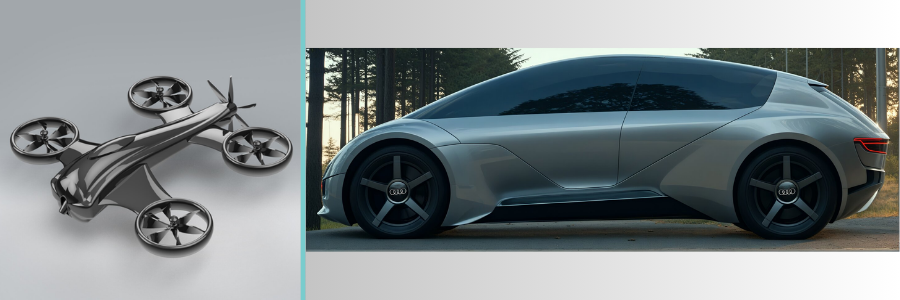
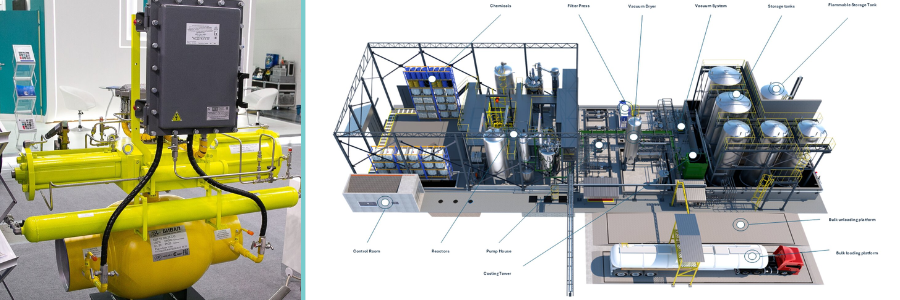
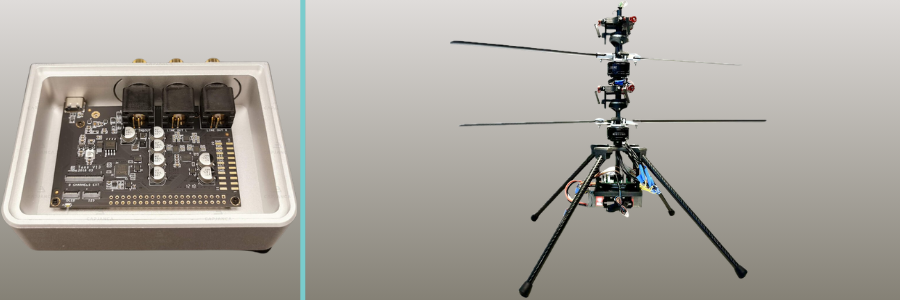
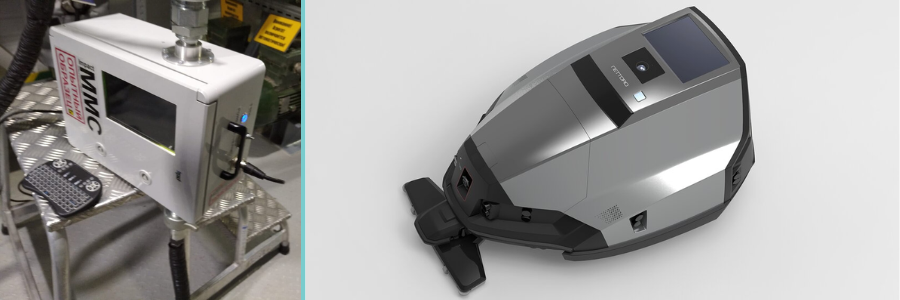
Concept designs of a drone and modern luxury vehicle by Cad Crowd design experts

RELATED: How CAD turns your idea into a prototype for CAD design companies & freelance services

Choosing the one right concept design

Say you’re developing a new hardware product. The concept generation phase gives you about a dozen or so potential designs, each with its own strengths and weaknesses. Based on technical feasibility, development cost, time-to-market schedule, and certification requirements, you narrow the selections down to half a dozen options. A possible issue with a patented design comes up, forcing you to remove another concept from the list. You have five remaining concepts available, and all of them seem to be promising enough. But you only have the resources to fully develop one product. So, how can you be sure that you’ll pick the right one? Concept testing by survey, and here’s how to do it properly.

Define clear objectives

Just like the beginning of market research, always start by defining exactly what you want to learn from the testing. Avoid vague objectives such as evaluating multiple concepts or gathering feedback from potential consumers, as they canlead to poorly executed research at best and inconclusive results at worst. You want the respondents to give specific answers about the concepts, so it’s only appropriate to throw around some specific questions as well. For example:

  • What do you think is good and bad about the concept?
  • How does the concept compare to other products you’ve already used before?
  • What features do you like the most?
  • Which design element is the worst in your opinion?
  • Is there any specific thing that makes you want this concept?
  • What are the main reasons that you wouldn’t use this concept?
  • On a scale of 1–10, how pleased are you with the concept?
  • What kind of improvements do you expect to see?
  • What features do you use the most?
  • Does the product feel ergonomic enough?

Let the things you want to know about the concepts (from the respondents) guide you through every decision, from formulating the questions to selecting the proper methodology. When you focus on specific questions, it increases your chances of acquiring coherent, decipherable answers rather than scattered pieces of responses to sort through. Narrow-focused answers make it easier for concept design experts to run the results analysis later, too.

Involve the right participants

If product testing is supposed to be a requirement for regulatory compliance and a real-world performance simulation as a form of final quality control, concept testing is all about asking the respondents for their opinions about a hypothetical new product. The keyword here is “hypothetical” because the product is yet to be materialized. All you have at this point are some concept designs, and you are in need of feedback from potential end-users.

In concept testing, respondents should primarily consist of consumers from the target market; you may also include expert users, even if they don’t belong to the same demographic. If you’ve launched a hardware product before and the new version is meant to expand your market, keep in mind that the current customers may react differently from the prospects when they’re exposed to the same concepts. Among the biggest causes of failure in concept testing are randomly chosen participants, for example, people who may never realistically buy or use the product. Their answers only dilute the insights gained from the real target market, further complicating an already complex process.

It’s advisable to recruit 150-200 respondents from each segment of the target demographic. You need to strike the right balance between speed and statistical strength, aiming to discover actionable insights and build decision-making confidence (concept selection) without dragging testing out longer than necessary.

RELATED: Top 10 benefits of reverse engineering services at product design & development companies

Testing methodology

There are four major methods commonly used for concept testing. It’s not uncommon to use a combination of two or more methods to gain as objective and reliable an insight as possible for product development experts.

Monadic: Each participant is presented with a single concept design to elicit an in-depth opinion, reducing the risk of comparison bias. Given the nature of the method, the data collected at the end of the process likely reflects respondents’ immediate reactions to a concept rather than their relative preferences. It won’t tell you why they chose any particular concept over another. That being said, my onadic survey is an excellent option for any of the following purposes:

  • Evaluation of an innovation with no direct comparison benchmark.
  • A review of a concept that requires a detailed demonstration.
  • Feedback generation on every aspect of a concept design.

In some cases, the monadic method is chosen for the simple fact that comparison bias is irrelevant to the survey result. For instance, the concept is to be developed as a direct competitor of an existing product (there will be comparison bias, but you don’t want it to affect your decision). You already know that the concept shares more than enough similarities with the alternatives, and the survey is solely intended to gauge whether the concept receives favorable feedback. Obviously, a monadic survey isn’t an ideal method to help you choose from multiple concepts, unless you have two or more concepts being tested by different groups of respondents separately.

Sequential monadic: The same group of respondents evaluates multiple concepts, one at a time. Sequential monadic gives you the benefits of an in-depth concept evaluation of its monadic counterpart, added with the ability to pit multiple concepts against each other. For order bias control, you should divide the respondents into several subgroups; a different subgroup evaluates the concepts in a different sequence, too. Among the best use cases of the method:

  • Evaluation of 2 to 4 concepts, and you need an in-depth report of each.
  • The feedback must include preference ranking.
  • Statistical comparison among the concepts is required.
  • The order of sequence in which you present the concepts may affect the objectivity or validity of the feedback.

Sequential monadic gives you a reasonable balance between detailed feedback and comparative preference in one go, making it an ideal method for budget-conscious concept design service and testing. While comparison bias is almost a given, the fact that a respondent can observe only one concept at a time can keep it to a reasonable minimum.

Comparative: Unlike with monadic and sequential monadic, where comparison bias might skew the results, you actually count on comparison bias when using the aptly called “comparative” testing method. If the goal is to put multiple concepts to the test and choose the most favorable one, this is probably the most straightforward way to do it. By allowing the respondents to do a direct comparison between competing concept designs, the data should be as unambiguous as they come. Best use cases of the comparative method:

  • A survey to figure out the key differentiators between multiple concept designs (from customers’ viewpoints).
  • Selecting the most customer-preferred design.
  • Research into whether end-users pay attention to subtle differences in multiple concepts.

The comparative method makes sense because this is what customers typically do before making a purchase. They put competing products side-by-side to understand the similarities and differences in the hope of making a well-informed buying decision. Comparative testing is how you gather preference-ranking data and identify which specific design elements most influence buyers’ choices.

Of course, the survey should ask for more than a simple ranking system. Respondents should be given the option to explain why they favor one concept over the others, providing insights to inform refinements.

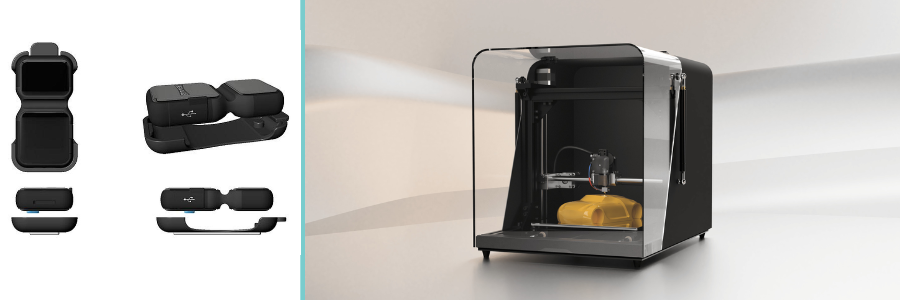
Concept design examples by Cad Crowd freelance experts

RELATED: How to improve product development for your company with engineering firms & design consultants

Protomonadic: A combination of monadic and comparative methods, protomonadic requires the respondents to evaluate the concepts in two phases. First, they evaluate the concepts individually and offer a detailed observation for each. In the second phase, they put the concepts side by side for direct comparison. Protomonadic is best used by design engineering experts for:

  • Concept testing involves complex designs, where thorough observation is required before comparison.
  • New product development research (to support investment decision).
  • An in-depth look into how certain design elements affect relative preference.

Among the aforementioned methods, protomonadic is expected to provide the most comprehensive overview of a concept’s potential marketability. The test data should indicate whether respondents’ evaluations of individual concepts align with their comparative preferences. For example, “Concept A” receives high praise for its assortment of features, but the majority of respondents say that they’re more likely to purchase “Concept B” because it’s more user-friendly. This might signal that you need to make some design compromises for the final product.

Note: there’s no single best method for every concept design testing. If you have to choose between multiple concepts quickly, the sequential monadic can be the ideal option. To gain a better understanding of how buyers respond to innovation, the monadic method promises a detailed evaluation. When in-depth comparison data is necessary, protomonadic is a wise choice. Choose the testing methodology according to the objectives, and always consider such factors as the complexity of concept design and budget.

Result analysis

Now that the testing concludes, analyze the data and look for such findings as:

  • Trends and patterns in concept selection among respondents
  • How the demographic variations (age range, occupation, ethnicity, cultural backgrounds, etc.) affect relative preference
  • Design elements with positive and negative feedback
  • Surprises, or any unexpected responses

Based on the analysis, it should become more apparent how potential buyers perceive the value proposition of each concept, what features generate the highest purchase intent, and the biggest causes of concern that might hinder adoption. Everything comes down to the simple purpose of enabling data-driven concept selection by product engineering services. The testing helps you take out all the guesswork as you choose the most promising concept design for a product.

Why concept testing matters

The idea behind concept testing is to better understand how your target market responds to a new design that could address a long-standing unmet need or offer a better alternative to existing products. You need validation (from potential buyers) that one of the proposed concept designs will perform well in the market when it’s finally launched. This validation plays no small part in your attempt to:

  • Save time and resources: when a concept gains positive feedback from the target market, you have the much-needed confirmation that further development is indeed worth pursuing. It’s best to validate the marketability of a concept as early as possible in an NPD project, so that you can focus on refining ideas that will actually work instead of churning out more design sketches with little feasibility, if any.
  • Minimize risk of failure: no one wants to develop a product that hardly sells. Respondents’ answers and observations are highly valuable for determining the next step in the development process. Whether you decide to add more features or abandon any particular design element, you should be able to trace it to the concept testing result analysis. You might not be able to provide everything that the customers want, but you can certainly avoid giving them the features they dislike.
  • Secure stakeholders’ investments: when presenting a new product concept to stakeholders (including investors), you need to back your claims of profitability with verifiable data. Concept design testing in which the respondents are representatives of the target market can make a strong case to encourage buy-in.

Furthermore, concept testing is a good measure to ensure product-market fit. While the main purpose of concept testing is indeed to select the most marketable design among many, the respondents’ answers also may reveal their preferences, needs, and pain points. Bear in mind that if the testing involves only your own concepts (without competitors’ products), the design that receives the strongest positive feedback isn’t necessarily a guarantee of market fit. It only means that the design is the best-reviewed of the bunch. But an insight into customers’ expectations helps you form the basis of a broader new product design service, which might include product positioning, marketing campaign, prioritization of affordability over versatility or portability, etc.

RELATED: From sketch to prototype with product design services for companies at Cad Crowd

The optimal and the adequate

It’s only natural that you want a clear-cut answer to everything, including matters of product design. In an ideal, simple world, selecting a concept is just a case of either/or; a concept is either good or bad, right or wrong, high-end or low-end, advanced or basic, and so forth. Everybody yearns for such simple, contrasting explanations because there’s a definitive line to separate one category from the other, leaving no room for confusion. Your target buyers also want the same thing, and so do your product designers. But the reality is that choosing among competing concept designs can be much more complex than that.

Not only do you evaluate every concept design against the problems it’s supposed to solve, but you also figure out how to deliver those solutions within the context of design constraints. Apart from the usual budget constraints, there may be challenges with fabrication methods, sourcing the right materials, securing reliable hardware component suppliers, or managing manufacturing costs.

And this brings us back to the concept testing data analysis mentioned above. You’ll find that certain design elements receive positive feedback, while others get nothing but crushing criticisms. There’s nothing wrong with that; in fact, the presence of both positive and negative reviews is an indication of concept design testing done right. In many cases, you see both high praise and harsh criticism directed toward the same concept. If you outright reject any concept that doesn’t receive complete and utter approval from the respondents, well then, you’re aiming for perfection, which unfortunately isn’t always a feasible objective to begin with. A perfect product doesn’t and can’t exist, at least not when you have to build it with all the various constraints that inevitably affect the development process and manufacturing design service effectiveness.

Choosing a concept isn’t a decision that revolves around the ideas of perfection and imperfection, but selecting one that you can develop into an optimal solution. Everybody has personal preferences, and there might be two or more solutions to the same problem. The keyword here is “optimal,” not “merely adequate,” because developing a concept into a product means optimizing the design to deliver practical solutions while maintaining strong market fit.
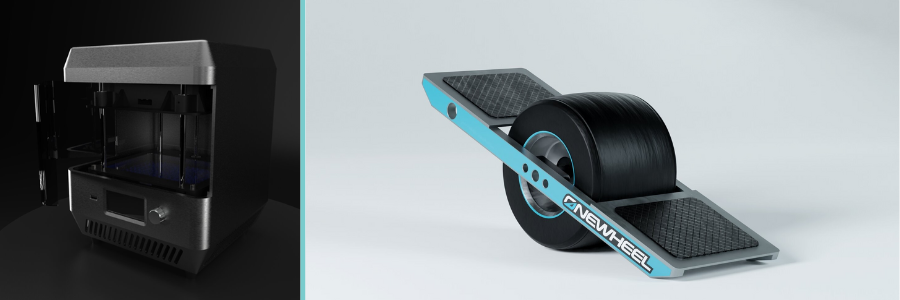
Concept design of a PCB ether and single-wheeled skateboard by Cad Crowd product concept designers

RELATED: What are proven product design principles when working with companies & freelancers?

Takeaway

Concept design testing within the context of a new product development is a lot more than just selecting between the right and the wrong or separating the good from the bad. It’s a process of discovery, where you’ll learn about customers’ preferences and what you can or should do to transform a mere concept into a design optimized for them in every use case scenario.

The notion of exposing potential buyers to multiple concepts early on in the development process in an attempt to gauge or rank design marketability sounds pretty straightforward indeed, but the reality is often the exact opposite. It takes some real planning and management to recruit the right respondents who represent every group in the target demographics and make sure that every question is framed in such a way to solicit useful answers and insightful feedback. Concept testing isn’t something you can do on a whim, and that’s where Cad Crowd comes in. Specializing in product design and development, the freelancing platform is populated with thousands of experienced project managers, industrial designers, engineers, prototype fabricators, and digital artists to handle even the most complex concept testing for hardware products.

Cad Crowd helps you streamline the whole process, from concept design presentation and respondent recruitment to method selection and data analysis. It doesn’t matter if you need a detailed evaluation of a single concept or comparative studies to choose between competing concepts; the professionals at Cad Crowd strive to provide accurate, unbiased, and valuable insights for your NPD project. Request a quote today.

author avatar

MacKenzie Brown is the founder and CEO of Cad Crowd. With over 18 years of experience in launching and scaling platforms specializing in CAD services, product design, manufacturing, hardware, and software development, MacKenzie is a recognized authority in the engineering industry. Under his leadership, Cad Crowd serves esteemed clients like NASA, JPL, the U.S. Navy, and Fortune 500 companies, empowering innovators with access to high-quality design and engineering talent.

Connect with me: LinkedInXCad Crowd

Production Facility Rendering: 10 Advantages of Visualization Services for Factory Design


An architectural visualization, more specifically, a rendering based on a BIM file, isn’t just a pretty picture to please the eyes. In the context of a large-scale industrial project, such as the construction of a brand-new production facility or a major renovation of an old factory, a visualization is supposed to be an accurate depiction of the structure and a precise representation of all the manufacturing and utility systems in the building. The visualization also serves as the foundation for crucial decisions, such as stakeholder approvals and budget allocations.

3D rendering services and data-rich BIM files walk hand-in-hand to give a better understanding of the factory layout along with all its equipment and machinery, offering a level of insight that no conventional 2D blueprint can deliver. The ability to get a clear grasp of the spatial relationship of the entire building and an automated clash detection prior to construction improves the chances of efficient design, including for future-proofing purposes.


🚀 Table of contents


Why production facility visualization matters

High-fidelity visualization requires familiarity with the works of architectural design and a strong knack for artistic touches. Similarly, a comprehensive BIM file needs 3D modeling proficiency and industry knowledge. All those might seem hard to come by in this day and age, but not in Cad Crowd. As a freelancing platform specializing in the AEC industry, Cad Crowd acts like a massive hub that connects clients of all backgrounds with the most capable industrial project visualization services. And when the rendering and BIM file are left in the hands of the platform’s best-qualified professionals, expect nothing less than the following 10 advantages.

Early detection of errors

Let’s start with the most obvious, an advantage that photorealistic rendering services can give to architectural projects of any kind: pre-construction error detection. Construction work, whether a brand-new building or a renovation, is often an expensive undertaking, and even more so if you’re talking about such a complex structure as a factory. A manufacturing facility isn’t supposed to be luxurious or fancy, but designed to be as efficient as possible and conducive to productivity. And the truth of the matter is that ensuring efficiency often requires a pretty substantial upfront investment. Every mistake, no matter how small it may seem, can swell the budget to an unfriendly extent.

Factories are most likely dense environments. In addition to all the structural support steel, chances are you’ll also find heavy machinery, complex utility grids, overhead cranes, various office spaces, and sometimes a massive warehouse under the same roof. Everything has to coexist and fit in a relatively limited space. A traditional 2D blueprint can probably represent the entire factory, along with all the equipment and structural elements, on one big page. It’s practical, but the visualization format makes it easy to overlook a “clash,” for example, a load-bearing beam that obstructs a stretch of fire sprinkler pipe. Because you can’t clearly see the mistake on a two-dimensional blueprint, the error is only discovered during the construction phase. The next thing you know, the project is put on hold until you find a workable solution.

An architectural rendering, especially when integrated with BIM (Building Information Modeling), allows you to run an automated clash detection before construction begins. A clash can be many things, from a simple mismatch between logistics and construction schedules to poor clearances and object interference.

In a complete render, all the components of the factory are properly visualized as interconnected 3D objects to give a clear view of how they interact with each other. The result is little to no risk of a stop-work order. Any spatial conflict in the construction plan is identifiable in the BIM file when the project is still in the digital phase, and corrections are nowhere as resource-demanding as onsite modifications. Since most construction projects suffer from budget overrun due to change orders, architectural visualization services make things cost-efficient. Also, it’s possible to “virtually” install any equipment on the factory floor in the rendering, allowing you to verify that everything has enough clearance for operation and maintenance.

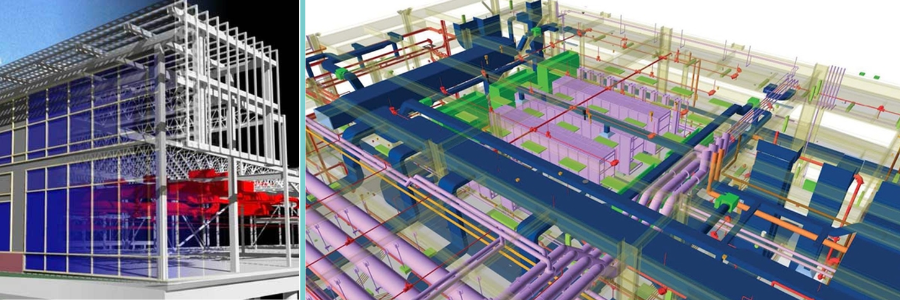
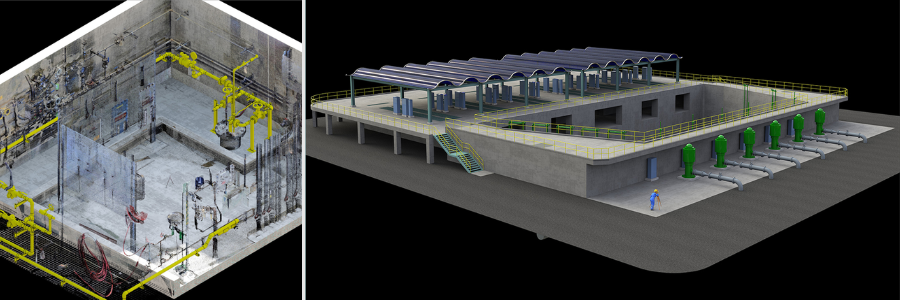
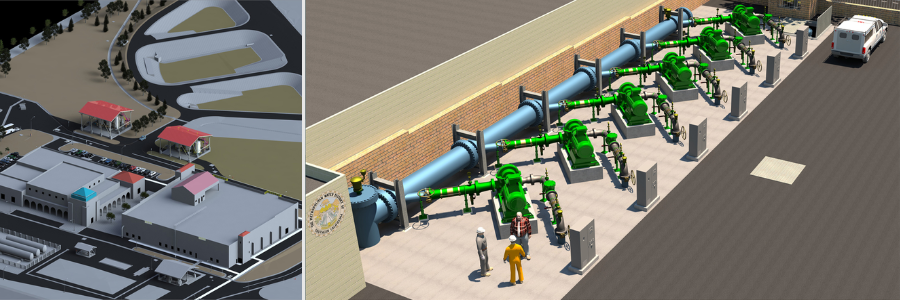
Production facility rendering and design by Cad Crowd freelance experts

RELATED: 12 important hiring tips for 3D rendering freelancers & 3D modeling service companies

MEP integration

Still on the subject of clash detection, a high-quality factory rendering allows for a comprehensive planning of the facility as a whole rather than as separate systems combined into one. Other than that, you’ll see not only a flat image as if you’re looking at a floor plan, but the spatial relationships among all the objects. And this is particularly important in the case of MEP (Mechanical, Electrical, and Plumbing) systems.

A manufacturing facility is, in essence, one big machine housed in an extensive structure. And like every machine, they need a proper electrical system, water inlets and outlets configuration, chemical piping, specialized HVAC components installation, and compressed air circulation, among other things. Just about everything is substantially more complex than what you typically find in residential buildings. Designing all these systems in isolation increases the likelihood of clashes. You don’t want to find that the ventilation duct is planned to be installed exactly at the same coordinate as a crane rail or structural steel support, leading to an untimely delay that costs thousands of dollars. The problem is that you can’t just move the parts to another spot because it may cause another series of clashes. Chances are, you have to dismantle a lot of interconnected parts and redo the process.

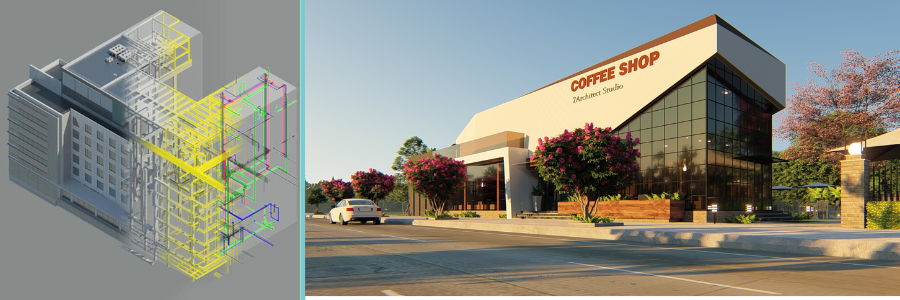
One of the best ways to ensure construction efficiency is zero conflict. Once again, architectural BIM services emerge as a reliable savior, providing a sort of “X-ray” view of the factory plan. BIM may not produce a photography-like visualization, but it can give you a clear outline of the building’s internal systems, which in turn allows for an overview of how the ducts, wiring, and piping integrate with the facility itself.

Stakeholders’ investment approval

Constructing a factory is an industrial project, and that’s capital-intensive. It may take tens, if not hundreds of millions of dollars, to build a new manufacturing facility capable of high-volume mass production. Like the vast majority of big industrial projects, it takes funding and approval by multiple stakeholders, which may include individual venture capitalists, the company’s boards of directors, or perhaps government agencies. 

One of the biggest challenges in securing the approvals of investors isn’t the technicalities of the construction itself, but the presentation. Not every stakeholder is trained to read a blueprint in the same way that an architect or engineer is. As a matter of fact, most people struggle to visualize a fairly simple 2D floor plan, let alone the construction plan of a gargantuan factory from a flat drawing.

You probably won’t need a sophisticated BIM file for this, as a photorealistic rendering would suffice to communicate a design for the less-technical audience. Throw in an animated walkthrough for the immersion effect, and you have a complete package of high-quality visualization to transform an otherwise complex architectural plan into an easily understandable view of a design. Add complex details when necessary, such as a showcase of the warehouse workflow or production line, for an extra touch of realism.

Investors are more likely to approve a big project when they’re confident in the design. Photorealistic rendering affords them the opportunity to take a glance at the foreseeable future when the construction reaches its final stage, and the factory building finally stands with all its industrial prowess. Visual clarity reduces the sense of risk and, therefore, speeds up the approval cycle for manufacturing design companies.

Safety compliance simulation

A factory is designed for productivity and efficiency, without sacrificing the health and safety of all the people populating the facility. Health and safety aren’t just moral obligations, but mandatory (as in, they’re required by law) and often have everything to do with financial concerns because non-compliance is a big liability. The problem is that most safety-related equipment and designs are built based on various “what if” scenarios, such as in the cases of fire, potential workplace injuries, occupational burnout, machinery-induced noise pollution, and more. 

Static two-dimensional images cannot reliably visualize the hypothetical scenarios in which accidents happen. Photorealistic rendering, on the other hand, can make use of animation to showcase “imagined” incidents where individuals’ health and safety are at risk in work environments. A 3D rendering expert may frame the animation in such a way that the audience can see from the perspective of an employee or a worker on the factory floor to understand the situation better. The simulation should be helpful for sightline analysis, emergency response training, and ergonomic optimization.

Efficient logistics

Forming the foundation of productivity in a manufacturing facility is a well-planned workflow, which can only happen when backed by efficient logistics. Think of it this way: if a forklift has to travel just one meter longer than necessary for every journey back and forth, the factory loses money in fuel, tires, maintenance, and time. A crane that takes a few seconds longer to carry raw material from the warehouse to the production line may cause a chain reaction of delay across the factory floor, leading to poor productivity and a loss of potential profit.

There’s no easy way to perceive the idea of congestion with static two-dimensional blueprints, such as when movements (whether of humans or machines) are hindered by some obstacles. Blueprints can’t visualize the possibility of crowding in heavy-traffic lanes during busy hours on the factory floor.

Animated rendering removes all the guesswork. By formatting the visualization as a spaghetti model (often used to explain the flow path of storms during hurricane season), you should be able to see with clarity how all the forklifts, cranes, trucks, materials, finished products, and people move about inside the facility. This is how you identify potential “traffic jams” or bottlenecks on the factory floor and plan for buffer spaces wherever necessary.

RELATED: Freelancing vs. in-house 3D visualization services: The best choice for companies

Accelerate construction

Just about every construction project appears to always happen in a rush. Heavy construction vehicles carry raw materials to the next processing station, while workers stay busy installing all the parts and assemblies in a seemingly random fashion. They’re all over the site, working on rebars with the help of rebar design services, steel structural supports, concrete, wooden beams, nuts and bolts, roofing components, and utility systems. But what looks like chaos really is a managed project, where everyone has a well-defined job description and carries out their duties as expected.

Another thing to mention is that long before the construction happens, there is usually a long process for design proposals, reviews, verifications, bidding, and approvals. The old way of doing architectural projects is linear and often slow. In the event of misunderstanding between the architect, engineer, or contractor, the construction schedule gets pushed back, and this adds to the project completion timeline. There’s also the problem with creating pages of 2D drafts just to plan for one specific location on the site. Each draft must be properly evaluated and approved by the stakeholders before the project can move forward. So if they have to do the same process dozens of times throughout the entire project, it can take months, if not years, to get the job done.

This is not to suggest that the old way is bad in any way. After all, people have been building production facilities for centuries before the proliferation of CAD or 3D rendering. That said, modern technologies, including photorealistic visualization and BIM, can improve efficiency a great deal. In the case of BIM, for example, the entire project plan is contained within a single file stored in a centralized database accessible by all stakeholders. Architects, engineers, and designers can update the plan simultaneously, and every modification is visible to everyone who has access to the file. Design reviews and approvals have become streamlined processes that happen in real-time. 

A BIM file contains not only an imagery of a structure, but detailed specifications of the materials, dimensions, geometries, tolerances, installation instructions, and manufacturer information of every component. The contractors understand the assignments well, component fabricators know exactly what to build, and the investors enjoy the comfort of knowing where the money goes. It even has scheduling information with automated clash detection to avoid conflicts with the construction timeline. Thanks to BIM, the entire project becomes predictable, more manageable, and highly efficient to expedite construction. And the sooner you get the facility up and running, the quicker you get to kick off production.

Thermal and lighting analysis

Every manufacturing facility should be well-lit in all areas. Great visibility is even more important in the actual production line. But it shouldn’t be all about installing the brightest lamps every few meters throughout the factory because they also generate heat. LEDs produce much less heat than the conventional incandescent type, so they’re a preferable choice for manufacturing design experts. If you have to use hundreds of LEDs, however, the increase in temperature would still be pretty noticeable. Let’s not forget that machinery, whether internal combustion or electric, also generates heat.

A lot of manufacturing facilities suffer from either hot zones or dark spots (sometimes both) due to poor air circulation, inefficient positioning of skylights, or improper placement of heat-generating equipment. This might not have been an issue in the old days when no better option existed, but now that architects and engineers are armed with modern rendering engines, an uncomfortable work environment and poor machine longevity because of excessive heat should be problems of the past. Advanced rendering engines offer many useful features for this purpose, such as Radiosity (which is an application of Finite Element Analysis) and Ray Tracing, to predict with great accuracy how light behaves in an environment to minimize dark spots. ThermoAnalytics can also visualize thermal data in high-fidelity graphics to help you get rid of hot zones. l

It’s worth mentioning that both Ray Tracing and Radiosity are capable of simulating natural lights as well. The visualization showcases the areas inside the facility that might be penetrated by natural light during daytime, so the engineers can then use the data to reduce/optimize the use of LEDs for energy efficiency. At the same time, the data gathered from thermal analysis reveals a clear view of how heat rises and accumulates in different spots, which offers an insight into how the HVAC system may mitigate the issue.

Environmental impact study

Anybody who’s been in the construction business, especially on industrial projects, is perhaps perfectly aware of the whole “NIMBYism” movement. It’s actually a pretty common phenomenon where residents oppose a new development in their local area, mostly out of fear that the new industrial infrastructure and industrial design services will negatively affect the surrounding environment. Sometimes, they also express concern for the possibility of noise pollution, an increase in traffic jams, or a decrease in their property value.

It can be difficult to dismiss the opposition unless you can provide an easy-to-understand visualization to inform the protesters that none of those concerns are actually true. Photorealistic renderings, both static and animated, give a clear explanation about how the factory handles its byproduct (if any), treats wastewater, implements a government-approved energy efficiency system, and manages noise. An aerial rendering of the facility should showcase the presence of green buffer zones, too. An accurate depiction of the facility and how it affects the environment fosters trust from the nearby community and helps de-escalate tensions in times of protest.

People might not be entirely interested in the actual environmental study conducted on the facility and what the data can tell them. However, you can produce some renderings based on that data to try to convince the community that everything is safe and runs in accordance with the regulations.

RELATED: 5 reasons freelancing studios are the future of 3D visualization services

Brownfield project management

A good number of industrial constructions aren’t actually greenfield projects (facilities built from scratch), but brownfield (renovations, retrofitting, or expansions). When old buildings are supposed to integrate with modern equipment and utilities, many things can go wrong, from incompatibility issues that lead to performance inefficiency or even weakened structural strength. The existing pillars, low ceilings, waste treatment systems, old electrical wiring, and even the roof structure can be engineering nightmares. 

Photorealistic 3D visualization services can help, for example, by converting the old blueprint into a 3D model or BIM file. However, an old building might have undergone multiple changes over the years, so the original construction documents are no longer accurate. Let’s not forget that many of the structural components suffer from degradation as well. Another option is LiDAR, which basically scans the old facility as it stands today and transforms the data into a 3D model. All of these require manual inspection, but modern visualizations are still better than relying on outdated blueprints.

Once you have the 3D models ready, planning for a brownfield project is no longer as complex as it used to be. Don’t get this wrong: Brownfield is almost always more difficult than greenfield, but at least the visualization helps you draft the project in a virtual environment, allowing for greater efficiency and accuracy. At the very least, the digital models afford the architects an opportunity to experiment with different factory floor layouts that facilitate efficient placements and installations of new production tools, heavy machinery, electrical wiring, lighting, HVAC components, and even routing for AGVs. The idea is to create a perfect fit, with zero interference, no compatibility issues, and enough spatial tolerances.

Scalable factory

Perhaps the greatest advantage of all is that photorealistic rendering opens the door to value engineering in preparation for growth. Manufacturing facilities may start with a single production line or hands-on assembly process, but they’re constantly looking to welcome emerging technologies, such as full automation and robotics. And with the current pace of development and competition, companies have no choice but to consider such growth an impending necessity, perhaps in the next 5 or 10 years.

From the perspective of infrastructure, it only makes sense to pour some additional resources upfront to make the building more scalable, or futureproof, if you please. In other words, a manufacturing facility built today must be able to adapt to the forthcoming industrial landscapes of the foreseeable future. If you build the factory by emphasizing only its usability for the current manufacturing systems and technologies, every major upgrade to the equipment and utility systems is likely cost-prohibitive.

Accurate visualization of the current structure enables the architectural design experts and engineers to plan for a flexible infrastructure designed to undergo changes and improvements without sacrificing the present-day functionality. For instance, the visualization may show a time-lapse animation that showcases how a new production line is added while keeping the current systems intact; the installation of solar panels on top of the roof structure without disrupting workflow; the integration of automated driverless robots with the crane equipment in the warehouse to achieve lean logistics, and so forth. 

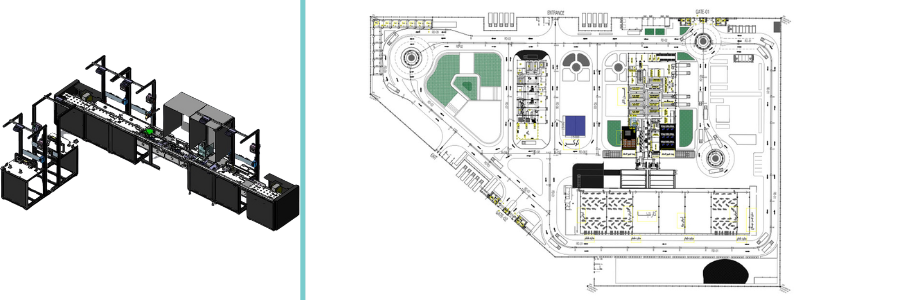
production equipment and facility floor plan by Cad Crowd design experts

RELATED: How to hire freelance CAD design talent for your project: Tips for design companies and firms

Takeaway

The advantages of visualization services for manufacturing facilities go beyond pre-construction planning and budgeting, but reach far into scalability and futureproofing the infrastructure itself. You can even say that photorealistic rendering pushes the boundary of what’s possible with architectural drafting to allow stakeholders to have a sneak peek at the future. This will then enable them to develop a comprehensive measure and devise strategies to be prepared for every new technological development in the manufacturing sector. Although it’s actually impossible to make a perfectly accurate prediction of what the future may hold, visualization services can at least give you educated assumptions and informed estimates so that what you build today helps you gain competitive advantages in the future.

Not every factory rendering is created equal, however. As much as advanced software plays a factor in determining accuracy and overall quality, the professionals tinkering with object geometry, composition, lighting, shadows, textures, patterns, and post-processing details are the real defining factors. It takes skills, experience, and artistic touches to produce a high-quality rendering of a small-scale building, let alone a gigantic production facility.

That being said, BIM professionals and render artists capable of translating the file into photorealistic imagery remain scarce at this point. Cad Crowd is your best bet to find and connect with the right talent to get the job done. The platform places heavy emphasis on the AEC industry and is largely populated by experienced professionals of related trades, including BIM and architectural visualizations. Request a quote today.

author avatar

MacKenzie Brown is the founder and CEO of Cad Crowd. With over 18 years of experience in launching and scaling platforms specializing in CAD services, product design, manufacturing, hardware, and software development, MacKenzie is a recognized authority in the engineering industry. Under his leadership, Cad Crowd serves esteemed clients like NASA, JPL, the U.S. Navy, and Fortune 500 companies, empowering innovators with access to high-quality design and engineering talent.

Connect with me: LinkedInXCad Crowd

Top 51 Platforms for Engineering Design Contests, Challenges & Competitions


Engineers aren’t merely architects. They’re fighters.

Some fight in silence. Others enter a challenge, throw down a CAD file, and make the competition work up a sweat.

Whether you’re a mechanical wizard, a product design expert, or someone who lives and breathes SolidWorks and stress analysis charts, this list is your golden gateway. These aren’t boring class projects or university-limited “think pieces.” These are paid competitions, real-world briefs, and innovations that hit the manufacturing line – or even the moon.

You’ll find international calls for next-gen mobility, jaw-dropping cash prizes for renewable energy breakthroughs, and concept-to-prototype showdowns that test every bolt, bevel, and brainstorm you’ve got.

So grab your mouse, your mesh model, and your engineering swagger. Here are the 51 platforms where design meets competition – and the best minds get paid to solve what others can’t.


Xprize

XPRIZE

XPRIZE is the engineering world’s Super Bowl – where innovation meets world-changing ambition. It’s not merely about genius designs; it’s about cracking humanity’s most significant challenges. With awards regularly over $10 million, challenges include moon landers, carbon capture systems, and even speedy COVID diagnostics. These competitions are marathons in length, taking years and engaging cross-disciplinary teams of engineers, scientists, and entrepreneurs. Competitors go through intense prototyping, public demonstrations, and technical critiques. Success brings fame, investment, and real worldwide influence. If you’re looking to make a dent in the universe and have the stamina to go the distance, XPRIZE is the ultimate proving ground.

Website: XPRIZE.org

Cadcrowd-logo

Cad Crowd Contests

Cad Crowd Contests turn freelance design into high-stakes engineering games. Clients launch real-world challenges – from innovative medical devices to rugged industrial tools – and engineers worldwide race to submit the best CAD solutions. Entries often require full 3D assemblies, realistic renderings, and deep insight into manufacturability. Winners don’t merely grab money – they regularly win long-term client projects and serious resume clout. With varied project briefs and a talent pool utilizing SolidWorks, Fusion 360, and Inventor, this is not your typical crowdsourced project. It’s a proving ground for mechanical design professionals who want their work noticed, constructed, and realized by serious industry players.

Website: CadCrowd.com/contest/lanch

grabcad

GrabCAD Challenges

GrabCAD Challenges are a goldmine for mechanical engineers with a technical flair. The 10-million+ community on the platform competes in contests funded by industry giants such as NASA, GE, and Stratasys. Challenges tend to revolve around optimizing components for additive manufacturing, designing consumer electronics, or enhancing industrial parts. Contests usually reward from hundreds to a few thousand dollars, but the actual prize is exposure and technical development. Engineers post comprehensive CAD models, occasionally with performance simulations or FEA, based on the brief. If you like tackling technical issues with creative geometry and careful constraints, GrabCAD is where design meets innovation with recognition from the community.

Website: GrabCAD.com

HeroX

HeroX

HeroX makes engineering challenges more accessible without diluting the ambition. Designed by XPRIZE co-founder Peter Diamandis, the site encourages clever minds to tackle real-world challenges with real-world applications – disaster relief shelters, low-cost energy solutions, or long-endurance drones, for example. Nonprofits, government, and tech-savvy corporations submit challenges. Prizes range from small to huge, and most competitions offer exposure, licensing, or development assistance in addition to cash. HeroX is perfect for engineers who desire meaningful work that doesn’t sacrifice the paycheck. With briefs that pay dividends in creativity, feasibility, and marketability, this is where your practical solutions can make a tangible, visible difference.

Website: HeroX.com

innocentive logo

InnoCentive

InnoCentive approaches engineering seriously – no filler, no fluff. Here, Fortune 500s, NGOs, and government organizations list tough technical challenges requiring real-world answers. Engineering design experts compete by offering proposals often supported by data, feasibility assessments, and sometimes even prototypes. Projects range from acoustic attenuation in plants to redesigning thermal systems and structural form. Awards range from $5,000 to $100,000 or more. This is not a popularity contest – it’s who can best fix the problem. Best for experienced professionals or research-focused designers, InnoCentive is ideal if you want to see your solution used in real products or industrial processes.

Website: Innocentive.com

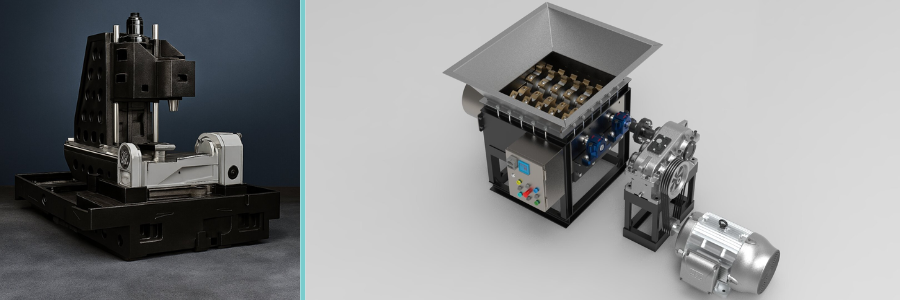
Engineering design by Cad Crowd freelance professionals

RELATED: What are proven product design principles when working with companies & freelancers?

Jovoto (for Hardware Projects)

Jovoto

Jovoto is typically a branding and visual thinker’s creative sanctuary, but when hardware problems fall, engineers had best take notice. These are infrequent but thrilling competitions when function is getting into bed with form. Imagine clever furniture, avant-garde mobility devices, and technology-enhanced home goods. The contests reward integrative thinking – what things look like, feel like, and work like in the actual world. Engineers who are industrial design dabblers or have some visual sense thrive in these arenas. Awards usually come between $5,000 and $25,000. In addition to money, your work may be highlighted in top media or generate product development interest. Jovoto’s hardware sprints are play areas for exquisitely engineered ingenuity.

Website: Jovoto Facebook

Freelancer Contests (Engineering Category)

Freelancer

Freelancer.com may be famous for logos and app development, but its engineering contest section is surprisingly lively. Startups and SMEs post design briefs for casing ideas, proof-of-concept models, or rapid-turn CAD projects routinely. The twist? These are speed contests – usually only days long and fiercely competitive. If you’re a SolidWorks whiz or a Fusion 360 speed demon, you can make quick money while building your portfolio. Follow-up freelance work is often offered to winners, particularly when they produce clean, manufacturable designs. Although pay is variable, the rapid pace of action keeps things lively. It’s an excellent sandbox for nimble engineers who enjoy rapid creative challenges.

Ennomotive

Ennomotive

Ennomotive is where serious engineers resolve serious industrial issues. Companies list very specific technical issues, like how to optimize a packaging line, design a new gearbox, or minimize wear in a conveyor belt system. The emphasis is on feasibility and quantifiable outcomes – submissions commonly come in the form of prototypes, cost studies, or simulations. Prizes typically range from $2,000 to $15,000, with some including additional contracts. If you’re experienced in mechanical, electrical, or manufacturing engineering, Ennomotive is a fantastic way to tackle real-world projects and gain client trust. Many contests are Europe-based, but open globally. This isn’t speculative design – it’s practical innovation that gets noticed.

Website: Ennomotive.com

reddot award design concept logo

Red Dot Concept Award

The Red Dot Design Concept Award celebrates the kind of design that wows both engineers and artists. It’s an international competition for prototype engineering services and product concepts in their infancy – ones that merge form, function, and practicability. Imagine medical equipment, household gizmos, mobility aids, and sci-fi wearables. Unlike most competitions, Red Dot winners receive museum-quality bragging rights: worldwide fame, a feature in Red Dot’s annual yearbook, and a coveted trophy envied by design experts. Engineers with an eye for beautiful solutions will love this. The focus is usability, innovation, and sustainability – ideal for those who both engineer by heart and hands.

Website: Red-Dot.org

MindSumo logo

MindSumo (Engineering Challenges)

MindSumo is designed for large corporations seeking innovative insights into design and technical issues. Their engineering challenges demand quick thinking – e.g., how to make a car’s HVAC system more efficient or how to make fan systems quieter – and not mere CAD models. Most submissions are short write-ups accompanied by diagrams or simple schematics. Awards are between $500 and $2,000, and it’s possible for there to be multiple winners who share rewards. It’s perfect for engineers who like to write clearly about technical solutions, particularly students or early-career professionals establishing exposure. Even when you don’t win, excellent ideas can get picked up by hiring managers. For low-risk, high-exposure problem-solving, MindSumo is the sweet spot.

Website: MindSumo.com

local motors logo

Local Motors Challenges

Local Motors revolutionized things by crowdsourcing the globe’s first 3D-printed automobile – and their struggles provided mechanical designers with a genuine chance at car stardom. The site welcomed engineers to share and co-work on everything from off-road trucks to space-age transportation pods. Entries weren’t abstract; winning projects regularly received prototyping and were road-tested. Although the company exists in a state of transition now, its history of hardware-first contests set a precedent for how engineering-driven communities can function. If you enjoyed designing for harsh applications, electric vehicles, or massive prototyping, Local Motors was a fairy tale. And if it comes back, it’s worth keeping an eye on.

Website: Local Motors LinkedIn

engineeringcom logo

Engineering.com competitions

Engineering.com is not all about news and CAD how-tos – it occasionally initiates design competitions that bring in the best and brightest engineering brains. Previous contests have centered on maximizing product performance, enhancing design for manufacturability services, and addressing sustainability issues. The engineering community here is serious business, so your designs will be critiqued by peers who share your technical tongue. Prizes include cash, visibility through high-traffic articles, and even video feature interviews. It’s a good way to have your work viewed by industry professionals, educators, and potential collaborators. Though less frequent than other competitions, they’re professional and solid – ideal for engineers seeking to build a profile in a respected field.

Website: Engineering.com

YouFab Global Creative Awards

YouFab logo

YouFab Global Creative Awards occupy the cross-section of engineering, digital fabrication, and art. From a kinetic sculpture crafted from 3D-printed gears to a smart lamp sculpted by CNC, this competition celebrates the strange, the bizarre, and the wonderfully useful. Mechanical engineers with a design edge shine here, especially if they can prototype and push the boundaries of materials, sustainability, and interaction. The judging panel looks for originality, concept strength, and execution. Awards come with international media exposure, exhibit opportunities, and sometimes funding. If you’ve ever dreamed of turning your garage-built prototype into an art installation, YouFab is your vibe.

Website: Youfab.info

Autodesk University Logo

Autodesk Design for Industry Competitions

Autodesk’s Design for Industry contests are catnip for mechanical engineering experts who breathe and sleep Fusion 360. These challenges tend to collaborate with startups or incubators in search of genuine product innovation – be it a new bike part, a cooling fan, or a collapsible device holder. Engineers must design components that can be manufactured at a reasonable cost and are mechanically feasible. Judging panels typically consist of industry specialists and Autodesk representatives. In addition to cash, winners receive access to accelerator programs, internships, or even licensing agreements. It’s a great match for students, recent graduates, and CAD professionals looking for feedback and validation from serious industry players.

Website: Autodesk.com

hackaday logo

Hackaday Prize

The Hackaday Prize isn’t your typical maker challenge – it’s an innovation competition for hardcore hardware engineers. Previous winners have constructed robotic arms, ventilators open-sourced, prosthetics that are intelligent, and automated agricultural systems. The money pool has reached up to $250,000, and submissions usually receive funding, media coverage, or mentorship. Submissions must be properly documented with schematics, source code, and, in many cases, working models. It’s a playground for people who enjoy electrical and mechanical engineering equally, combining soldering with stress testing. Whether you’re a solo indie inventor or a group of PhDs, Hackaday challenges you to build your most brilliant idea – and possibly transform lives in the process.

Website: Hackaday.com

DesignCrowd logo

DesignCrowd (Engineering Category)

DesignCrowd might be famous for its graphic and web design offerings, but its “Product Design” and “Industrial Design” categories sometimes feature reputable mechanical design contests. These are usually startup or inventor-created briefs seeking ergonomic handles, consumer product enclosures, or CAD-ready components. Engineers who have an appreciation for form and function can excel, particularly if they have the ability to marry mechanical feasibility with good looks. While competitions don’t occur often, those that do come around are well-funded and expertly scrutinized. Successful entries can result in prototyping contracts or complete product development orders. It’s an excellent vehicle for engineers who do design work as a side hustle and need to exercise their creative muscles.

Website: DesignCrowd.com

RELATED: Why design for manufacturability (DfM) is essential for product success when hiring a design firm

ninesigma logo

NineSigma Open Innovation Challenges

NineSigma is not a popularity contest or a cut of pretty face models – it’s high-stakes, technically challenging problem-solving for multinational corporations. Challenges are frequently under NDA and center on bleeding-edge subject matter such as next-generation polymers, advanced filtration systems, or microgrid components. Prizes can be anything from $25,000 up to $100,000+, and the majority of solvers are professional scientists, engineers, or university groups. Proposals must be substantial: experimental results, mathematical proof, or even working prototypes. If you’re a mechanical, chemical, or materials engineer with serious R&D credentials, NineSigma is where you’ll find challenges worthy of immersing your brain in – and clients who actually need and utilize what you create.

Website: NineSigma.com

Innovation World Cup logo

Innovation World Cup Series

The Innovation World Cup Series is an international competition designed for the future of technology – IoT design services, wearables, smart cities, and energy systems. But beneath all the software stand strong mechanical designs and integration issues that engineers are ready to solve. Participants deliver functional prototypes or design concepts that meet the requirements of innovation, manufacturability, and practical use. Winners receive more than cash – they’re introduced to industry accelerators, manufacturers, and international investors. With a robust hardware element in so many tracks, this series is perfect for engineers who realize that a good idea is only good if it can be constructed, scaled, and actually hold up to the actual world.

Website: InnovationWorldCup.com

Cradle to cradle logo

Cradle to Cradle Product Design Challenge

The Cradle to Cradle (C2C) Product Design Challenge is all about sustainable engineering. It focuses on green, circular economy solutions – products that are disassembled, reused, and are comprised of safe materials. Module designers, energy efficiency experts, and green manufacturers will particularly find this challenge highly rewarding. Awards are usually in the range of $2,000 to $10,000, and winners are featured in the sustainability world and occasionally asked to collaborate with similarly minded manufacturers. This is a competition where lifecycle thinking, environmentally responsible materials sourcing, and functional innovation without damaging the earth are greatly encouraged. Purposeful building will make C2C resonate.

Website: C2Ccertified.org

Thomas Edison Innovation Challenge logo

Thomas Edison Innovation Challenge

Tap into your inner inventor with the Thomas Edison Innovation Challenge – a celebration of practical ingenuity and everyday problem-solving. Available to makers, designers, and engineers, the challenge asks for product concepts that meet an actual human need, at home, in the field, or on the construction site. Manufacturability, safety, and marketability are given priority. Mechanical engineers tend to take the lead, particularly in the realm of tools, mechanical devices, or ingenious home systems. Awards run from $5,000 to $25,000, and winners receive licensing or startup interest. If you think like Edison – frugal, do-it-yourself, and indefatigably inquisitive – this competition was designed for you.

Website: ThomasEdisonPitch.org

The James Dyson Award logo

The James Dyson Award

The James Dyson Award is the benchmark for refined, functional engineering design, particularly for those solving actual-world issues. Open to students and young alumni, it honors projects that are functional, producible, and influential. Contestants usually submit working prototypes, CAD files, test data, and user testimonials. The grand prize? Up to $40,000 and immediate industry validation. While geared toward students, professionals can enter through the international category. Previous winners have started companies, secured licensing agreements, and attracted big manufacturers’ attention. If your idea bridges user needs and sharp engineering, this competition doesn’t just reward your talent – it elevates your whole career.

Website: JamesDysonAward.org

Make48

Make48 Engineering Sprint

Make48 isn’t your typical engineering contest – it’s a high-octane invention sprint where teams brainstorm, prototype, and pitch a new product in just 48 hours. You’ll have access to machining experts, 3D printing pros, and CAD design services, all under a ticking clock. Quick-handed mechanical engineers and ideation wizards do well here. Products are reviewed by licensors and retail professionals, so real-world viability counts. It’s a TV-show experience, but with actual stakes: winners can take home licensing agreements, royalties, and national attention. It’s a crazy mix of engineering toughness and entrepreneurial gunpowder – ideal for builders who crave the thrill.

Website: Make48.com

Launch Forth challenges logo

Launch Forth Challenges

Launch Forth once featured some of the most vibrant engineering competitions out there, particularly in mobility, aerospace engineering services, and urban technology. Their back issues reveal challenges that required actual problem-solving: rethinking car suspension systems, developing modular housing, and building low-cost transit innovations. The prize money was usually $5,000 to $10,000, but some of the winners took away partnerships and product launches with companies like HP or Polaris. Although the platform has been dormant in recent years, its potential and format were a highlight of the engineering world. In the unlikely event that Launch Forth comes back to life, anticipate top-notch briefs with commercial potential and true build specifications – well worth monitoring.

Website: LaunchForth.io Instagram

Fuseproject logo

Fuseproject Design Challenges (by Yves Béhar)

Fuseproject, founded by design legend Yves Béhar, periodically hosts design challenges that require both engineering delicacy and visual distinction. These aren’t just pretty ideas on paper – they demand functional ideas with mechanical design: structural integrity, part interfacing, integrated tech, and longevity. Projects vary from disaster relief kits to ergonomic furniture and intelligent health products. Mechanical engineers familiar with user-centered design will love these briefs. Prize value fluctuates, but the prize is prestige – Fuseproject is globally recognized, and being associated with its contests can launch a career. If you love the intersection of technology and design, this is your playground.

Website: Fuseproject.com

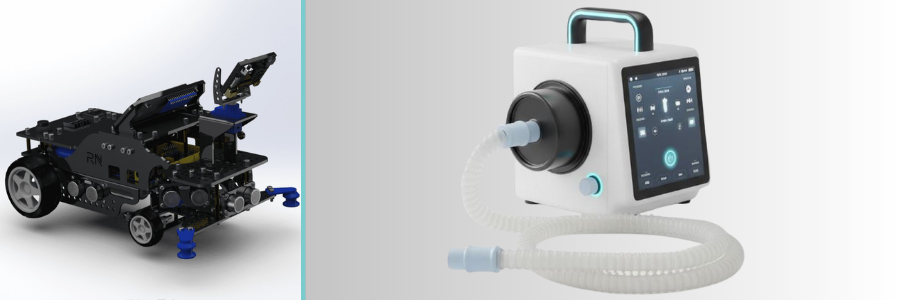
Cad Crowd freelance experts design examples of a racing drone and smoke aspirator

RELATED: The 5 stages of prototyping for any new product idea for product design service companies

hacksterio logo

Hackster.io Design Contests (Hardware Edition)

Hackster.io is a hardware engineer’s playground with regular contests in IoT, robotics, health tech, and environmental sensing. While software may get a turn in the spotlight, most challenges require actual mechanical engineering – thermal design, enclosures, stress-tested components, and motion systems. Mechanical engineers play a key role in teams creating real-world prototypes, and sponsors such as Bosch, Arm, and Intel support the prize amounts ($5,000–$25,000). Entries should include documentation, CAD files, photos or videos, and typically open-source licensing. It’s best suited for tinkerers who create finished projects. If you’re half hacker, half design engineer, and all about getting your hands dirty with hardware, Hackster’s competitions provide you with the spotlight and an international audience.

Website: Hackster.io

openideo logo

OpenIDEO Circular Design Challenges

OpenIDEO’s Circular Design Challenges bring international engineers, designers, and innovators together with big-picture sustainability challenges, such as lowering plastic waste, thinking differently about packaging, or enhancing health delivery in remote communities. These are not idea boards; several of the briefs demand real-world solutions with prototyping, material availability, and scalability included. Eco-oriented mechanical engineers who value systems thinking flourish here. Challenges typically last multiple weeks and involve mentorship, collaboration tools, and exposure to industry experts. Prize-winning teams can get funding, pilot development, and meetings with NGOs or social impact investors. If your engineering brain inclines towards ethical impact and sustainable longevity, this is your platform.

Website: OpenIDEO.com

Thingiverse

Thingiverse Design Contests

Thingiverse is more than a file-sharing site for 3D printing design services – it’s a community, and its sponsored competitions frequently crank up the pressure on engineers who adore digital fabrication. Competitions require submissions of designable products that can be printed, mechanical toys, modular tools, and functional gadgets. The atmosphere is maker-centric and open-source in nature, but the winning entries demonstrate considerable CAD skill and insightful mechanical systems. Though prizes are not always huge, winners receive exposure, product publicity, and a devoted following. For engineers who enjoy prototyping in their own homes, testing FDM or resin printers, and posting designs to an enthusiastic crowd, Thingiverse contests provide excitement, fame, and filament-worthy accolades.

Website: Thingiverse.com

instructables logo

Instructables Engineering Challenges

Instructables contests not only pay for what you make, but also for how well you instruct others to make it too. Their engineering-focused challenges invite documentation-heavy submissions: be prepared to hand over step-by-step tutorials, diagrams, source files, and photographs. Challenges range from automation systems and mechanical inventions to home hacks and kinetic sculptures. Awards tend to be cash, toolkits, or hardware donated by sponsors such as Dremel or Arduino. But beyond the booty, the real prize is exposure – winners are often showcased on the front page, in newsletters, and even in sponsored campaigns. For tinkerer engineers who enjoy storytelling and open sharing, this site is a great outlet for creativity.

Website: Instructables.com

core77 logo

Core77 Design Awards

Core77 Design Awards are an old favorite in product design services – but they also celebrate outstanding mechanical engineering in beautifully constructed consumer products, medical devices, wearables, and more. Awards like “Design for Sustainability” or “Tools & Equipment” tend to showcase mechanical products that strike a balance between usability, aesthetics, and precision manufacture. Judges are seasoned pros – from IDEO veterans to MIT professors, so your work gets seen by some of the best in the field. Winning means global recognition, press exposure, and a feature in Core77’s annual showcase. For engineers who obsess over tolerances and touchpoints, this competition validates your ability to make innovation look effortless.

Website: Core77.com

Autodesk University Logo

Autodesk Sustainability Workshop Challenges

Autodesk’s Sustainability Workshop periodically releases special-interest but relevant design challenges targeting green engineers. These competitions focus on saving energy, improving thermal performance, or designing for circularity – all through intelligent mechanical systems. With software such as Fusion 360 or Inventor, users are challenged to illustrate lifecycle thinking, model performance, and establish feasibility through detailed CAD. Submissions could include passive cooling systems, recyclable assemblies, or systems minimizing material loss. While the competitions are rare, they’re deeply rewarding and often backed by environmental partners or green manufacturers. If you’re an engineer who sees sustainability as an engineering challenge – not just a buzzword – this one’s for you.

Website: Autodesk.com

Tikkun Olam Makers logo

Tikkun Olam Makers (TOM) Challenges

TOM design marathons are about more than invention – they’re about impact. These community-led challenges pair engineers with people living with disabilities (“Need-Knowers”) to co-create assistive technologies. Mechanical engineers are essential in prototyping adaptive tools like ergonomic grips, mobility aids, and custom devices. You’ll work fast: modeling, stress testing, and iterating in real-time with direct feedback from end users. The goal isn’t prize money (though funding and scaling support are offered) – it’s usability and transformation. If you’re a problem-solver with a passion for purpose-built design, TOM provides unparalleled reward: the knowledge that your engineering made someone live better, move more easily, and become independent.

Website: TomGlobal.org

HackHome logo

Hack Club Hardware Engineering Challenges

Hack Club’s engineering challenges tend to reach out to young inventors – but don’t be mistaken: the hardware requirements are real. Whether creating wind turbines, water harvesting, or tactile feedback sensors, these competitions encourage hands-on prototyping and critical thinking. Engineers – particularly mentors or collaborators – can assist in bringing student visions to reality, facilitating fabrication, CAD modeling, and outdoor testing. The crowd is highly energetic, and prototypes often go on to participate in more advanced incubator programs. The awards might be small, but the exposure, reach, and mentorship opportunities are enormous. It’s a grass-roots innovation workshop where the future generation of engineers learns through construction, along with those already within the profession.

Website: HackClub.com

REbuild manufacturing logo

Re:Build Design Challenges

Re:Build Manufacturing periodically issues high-stakes engineering contests designed to revitalize American manufacturing. The contests address machine parts, modular infrastructure, or tooling upgrades. Mechanical engineers are asked to submit complete design documentation: CAD files, fabrication drawing services, material specifications, and cost models. Challenges prioritize manufacturability, scalability, and domestic sourcing – a win-win for engineers who work in automotive, aerospace, or heavy industry. Cash awards or fabrication orders are typical rewards, and exceptional submissions usually result in further collaborations. It’s not a competition – it’s an opportunity to help revitalize brilliant, home-grown manufacturing. Be thinking big solutions, designed smart, and produced at home.

Website: Rebuildmanufacturing.com

ADM logo

Advanced Design & Manufacturing Expo Contests (ADM)

ADM shows are engineering playhalls masquerading as trade exhibitions – and they sometimes feature on-site competitions aimed at medtech, robotics, and package technology. Picture this: you’re pitching your mechanical solution to real manufacturers, with cash and contracts on the line. Even when there’s no formal contest, you’ll find rapid-fire booth challenges, prototyping events, and judging panels from OEMs and suppliers. Engineers showcasing ergonomic surgical tools, precision actuators, or next-gen packaging machinery fit right in. These expos are high-stakes networking events with serious competitive angles. Arrive with refined CADs, sanitized prototypes, and a concise pitch – you could be walking out the door with a partner or an order.

Website: ADMtoronto.com

RELATED: Trends shaping the future of product design for industrial design services

ASME logo

ASME Innovation Showcase (ISHOW)

ASME’s ISHOW is where hardware innovation converges with global good. Engineers enter socially responsible physical products – consider medical technology, agricultural systems, or water filtration devices. It’s not an invention; it’s engineering for the underserved masses. Entrants are required to demonstrate full documentation: CADs, bills of materials, market studies, testing procedures, and so on. Finalists pitch before a group of industry experts and social entrepreneurs. Up to $50,000 and hands-on technical support are awarded to winners to implement their designs. This is where engineering intersects with ethics, and large ideas converge with the individuals who need them most. For mission-driven innovators, ISHOW is the ultimate test ground.

Website: ASME.org

ASME logo

Call for Makers: Maker Faire Contests

Maker Faire can sometimes seem like a fun festival, but local Maker Faire chapters frequently have surprisingly competitive engineering competitions. The challenges are ideal for mechanical inventors creating kinetic sculptures, green devices, or interactive hardware projects. Usually, entries need a working prototype, build log, and, occasionally, open-source documentation. The atmosphere is cooperative, but the builds tend to be challenging – wind-powered cars, robot art, or mechanical brain teasers are all games. Prizes will be small or symbolic, if anything, but the true worth is exposure, feedback from the community, and possible partnerships. If you’re an enthusiast of the happy, messy world of engineering, Maker Faire is your playground.

Website: Makerfairerome.eu

formlabs logo

Formlabs Design Awards

Formlabs, a heavyweight precision 3D printer, initiates high-quality design contests every so often with a focus on practical applications of additive manufacturing design services. Challenges range from tooling systems to one-off jigs, prosthetic parts, and functional mechanical assemblies. Printability, functionality, material performance, and aesthetic integration are judged. Engineers aware of tolerance stacking, post-processing, and design-for-print concepts will excel. Rewards are in the form of cash, prizes, and exposure through industry blogs and partner networks. These are not art exhibitions – they’re engineering exhibitions that require precision and purpose. Whether you’re designing snap-fit enclosures or surgical-grade instrumentation, if your design is pushing the boundaries of what’s printable, Formlabs puts you in the spotlight.

Website: Formlabs.com

Wevolver

Wevolver Engineering Challenges

Wevolver engineering challenges are as inspiring as they are serious. In collaboration with sponsors like NVIDIA, Mouser, and ARM, Wevolver hosts contests that dig deep into modern hardware problems – robotic actuation, thermal regulation, wearable integration, and more. You’ll be asked to provide not just CADs, but detailed documentation, simulations, and feasibility studies. The judging panel often includes practicing engineers and product developers. Prizes range from high-end hardware and development tools to publication and job offers. For anyone who views engineering as a creative and technical field, Wevolver stands out. It’s where next-gen designs receive serious validation – and real-world traction.

Website: Wevolver.com

Sculpteo

Sculpteo Agile Design Contests

Sculpteo’s design competitions are laser-tuned to functional 3D printing. Engineers are tasked with remaking mechanical components utilizing additive manufacturing – lightweight brackets, snap-fit joints, integrated hinges, or intelligent use of smart materials. Judges seek creativity with technical substance: submissions need to be printable, trustworthy, and optimized for strength, cost, and efficiency. Submissions typically comprise STL files, simulations, and performance comments. Cash awards, Sculpteo printing credits, and global visibility are the rewards. If you enjoy modeling according to DfAM principles and desire to witness your model transition from screen to high-performance print, this is your platform. It’s engineering vs. agility – and every micron matters.

Website: Sculpteo.com

Autodesk University Logo

Open Design+Make Competitions by Autodesk

Autodesk’s “Design+Make” competitions are more than just nice renders – they’re all about real-world solutions to world problems. Frequently co-hosted with sponsors such as TechShop or makerspaces, these challenges require end-to-end design thinking: complete CAD models, fabrication plan, and a video demonstrating the prototype in action. Projects could address access to clean water, disaster relief shelters, or intelligent infrastructure for cities. Engineers able to ideate quickly, prototype well, and explain well will succeed. Awards are from cash to Autodesk licenses, but the real victory is impact and visibility. If you’re committed to applying engineering to creating a better world, this is where mission meets design.

Website: Autodesk Design & Make

Autodesk University Logo

MassChallenge Hardware Track

MassChallenge is a startup accelerator – but it’s a launchpad for serious hardware innovation. In its Hardware Track, engineers have to provide fully developed physical products, frequently in medtech, clean energy, or automation. Robotic farm equipment, surgical equipment, or industrial IoT products are examples. The judging emphasizes engineering resilience, market viability, and impact on the user. Not only do winners receive money, but they also receive mentoring, access to investors, and international exposure. Engineers are required to bring CADs, prototypes, feasibility information, and business plans. It’s a competition and a startup-building bootcamp all in one. For mechanical engineers who aspire to go from builder to founder, this path might be your business boom.

Website: Masschallenge.org

EarthTech logo

EarthTech Challenge (Hardware Category)

EarthTech’s hardware category is a call to arms for engineers and engineering design firms who aspire to save the world – literally. Challenges address climate change, clean water, energy access, and the circular economy. Submissions must be more than idealistic – they require strong CAD, prototypes, feasibility analysis, and scalability plans. Judges assess manufacturability, sustainability, and impact. Prize pools often exceed $50,000, and winners receive support from social venture firms and sustainability incubators. Whether you’re designing water purification units, solar-powered machines, or bio-based consumer products, this challenge rewards heart and hardware. For engineers who view sustainability as a cause, not a buzzword, EarthTech is your proving ground.

Website: EarthTech.io

indiegogo logo

IndieGoGo Hardware Sprint Competitions

IndieGoGo’s Hardware Sprints are a series of brief, intense contests for product-ready concepts. Unlike conventional crowdfunding, these are judged contests intended to identify launch-ready inventions. Mechanical engineers must present CAD models, cost analyses, sourcing plans, and a minimum of one functional prototype. Judges typically consist of product managers, VCs, and hardware mentors. Winners receive cash, campaign boosts, and sometimes access to startup accelerators. It’s less of a build-it-later approach and more of a “show us now” pitch. If you’re already in the prototyping phase and need momentum to get your product to market, these sprints offer legit exposure – and maybe your first round of backers.

Website: IndieGoGo.com

Next Engine logo

NextEngine 3D Scan-to-Design Contests

NextEngine’s Scan-to-Design contests are a niche delight for reverse engineering pros. Contestants are given challenging scan datasets and have to convert them to usable, improved CAD models. It’s not merely a copy job – it’s about enhancing: improved fit, improved geometry, or improved usability. Seasoned mechanical engineers with expertise in dimensional analysis, tolerance stack-ups, and digital cleanup flourish here. Accuracy, usability, and engineering savvy determine entries for judging. Awards are generally modest – cash, software licenses, or 3D equipment – but winners can usually obtain consulting projects or software collaborations. If tolerances in particular make you geek out, don’t just suffice and rebuild; participate in this competition, which is customized for your precision-loving brain.

Website: NextEngine.com

Robohub logo

RoboHub Global Robotics Competitions

RoboHub hosts global robotics competitions that combine full-stack complexity with real-world applicability. Look forward to autonomous vehicles, grippers on robots, arms with sensors, and chassis on mobile platforms. Mechanical engineers are required for structural design, motion control hardware, joint optimization, and chassis dynamics. These contests test not only design integrity but also field adaptability – meaning your system has to work under pressure. Prizes often include funding, lab access, and support from robotic research institutions. Whether you’re working solo or teaming with coders and AI experts, your mechanical designs will literally move the project forward. For robotics engineers who build hardware with brains, this is the arena.

Website: RoboHub.org

WAZP logo

WAZP Design for Additive Manufacturing Contests

WAZP emphasizes scalable, supply-chain-efficient additive manufacturing. Design challenges here require consumer-grade products printable with low post-processing and superb structural integrity.

Engineers and manufacturing design services who have become proficient at DfAM principles – such as orientation for strength, print support minimization, and part consolidation – will adore the rigor here. More than imagination will be required; simulation-driven outcomes will be necessary.

Website: WAZP.io

stratasys logo

Extreme Redesign Challenge (by Stratasys)

One of the old standbys in 3D engineering contests, this contest requires students and professionals to create a new product or redesign an existing one in 3D printing. Imagine redesigning a bicycle hub for maximum lightweight efficiency, reengineering brackets for optimum load-carrying capability, or reimagining cooling fins as compact versions. Solid modeling ability is essential, and awards range from printers to scholarships and equipment.

Website: Stratasys.com

formnext logo

Formnext Start-up Challenge

Formnext is the largest trade show for additive manufacturing and features a competition for startups with solid engineering behind them. You require a product – typically hardware-based – and a supporting dataset to demonstrate its viability.

This is like Shark Tank for engineered products. You’ve got your models, your cost profiles, and your production streams attacked. The payoff? Investment, media buzz, and B2B deals with manufacturing giants.

Website: Formnext.mesago.com

Helicopter drone and transmitter PCB design by Cad Crowd freelance experts

RELATED: Industrial design vs. product design: What sets these services apart for companies?

Solar Decathlon logo

Solar Decathlon (Engineering Track)

While historically academic, Solar Decathlon’s engineering competition is available to professionals and has already seen real-world product submissions, such as solar HVAC equipment, modular building insulation systems, and deployable power plants.

The competitions involve CAD, overall system design, energy modeling, and real-time testing. It’s one of the strongest challenges for energy engineers with a mechanical flair.

Website: SolarDecathlon.gov

NASA TechLeap logo

NASA TechLeap Prize

NASA’s TechLeap challenges are hardware and applied innovation all the way. They’ve issued design competitions for landers, payload deployment mechanisms, and self-sustaining data-collection units.

Don’t expect simple entry requirements, scrutiny-free feasibility review, and flight tests in a few instances. Mechanical, aerospace, and electrical engineering services are all invited to the table, but only the cream rises above the evaluation level.

Website: NASATechLeap.org\

Product Hunt Makers Festival logo

Product Hunt Makers Festival (Hardware Edition)

This isn’t a software phenomenon. Periodically, Product Hunt hosts Makers Festivals with physical product categories. Engineers have submitted kinetic desk toys, folding electric bicycles, IoT wearables, and portable tools.

These are “hackathons” in name but anticipate actual deliverables: CAD, renderings, MVPs, and demos. Rewards? Sometimes money. Always visible.

Website: ProductHunt.com

Final thoughts: Where engineering becomes a battleground

It’s not just a list. It’s a catalog for the bravest minds in mechanical design, industrial problem-solving, and CAD-spurred creation. Chasing $100,000 contracts or forging grassroots prototypes for humanitarian assistance doesn’t matter. Both reward one thing above all else: actionable innovation.

Cad Crowd is one of the best freelance platforms for AEC companies in the US and worldwide. With a network of over 119,500 experts, we’re sure to match you with the best talent for your most unique and challenging projects. Request a quote today.

author avatar

MacKenzie Brown is the founder and CEO of Cad Crowd. With over 18 years of experience in launching and scaling platforms specializing in CAD services, product design, manufacturing, hardware, and software development, MacKenzie is a recognized authority in the engineering industry. Under his leadership, Cad Crowd serves esteemed clients like NASA, JPL, the U.S. Navy, and Fortune 500 companies, empowering innovators with access to high-quality design and engineering talent.

Connect with me: LinkedInXCad Crowd


Top 33 Electronic Device Design Services Companies for Engineering & Product Design Firms


It’s easier than ever to develop and introduce a new electronic device to the market. Don’t get this wrong, the work itself remains a complex undertaking that most likely involves a multidisciplinary team of engineers and designers, but of course, now you have easy access to those design engineering professionals, right from your laptops. You can find hundreds of product development companies and firms, offering their services to design and build new electronic devices at competitive rates with a promise of quality to boot. Design service firms are different from freelancing platforms or job boards.

However, there are a few exceptions where a freelancing platform also functions as an agency or project manager to bridge communication between the professionals and the clients. Take, for example, Cad Crowd; although the platform is primarily a freelance marketplace that specializes in the product design and engineering sector, you can post invitation-only contests and private projects, or use the platform to outsource engineering help on an ongoing basis.

Think of Cad Crowd as a one-stop shop for all your electronic device development service needs, where you’re spoiled with a selection of resources to improve your chances of developing a successful product. An electronic product needs at least two major assemblies: the PCB to manage power delivery as well as control or signal processing, and the hardware enclosure. Not everyone has the resources to bring a product idea to market, let alone handle the entire development process on their own. And that’s where design companies swoop in to offer assistance. Some of the finest of such companies are listed below.

cadcrowd-logo

1. Cad Crowd

Hailing from Canada and now with several offices in the United States, Cad Crowd is a leading freelance marketplace that sets itself apart from the competitors by focusing heavily on the design, engineering design services, and product development sectors. It’s a highly specialized platform that serves as a hub to connect clients with design and engineering professionals from all over the globe. Cad Crowd serves as both an agency and a project manager to ensure an ideal match between talent and roles and hassle-free collaboration throughout the project. Populated by hundreds of thousands of industrial design freelancers, Cad Crowd is among the most trusted platforms used by clients of all backgrounds, including everyday inventors and major corporations alike, to accelerate electronic device development.

Website: Cadcrowd.com

synapse logo

2. Synapse Product Development

A technology and engineering consulting firm offering robust product development services – takes pride in helping clients bring innovative consumer electronics, such as medical devices and IoT solutions, to market. Synapse is known for its unparalleled expertise in electrical/electronic engineering, embedded firmware, and hardware fabrication to transform abstract concepts into manufacturable products. A good number of electronic products in their portfolio implement advanced sensor integration, ultra-low power requirements, and high-frequency wireless connectivity. Clients range from tech startups to Fortune 500 giants. The company is part of Capgemini Invent, a design and innovation powerhouse that primarily focuses on developing intelligent hardware devices.

Website: Synapse.com

Softeq

3. Softeq

Assuming your project has anything to do with IoT design services, robotics, wearables, machine learning, or blockchain, Softeq has just the right services to cater to your needs. The firm provides end-to-end custom software development (front-end, back-end, DevOps), embedded systems, digital transformation, and electronics device design, covering both PCB engineering and enclosure fabrication.

Website: Softeq.com

Cardinal Peak

4. Cardinal Peak

A Colorado-based engineering firm- boasts a capable team with indisputable expertise in embedded software, cloud integration, and, of course, hardware engineering. Cardinal Peak specializes in developing IoT solutions (smart home products, connected devices, and other Internet-enabled products) and in designing audio hardware (as a member of the Qualcomm Advantage Network).

Its market scope encompasses such a broad range of industries as consumer electronics, robotics design, automotive, healthcare, security control, audio streaming, and even the aerospace industries. With a multidisciplinary team of experts behind every service, Cardinal Peak excels at end-to-end product development, from initial concept generation and feasibility studies to prototyping, certifications, and mass production.

Website: Cardinalpeak.com

Voler systems logo

5. Voler Systems

Located in Silicon Valley, alongside tens of thousands of other tech companies, has made a name for itself in the IoT, wearable product design, and medical device sectors, particularly in hardware and firmware engineering. Unlike the vast majority of tech startups in the area, however, Voler Systems has a long 40+ years of experience working on sophisticated projects involving crucial technologies such as wireless connectivity, advanced sensors, ultra-low-power management, and motion control. It offers a comprehensive range of services for electronic device projects, including FPGA, circuit design, prototype fabrication, and DFM. If your new electronic device is supposed to be battery-powered or equipped with gesture sensors and requires proper validation, Voler Systems is an easy recommendation.

Website: Volersystems.com

Arira Design

6. Arira Design

The primary fields of expertise of Arira Design are system-level design and PCB engineering services. The company employs a team of seasoned professionals with in-depth knowledge of high-speed circuitry, signal integrity, and complex power delivery. A collaboration with Arira reinforces your project with decades of combined firsthand experience in electronic hardware engineering, performance analysis, validation testing, and DFM practices. Their services cover such advanced industries as battery management systems, storage networks, IoT, telecommunication, and networking. Arira Design is a veteran in electronic device development, capable of handling complex requirements for successful commercial release. 

Website: Ariradesign.com

Simplexity Product Development logo

7. Simplexity Product Development

You can get a full spectrum of electronic device design services from Simplexity, whose expertise covers mechatronics, power management, IoT, fluidics and microfluidics, and embedded motion solutions. The engineering firm’s core capabilities include robotics, automation, biotech, wearables, commercial equipment, and consumer devices. Backed by 20 years of experience in the business, it offers a turnkey product development service that encompasses everything from hardware design and system engineering to prototyping and the entire project management. Simplexity is easily among the top choices if you want to develop a complex and complete product rather than a specific part or component alone. The company has three offices in San Diego (California), Portland (Chicago), and Seattle (Washington).

Website: Simplexitypd.com

Brash Inc

8. Brash

There isn’t much to say about Brash Product Development that hasn’t already been highlighted elsewhere. The firm offers four major services: Design, Engineering, Software, and Manufacturing. But most importantly, they can do it all exceptionally well. Brash was involved in the development of such sophisticated electronics as B-Temia biorobotic (which basically is a state-of-the-art exoskeleton), the BreathSuite inhaler add-on, the Intrex wearable, and the DOMONO smart camera, to name a few. 

Website: Brashinc.com

Design1st

9. Design 1st

One of Canada’s most recognizable hardware engineering firms, Design 1st has established a respectable place in the industry thanks to its comprehensive end-to-end product design service. A key to the firm’s long-standing reputation for quality is its ability to navigate the tricky balance between practical engineering (manufacturability, functionality, durability, etc.) and surface details like aesthetics and ergonomics. Design 1st places heavy emphasis not only on DFM services but also on DFA, with a holistic approach to concept development to improve cost efficiency. Powered by a cross-functional team of mechanical engineers, prototype fabricators, PCB designers, and firmware developers, Design 1st is among the true specialists in electronic product development all across North America.

Website: Design1st.com

Promwad

10. Promwad

Here’s just a few of the services Promwad offers: hardware design (such as PCB schematic/layout and mechanical engineering for electronic device enclosures), embedded software development, FPGA, SoC, and manufacturing support. In short, all that you need to build an entirely new modern electronic device from scratch. Promwad is headquartered in Essen, Germany. Over the past two decades, Promwad has built a capable team of more than 100 CAD engineers and managers, with combined expertise in FPGA design, industrial automation, adaptive computing, telecommunications, and audio/video streaming. As for manufacturing capabilities, you’ll be pleased to know the firm offers both small-batch and large-volume production, whether you need specific components, enclosures, or fully assembled devices.

Website: Promwad.com

NYL Technology

11. NYL Technology

Generative AI services make up a good chunk of what NYL Technology does, such as LLM and chatbots. Having said that, the firm doesn’t hold back when it comes to hardware engineering either. It provides a full-scale custom software development and is equipped with a cutting-edge rapid prototyping technology to turn your electronic device ideas into reality under one roof.

Website: Nyl.technology

Embevity

12. Embevity

Although primarily known as a specialist in embedded system development, Embevity has no lack of expertise in electronic hardware design either. Much of what they do centers on delivering a comprehensive service across the entire device design cycle, which typically encompasses complex tasks such as feasibility studies, multi-layer PCB schematics, advanced FPGA design, enclosure engineering, prototype design services, and validation. Based in Poland, they’re currently a Nordic Semiconductor Design Partner, an AMD Embedded Partner, a Zephyr Ecosystem Vendor, and a Microchip Authorized Design Partner. It’s a pretty impressive achievement considering how Embevity’s core team consists of just 25+ professionals.

Website: Embevity.com

Elsys

13. ELSYS Design

Headquartered in the heart of France and with branch offices all over the country, ELSYS is one of Europe’s major engineering firms specializing in electronic design services. The firm is currently an ARM Approved Design Partner and a member of the Intel Partner Alliance. Its range of expertise covers PCB design, FPGA, SoC, ASIC, embedded software development, mechanical engineering designers, IC layout, and analog mixed-signal verification. You can also tap into the firm’s “intervention” modes, which include consultancy as well as turnkey design service for small and mid-volume manufacturing. ELSYS even has a dedicated design center that basically allows you to hire the whole company to implement your own development methodology. 

Website: Elsys-design.com

Ex Dynamics

14. Ex Dynamics

Collaborating with an experienced firm affords you the much-needed peace of mind, which is often hard to find in a high-stakes project. It’s good to know that Ex Dynamics is willing to lend you the expertise of an interdisciplinary team with 60 years of combined experience in product development, manufacturing, and industrial design. The firm’s comprehensive electronic device development service covers the entire design process, from early conceptualization and feasibility analysis through physical prototyping, performance analysis, and compliance assurance. Furthermore, Ex Dynamics has in-house capabilities and the necessary facilities to implement an iterative approach to design verification.

Website: Ex-dynamics.com

Tessolve

15. Tessolve

Positioning itself as a semiconductor solutions provider, Tessolve’s work mainly revolves around chip design, analog & mixed signal engineering, and FPGA emulation. That being said, the firm also offers a respectable range of post-silicon services, including PCB design and manufacturing services, New Product Introduction (NPI), and volume production. It’s basically an in-house, end-to-end advanced electronic device development firm.

Website: Tessolve.com

ajprotech logo

16. AJProTech

It’s the company behind the design and development of the Nvidia Jetson Carrier Board, the Sound Oasis Sleep Therapy Device, and the AcquaTap portable water generator, just to name a few. AJProTech takes pride in its straightforward way of product development that comprises in-depth feasibility research, rapid prototyping, enclosure engineering, embedded firmware and software, and PCB designers. It’s essentially a turnkey service, kicking off with problem identification and going all the way to mass production. The firm’s largest client base comprises startups and mid-sized companies seeking to accelerate time-to-market while keeping the design optimized for mass manufacturing.

Website: Ajprotech.com

Wizlogix

17. Wizlogix

Most electronic devices, whether consumer-grade or those intended for use in professional environments, consist of an internal PCB and hardware enclosure. Thanks to the proliferation of rapid prototyping, it’s now easy to fabricate your own enclosure using a commercially available 3D printer; sometimes, you only need the PCB made by experts. In such cases, the Singapore-based design engineering firm Wizlogix makes for an excellent partner. It offers a full turnkey PCB design, fabrication, and assembly for various applications, including consumer electronics, automotive components, military equipment, etc.

Website: Wizlogix.com

Speck Design logo

18. Speck Design

Based in Silicon Valley with a strong background in UX and industrial design, Speck is well-known for its ability to create a seamless blend between excellent hardware quality and an intuitive digital experience. Their portfolio is the ultimate testament to an unquestionable expertise in transforming creative ideas into innovative electronic devices. And it’s not just consumer electronics; Speck is well-versed in navigating the complex landscape of robotics and medical technologies as well. Another one of the firm’s points of highlight is how the team takes the client onboard throughout the product development process, from concept generation to the actual engineering phase to performance analysis. 

Website: Speckdesign.com

Smart Design

19. Smart Design

The guiding principle at Smart Design has always been to drive innovation by leveraging emerging technologies. The firm doesn’t clearly distinguish among its services, which primarily include mechanical engineers, product development, and industrial design. The idea behind the lack of compartmentalization is to ensure that every project receives equal attention across all fields of expertise, to build a product born of seamless integration across multiple branches of knowledge. Every electronic device design process is guided by DFM and DFA to reach the final prototype stage as soon as technical feasibility allows.

Website: Smartdesignworldwide.com

studiored logo

20. StudioRed

A clear-cut new product development firm- focuses on four major services to bring ideas into reality: industrial design, mechanical engineering, prototype fabrication, and UI/UX maturation. DFM starts early on in the design process, which means design efficacy (both for cost reduction and smooth transition into manufacturing) takes its place at the top of the priority list. Additionally, with in-house prototype fabrication capabilities, new concept design & product development services can proceed through rapid iteration regardless of complexity. StudioRed has been in operation since the early 1980s and now has extensive experience across consumer electronics, autonomous vehicles, medical devices, and robotics.

Website: Studiored.com

Very Technology

21. Very

While the core competency of Very lies in enterprise-level AI solutions, the firm is also capable of developing more conventional electronic devices, covering both hardware engineering and embedded software development. They have the expertise to build custom PCBs, develop firmware, design the enclosure, and provide manufacturing support, ensuring a seamless transition from the final prototype to a market-ready product.

Website: Verytechnology.com

Byte-Lab

22. Byte Lab

When looking for an electronic product development partner, chances are you focus the search mostly on firms based in North America and Western Europe in the hope of finding quality services. Byte Lab might just be the firm to change your mind. Based in Zagreb, Croatia, the firm played a significant role in the development of popular products such as Philips’ Connected Airfryer, sanSirro’s Qus-Smart Sportswear, Crossbox High Accuracy GPS Lap Timer, and Signify’s HVAC Control Module, among others. Byte Lab specializes in end-to-end electronic product development, including engineering designers and manufacturing services that transform ideas into reality and bring them to market.

Website: Byte-lab.com

Prevas

23. Prevas

Throughout Prevas’ long 40 years of history, it has participated in the developments and launches of more than 8,000 products, both electronics and mechanical, or a combination of both. Employing a multidisciplinary team of diverse skill sets and backgrounds, the firm takes pride in its ability to handle the full spectrum of product development, including post-launch support.

Website: Prevas.com

Nuvation-engineering

24. Nuvation Engineering

The way Nuvation Engineering describes what they do is just about as straightforward as you can expect. The firm primarily deals with the design and development of electronic devices, turnkey-style. Included within the services are hardware engineering, embedded software/firmware development services, FPGA design, system architecture, certifications, and pilot builds. In other words, they have what it takes to learn about your ideas and turn them into tangible electronics. Nuvation is backed by enough engineering power to serve such industries as industrial automation, AI, telecom, data management, medical devices, imaging systems, energy storage solutions, life sciences, and consumer electronics.

Website: Nuvation.com

Lemberg Solutions

25. Lemberg Solutions

Although the firm doesn’t explicitly mention electronic device designers, it does offer an “embedded engineering” package that covers firmware development, FPGA programming, hardware fabrication, and rapid prototyping. Lemberg employs a sizable team of more than 200 engineering experts, and the firm itself has 15 years of experience in the business with an impressive 94% customer satisfaction rate.

Website: Lembergsolutions.com

Goddard Technologies

26. Goddard Technologies

Assuming your idea of a new electronic product is a medical device, Goddard Technologies should be on the shortlist. The firm is well positioned to provide a full range of services, including electronic and mechanical engineering, industrial design services, prototyping, product validation, and eventual transfer to manufacturing. In fact, it also offers low-volume manufacturing, which often is the first right step to take immediately after the final production prototype is ready and approved, before moving to a bigger scale. In addition to specializing in medical device design, Goddard also develops life sciences products and industrial instruments.

Website: Goddardtech.com

Delve logo

27. Delve

A product development firm that does it all, Delve has just the right skills and facilities to be a reliable firm for clients looking to build medical devices, commercial or industrial equipment, and consumer electronics. As far as product development expertise is concerned, Delve hits the mark of a competent partner with skills in industrial design, embedded software, prototype fabrication, and electrical engineering firms. One thing that separates Delve from the competitors is the implementation of what’s known as “human factors engineering,” which basically puts into context the importance of safety (risk-mitigation) for products meant to be used not just by humans but also “on” humans. This is especially relevant when developing medical devices. 

Website: Delve.com

Battelle

28. Battelle

It might not be entirely accurate to define Battelle as an engineering firm. It’s more like a vast community of more than 1200 scientists and 3D engineers operating in eight state-of-the-art laboratories all across the United States. Battelle has a long history of working for the U.S. government on national security projects, medical technologies, and infrastructure. That said, the firm is no stranger to collaboration with private entities, including educational institutions, organizations, and industries. A partnership with Battelle can deliver nearly a century of engineering experience to your projects. Their capabilities span the full spectrum of product development, from in-depth technical research for feasibility to advanced electronic product certification.

Website: Battelle.org

Fidus

29. Fidus

Everything about Fidus screams advanced electronic device development. They offer an extensive assortment of services, covering FPGA, embedded software, ASIC, PCB layout designers, mechanical engineering, thermal design, and signal integrity. You don’t even have to choose which services you receive, as the firm can provide all of them to support a full product lifecycle. Fidus is among the top-tier partners of major tech vendors such as Intel and AMD, known for pushing the boundaries of what’s technically possible while maintaining compliance with current standards.

Website: Fidus.com

Integra Sources

30. Integra Sources

A turnkey electronic device design service- Integra Sources has both the engineering expertise and advanced equipment to handle even the most demanding product development projects. It doesn’t really matter whether the new product is a consumer electronics device, a medical instrument, or an industrial device; they can take you through the full development cycle, from research and development through prototyping to mass production.

Website: Integrasources.com

Tri-star-Design

31. Tri-Star Design

Based in Massachusetts and with more than 30 years of product development experience, has long been a prominent name in robotics technology, medical device design, biosensors, consumer electronics, military products, and warehouse automation. They’re a turnkey engineering firm, providing a full range of services from concept generation to a ready-to-launch, certified product. In the context of electronic device development, this means comprehensive expertise in PCB design and rapid prototyping services, embedded software, advanced FPGA design, DFM, compliance qualification, and project management.

Website: Tristardes.com

Hemargroup

32. Hemargroup

Say you’re running a startup or a small group of tech enthusiasts with a vague idea of an innovative electronic device, but still unsure about taking it to the next level. What you need is a reputable firm, but with startup-friendly processes where you can accelerate the research, design, and production timeline. Hemargroup, a Swiss-based engineering firm, might be the right partner in this situation. Keep in mind that most design firms in Europe do not provide full support to small businesses, startups, or individual clients for product developers. Hemargroup is one of the few willing to do so and even provides mass-production support, marketing, and logistics management.

Website: Hemargroup.ch

Intechhouse

33. InTechHouse

Of all the services provided by InTechHouse, you’ll be focusing mainly on three departments for electronic device design: hardware engineering design and prototyping, embedded software development, and low-volume production. The firm separates itself from competitors by offering several collaboration models. You can hire the firm in its entirety to handle a project at a fixed rate, hire specific professionals as extensions of your existing team, or use the usual and flexible hourly rate for when it’s difficult to specify project cost from the get-go.

Website: Intechhouse.com

Takeaway

The development of a new electronic device involves not only electrical know-how, but also industrial design, firmware development, and mechanical engineering as well. It is, and has always been, an interdisciplinary project in which team members combine the expertise of their respective fields to build a device that’s both technically feasible and financially viable.

Sometimes the difference between a failed and successful product lies in the 3D design firm you hire to take on the development project. A capable firm should find no problem in navigating the fragile balance between quality and production cost, which ultimately determines the sales figure and profit. A qualified team of professionals can provide strategic guidance through the likely complex part sourcing, DFM approach, and regulatory compliance requirements.

How Cad Crowd can help

Of all the companies listed above, Cad Crowd earns the distinction as the only non-traditional design firm, thanks to its versatile hiring method. It’s a freelancing platform, alright, but a highly specialized one, to the point where the quality of service is just about identical to (if not better than) that of a full-blown design firm. Furthermore, you’re also provided with IP protection through an NDA and everything else related to patent applications. Cad Crowd bridges the gap between hiring a full-service design firm and 3D design freelancers, and in the process, delivers the best of both worlds in one go. Contact us for a free quote today.

author avatar

MacKenzie Brown is the founder and CEO of Cad Crowd. With over 18 years of experience in launching and scaling platforms specializing in CAD services, product design, manufacturing, hardware, and software development, MacKenzie is a recognized authority in the engineering industry. Under his leadership, Cad Crowd serves esteemed clients like NASA, JPL, the U.S. Navy, and Fortune 500 companies, empowering innovators with access to high-quality design and engineering talent.

Connect with me: LinkedInXCad Crowd

CAD Outsourcing: Architecture & BIM Drafting Strategies for Architectural Design Firms


The AEC industry is no stranger to outsourcing. Back in the day, architectural design firms probably saw outsourcing as a quick alternative to full-time hiring in times when the workload was too much to handle by the in-house team. They may hire smaller firms or freelancers to do the drafting or basic quantity takeoffs on smaller projects, just to keep the workflow running while the internal team is preoccupied with higher-stakes tasks. Things have changed quite a bit since then, most likely as soon as 3D modeling turned mainstream and BIM entered the scene afterward.

With the possible exception of real-time rendering in architectural visualization, BIM is arguably the biggest thing to have ever happened to the industry in a long time. It has introduced a new paradigm in design workflow by putting everything into a data-rich digital simulation where structural designs, materials, scheduling, cost estimation, clash detection, and energy performance are laid bare. The interactive nature of the BIM file makes the architectural design process an immersive experience and is loaded with all the data you need to formulate an informed design decision each time. The problem is that BIM professionals are few and far between, at least for now.

Outsourcing, which started as an “option” in the old days, has now become a necessity if an architectural firm wishes to take full advantage of everything BIM has to offer. And as an AEC-focused freelancing platform, Cad Crowd has the resources and the network to connect you with some of the most talented BIM specialists from all over the world.


🚀 Table of contents


BIM outsourcing strategies

With the lack of BIM experts in the industry, outsourcing is no longer a simple cost-saving measure for architectural firms, but a strategic move to gain a true competitive advantage. There are more than a few ways to make sure you get the best out of your money by hiring external BIM experts; some are listed below.

Pilot project

As a general rule, it’s a bad idea to fall into the trap of hiring a BIM partner solely based on what you see on their portfolio and other clients’ reviews. While both are pretty good indicators of quality of services, you can certainly use a little bit more concrete evidence of their capabilities. BIM is as sophisticated as architectural drafting services get at this point, and most likely used for a reasonably large project that involves complex technical calculations of geometry, bill of materials, prefabricated components, etc. And just because a potential partner, whether a firm or an individual freelancer, says they can do the job well, you are under no obligation to take them at their word. Instead, use the “pilot project” strategy.

The idea behind a pilot project is to gauge the partner’s technical proficiency and see if they have the expertise to handle a small-scale BIM task. In addition, you also get the chance to establish an efficient communication protocol without any big investment. Since the primary objective is to make sure that the partner can work at the pace you desire, hire them to do a BIM project that’s somehow representative of your typical workflow. The project must be small enough that you don’t have to spend too much money on it, yet sufficiently challenging because it needs to be a test at the same time.

Another benefit is that you have the chance to establish a BIM Execution Plan (BEP) early on, in case you actually end up collaborating with the partner for future and larger projects. BEP may contain guides to procedures like file naming conventions, software to use, file formats, data sharing, and so forth (you know a project is complex enough if you have to use an elaborate execution plan). Assuming the pilot project is successful with the partner delivering exactly what’s promised, you gain the confidence to bring the collaboration further. If not, move on to the next candidate. Either way, the time and effort you spend running the pilot project are resources well spent.

BIM rendering and design examples by Cad Crowd architectural experts

RELATED: 5 ways 3D architectural visualization can revolutionize your design process

Layered review

Outsourcing makes little sense if the deliverables fail to meet your expectations. In an ideal world, you should only outsource a BIM project to a partner proficient enough to create models that exceed (or at least match) the in-house quality standards. Otherwise, you might as well just rely on the team you already have.

It’s only natural that most freelancers and BIM service providers claim to have their own internal quality assurance professionals whose primary role is to ensure that all files are checked for errors and analyzed for inconsistencies before delivery to clients. All this sounds very reassuring, up until the point you remember that true professionals run their work through a third-party evaluation service. There’s no need to hire any independent analyst here; if the partner does use such a service, it’s a big plus all to your advantage, but you still need to practice due diligence anyway. An effective analysis happens in a layered review process to make sure that the audit is dependably objective:

  • 1st Layer: an automated review process in the form of clash detection by software. Solibri, Navisworks Manage, Revizto, ClashMEP, Autodesk Construction Cloud, BIM Track, and Bentley Navigator are among the most widely used options.
  • 2nd Layer: Make it clear in the project brief that the deliverable must be reviewed by at least one senior member of the outsourced team. Provide a list of the quality standards used by your firm and have the partner compare it against the deliverables.
  • 3rd Layer: your in-house team reviews the work, both automatically and manually, to ensure everything is in order. This means the outsourced team has to send a copy of the file ahead of schedule to compensate for the audit process and the possibility of a revision or two.

Please note that revisions are nothing but normal in any kind of outsourced task. The lack of direct supervision and management means you can’t control everything that happens during the workflow. Just because the deliverable isn’t 100% correct doesn’t mean the outsourced team is doing a bad job. In some cases, multiple rounds of revisions are still acceptable so long as the mistakes are within the margin of error. 

BIM component outsourcing

Considering how popular BIM is in today’s architectural landscape, there’s a good chance that your architectural planning and design firm will gradually (if not already) implement the technology in current and future projects. In the grand scheme of things, however, adoption is slow. Even for firms that have used BIM for a little while at this point, they still occasionally suffer from what’s typically referred to as BIM Bloat.

One thing that separates BIM files from other architectural visualizations is the amount of information contained directly in the models. BIM is supposed to be data-rich, filled with just about every single detail you can muster about structural elements, materials, plumbing configuration, HVAC installations, construction schedules, cost estimation, timeline projections, and more. With that in mind, there’s actually such a thing as too much data. Information overload happens when a BIM file is embedded with an excessive amount of non-critical data, leading to performance issues and unreliable error identification.

In a specialized component outsourcing scenario, you’re not hiring a partner to build an entire 3D building model from scratch. The main focus of the collaboration is to create efficient content libraries (such as Revit Families) to ensure standardized high-performance BIM components. For example, you can ask the partner to parametric components like cabinetry, doors, appliances, roofing, flooring, piping, or basically any architectural element with only the necessary metadata, such as manufacturer links, fire ratings, U-Values, etc. This project serves two major purposes: achieving a leaner component library and preparing an in-house team to create better BIM files.

Specialized BIM partner

It’s not uncommon for an architect or a small architectural firm to outsource or subcontract a certain portion of a project. A licensed architect is a qualified expert in building design, code compliance, project management, and cost estimation, but they might not be as adept at trade-specific tasks like HVAC duct routing, electrical wiring, or plumbing pipe installation. A typical strategy to solve the problem is to outsource the jobs to a BIM partner that specializes in MEP (mechanical, electrical, plumbing) and MEP drafting services.

This allows the architect to maintain control over design intent while ensuring that the actual construction/fabrication of MEP components has no negative impact on the building’s aesthetic and structural integrity. Because the MEP services will be integral parts of the building, the outsourced partner will need access to the architectural draft so they can configure a proper integration between the services and the structure itself. An MEP specialist often works directly with fabricators to locate the clearance zones (based on the provided draft) for installation and determine the right tolerances for maintenance. Once the plan is ready, the partner integrates the diagram with the architect’s BIM file for clash detection.

A big architectural firm probably employs an MEP professional to handle the task, but an architect running a small firm or a one-person business probably cannot justify hiring a full-time salaried expert for the job. Outsourcing to a specialized BIM partner enables the architect to focus on the design and management side of the project rather than getting bogged down with the particulars of non-structural building components.

RELATED: Why is 2D drafting still relevant for different types of architectural drawings?

Building energy modeling

Not every architectural project needs a Building Energy Modeling (or BEM), which is a subset of BIM that specifically concerns indoor air quality, energy consumption, and acoustics. But thanks to growing awareness of the importance of eco-friendly architecture and sustainability, every architectural firm must take these issues more seriously. 

In short, BEM uses a digital model of a structure to evaluate energy performance under various conditions. Take, for example, an architectural model to simulate and analyze the energy-saving potential of different HVAC configurations; even seemingly simple things like insulation materials can affect the overall effectiveness of the entire service installation over a long period of use. Hiring a BEM freelancer should count as specialized CAD outsourcing, too.

Instead of hiring a sustainability consultant full-time or purchasing an expensive simulation tool that you use probably no more than half a dozen times a year, outsourcing the task to a specialized professional is the more sensible choice. Because you have to send the BIM file of the structural design to ensure accurate evaluation, such a project may involve an NDA, so make sure to prepare the form and that the outsourced partner is willing to agree to your IP protection term.

BEM should provide not just a report of the energy performance, but also simulation-based suggestions on various elements like the size of the HVAC system, ventilation, window-to-wall ratio, design of shading device, roof insulation, and more. BEM outsourcing is a popular strategy often used by small to mid-sized architectural firms to compete with their bigger counterparts. In the event a client asks about why a certain design approach is taken while the alternative is discarded, the firm can easily explain that everything is based on a valid simulation technology by a professional partner. This is how the small firms increase their credibility without allocating big financial resources – resources they can otherwise spend on the core design and construction services.

3D BIM designs by Cad Crowd architectural design freelancers

RELATED: Top 31 3D architectural rendering platforms for freelance Maya 3D modelers & artists

Augmentation model

Hiring freelancers as external non-payrolled professionals makes things practical and straightforward. You pay someone from outside the company to handle tasks that would be too time-consuming or resource-demanding for the in-house team to do. Think of it as bringing in a reinforcement without all the overheads typically associated with full-time salaried employees, like benefits and insurance. In many freelance engagements, the work is performed off-site, and this is especially true for architectural drafting projects. The freelancer does much of the drafting work without direct contact/supervision from the employer. For example, a freelancer based in Canada might be hired by an architectural firm located in the United States. Sometimes, the employer and the employee are on different continents entirely. 

But CAD outsourcing is also possibly done in a “staff augmentation model” method, where the employers bring in additional workforce to reinforce the in-house team. The external employees are hired on either a contractual or per-project basis, but they may work alongside the internal ones under the same roof, at least temporarily. These CAD design services serve as an extension of your firm for the duration of the contract.

A staff augmentation model makes good financial sense if the external team only consists of a small group of people, or perhaps an expert BIM consultant, and they’re locally-based. Otherwise, you may have to compensate for the travel and accommodation expenses, which can pile up to a huge bill very quickly. This is not to say that overseas staff augmentation always amounts to an expensive venture, because it all depends on how the reinforcement can improve your team and project.

Knowledge transfer

Considering how the AEC industry is in a transitory period from 2D drafting to BIM implementation, chances are you’ll see a lot of staff augmentation in the coming years in an attempt to expedite adoption. Many firms will hire BIM experts and consultants to help prepare their internal teams for the changes and to ensure a smooth transition.

One of the primary objectives of staff augmentation is to facilitate knowledge transfer. At this point, the AEC industry has to admit that trained BIM professionals are still relatively scarce. For some reason, the industry appears to be hesitant to make the move toward full adoption, despite the perceived maturity of the BIM technology itself. Many new architects on their way to licensure aren’t necessarily adept at BIM, either. In fact, many architectural schools and instructors don’t require the students to use it in the first place.

Hiring BIM experts, especially with the staff augmentation model, opens the doors to an effective hands-on knowledge transfer. BIM remains a highly specialized field in the architectural discipline. While the benefits are enormous, jumping into BIM all at once can be pretty intimidating to seasoned architects, let alone the junior ones. By including “knowledge transfer” as a job specification in staff augmentation, the freelancer understands that part of the role is to provide guidance on BIM implementation, rather than taking over the task. Guidance can be as simple as a walkthrough of a model, an hour of presentation into the BIM software at the beginning of a shift, a crash course, or anything else your firm may see fit.

The FTS workflow method

Say the in-house team is already familiar with using BIM for architectural drafting, but a project has a tight deadline that makes everyone feel rushed. A reinforcement may help reduce the workload for the team, but on the other hand, it just isn’t the right time to hire new employees. Let’s not forget that the project must be completed as quickly as possible, that even with the addition of new employees, everyone still has to work overtime almost every day just to meet the deadline.

What you need in this situation is an FTS-based outsourcing. FTS, short for “Follow-the-Sun” model, is a strategic outsourcing method that leverages the global time zones to increase productivity. The idea is to keep the project running even when the traditional work hours are already over in your local time. 

Let’s say your firm is located in New York, USA, where the typical work hours last between 9 AM and 5 PM local time. Because the construction is already scheduled to begin within the next few weeks, you need to get the BIM file done in record time, as it needs to be reviewed and evaluated by the architectural design expert first. And it’s always important to take into account the likelihood of having to revise the file, too.

Outsourcing with an FTS model means hiring freelancers located in different time zones, so that the work on the BIM file is running around the clock. In this case, you need someone to pick up exactly where you left off at 5 PM. A freelancer located in Australia or Japan would make for a good candidate, because it’s still morning in those two countries while your in-house employees have already signed off. To keep the project running 24/7, you may want to consider bringing in another freelance drafter (from yet another timezone, preferably in the UK or Europe) to fill in the void between the end of the second shift and the start of the first one. The cycle continues until the BIM file is ready just in time.

Cloud-based collaboration

A prerequisite for BIM outsourcing is a cloud-based collaboration tool, and even more so if you’re using the “follow-the-sun” model. Some portions of an architectural project workflow might still rely on the tried-and-true FTP or email, but it won’t be sufficient for BIM, as it takes real-time collaboration. Among the most popular of such platforms are Autodesk BIM Collaborate Pro, Trimble Connect, BIMcollab, Graphisoft BIMcloud, Newforma Konekt, and Bentley ProjectWise.

The idea behind cloud collaboration is to allow everyone (architects, engineering design experts, designers, clients, or any authorized stakeholder) to access the BIM file simultaneously. It enables co-authoring and instant feedback because everyone is viewing, editing, and working on a single centralized dataset. Most, if not all, cloud-based platforms automatically record version history, making it easier to revert to the previous configuration in case one of the outsourced partners makes a mistake or some disproved modifications. Because changes happen in real-time, there’s minimal coordination gap. 

Cloud collaboration also opens the door to effective issue tracking. Multiple teams located in different time zones might be assigned to handle specific tasks to avoid overlapping designs. If the team in the US takes care of the structural design, the freelancer in Japan can do the HVAC and MEP layout, whereas the European partner handles the issue tracking. The final design decision is ultimately at your firm’s (or the client’s) discretion, but cloud collaboration is always helpful to improve transparency. Even if you can’t provide direct supervision to overseas outsourced partners at all times, the real-time coordination keeps the workflow in control with clear deliverables, as observed in the centralized BIM file. 

architectural BIM examples by Cad Crowd professional freelancers

RELATED: Transforming institutional spaces: The power of interior design and 3D rendering services

About risk management

Every task outsourced to an external partner comes with a risk of issues concerning intellectual property and data security. And when it comes to CAD outsourcing, especially for any project that has anything to do with a BIM file, you just can’t be too careful about confidentiality. To minimize the risk, the collaboration needs to be carried out under the umbrella of compliance with ISO 19650 (the international standard for BIM information management) and Common Data Environment or CDE, to restrict file access (in practice, the outsourced partners need only to have access to the data relevant to specific tasks assigned to them).

At the very least, enforce an NDA (Non-Disclosure Agreement) as the legal framework to protect your firm against unauthorized data access/sharing of any sort.

Takeaway

There’s no denying that BIM has introduced some major improvements to the AEC industry almost in its entirety, from design and sustainability planning to construction management and cost estimation. Despite its proven usefulness, maintaining an in-house team of BIM professionals remains quite a challenge for small to mid-sized architectural firms. While software and hardware are getting more affordable every year, the relative scarcity of trained BIM specialists is a challenge too difficult to overcome at this point. It does seem that the vast majority of the available BIM workforce choose to offer their services as independent contractors instead of full-time salaried employees. And it’s no coincidence that most of those independent talents find home in Cad Crowd, a freelancing platform specializing in the Architectural, Engineering, and Construction industry. Request a quote today.

author avatar

MacKenzie Brown is the founder and CEO of Cad Crowd. With over 18 years of experience in launching and scaling platforms specializing in CAD services, product design, manufacturing, hardware, and software development, MacKenzie is a recognized authority in the engineering industry. Under his leadership, Cad Crowd serves esteemed clients like NASA, JPL, the U.S. Navy, and Fortune 500 companies, empowering innovators with access to high-quality design and engineering talent.

Connect with me: LinkedInXCad Crowd

A Startup Guide to Concept Design for Hardware with Product Design Services Companies


So you have an idea for the next “big” thing that will revolutionize the world. Maybe it struck you in the shower. Maybe it struck you in the wee hours of 3 in the morning when you’re half-awake and chatted with your cat. You drew something vaguely potato-wing-like on a napkin, and now you’re certain that it will shake up at least three markets. To the exhilarating and sometimes frightening world of hardware concept creation!

Hardware development is not a weekend hack-a-thon to build a new app. There are no quick patches or magical “undo” buttons when you find that your prototype’s battery roasts like a toaster oven on steroids. That is precisely why there are concept design services. It is the step that prevents your idea from becoming a costly paperweight.

Startups like to downplay how complicated this stage can be. There are drawings to figure out, user requirements to go over, materials to keep in mind, and prototyping techniques to schedule. Leave any of these behind, and you’ll have something lovely on Instagram but breakable in half when a toddler lays hands on it.

The best news is, you don’t have to do this on your own. Product design service firms are experts at taking goofy ideas and turning them into viable, manufacturable designs. Hiring professionals up front will protect you from unwarranted expense and torturous revisions. Places like Cad Crowd enable you to get in touch easily with seasoned product designers who both know how to be creative and also understand engineering. They’re your concept design safety net.

Here, we will take you through the basics of hardware concept design without blowing your mind with techno-jargon. We will also touch on why sketches matter more than you know, running tests on assumptions without spending a fortune, and what you can expect when working with design services companies. There will be some laughs, some cautionary tales, and plenty of real-world tips along the way. When you are finished, you will have a clear vision for taking your “potato with wings” and making it a polished product that has a legitimate chance at succeeding in the marketplace.


🚀 Table of contents


The thrill and terror of your first hardware idea

All entrepreneurs have experienced that shivery moment when a flash of inspiration hits you. Your mind leaps ahead to the media spotlights, the TED talk, and the yacht you will one day buy. But between your scribbling in the notebook and your first prototype, harsh reality will snap you back to attention with a large rubber glove.

Hardware does not play nice. While software may be a question of painting a virtual image, hardware is a question of sculpting marble. As soon as you take away too much, you can’t just hit “undo.” No, there is something about watching your “innovative” design splatter its initial drop test onto a cold concrete floor. It wobbles, flails, and then your brilliant idea is torn to smithereens like a disappointed LEGO set after a fit from a toddler.

This is where concept design saves your sanity. It has nothing to do with making pretty pictures. Concept design experts ask difficult questions before you invest hard money. It forces you to see options, consider functionality, and consider manufacturability. Good product design services companies will even shoot holes in your plan to prevent it from falling apart literally.

Product design of a sports and training sleeve and paintball gun by Cad Crowd design freelancers

RELATED: What are proven product design principles when working with companies & freelancers?

What concept design really is (Jargon-free)

Hardware concept design is really the translation office from your imagination to the factory floor. What you are doing here is taking your idea and making it something that can be translated, tested, and ultimately made.

It involves sketches, renderings, rough models, and lots of “what if” talking. Unlike industrial design, which is deeply interested in form and appearance, or engineering design, which drills into technical detail, concept design is the playpen where art and science meet.

Consider a Venn diagram where one of the circles is “Looks Cool,” and the other is “Actually Works.” Concept design is the lovely overlap. It is why your shiny toy won’t need duct tape to function.

Good concept design is also narrative. A business-grade rendering or mockup tells investors, fellow colleagues, and potential clients, “This exists. This is happening.” And when you use a service like Cad Crowd to source designers, you are not just hiring a pair of hands. You are getting access to people who understand how to take your idea and make them understand clearly without your needing to defend your napkin scribble in a boardroom.

Turning brain sparks into tangible plans

Do not rush off to your CAD software or 3D printing design service just yet. Step back and ask yourself: Does anyone actually need this thing? Founders are prone to falling in love with what they’ve created, only to discover later that no one else wants it either.

Begin with market research. It does not need to be a grueling spreadsheet endurance test. Interview prospective users. Blog. Observe what people grumble about in criticisms of products that already exist. If your device resolves a genuine pain point, you are already ahead of half the startups in the world.

Next, describe your product’s major functions. What is it solving for you? What sets it apart? Keep it brief. There is a temptation to pack it with every conceivable feature. Now your sleek smart toothbrush doubles as a music player, weather checker, and espresso machine. That is feature creep, and it is the bane of good hardware design.

Product design companies can help here, too. They’ve seen what works, what doesn’t, and what eats through a budget faster than “crowdfunding fiasco.” A company you find through Cad Crowd can help your idea flow into a tight, buildable idea without your laying out one dime on tooling.

Sketches, renderings, and rough models

Don’t underestimate the authority of a poor drawing. Some of the greatest products ever created were badly drawn. Perfection isn’t the goal here. Communication is the goal.

Start with pencil sketches. Even if your drawings in elementary school were better, you can still mark principal shapes and functions. Once you have a number of promising leads, go to digital media like CAD.

They enable you to experiment with proportions, dimensions, and mechanical components more accurately.

Your professional design team can bring it to life. They make it possible for stakeholders to see your product as real. Photo-realistic images are something that product design experts can do well. These can be used to entice investors or test consumer appeal on social media. Platforms like Cad Crowd introduce you to designers who can turn your gadget into a million-dollar product before manufacturing a prototype.

If you’re the do-it-yourself type, you can make crude models using foam, cardboard, or even clay. Low-cost models allow you to try out size and ergonomics without jeopardizing expensive materials. You may find that your hand-held device is child-proof but painful for an adult. Worse to find that out than after a complete production run.

Prototyping without burning your wallet

At some point, your sketches and CAD models must leave the virtual world. That is where prototyping fits in. It is like the ugly teenager phase of your product. It is not yet attractive, but it is growing really fast. Rapid prototyping is within surprisingly easy reach. 3D printing lets you make physical models rapidly and inexpensively. You can try out shapes, fit, and even primitive functions without selling your kidney for the price of production. Foam models are another inexpensive way to check ergonomics. They are the action figure figurine form of your product: inexpensive, small, and surprisingly enlightening.

CNC machining costs more but produces more accurate and durable prototypes. It’s convenient if you need to test-run mechanical pieces or stress areas. Regardless of what you choose to do, don’t fall into the thinking trap that your first prototype must be perfect. It is meant to fail where you did not expect it. That is what it is for.

It is at this point that most entrepreneurs fear, believing that defective prototypes will scare away investors or partners. Actually, the fact that you are working towards refining and testing your idea indicates that you are mature. Product design services companies, especially those you can access through Cad Crowd, can guide you through prototyping design services without resource wastage. They know what areas can be started with for trial purposes and what can be done on the next round.

RELATED: Designing for visual impact with your product design services company

Manufacturing and material considerations prior to pledge

Oh, materials. They are the unsung heroes and sometimes villains of hardware creation. Get it wrong, and your product cracks, warps, or costs more to make than you wanted. Get it right, and you can save money, increase longevity, and get your product to be more appealing.

Start by considering the environment in which your product will exist. Will it see moisture, heat, or abuse? A fashion plastic can be stylish-looking, but it could melt faster than an ice cream cone at the beach on a hot summer day if it’s exposed to high temperatures. Metals are strong but heavy, and some composites are light but stiff. There are always compromises with each.

Manufacturability is as much a consideration as appearance. Some materials are harder to machine, mold, or assemble. If your product requires exotic parts or impossible tolerances, factories will avoid you or charge you an outrageous sum. It is for this reason that hiring a product design services company in the beginning is a good idea. They can identify manufacturing nightmares in advance before you become infatuated with a design that cannot be produced in quantity.

Another thing to consider is sustainability. Consumers have become increasingly conscious of saving the environment (as we all should). By using recyclable materials on your product, you can attract consumers that promotes sustainability. Like the designers from Cad Crowd, they can help you and your engineering design firm find a balance between sustainability, quality, and price.

Designing with product design services firms

Working with a product design services firm is like leaving your baby with a babysitter for the first time. You worry that they will mess it up or, worse still, will attempt to make it “better” in a way you don’t like. But a good design partner will treat your conception carefully and react with proficiency that you can never reproduce by yourself.

Start by looking for prospective partners. Look for portfolios that match your product’s level of style and complexity. Check out reviews and testimonials. Don’t be afraid to ask for references or samples of similar projects.

In any aspect of life, communication is always the key. Always know what you want, especially regarding the project deadline and allocation of money. Ask for updates, even if it’s a drawing or scribbles. A professional designer can’t deliver your expected results if you can’t communicate clearly what you need.

Legal protection is also important. Use of non-disclosure agreements (NDAs) to protect your intellectual property. Most professional CAD design services will require it and will willingly sign.

Platforms like Cad Crowd make it easier for you to complete your team. They can connect you with screen-tested designers and engineers specializing in hardware concept design or CAD. Especially, if you require assistance in creating starting sketches, 3D modeling, or production-ready file preparation, you can find the perfect match for you without wasting months asking for recommendations.

Lastly, don’t forget cooperation is a two-way street. Hear criticism out. Experienced designers may propose changes that maximize usability, minimize cost, or ease manufacturing. While it stings to leave behind your original idea, the changes often are between a product that fails and a product that succeeds.

Common mistakes first-time founders make

Every new hardware startup founder has a horror story to tell. Some of them are funny in hindsight. Some of them are a nightmare. Listening to them can spare you the expensive mistakes.

One of the biggest mistakes in business is adding more features to a product. It all starts with a simple idea, let’s say you want to produce a cooler bottle that keeps drinks cold for longer hours. Next, you want to include a Bluetooth speaker, a cup warmer, and a built-in blender. Now, the final product is more expensive than the latest game console. This reminds you to keep your product simple and not add unnecessary features just because it’s in the latest trend.

Another common mistake is neglect of design for manufacturability services. You may create a beautiful product that looks wonderful, but is impossible to produce at an affordable price. Factories are not magic. If you specify super-tiny tolerances or unique parts never made before, expect stratospheric prices or pleasant rejection letters.

Forgetting to test is another classic repeat offender. You’re convinced your design is perfect, so you launch straight into manufacturing. And you discover that the battery lasts only twenty minutes, or the hinges collapse at slight pressure. Iteration is dull, but it’s much cheaper than recalling ten thousand dead units.

Finally, poor communication can swamp even a good project. When you are vague with your product design services company, you invite miscommunication. Specific instructions, attainable expectations, and regular feedback prevent frustration from both sides. Cad Crowd makes it a lot easier to locate communicative, talented designers, but you still need to speak up.

Product and hardware design of an LED lamp and 3D printer by Cad Crowd design freelancers

RELATED: How innovative design techniques can supercharge your new product concept

The magic of iteration and feedback loops

Iteration isn’t sexy, but this is where the magic happens. Every incredible piece of hardware you adore, from your favorite headphones to your appliances in the kitchen, had thousands of iterations before it went to market. Even Apple and Dyson, those industry giants, test and iterate furiously.

Each revision is picking up something new. Maybe your device is cumbersome to hold, or maybe one button’s placement is confusing for users. These small adjustments, repeated time and again, make a good product into a great product through prototype engineering services.

User testing is worth its weight in gold. Show your prototype to someone who has never seen it before and observe what they do. They will press the wrong button, flip it over, or use it in a way that you never dreamed. It’s an eye-opener, but it teaches you things that no spreadsheet ever could.

Never give up on failure. Treat every mistake as a veil for progress. The earlier your mistakes, the earlier your growth. Work with your product design services company to incorporate critiques, re-doing designs, and building improved prototypes. Cad Crowd’s network of designers can guide you through such loops efficiently and steer clear of wasteful setbacks.

Bonus tips for navigating the wild world of hardware design

Even with the best design, hardware development tends to surprise you. These are some other tricks to put in your regular bag and maybe avoid a surprise crash:

But packaging can shatter or create the first customer impression. Packaging design services decide shipping expenses, shelf life, and even safety. Involve your product design company in packaging decisions. Designers on sites like Cad Crowd can suggest functionalities that are affordable, aesthetic, and functional.

Don’t accept the first manufacturing offer at face value. Research alternatives like injection molding, vacuum forming, or die casting. Another option, usually, will be cheaper or improve the quality. A skilled designer will walk you through the pros and cons without getting bogged down with details.

Real-life situations

Just imagine the pet feeder; the first designs were stunning on paper. However, when the first batch of manufactured products arrived, the hinge on the lid failed after a few cycles. Customers posted videos of cats blissfully trashing the feeders like furry little engineers. The company recalled the product and re-engineered the hinge, an expensive lesson in testing in real-world environments.

And another founder wanted to create a wearable fitness tracker with a revolutionary clasp system. They skipped user testing because “everyone knows how to use a clasp.” But they didn’t. The clasp was so user-unfriendly that customers wore the tracker backwards or broke it attempting to buckle it. A single round of user testing could have avoided months of embarrassment and lost sales.

It’s because of anecdotes like these that iteration, open feedback, and collaboration with product development experts are so crucial. A good designer will not just provide you with neat files. They will burst bubbles in assumptions, suggest ways to make it better, and guide you around pitfalls that have swallowed up other founders whole.

RELATED: The 5 stages of prototyping for any new product idea for product design service companies

The role of branding in hardware concept design

It’s easy to take only care of the physical aspects of your product and neglect branding. Branding, however, is not merely logos and color schemes. Branding is what informs your design decisions from the start. Is your product sleek and futuristic? Friendly and playful? Outdoor-inspired and tough? These decisions determine everything from material selection to button shape.

Your designer can incorporate branding into the concept phase. If, for instance, your company is concerned about sustainability, that should guide your selection of materials and packaging. If your item is aimed at a high-end market, your concept design should be sophisticated and precise. Cad Crowd’s network has designers who know branding as part of the larger picture and will make sure your product and your brand are a natural fit.

Getting ready for manufacturing like a pro

Once you have already planned your product, you must prepare for large-scale production. This is the most underestimated phase for the first-time businessman. For them to create a successful product, they need detailed drawings, clear specifications, and clear illustrations. That’s why sloppy documentation and management can result in a very expensive failure.

Work with your product design services firm to create manufacturing-ready documents. Double-check every measurement, every tolerance, and every material specification. Don’t rely on the manufacturing design firm to “figure it out.” They will produce exactly what you give them, which can mean producing 10,000 pieces with a defect that could have been identified early on.

You ought also to think about production locations.  Home-country production can be easier in terms of communication and quality control, but foreign production can be less expensive, but needs to have great screening and perhaps longer lead times.  Think in terms of shipping, tariffs, and variations in communication styles.  A seasoned global manufacturing designer will make this easier to do.

Holding sanity together through the highs and lows

Hardware construction is a series of rollercoasters. There will be a time when you will wonder why in the world you ever thought that your plan was a good idea, but that’s fine. Remember to surround yourself with positive peers, mentors, or even online communities of fellow founders. Share your stories, and sometimes, a word of encouragement here and there from someone who has walked in your footsteps can make all the difference.

Failures are redirections. These are your long-term motivations. Keep in mind that you’re making something real, that people can hold, use, and keep close to their hearts. That’s worth the headaches. Knowing you’re leaving a legacy.

Hardware design of an operator crane and scooter by Cad Crowd product design experts and freelancers

RELATED: How CAD turns your idea into a prototype for CAD design companies & freelance services

One last push toward action

You now have information, game plans, and a little bit of sound advice. But information does not build a product. Action does. Start sketching. Research your market. Get in touch with a product design services company. Sites like Cad Crowd wait in the wings with a group of good designers who can transform your “someday” idea into a real, producible product.

Don’t wait until your concept is perfected because it won’t be. Perfection is the progress killer. The sooner you get your idea in motion, the sooner you can learn, adapt, and build something amazing. The world doesn’t need another napkin drawing that has been left behind. It needs your idea, refined, experimented with, and ready to take over the world. Request a quote today.

author avatar

MacKenzie Brown is the founder and CEO of Cad Crowd. With over 18 years of experience in launching and scaling platforms specializing in CAD services, product design, manufacturing, hardware, and software development, MacKenzie is a recognized authority in the engineering industry. Under his leadership, Cad Crowd serves esteemed clients like NASA, JPL, the U.S. Navy, and Fortune 500 companies, empowering innovators with access to high-quality design and engineering talent.

Connect with me: LinkedInXCad Crowd

13 Reasons Why Companies Outsource IoT Design & Development to Product Design Firms


Smart fridges now tell us we’re out of milk. Fitness watches remind us we’ve missed a workout. Even the office coffee machine can email a status report. The Internet of Things is no longer science fiction. It has taken over kitchen counters, factory floors, and even dog collars. The vision is exciting, but reality, when it comes to creating an IoT product, is that it’s like tussling with a very intractable octopus made of wires, firmware, and stubborn protocols.

Imagine a team of more-than-enthusiastic engineers huddled around a homebrewed IoT prototype design engineering services. The lights that flicker appear nice until smoke seeps out of an electrical board. The marketing department is worried when someone comments, “I guess we should have asked for help.” At this stage, hiring people doesn’t seem like a waste of money anymore; it seems like plain sense.

Companies that hire others to design and build their IoT systems are not cutting corners. They are making choices based on the resources they have, the time they have, and what they know. It’s hard to deal with hardware, software, data processing, connections, and the user experience all at once. It’s hard to make all of those things function together.

This is what makes Cad Crowd different. Companies are put in touch with independent experts and professional product design firms that are experts in the Internet of Things. Instead of beginning from scratch or using up all of your in-house talent, you may locate professionals from all around the world who have already worked on IoT projects.

Cad Crowd businesses outsourcing is just like selling your stubborn octopus for a choreographed set of elegant dancers. In the following pages, we will expound on the strongest justifications why businesses outsource their IoT dreams to product design businesses and how Cad Crowd has emerged as a go-to partner in realizing such dreams.


🚀 Table of contents

The complexity of IoT is real

Anybody who has ever tried to build even the simplest smart something understands the torture. You have hardware in the beginning that won’t melt when you press on it. Then, naturally, there is firmware, a euphemism for “the thing which crashes at 2 a.m. for no good reason.” Add wireless networking, data processing, and security components, and you’ve complicated your tidy device into a NASA mission.

Now, picture all that done in-house and without experience. You may have an in-house engineer familiar with MQTT, Zigbee, and LoRaWAN. Or you can go to Cad Crowd and hire a product design firm that has someone with experience already familiar with that lingo, as well as mechanical design, electrical engineering services, and user interface strategy. They are not hobbyists. They’ve designed everything from smart farming sensors to connected medical devices.

A pinch of humor: trying to do all the IoT subtleties in-house is like trying to bake the wedding cake, perform the ceremony, and play the organ all at once. Cad Crowd outsourcing gives your company a team that will do the finicky stuff so you can focus on the bigger picture.

Product design examples by Cad Crowd engineering experts

RELATED: Why most products fail and proven tips for success with new product design services firms

Time is money, and outsourcing saves both

Corporate calendars have no mercy. As your in-house engineers play catch-up between maintenance tasks, customer support tickets, and all else, your IoT project quietly gathers dust on the back burner. The longer it gathers dust, the more likely your competition will get to steam ahead.

Cad Crowd hiring is not from scratch. Consumer product design firms on the site already have established processes, tried-and-true components, and sophisticated design tools. They are able to catch up at light speed without months of setup or training.

Picture waiting for your office kettle to boil in comparison to buying a coffee from an expert barista. The latter is faster, more effective, and always on point. That’s what outsourcing does to your IoT timeline. While your competition is waiting for components to deliver, the Cad Crowd team of your choice could have an operational prototype on the table already.

World-class expertise at your doorstep without the burden

It takes funds to bring in-house talent on board. Salaries, benefits, office space, and equipment don’t pay for themselves. And assuming that you need a few months of focused development. Redundancy thereafter may not be a morale booster.

Cad Crowd outsourcing eliminates all the trouble. The website contains a global pool of skilled product design businesses and freelancers who have been vetted. You can pick a team in your time zone or halfway across the globe. The red tape is minimized, there are negotiable rates, and you need not bribe your human resources team with doughnuts to facilitate yet another acquisition.

This international access also gives you feedback from other markets. A European designer can offer compliance points for EU standards, while an Asian manufacturer can offer cheap material. The result is an improved, stronger IoT product designed by verified IoT design freelancers.

Cutting-edge tools and technologies

Commercial product design businesses have an enormous equipment investment that any other business would not be able to afford to buy for a single project. The CAD software, simulation platforms, 3D printers, and test equipment are incredibly costly.

When you hire a firm from Cad Crowd, you can use those tools in a back-door manner. They already have the high-tech equipment installed, and they know how to operate it. It is driving your next-door neighbor’s sports car without necessarily paying insurance or service fees.

In addition, these companies are still responsive to evolving IoT standards and security protocols. They’ve watched what succeeds and what absolutely fails. Such experience spares your business expensive mistakes and embarrassment-prone recalls.

Scalability and flexibility

Few projects remain the same size. An IoT pilot that is small can be grown into a complete production run right away. Maybe your management mid-stream changes and wants to include a new feature, or users are asking for another connectivity option. It’s slow and painful to build out an internal team to meet new needs.

Cad Crowd agencies are built to scale. Need to bring in more staff for an unexpected surge of development? They scale. Need to pivot on a new tech? They adjust without the apocalypse of in-house meetings typical of engineering design firms.

Think of having it like you’re employing a band who can add new instruments at the same time whenever the song altered. You won’t have to have all-night vigils telling your intern to trumpet. What you are getting with Cad Crowd is individuals who can shift without losing tempo.

Risk mitigation and compliance

If you’ve ever tried to battle IoT compliance alone, you know that it is like playing a game with rules that change every five minutes. Wireless certifications, safety testing, and data privacy laws vary by country, even by region. One misstep on one requirement can delay product launch or require redesigns at great expense.

Offshoring to product design firms via Cad Crowd is a big load off your back. They’ve already resolved compliance issues in several industries. They know when a medical device must undergo certain certifications or when an ag sensor needs to be compatible with the environment. They know security issues and can design security into your device initially.

Picture them as experienced tour guides in an unfamiliar city. You could walk the regulative streets yourself and attempt not to get lost, or you could let someone else guide you around and point out where the potholes are. Cad Crowd freelancers put your IoT project on the right path, reducing expensive mistakes.

RELATED: Build your 3D product rendering team with freelance service experts & design companies

Fresh innovation

Innovation is based on fresh vision. If the same people brainstorm for a long time, their ideas will start sounding like warmed-over leftovers. Having outside specialists, such as Cad Crowd, brought in can introduce a new vision.

Product design firms have a wide variety of projects, and as such, they have lessons learned from other industries. A wearable fitness tracker designer might suggest a user interface tweak that simplifies your industrial sensor to use. Another firm will offer a process for producing it, borrowed from consumer electronics, that will cut costs for your company by thousands.

Picture a lackluster brainstorming session where heads nod in politeness. Then picture an energized Cad Crowd team walking in with assertive ideas and renewed vigor. It is like receiving flat soda instead of carbonated soda.

Stay focused on core business, not soldering irons

Your company probably isn’t in the business of debugging Bluetooth sockets or soldering circuit boards. Every minute your employees spend viewing IoT esoterica is a minute they’re not spending on marketing, customer relations, or strategic planning.

Cad Crowd businesses’ outsourcing allows you to work on what your business excels at. The product design engineering experts will do connectivity protocols while your staff works on customer engagement or positioning of your product. That is what prevents you from burning out and moves your business ahead.

Imagine a CEO trying to debug firmware at lunch. Not only a waste of leadership time, but it also potentially has a chance of burnt components and frazzled nerves. Cad Crowd keeps the right people on the right tasks so your business stays productive and competitive.

Engineering product designs with IoT capability by Cad Crowd freelance engineers and experts

RELATED: A comprehensive guide to engineering product development services for companies & startups

Specialized knowledge in emerging IoT niches

It’s no longer just smart heaters and fitness trackers worn on the wrist that make up the Internet of Things. Every day, new uses come up, ranging from medical hardware that can connect to the internet of things to self-driving drones for smart farming. Each section has its own problems to solve. A group of coders who have never worked on industrial automation might not know how to set up a reliable network of sensors in a factory.

Businesses can get in touch with experts in these new areas when they hire product design firms through Cad Crowd. For example, a company could be an expert in the Internet of Things (IoT) for cars and know how to connect cars to everything else. Another person might be an expert in making tools that can work in harsh conditions, like on oil rigs or testing sites in the cold.

It’s like trying to teach your pet how to tap dance while working for the company. Having a master from Cad Crowd, hire someone who has done the dance steps hundreds of times and done them perfectly each time.

IoT products are rarely correct the first time. There’s typically some prototyping, testing, and refining. Internal teams typically have so much else to be accountable for that creating and testing multiple prototypes is glacially slow, even for the best prototype design engineering experts.

Cad Crowd product design firms are excellent at rapid prototyping. They are able to 3D print cases, construct them, and integrate wireless features in a matter of hours. This enables you to iterate numerous times prior to your competition’s first prototype being put on the workbench. Increased iterations equate to better products, fewer bugs, and happier customers.

Picture a turtle and a rabbit racing. Your underleveraged in-house staff is your turtle trudging to a prototype. Your Cad Crowd business is your rabbit, soaring with some polish on the models. In IoT development, being the rabbit can make all the difference.

Improved collaboration tools and communication

New product design firms have embraced advanced collaboration tools. The majority of Cad Crowd teams use websites to display 3D models, timelines, and comments in real time. This openness means that everyone is always on the same page, even if teams are based on different continents.

Just consider how much better than endless email loops one has forgotten to add the newest file. With Cad Crowd companies, the chances are slimmer you will have a “wrong version” hell at the eleventh hour. Stress-less communication saves time and enhances the quality of the end product.

And, by working with international teams on Cad Crowd, you can take your business global. You’re not just offshoring an assignment. You’re collaborating with experienced professionals and product development experts who might bring ideas your employees never considered.

Competitive advantage

In changing markets, if you don’t move forward, you fall behind. IoT technology continues to evolve at a fast rate, and customers need the latest functionalities. Cad Crowd outsourcing enables you to cut through competition by developing advanced, state-of-the-art products at a faster time-to-market.

Assuming your competitor loses six more months of in-house production. Your Cad Crowd-supported project is entering the market on time with additional features included and an improved user interface. The marketplace likes flexibility. Not only is outsourcing an economy-saving tactic, but it is a competitiveness tactic, making your business an innovator.

Improved resource allocation

You do not have much money, time, or energy. Placing too much of all of them on IoT development will leave other important areas like marketing or customer service in arrears. Offshoring via Cad Crowd allows you to allocate resources wisely.

Instead of hiring a dozen full-time Internet of Things services for a temporary requirement, you can rent a Cad Crowd firm for the duration of your project. This is flexibility that maintains your overhead low and your CFO smiling. It keeps your core staff from burnout, who can work to their abilities instead of being spread across the board.

IoT engineering design by Cad Crowd freelance internet-of-things experts

RELATED: Why is human factors engineering important for product design & medical device design firms?

Peace of mind

The greatest underutilized benefit of outsourcing is peace of mind. You can be certain that trained professionals are on your IoT project, enabling you to focus on strategy, partnerships, or just getting a good night’s sleep.

With Cad Crowd, you do not take the chance on untested freelancers or novice agencies. The platform gets you introduced to tested experts with a tested record. That promise makes outsourcing a smoother choice for stakeholders and calms anxiety for all involved, starting from concept design services.

Peace of mind is gold when your business name and revenues are at stake with a successful product launch. Getting it done by a productive Cad Crowd team provides peace of mind that your IoT idea is in good hands.

How to choose the right firm on Cad Crowd

Hiring a product design firm is hiring a dance partner. You would have the best dancer who is fitted to you and dances in rhythm to the same beat. Cad Crowd makes it simple, but it’s better to plan than not.

First, read portfolios thoroughly. See if the firms have done projects like yours. Pay attention to the sectors they’ve worked for and the technologies they’re familiar with. Secondly, talk freely about your budget, goal, and time frame. A good firm will be realistic about what can be accomplished and will come up with innovative ideas if necessary.

Interview them about their process and tool of choice. Cad Crowd freelancers prefer to use updated software when creating models and testing. Make sure that the freelancer you hire will also align with your process. Finally, start with a small project or prototype test before taking on a full-length project.

Cad Crowd also has ratings and reviews, which can be a great means of determining whether a company is communicative and reliable or not. Use these tools to determine a partner who will be like part of your own team instead of an outside contractor.

The IoT universe is thrilling but multifaceted. To create and design networked things is to juggle hardware, software, regulation, and user experience while getting there ahead of everyone else. Trying to do it all in-house will lead to burnout, missed deadlines, and costly mistakes.

Outsourcing product design to product design firms through Cad Crowd is not only easy. It’s also intelligent. With the talent pool worldwide, your business comes in contact with the most advanced tools, creative minds, and mature expertise. If you are launching a smart home gadget, a medical device, or an industrial sensor, Cad Crowd makes you come in touch with the brightest professionals to make your vision a reality.

Instead of fighting with tangled wires or breaking codes for obscure protocols, you can focus on expanding business and making customers happy. Let the techs handle the technicalities and free your employees to shine where they are most effective.

For companies ready to turn their IoT ideas into reality, the way is now open. Find Cad Crowd today and find skilled product design firms and individual designers that can turn your ideas into smart products that succeed in a competitive market. Request a quote today.

author avatar

MacKenzie Brown is the founder and CEO of Cad Crowd. With over 18 years of experience in launching and scaling platforms specializing in CAD services, product design, manufacturing, hardware, and software development, MacKenzie is a recognized authority in the engineering industry. Under his leadership, Cad Crowd serves esteemed clients like NASA, JPL, the U.S. Navy, and Fortune 500 companies, empowering innovators with access to high-quality design and engineering talent.

Connect with me: LinkedInXCad Crowd

Top 51 MicroStation Design Companies for CAD Drafting & Civil Engineering Services in US


MicroStation, the behemoth CAD program of Bentley Systems, dominates the fields of civil engineering, infrastructure planning, and drafting. Its accuracy, versatility, and industry-leading capabilities have established it as the first choice of engineering companies that desire the best in 2D drafting and 3D modeling. Extricating oneself in the sea of MicroStation-specialized companies is somewhat analogous to extricating oneself in a forest—the world is full of miracles, but which path brings one directly to the top destination?

This guide ventures into the crème de la crème: 51 US firms that offer expertise in MicroStation, and a couple of standout top performers from other high-cost economies like the UK, Australia, and Canada. Whether you need drafting, designing, or civil engineering consulting, this directory is your go-to guide for sound expertise.

MicroStation drafting specialists: Where accuracy meets creativity

MicroStation drafting is not merely lines on paper—it’s creating the skeleton of any civil or architectural project with ruthless precision and artistic flair. Companies in this category are excellent at providing world-class CAD drafting services, where every technical detail lives up to project standards.

Cadcrowd

Cad Crowd

Cad Crowd stands out from typical firms by having a call-up team of world-class freelance CAD designers, who are the majority MicroStation specialists. Need a bridge design? Highway design? A sophisticated site grading plan? Cad Crowd welcomes you to screen-approved professionals who’ve worked from city infrastructure to large industrial ventures, while providing customers with flexible options for hiring and budget flexibility. No matter if you’re a huge engineering company with spare drafting or a small builder who requires civil plans under a tight deadline, Cad Crowd’s website places you directly in contact with MicroStation professionals based in the US, Canada, and other high-end economies. No intermediaries, just talent and delivery.

Website: CadCrowd.com

AECOM logo

AECOM

AECOM is one of the giants of infrastructure and engineering, and it brings some serious muscle to the CAD drafting arena. With a team of powerhouse professionals skilled in MicroStation, the company encompasses all aspects of urban design, transportation systems, and utility infrastructure. A first-stop destination for large-scale project drafting services with precision-cut accuracy, AECOM’s draftsmen are a first-stop destination for sophisticated civil engineering requirements. Ranging from roadway planning to contouring entire cities, all the technical nuances are plotted to precision with their MicroStation know-how. No surprise that AECOM is a household name when precision, size, and smart engineering need to come together in one smooth blueprint.

Website: AECOM.com

Michael Baker International logo

Michael Baker International

Michael Baker International is a transportation infrastructure and engineering giant whose credibility rests on meticulous MicroStation drafting experts beyond expectations. What makes them strong is that they can reconcile technical finesse with pragmatic, outside-the-box thinking. From highways to bridges to highly complicated infrastructure projects, their designs are consciously created and developed to suit the specific requirements of each project. Clients value their dedication to attention to detail, intelligent design solutions, and an innovation-oriented mindset that delivers value in the long term. For CAD and civil engineering, Michael Baker International is a company known to many to count on.

Website: MBakerIntl.com

SnapEDA logo

SnapEDA

SnapEDA is more than a downloadable library source for components—there’s serious know-how behind it. Several of its most prolific contributors are veteran Altium users who freelance as consultants and apply their experience with board design and pin library customization. Because they actually professionally design and build PCBs, the information isn’t merely comprehensive—it’s written by individuals who do so for a living. Whether knee-deep in a schematic or addressing schematic problems, SnapEDA never comes across as a library hub—it’s a peaceful partnership with a few of the industry’s top brains, all collaborating to make your design journey smarter and quicker.

Website: SnapEDA.com

RELATED: Civil engineering consulting services cost, rates, and pricing for companies

WSP logo

WSP USA

WSP USA stands out with its accuracy, MicroStation CAD drafting services used to support transportation systems, eco-friendly projects, and urban infrastructure planning. Whether designing highways, transit, or sustainable city spaces, WSP’s experts bring a watchful eye to every detail. Clients appreciate how the company blends technical capabilities with an open, responsive approach, always tailored to meet distinct project goals. This commitment has made WSP a go-to collaborator across industries that need innovation and reliability. From concept to delivery, their CAD specialists spearhead the development of wiser, greener communities nationwide.

Website: WSP.com

Stantec logo

Stantec

Stantec excels at MicroStation drafting by integrating razor-sharp technical acumen with bold innovation thinking. Globally recognized as creative thinkers, they design it all, from complex site development plans to revolutionary sustainable infrastructure projects. The company doesn’t just follow the drawings—they make it happen, crafting designs that are smart and sustainable. From massive-scale civil engineering design services to draftsmanship detail with accuracy, Stantec brings a clear, precise, and unique design touch to the table. Their MicroStation solutions demonstrate close familiarity with the software as well as the big picture involved with contemporary infrastructure design.

Website: Stantec.com

Parsons corporation logo

Parsons Corporation

Parsons Corporation brings MicroStation drafting to life on some of the world’s most challenging defense, transportation, and infrastructure projects. Their professionals don’t make drawings—they develop solutions in record time without sacrificing accuracy. From a pivotal military complex to an at-risk transit system, Parsons’ professionals interpret intricate design challenges into precise CAD models with meticulous attention to both precision and speed. For its withstanding the pressure, they always deliver tight schedules with elegance. This combination of technical competency and dependability makes Parsons the go-to organization for high-impact MicroStation drafting and design initiatives.

Website: Parsons.com

Michael Baker international logo 2

Michael Baker Jr.

Michael Baker Jr. has made a name for itself in the civil engineering industry by focusing on infrastructure projects that literally shape communities. With emphasis placed heavily on accurate MicroStation drafting, the company is a master at accuracy and compliance with municipal specifications. From stormwater collection systems to sophisticated wastewater solutions, they are masters of the back-end work that keeps cities going on a day-to-day basis. They might not be glamorous undertakings, but they are absolutely vital. As a spin-off deeply rooted in civil design, Michael Baker Jr. combines technical excellence with purpose, so each line the designers draw is more about the greater good.

HDR Inc logo

HDR, Inc.

HDR, Inc. is notable for the seamless incorporation of MicroStation into CAD drafting with best-in-class accuracy in construction documentation and design plans. Its area of expertise is breaking new ground on infrastructure projects, particularly in energy and transportation. From developing efficient transit infrastructure to facilitating energy facility planning, HDR CAD professionals translate complex engineering ideas into concise, constructible designs. They excel at translating visionary visions into usable designs with precision and reliability. With MicroStation as their go-to platform, HDR finds all jobs—large or small—on technical competence and intelligent drafting, with a solid foundation.

Website: HDRinc.com

CHA consulting logo

CHA Consulting

CHA Consulting is a heavyweight in the MicroStation CAD drafting business, particularly in transportation, environmental, and civil engineering. Not only are they technically correct, but they’re also based on a foundational knowledge of what compliance really is. From highways to site plans to environmental reports, their staff ensures everything is deliverable, from top to bottom, down to the details. Their clients know they can count on them because they never compromise on quality, and their CAD outputs carry an awareness of detail and standards. If you require reliably solid drafting with engineering brawn, CHA Consulting is a reliable go-to source.

Website: Chasolutions.com

dewberry logo

Dewberry

Dewberry is a long-standing engineering and consulting company of high standing in its amazing infrastructure design services—and yes, they’re fairly proficient with MicroStation. Highway and rail corridor through multi-dimensional land development projects—Dewberry’s drafting department produces construction-ready documents to stringent industry standards. Their CAD experts have a reputation for clean, compliant, and very detailed MicroStation drawings that simplify the lives of contractors and municipalities. Where they excel is in their responsiveness and willingness to work together, particularly with government projects like DOTs and federal clients.

Website: Dewberry.com

MicroStation treatment plant design by Cad Crowd civil engineering experts

RELATED: Civil engineering services rates, and complete cost breakdown for companies

Civil engineering goliaths using MicroStation: Building America’s backstop

Technical know-how and computer skills are the domain of civil engineering. Such companies are the leaders, utilizing MicroStation as a fundamental instrument in design, analysis, and construction documentation.

Tetra Tech logo

Tetra Tech

Tetra Tech is a master at working miracles with MicroStation. Their engineers do not draw—instead, they work in elegance, reclaiming wetlands or collaborating with large water systems. Civil engineering with Tetra Tech, together with CAD drafting services, involves designing highways, levees, and pipelines into existence. It is more than lines on a screen; it’s an intelligent, sustainable infrastructure realized. From environmental issues to enhancing infrastructure, their professionals blend technical know-how with painstaking attention to detail. When the time comes to meet tough engineering challenges, Tetra Tech doesn’t merely keep pace–they set the pace through innovation, precision, and passion for problem-solving.

Website: TetraTech.com

Burns McDonnell logo

Burns & McDonnell

Burns & McDonnell is a giant in end-to-end civil engineering, where precision operates hand in hand to support innovation. Their engineers don’t merely design buildings–they make them a reality through meticulous planning, flawless execution, and technical depth. The wild card in their arsenal? MicroStation. Such a powerful program helps them solve intricate structural and site development issues with precision and beauty. From giant infrastructures to complex site designs, they fine-tune each detail using MicroStation. Burns & McDonnell stand out because they blend groundbreaking solutions with reliable engineering approaches to provide projects that are visionary yet structurally stable.

Website: BurnsMCD.com

HNTB logo

HNTB Corporation

HNTB Corporation has been pioneering infrastructure development for nearly four decades, most famously in highway, bridge, and other transport network design. The one thing that distinguishes their Civil Engineering division is their extensive background of applying MicroStation—an award-winning CAD software—to produce extremely accurate and constructible drawings. Whether revolutionizing the movement of cities or restoring deteriorating infrastructure, HNTB provides solutions that are innovative yet reasonable. Their commitment to technical accuracy ensures projects are not just visionary but construction-ready in the physical world as well. To both private owners and public agencies, HNTB continues to be a reputable name for civil engineering superiority.

Website: HNTB.com

RSH logo

RS&H

RS&H takes civil engineering to the next level with the seamless integration of MicroStation in its projects, especially airports and complex transportation infrastructure. Their design professionals utilize the platform not only for documentation but to design gorgeous, detailed models that enable smarter, more efficient project delivery. Whether setting out runways, terminals, or highways, RS&H insists on precision-driven detail on each point. Quality and innovation-focused attention reduces timelines and protects budgets with fewer costly mistakes. MicroStation is more than just another RS&H tool—it’s a part of how they build grander visions of infrastructure into reality, from blueprints to thriving hotbeds of activity.

Website: RSandH.com

Transystems logo

TranSystems

TranSystems is the giant of the transportation engineering field, and its best-kept secret is MicroStation. Whether they’re creating precise roadway upgrades or orchestrating complex transit infrastructure, they use this CAD program to infuse total precision into everything they do. Their engineers don’t simply design routes—they maximize the manner in which human beings and commodities travel through states and cities. From highways to rail networks, TranSystems brings vision to life through real-world performance by unleashing the power of MicroStation’s deep tools by CAD design experts. The outcome? Infrastructure that is not only efficient, but visionary too. What they are able to accomplish demonstrates that transportation planning can be innovative and highly detail-oriented.

Website: Transystemsllc.com

Mott MacDonald logo

Mott MacDonald (US Division)

US business for Mott MacDonald is unique through the fusion of global expertise and profound local understanding. Renowned for tackling high-impact civil engineering issues, the company trusts MicroStation to impose structure and accuracy onto projects that are defining contemporary life, particularly transport infrastructure and city planning. Ranging from complex rail networks to innovative highway systems, their activities are driven by an enthusiasm for sustainable and resilient design. What differentiates them is their capacity to take a global vision and replicate it as region-by-region success stories, harnessing the latest CAD software to master complexity and provide real-world results to America’s constantly changing cities and transportation infrastructure.

Website: MottMac.com

Golders Engineers logo

Golder Associates

Golder Associates excels by combining geotechnical engineering knowledge with careful MicroStation draftsmanship. It’s more than just drawing lines—it’s purposeful design. Their company focuses on tough projects where geology, rock, and stability meet the requirements of working infrastructure in the real world. Each design that they produce is a reflection of their respect for nature and structural integrity. From tunneling through tailings dams, Golder has an environmentally responsible perspective on each technical choice. The result? Designs that work on paper, and in nature, too. For those clients concerned about long-term survivability and sustainability, Golder provides a sound, technically sophisticated answer based on practical expertise.  ????

Website: Golders.ca

Louis Berger logo

Louis Berger

Louis Berger has been a top name for decades in global infrastructure and transportation planning. Famed for executing gigantic civil engineering projects, the company doesn’t merely draw up concepts—it constructs visions based on accuracy. Their engineers use MicroStation to create extremely detailed plans that not only lend dignity to massive constructions but also maintain the safest and most environmentally friendly standards. From highways, bridges, to mass transportation systems, Louis Berger combines creativity with responsibility. Their use of cutting-edge CAD tools make sure that every project is resilient and sustainable enough to stand the test of time and benefit communities for generations. 

Website: LouisBergerInternational.com

Woolpert logo

Woolpert 

Woolpert is where spatial smarts meet engineering accuracy. This pioneer combines the best GIS know-how with an unshakable civil engineering foundation to provide more intelligent infrastructure solutions. With MicroStation, their engineering design services map out everything from complex site plans to precise utility design and optimal road structures. The end result? Highly effective projects that interface perfectly with the local landscape. Whether they’re designing a city block or charting the future of transportation, Woolpert is precision, simplicity, and sustainable design from start to finish. They’re not building infrastructure—they’re building smarter, more connected communities with each stroke. 

Website: Woolpert.com

Langan logo

Langan Engineering

As far as civil engineering goes, Langan Engineering’s mastery of MicroStation is relentless. This technology advantage drives everything from land development and environmental services to intricate infrastructure improvements.

Their staff uses the software as a tool, but also as part of their process, guaranteeing accuracy, efficiency, and wiser project implementation. Creating environmentally friendly developments or coordinating precise site plans, Langan’s MicroStation expertise brings sophistication and precision to each drawing. It is the intersection of technical expertise and practical application that makes Langan a go-to company in civil engineering. 

Website: Langan.com

RELATED: What are environmental engineering costs, consulting rates & pricing for companies?

Boutique & specialized MicroStation firms: Niche market creativity 

Small boutique firms are sometimes in a better position to provide more individualized service and specialty capabilities. Boutique firms are particularly well-positioned for using MicroStation on specialized projects needing creativity and attention to detail. 

MNS logo

MNS Engineers

MNS Engineers leads the land surveying and civil engineering professions with precision and dependability on which local governments and private developers can rely.

They are differentiated through their professional application of MicroStation-driven drafting services, so every design is crisp, precise, and customized to actual conditions.

From planning infrastructure upgrades to site preparation for new ventures, MNS employs technical savvy and hands-on experience on each project.

Their team doesn’t simply produce plans—they produce assurance. Through an unwavering dedication to quality and creativity, MNS Engineers continues to define communities with intelligent, well-planned solutions. 

Website: MNSEngineers.com

GHD group logo

GHD Group 

GHD Group, the civil engineering giant, marries Australian roots with an intense presence in the United States. Renowned for solving complex infrastructure problems, the firm’s civil engineering experts use MicroStation on an array of projects ranging from water resource management and transportation systems to advanced environmental planning. Their staff utilizes the application to bring precision, efficiency, and imagination into every phase of development.

From smarter highway design to managing sustainable water networks, GHD continually demonstrates the strength of digital software such as MicroStation in enhancing engineering results.

Their international experience and in-the-field know-how make them one of the leading industry players in civil engineering. 

Website: GHD.com

Cardno logo

Cardno 

Australian powerhouse Cardno blends fastidious MicroStation drafting with cutting-edge environmental engineering experts to create smarter, more eco-friendly infrastructure. Their citizens don’t simply create lines on a screen—Cardno’s citizens create sustainable solutions that meet the needs of real-world challenges. From creating sustainable transport systems to building resilient urban communities, Cardno has the art of finding the balance between technology and nature down to a science. Its focus on creative thinking makes it a partner of choice for infrastructure developments that require technical know-how and social responsibility. At Cardno, what they build is less important—it’s how carefully it’s planned.

Website: Cddho.com

SME logo

S&ME, Inc. 

S&ME, Inc. is a mid-sized company that brings actual brawn to the art of land planning and site development. Popular for its down-to-earth approach and extensive experience, the firm uses MicroStation to provide high-end civil and geotechnical engineering drafting services. Whether it’s planning the foundation for a large commercial development or meticulously mapping out every aspect of a sophisticated land project, S&ME balances technical accuracy with intelligent, forward-looking thinking. Solutions from S&ME are set apart as being both detail-rich and rooted in practical issue-solving, making them a quality choice for clients who demand quality, productivity, and design that performs stunningly from the first day. 

Website: Smeinc.com

Michael Baker international logo 2

Michael Baker International’s Environmental Group

Michael Baker International knows intricate infrastructure, but its Environmental Group is one worth getting up close and personal with. This team seamlessly combines environmental responsibility with civil engineering and uses MicroStation as one of their main design tools. Whether it’s wetland restoration, stormwater management design, or the preservation of ecological environments, their staff works on projects where precision and compliance with regulations are not an option. Their selling proposition is the way they incorporate design software harmoniously in sustainable planning and engineering, as well as environmental considerations in what they produce. It’s an intelligent, forward-thinking approach that shows that sustainability and infrastructure are not mutually exclusive forces, but a winning combination with the right level of expertise. 

27. EXP US Services

exp logo

EXP US Services adds some serious engineering heft to the municipal infrastructure mix. Their Civil Engineering group doesn’t merely conceptualize—instead, they develop very detailed plans in MicroStation, a robust CAD program that’s more appropriate for large cities. Stormwater networks, highways—you name it, it’s all handled with precision. And all because of their expertise, cities run smoothly like clockwork, efficiently, and sustainably. MicroStation enables EXP to remain one step ahead of design issues, with precision and accuracy that the modern infrastructure requires. When city centers require intelligent, well-planned engineering solutions, EXP is the buzzword on everyone’s lips—for all the good reasons.

Website: Exp.com

JMT logo

JMT (Johnson, Mirmiran & Thompson)

JMT (Johnson, Mirmiran & Thompson) is the leader in civil engineering with its complete line of services and master MicroStation drafting skills. From transportation systems and utility infrastructure to site-level design, this company and its civil engineering experts know how to bring innovation and accuracy to the table. Their drafters and engineers collaborate across disciplines, so they’re a go-to for complicated public and private projects. Where JMT really shines in the real world is how they can combine technical prowess with real-world, in-the-trenches solutions, providing outcomes that not only appear good on paper but function well in the trenches.

Website: JMT.com

Ramboll logo

Ramboll

Ramboll is a Nordic giant of engineering, making waves in America for its civil engineering capabilities. With a focus as laser-sharp as transportation and urban infrastructure, the company combines Nordic attention to detail and local expertise. And how do they do it? Their adoption of MicroStation, a CAD giant capable of powering intricate design activity with breathtaking precision. From highways and bridges to smart city networks, Ramboll experts trust MicroStation to conceive, define, and execute enormous projects with technical panache. It’s not design—it’s creating the infrastructure of the future, and Ramboll is smack in the center of it all.

Website: Ramboll.com

Tylin International logo

T.Y. Lin International

T.Y. Lin International is an engineering and bridge design innovator of transportation design that marries structural beauty with leading-edge technology. Its structural engineers use MicroStation to create intricate infrastructure projects–from a gleaming city overpass to an extensive transportation network. Not only is it accuracy that makes them stand out, but also the artistic sensibility that goes into each and every project. With the robust drafting capabilities of MicroStation, T.Y. Lin International designs cutting-edge, detail-oriented solutions that change the way we travel through cities and landscapes. Not surprisingly, they are the infrastructure’s go-to name, where each line drawn contributes to making the future of global connectivity a reality.

Website: Tylin.com

AECOM logo

AECOM’s Specialized Subunits

Below the purview of AECOM activities are specialist task units that pay attention to detail. These groups excel in the art of fine MicroStation drafting, addressing the complicated needs of waterworks and site remediation projects. From describing complicated piping systems or creating a contaminated site remediation model design, their expertise is far more than skin-deep. These subgroups do not simply write—they create clarity, accuracy, and long-term solutions, making sure each environmental and infrastructure issue is solved with technical brilliance. For very specialized design work, these specialist groups are the unsung heroes behind the scenes that turn blueprints into breakthrough results.

High-cost country leaders outside the US: Best of the best

Though this list is focused on the US, some of the elite UK, Australian, and Canadian companies have best-in-class MicroStation capabilities at top-of-market prices, with international experience on their agenda.

arup logo

Arup Group (UK)

The UK-based Arup Group is no stranger to pushing the boundaries of what can be achieved in civil engineering. Described as visionary, dare-to-be-different infrastructure developers, Arup undertakes difficult overseas projects demanding accuracy, creativity, and perseverance. To bring these concepts into reality, their teams employ MicroStation—a highly capable design platform that is able to satisfy their sophisticated 3D modeling design services and drafting requirements. From a futuristic transport hub to an eco-friendly cityscape, Arup’s commitment to quality and innovation shines through in all the details. MicroStation is a major part of enabling them to design cities and systems that are not just efficient but future-proof too.

Website: ARUP.com

Mott MacDonald logo

Mott MacDonald (UK Headquarters)

UK-headquartered Mott MacDonald is one of the world’s largest consultancy giants when it comes to using MicroStation drafting. Its team brings technical élan and precision to several of the world’s most advanced transport and city planning schemes. From roads and railways to redeveloping entire city quarters, Mott MacDonald’s UK office combines creative thinking with great engineering design experts. Not only are they employed by customers for their computer abilities, but also for their expertise and ability to deliver sustainable, visionary infrastructure. For whatever high-end drafting requirements are necessary, this firm continues to advance the quality, productivity, and visionary design frontier.

Website: MottMac.com

Aecom

AECOM Australia

AECOM Australia is a very strong civil engineering name for intricate water management and transport mega-projects. Their ace? Profound MicroStation expertise, the CAD platform that blends precision and innovation. From planning flood management systems to transforming metropolitan transport systems, AECOM’s Australian consultants are skilled at marrying the latest technology with practical application. From detailed drawings to master infrastructure plans, they convert challenges into pragmatic, state-of-the-art solutions. It’s this intermarriage of technical competence and innovative design that places AECOM Australia on the engineering map.

Website: AECOM.com/en-au

GHD group logo

GHD Australia

GHD Australia is on its own merit for its precision and skill in MicroStation design, particularly in water infrastructure and environmental projects. The company doesn’t just meet design standards—they exceed and establish new standards. Their quality of work is the industry standard for its attention to detail and uncompromising dedication to sustainable outcomes. With highly sophisticated stormwater infrastructure to global-scale environmental planning, GHD establishes a combination of technical ability and creativity that few can equal. No wonder they are among the first names chosen for MicroStation drafting in Australia’s continuously changing infrastructure and environmental design scene.

Website: GHD.com/en-au

WSP logo

WSP Canada

WSP Canada brings some strong engineering when it comes to transportation and infrastructure projects that need to withstand the varied and sometimes severe conditions of Canada. With offices located throughout the nation, WSP’s staff are experts in MicroStation drafting and civil and structural engineering services tailored to meet the specific needs of northern climates, heavy terrain, and suburban growth. Their work keeps it all in motion, from highways and bridges to transit systems, pairing cutting-edge CAD technology with deep knowledge of conditions in the area. It’s not a matter of drawing lines—it’s a matter of constructing wiser, stronger, greener infrastructure throughout Canada.

Website: WSP.com/en-ca

Stantec logo

Stantec Canada

Stantec Canada blends a local presence with a global vision, especially in infrastructure and municipal development. Their teams across the country rely on MicroStation to push accuracy through every stage of the design workflow, from large-scale transportation to complex urban planning solutions. It’s not just dotting lines on a screen—it’s creating resilient, smart communities that will last an eternity. By combining sophisticated CAD tools such as MicroStation with their full awareness of Canadian environments and requirements, Stantec designs to global standards but with the unique character of each location they are working in.

Website: Stantec.com

Hatch ltd logo

Hatch Ltd. (Canada)

Canadian giant Hatch Ltd. has some heavy-hitter expertise to offer in the area of mining and infrastructure plans. Renowned for resolving some of the most difficult civil engineering challenges, the company employs MicroStation to produce precision engineering drawings with no room for mistakes. From building transportation networks, tunnels, or industrial mining centers, Hatch’s capacity to integrate innovation with precision makes it stand out. Its professionals employ MicroStation’s robust functionality to guarantee every endeavor meets meticulous technical standards, because in high-risk engineering, precision is non-negotiable. Hatch demonstrates that with the appropriate platform, even the most challenging tasks are manageable.

Website: Hatch.com

Ramboll logo

Ramboll UK

Ramboll UK is making waves in civil engineering, particularly when it comes to rethinking cities and reimaging transportation systems. Renowned for the creative application of MicroStation, the team explores the technical detail of infrastructure planning without forgetting bigger objectives. From regeneration strategies that infuse new life into exhausted areas to the intricate realm of transport networks, Ramboll engineers apply accuracy and imagination to every design. Their UK headquarters continues to lead the way in providing sustainable, future-proof infrastructure, demonstrating that design excellence not only facilitates progress but catalyzes it from the ground up.

Website: Ramboll.com

AECOM logo

AECOM UK

AECOM UK provides the same heavyweight engineering and MicroStation design solutions as its US and Australian offices, but with a very British flavor. Expertise in large-scale infrastructure, its team undertakes and immerses itself in knotty city and transport challenges, and from redesigning railway systems to reconfiguring city landscapes. Their power lies in an unbroken blend of design accuracy and practical use within the real world, and they are a one-stop solution for anything from computer-aided sketching to complete civil engineering. From underground rail networks to massive motorway systems, AECOM UK brings each challenge innovation, expertise, and an unmistakable sense of vision to create smarter, more connected cities across the United Kingdom.

Website: AECOM.com/en-uk

Parsons corporation logo

Parsons Australia

Parsons Australia combines innovative technology and extensive local expertise to provide superior results in the transportation and defense sectors. Motivated by MicroStation drafting at the core of their design function, their experts are engaged on some of Australia’s most challenging infrastructure and military projects. It’s not software—it’s accuracy, versatility, and good engineering, including by structural engineering experts, that adheres to rigorous national regulations. Whether they are developing high-security buildings or intricate transportation networks, Parsons’ business in Australia balances inspiration with hard-earned expertise to gain a reputation for innovative solutions born of real-world pragmatism. That is where intelligent design meets earnest mission objectives.

Website: Parsons.com

RELATED: Top 37 civil engineering companies & CAD design services firms in the US

Specialized consulting in civil & infrastructure with MicroStation expertise

They are specialists in consultancy and provide top-level MicroStation services as part of comprehensive civil engineering and infrastructure management.

WSP logo

WSP USA – Transit and Rail Group

WSP USA’s Transit and Rail Group is a real giant in rail design. Their specialty team doesn’t play games with MicroStation—they’re experts. From cutting-edge rail corridor designs to accuracy-driven signaling reports, their team brings clarity and innovation to each project. With sound knowledge of transit infrastructure behind them, they make sure designs are not only practical but also future-proofed. Whether optimizing rail corridors or safety infrastructures, WSP USA is the gold standard, demonstrating that top transit design starts with the proper tools and expertise.

Website: WSP.com/rail-and-transit

Michael Baker International logo

Michael Baker International – Water Resources Division

Michael Baker International’s Water Resources Division is where intelligent engineering meets flowing innovation. Specializing in water treatment systems and hydraulic design, they resolve intricate problems with precision and intent. How are they different? Their skilled application of MicroStation—impressive design software enabling them to create precise, high-quality design and construction records. From clean water solutions to flood management, this business is leading the way with infrastructure that matters. A combination of profound technical expertise and digital excellence, all harnessed to provide sustainable solutions protecting communities and keeping them functioning.

Website: MBakerIntl.com/en/practices/water

Hatch ltd logo

Hatch’s Infrastructure Consulting

Hatch’s Infrastructure Consulting team understands that excellent design makes great cities. With a very strong emphasis on sustainability, their civil engineers employ MicroStation to design intricate energy and transportation projects. From highways to waterpower systems, Hatch strikes a balance between precision and purpose, building infrastructure that works for people and the planet. Their vision is not simply for constructing what gets the task done today—it’s for developing systems that will endure through the decades for generations. MicroStation enables them to envision and shape all the particulars, which makes Hatch the industry leader in wiser, more sustainable infrastructure consulting.

Website: Hatch.com/en/Projects/Infrastructure

RSH logo

RS&H Aviation Group

The RS&H Aviation Group is a top-tier division that performs airport civil engineering, and they’re not flying blind. With MicroStation as their initial go-to drafting tool, they meticulously plan and design from taxiways and runways to terminal site plans. With expertise, they contribute to the construction of airport infrastructure throughout the nation, with precision and innovative spirit at every step. From updating systems on the ground to creating from scratch, this team’s skill guarantees that each blueprint facilitates more efficient, secure flying, from initial draft to completed project.

Website: RSandH.com/solutions/aviation/

Golders Engineers logo

Golder Environmental Engineering

Golder’s environmental engineering process is far from traditional. Incorporating MicroStation into their workflow, the team addresses complex geotechnical and environmental issues with dramatic flair by their geotechnical design experts. From cleanups to infrastructure construction, each project is supported by state-of-the-art design tools and a care for the earth. It’s not engineering—it’s designing sustainable solutions that will last. Through the all-encompassing power of MicroStation, Golder can make sense of the toughest projects, creating a cleaner, safer, more sustainable world through intelligent design and environmentally responsible innovation.

Website: Golders.ca

Tetra Tech logo

Tetra Tech Energy Division

Tetra Tech’s Energy Division means business in making the future electrifying. Their experts are skilled in the application of MicroStation drafting software to design and maintain everything from sophisticated power infrastructure to innovative renewable energy projects. Designing solar farms, wind farms, or transmission lines, they deliver precision at every step. With an emphasis on innovation and sustainability, Tetra Tech turns great energy concepts into a tangible reality. It’s where exceptional engineering comes together with a smarter, cleaner approach for energy solutions.

Website: TetraTech.com/solutions/energy

CHA consulting logo

Transportation Division of CHA Consulting

CHA Consulting’s Transportation Division excels in the competent application of MicroStation to create safe, efficient highways and bridges. Their engineers apply precision and vision to each project with emphasis on constructability and safety from minute one. Redesigning highwayways or building intricate bridge systems is no challenge for CHA’s transportation engineers, who excel at making room for technical specifications while applying pragmatic solutions. Their MicroStation design efforts are not just a matter of placing lines on paper—it’s constructing infrastructure that endures, operates well, and safeguards. It’s this out-of-the-box thinking that continues to propel transportation design at CHA.

Website: CHAsolutions.com/markets/transportation

Burns McDonnell logo

Burns & McDonnell Environmental Services

Burns & McDonnell’s environmental services team is saving the world—no, they’re making smart design choices with MicroStation. This robust software assists them in planning and documenting intricate water and wastewater treatment facilities with accuracy. From original design to final report, MicroStation documents each pipe, pump, and process line. It’s not a question of being productive—it’s a question of providing sustainable solutions on target. With technical superiority and environmental stewardship in mind, Burns & McDonnell demonstrates how innovation and infrastructure can be compatible.

Website: BurnsMCD.com/services/environmental

Langan logo

Langan Environmental & Civil Engineering

Langan Environmental & Civil Engineering is renowned for solving some of the most difficult land development problems. With a highly skilled team that relies on the integrity of MicroStation, they create designs that aren’t merely technically correct—they’re designed to be environmentally tough. From brownfields and wetlands to dense urban areas, Langan marries civil engineering capability with environmental awareness. It’s this combination of technical expertise and regulatory expertise that makes them a player with respect to high-stakes projects. When projects become complex, Langan is able to draw the right lines—literally and metaphorically.

Website: Langan.com

Parsons corporation logo

Parsons Transportation Group

Parsons Transportation Group is a giant in the highway, bridge, and transit system sector. Famous for being brave enough to work on some of the most intricate infrastructure projects in the world, Parsons doesn’t shy away from bringing concepts to life—rather, it uses high-end software such as MicroStation to actually bring these concepts to life. Its design and build packages aren’t rudimentary, merging precision and creativity into every element. A high-speed rail corridor or a mass interstate realignment, Parsons delivers with computer smarts and a focus on defining the future of mobility through intelligent, high-performance transportation networks.

Website: Parsons.com

MicroStation design examples by Cad Crowd civil engineers

RELATED: A comprehensive overview of steel detailing services and their importance for construction companies

Why MicroStation? A quick word on its enduring power

MicroStation succeeds because it boasts a stable, generic platform that can handle massive civil and infrastructure projects with accuracy. Its natively supported 3D modeling services and straightforward integration with Bentley’s set of software tools make it more capable of addressing intricate engineering processes.

Wrapping Up

Choosing the right MicroStation design company for your CAD drawing or civil engineering needs is a matter of comprehending your project’s nature, the level of experience required, and partnership style. The 51 companies profiled below are among the best professionals available in the US and choose high-priced countries around the globe, each possessing a unique set of experience, innovation, and zeal for their work. Cad Crowd is the number one platform to find civil engineering experts for your important projects.

Whether it’s a mammoth transport infrastructure project or a specialized site development for which precise drafting is essential, these companies are ready to turn your engineering visions into reality with the precision and vigor of MicroStation. Request a quote today.

author avatar

MacKenzie Brown is the founder and CEO of Cad Crowd. With over 18 years of experience in launching and scaling platforms specializing in CAD services, product design, manufacturing, hardware, and software development, MacKenzie is a recognized authority in the engineering industry. Under his leadership, Cad Crowd serves esteemed clients like NASA, JPL, the U.S. Navy, and Fortune 500 companies, empowering innovators with access to high-quality design and engineering talent.

Connect with me: LinkedInXCad Crowd

How CAD Modernizes Product Concept Design at Industrial Design Services Companies


The classic napkin drawing has finally found its match. What used to begin with scribbled concepts and hours spent taking things back to the drawing board is today an extremely digitized, lightning-paced, and amazingly accurate process – and all thanks to Computer-Aided Design, or CAD design services. Today’s industrial designer does not need to struggle through trial-and-error fiddling or cumbersome prototypes that require weeks of rewriting. They use the digital might of CAD to visualize, simulate, and optimize ideas prior to making a single part.

Here comes the revolution. CAD and industrial design coming together is not a trend, but a complete paradigm shift in bringing ideas to product reality. Whether it’s consumer electronics, medical devices, wearables, or smart kitchen appliances, CAD tools are turning sketches into complex, production-worthy products quicker than ever before.

And when it comes to staying ahead in this fast-moving design world, Cad Crowd has emerged as the go-to company. More than just a talent pool, Cad Crowd is a global hub of elite CAD designers and industrial engineers who are rewriting the rules of concept development – one digital model at a time.

But how, precisely, is CAD fueling this revolution? Let’s take a closer look at the sexy, streamlined, and unexpectedly human face of computer-aided design.


🚀 Table of contents


From Scribbles to solids: CAD as the designer’s superpower

Concept design is both thrilling and agonizing. It’s the design rollercoaster where imagination gallops full-speed ahead, only to be brought back into check by the harsh realities of cost, manufacturability, and schedule. Not so long ago, this process was driven by crumpled-up pencil mark-ups, clumsy foam models, and the prayer that you got the first guess right. Those analog mockups were tangible, no doubt – but also slow, delicate, and agonizingly unforgiving when it came to redrawing.

Then, computer-aided design (CAD) emerged on the scene like a superhero cape-clad crusader for industrial designers.

With the powerhouse software of SolidWorks, Rhino, AutoCAD, and Fusion 360, the industrial design expert’s crude sketch can morph into a stunning, precise 3D model in the blink of an eye. Need to carve an ideal curve? Adjust the thickness of a casing? Try out if the design can withstand a drop? CAD makes all these possible on your screen – with the added advantage of undo keys and unlimited iterations. It’s almost like going from charcoal sketch to sculpting with light.

What used to take days using clay or cardboard now takes hours or even minutes. But more significantly, it means that designers have the liberty to experiment without fear. If it does not work, it is a quick fix – not a complete redo.

CAD didn’t simply update concept design – it’s turbocharged it. It takes nebulous ideas and turns them into proven, buildable concepts, closing the gap between imagination and manufacturing. Now, designers don’t only imagine – now, they model, simulate, and iterate those imaginations with speed and accuracy. That’s the true superpower.

3D product design of a luxury necklace and headphones by Cad Crowd design experts

RELATED: How to reduce new product development risks for design services companies

Speed, precision, and no guesswork: How CAD is redefining product design

There’s that magic moment in the life of every product – when it transitions from a crude drawing or delicate prototype into something you can actually produce. That used to take an exhausting period of time. Weeks of revisions. Months of reworks. But CAD (Computer-Aided Design) has entirely revamped the playbook.

Now, once an idea is captured digitally, the actual work starts – quickly. Designers can try out immediately how a hinge will function after 10,000 cycles. Want to test airflow through a snug casing full of sensitive electronics? Model it in minutes. Wonder how the product will appear in chrome versus matte black under lighting in the showroom? Render it and observe every nuance of the reflection.

This is not a time-saver – it’s a power shift. CAD provides industrial design companies with accuracy and authority unimaginable in the past. No more assumptions, no more “wait and see.” Each design decision is supported by actual data, virtual simulations, and testing that reveal flaws before anything physical is created.

The result? Improved products. Improved decisions. Fewer surprises.

Rather than responding to issues after prototyping or production, designers are actually addressing them ahead of time in the concept stage. They’re not only creating products – they’re creating confidence in the process. CAD enables groups to see further in advance, to construct smarter from the beginning, and to optimize that pivotal process from idea to real-world innovation.

That’s not evolution. That’s brainy design – and a significant step up in how we give ideas life.

CAD + collaboration = Creative firepower

Contemporary product design isn’t the isolated, lone genius scribbling concepts on a napkin anymore. Now, it is a complex interplay between industrial designers, mechanical engineering experts, UX specialists, marketers, and even users who will ultimately be utilizing the product. That is, it’s a team effort – one that requires perpetual communication, quick iteration, and accommodation.

But in the past, concept design was not exactly a workshop of collaboration. Legacy tools – such as static sketches, foam mockups, and unnecessary email chains – were buggy and unwieldy. They were slow to accommodate the speed of innovation and the demand for real-time commentary. Designers could spend weeks honing a concept, only to discover the engineers couldn’t implement it – or that marketing had a whole different idea.

Then CAD came along – and the world changed.

Computer-Aided Design transformed the way teams ideate, iterate, and bring to life. Particularly today, with cloud-based CAD software and collaborative spaces, the design process has gone truly global. A Toronto designer can model the outside of a product while a Berlin engineer works on the internal features. Meanwhile, a Seoul UX consultant is testing how it handles in a user’s hand. It all occurs in real time, with changes automatically tracked, revisions stacked effortlessly, and no one excluded from the loop.

It’s not only efficient – it’s lightning in a bottle. This kind of transparency and integration stimulates creativity. With less siloing and more collaborative input, teams can share out-there, unconventional ideas and actually pursue them without missing deadlines. CAD unleashes diverse thinkers to collaborate in a common digital sandbox, where walls come down and innovation blooms.

This collective magic not only speeds things up. It improves things. It provides a window of opportunity for multidisciplinary innovations and brings design to the people. You no longer have to have everyone in the same room – or even on the same continent – to form something remarkable.

And this is precisely where Cad Crowd becomes the secret weapon. Cad Crowd is not merely a freelance platform. It’s a network of premium CAD designers and engineers at your disposal. Want a team that can turn your napkin sketch into a fully realized, ready-to-manufacture prototype? Done. Want someone to craft a beautiful enclosure or 3D print-optimize your product? Someone in the Cad Crowd community has already figured out a better way to do it.

With Cad Crowd, you’re not just outsourcing tasks – you’re building a remote dream team that’s already aligned with the pace and expectations of modern design. They speak the language of collaboration, and they live inside the CAD ecosystem. That’s the new creative firepower – and it’s lighting up the future of product development.

Digital twins: CAD as the secret behind smarter, sleeker products

From voice-activated thermostats to palm-top drones that deploy midair, products these days are supposed to be geniuses straight out of the box. But all that smarts – sensors, circuit boards, batteries, Bluetooth modules – must be shoehorned into increasingly slender, more ergonomic packages. Getting that magic to work without the product burning up, frying itself, or shaking apart is no small thing.

This is where CAD comes in as the silent hero.

With CAD, designers don’t simply draw good-looking shells – they create digital twins: precise virtual replicas that replicate how the real product will perform. Such models do much more than depict dimensions. They model real-world stress, thermal flow, electromagnetic interference, and even how consumers may touch the product.

Suddenly, designers and product design engineers aren’t operating in the dark anymore. They’re not guessing if a new case will heat up too much or whether a button will be easy to press. They’re trying it – all of it – before any prototype is even created.

For companies providing industrial design services, this makes all the difference. Function and design no longer need to battle for supremacy; they’re created simultaneously. Redesigns are fewer, development cycles are quicker, and a lot more confidence entering manufacturing is the new reality.

In short, CAD-enabled digital twins are making smart product design a precision engineering endeavor – and the outcomes are simply nothing short of brilliant.

Goodbye silos, hello synergy: How CAD unites design, engineering, and manufacturing

In the past, product development was a disconnected experience between designers, engineers, and manufacturers. Designers would design something wonderful, engineers would struggle with making it feasible to produce, and manufacturers would be left to figure it out – oftentimes from nothing more than a sketchy drawing and a hopeful smile. The outcome? Miscommunication, redesigns, blown budgets, and much frustration.

That antiquated model is rapidly disappearing, thanks to CAD. By beginning the design process in computer-aided design software, groups now share the same digital language. CAD files can be seamlessly transferred from design to engineering to manufacturing. A 3D model is more than an idea – it’s a living, breathing data source that everyone can collaborate on in real time.

Now, designers don’t have to speculate whether their concepts are manufacturable – they can check for manufacturability in an instant. Engineers can get involved early, making important adjustments on the fly. And manufacturing design experts? They receive accurate, detailed geometry that drives tooling and production without the need for a complete rework. What once was three disconnected steps now becomes one intelligent, integrated workflow.

This is where Cad Crowd excels. Their independent CAD professionals don’t work independently – they communicate and work with engineers and production staff to produce designs that are not just beautiful but also feasible to build. Whether prototyping or gearing up for full-on manufacturing, Cad Crowd keeps everyone on the same page and moving fast.

No more silos. No more cumbersome hand-offs. Just unadulterated synergy – concept to creation.

3d rendering of products by Cad Crowd design and manufacturing experts

RELATED: The simple secret to unlocking new product innovation at design services companies

Iteration without the price tag: Why CAD makes experimentation affordable

Money speaks in product development – and at the concept phase, it screamed. Each design adjustment came with physical prototypes, delayed times, and material expenses. A single miscalculation could land you back to square one, losing thousands on tooling or replicating costly molds. It was a heart-pounding, wallet-emptying procedure.

Enter CAD, and all of this is different. Suddenly, testing six various housing arrangements doesn’t take six prototypes. Want to know how a new grip texture will feel? Model it and calculate the results – no injection mold needed. Need to test out another material? Replace it virtually and compare performance characteristics, all in a virtual space.

This is more than a change in workflow – it’s a radical redefinition of what iteration is. CAD eliminates the cost barrier to play. You can experiment without breaking the bank by committing to an expensive physical process each time. It converts “What if?” from a cost risk into a creative invitation.

That’s where Cad Crowd excels. Their seasoned product design services celebrate this CAD-fueled freedom, working in tandem through speedy back-and-forth iterations to hone your idea into a refined, production-critical masterpiece. They don’t only provide a design – They co-evolve it with you.

And since Cad Crowd’s talent base works remotely and on demand, you’re not financing overhead – you’re financing results. That means every development step remains affordable, scalable, and totally in sync with your project objectives.

So go ahead: push the boundaries. With CAD and Cad Crowd, iteration is no longer a cost; iteration is a step forward.

Where aesthetic meets engineering brilliance

Industrial design is not simply a matter of producing something that functions – it’s a matter of producing something that people will actually use. It’s the skill of finding a balance between beauty and performance, between emotion and accuracy. If a product is stylish but fails on day one, it’s bound for the landfill. If it’s sturdy but ugly and uninspired, it sits on store shelves in retirement. The magic occurs when form and function become one – and that’s precisely where CAD and engineering design services enter the scene.

Computer-Aided Design (CAD) turns design from guesswork to computed creativity. Those sleek curves and lines? With CAD, they’re not only pretty – they’re designed. Surfacing software allows designers to shape forms that are as functional as they are lovely. Vent holes are part of the design language, not an afterthought. An ergonomically tested smartwatch can be designed digitally, without a single prototype being produced, while internal layout and strength are optimized.

CAD bridges the gap between engineering reality and design intent. It is no longer a fight of wills to make a product visually pleasing or functional. You can do both now – and you should.

That’s why Cad Crowd is a game-changer. Their network of freelancers consists not only of CAD drafters and engineers, but also industrial designers who know that visual beauty isn’t icing on the cake – it’s in the recipe. These professionals design products that make eyes pop, hands reach out, and work perfectly. With Cad Crowd, your design doesn’t have to sacrifice style for function. You get both – engineered to perfection.

How CAD gives industrial design firms a manufacturing jandoff boost

In industrial design, a great idea is worthless if it can’t be transferred seamlessly to the production floor. That’s where CAD (Computer-Aided Design) really rocks – it closes the gap between the design studio and the factory floor with speed and accuracy, especially with design for manufacturability services.

When designers design models in CAD, they’re not merely creating something that is pretty. They’re creating digital products that are producible day one. These files can be exported directly into CNC machines, 3D printers, or injection molds without interference. This is because CAD preserves data fidelity so high that what is produced is precisely what was created, down to the micron.

Which means less surprise when parts arrive on the factory floor. With design-for-manufacturing principles integrated into the CAD process, expensive production mistakes are cut down to size, and time-to-market receives a significant improvement. From creating a prototype smart device in San Francisco to producing a large quantity of custom enclosures in Shenzhen, you can count on the same CAD file to produce reliable results.

This flexibility is a game-changer for industries like consumer electronics device companies and medical devices, where speed, precision, and quality are non-negotiable. Industrial design firms can now adopt distributed manufacturing strategies – printing or molding across multiple locations – all seamlessly powered by CAD.

And if you need CAD designs production-ready from the get-go? Cad Crowd brings you in contact with veteran designers who know the entire pipeline. These are not merely artists – they are engineers who create models developed to conform to actual manufacturing. From racing a deadline to ramping up a product launch, Cad Crowd provides you with the CAD know-how that keeps production moving smoothly.

Crowdsourced design, solution-oriented: How Cad Crowd is revolutionizing the game

Crowdsourcing isn’t what it used to be – and that’s a good thing. What once had a reputation for being a fast-and-cheap shortcut is now a powerful engine for innovation, especially in the world of CAD and industrial design. At the forefront of this transformation is Cad Crowd, a platform that’s turned the typical design process on its head by tapping into a global network of brilliant minds.

Cad Crowd offers more than just freelance help – it brings a hybrid approach that combines open design challenges with curated, one-on-one collaboration. Companies can launch design contests to spark a flurry of inventive ideas, then choose the standout designer from the crowd to bring the concept to life. It’s a clever blend of creativity and execution, where fresh perspectives meet serious engineering muscle.

For startups, entrepreneurs, and fast-scaling businesses, Cad Crowd offers a vital shortcut through the expensive and time-consuming world of in-house design. Hiring a full team isn’t always realistic – especially when agility matters. Cad Crowd acts as your virtual product design department, ready when you are, no overhead required. Whether you’re working on a consumer gadget, medical device services, or rugged industrial equipment, you get access to pre-vetted CAD professionals who understand your goals and work seamlessly to deliver stunning, functional results.

This isn’t just about slashing budgets – it’s about leveling up. Cad Crowd empowers you to pursue cutting-edge product ideas without sacrificing quality or speed. You don’t have to choose between affordability and excellence. You get both – plus the added benefit of working with a team that’s laser-focused on solving your specific design problem.

By merging global collaboration with top-tier engineering, Cad Crowd is reshaping how great products get made. It’s not just a design platform. It’s a launchpad for the next big thing.

CAD is the future – and the now

Computer-Aided Design is more than a tool of the future – it’s redefining the product development game today. With innovation hurtling ahead, CAD technology is being powered by AI-assisted design recommendations, generative modeling, real-time simulation, and even topology optimization. Product development experts don’t have to do it alone anymore; they’re working alongside smart systems that process millions of data points and design iterations within seconds.

Nevertheless, in this maelstrom of progress, there is one thing that does not waver: technology is just as strong as the minds that direct it. The human element – creative instinct, hands-on know-how, and a gut feeling for what works – is irreplaceable. AI can propose forms, but it can’t comprehend market forces or emotional design. It can refine a shape, but it can’t sense the gravity of a customer’s expectation.

That’s where Cad Crowd is different. It’s not merely a venue to hire a person who has the capability to work with CAD software – it’s where businesses encounter innovative professionals who understand how to leverage these tools strategically and creatively. These are the engineers-turned-designers who think like them, create like entrepreneurs, and mold like artists.

CAD is the driving force behind contemporary design. But visionaries continue to drive. Cad Crowd is not only a part of the CAD revolution – it’s a leader in it. When you want designs that look great on the screen but translate into the real world, this is where you’ll discover the talent that can get that done.

RELATED: Speeding up product development with new product design services companies

Wrapping it up: Why Cad Crowd leads the pack

It’s easy to use CAD. It’s not so easy to master it.

The top industrial design experts understand that CAD is not merely about quicker drafting or more glamorous renders. It’s about revolutionizing how product ideas are developed, tested, tweaked, and released. It’s about accelerating time to market, increasing design excellence, and minimizing waste – all while extending creative horizons.

Cad Crowd doesn’t just ride this wave – they help build it. By connecting companies with elite CAD professionals around the globe, they empower businesses of all sizes to modernize their product concept design workflows. Whether you’re launching a revolutionary wearable or refreshing an existing product line, Cad Crowd makes it smarter, faster, and more scalable.

From concept sketches to manufacturable 3D files, from photorealistic rendering to functional prototyping, they’ve got the talent and tools to transform even the roughest idea into something market-ready.

In a world where the next big idea could come from anywhere, Cad Crowd ensures you’re ready to design it, model it, and bring it to life – with CAD precision and creative fire. This isn’t something that you can just find or get anywhere. It’s a result of years of expertise and well-honed skills from being in the industry. 

So go ahead – dream big. CAD’s got your back. And Cad Crowd is ready to help. Get a free quote today.

author avatar

MacKenzie Brown is the founder and CEO of Cad Crowd. With over 18 years of experience in launching and scaling platforms specializing in CAD services, product design, manufacturing, hardware, and software development, MacKenzie is a recognized authority in the engineering industry. Under his leadership, Cad Crowd serves esteemed clients like NASA, JPL, the U.S. Navy, and Fortune 500 companies, empowering innovators with access to high-quality design and engineering talent.

Connect with me: LinkedInXCad Crowd

Architectural Visualizations vs. Architectural Renderings: A Comparative Guide for Services


Visualization and rendering are the most commonly used words in architecture, and also the most confusing. Are they the same animal, just differently dressed, or do they serve entirely different purposes? If you’ve ever found yourself scratching your head as you flick through a design portfolio, then this guide is for you. You’ll learn not just what each service entails but how to find the right talent for your next architectural project, and why Cad Crowd is a great place to come looking for seriously skilled freelance professionals in this area.

Setting the scene: You are an architectural design expert, a designer, or even a client with this really ambitious dream of turning a plot of land into the next iconic skyscraper or chic residential complex. Your mind is filled with ideas, like confetti being thrown in a parade. However, unless you are able to show someone else that idea stays in your brain, like some rare Pokémon that nobody knows about. That’s where architectural visualizations and renderings come into play. They translate imagination, bridge concept and reality, and sometimes even rescue client presentations that would be adrift in some muggy waters of misunderstandings.


🚀 Table of contents


Understanding architectural visualizations

Architectural visualization is a medium that expresses highly detailed, often three-dimensional depictions of designs. Consider this as a kind of crystal ball through which the architect, client, and stakeholders are granted permission to look into the future. This can range from the simplest 3D model showing space and scale to complex photorealistic scenes that make one question whether the building already exists.

Indeed, it is in the beauty of architectural visualization that it can be so versatile: from interior layouts to exterior facades, from lighting effects to landscaping details-everything could be shown within one single visualization. If ever you experienced admiration for some sort of computer-generated image, which felt so real you could almost feel the sunlight beating on your face, chances are high you were looking at an architectural visualization.

Well, here is where things get very interesting: now, architectural visualization services have not only become technical but have also become a storytelling device, enabling architects to actually talk about the space experience. With the ability to virtually walk through a hotel lobby in the future and notice how the sun filters through skylights or how shadows dance on textured walls, it shows you what it looks like in reality and goes beyond being more than a drawing to an experience that can delight, persuade, and inspire.

It’s not about slapping shapes and textures together to make a visualization. It requires knowledge of software, lighting, materials, and spatial perception. Among professionals, 3ds Max, SketchUp, Blender, and Revit are common; additional rendering engines like V-Ray or Corona bring the finished image to life. A good visualization artist takes that blueprint and develops an exciting digital model that is often colored enough to sometimes be mistaken for a photograph when it crops up.

But probably the most important, and least talked about, aspects of visualization come in problem-solving for designs well before a single brick has been laid. Such is the case, for example, when an office building visualized in 3D shows that certain windows are oriented to the street at an awkward angle, with considerable glare inside offices. Being able to catch this in a visualization allows architects to make adjustments in the design much earlier in the process, and saves a great deal of time and money, and quite a fair share of frustration at the construction phase.

These visualizations are priceless in the case of complex structures, too. Think about a modern museum where swooping curves cross planes; any flat blueprint can only begin to give a sense of what it’s like to walk through such a space. A good visualization captures human movement through galleries, light and material interactions, and a realistic sense of scale that drawings alone can’t provide.

The other interesting application involves virtual walkthroughs whereby an architect can afford a client an opportunity to see deeply into his or her potential building and get a feel of the inside as if it were currently standing. It would prove more useful in residential work, such as for 3D residential rendering services, when clients want to feel the flow of rooms, or in commercial developments, when the impact of such areas as a lobby, an atrium, or a public area needs to be fully grasped.

3D rendering and visualization of an A frame home and sleek bathroom design by Cad Crowd freelance visualization services

RELATED: Top 31 3D architectural rendering platforms for freelance Maya 3D modelers & artists

Getting into architectural renderings

By contrast, architectural renderings are the final presentation in relation to a particular building or structure. Though renderings could use 3D models, they can also be made as 2D illustrations or digital paintings. Briefly put, a rendering is just the finished and presentable version of any design showing style, materiality, and atmosphere.

You can sort of think about renderings as the Instagramworthy architecture; it’s done with considerations of composition and lighting, even sometimes an artistic flourish. Other than flat visualizations that may have their focal point on technical accuracy and spatial understanding, renderings are to amaze, absolute emotional drums beating. Renderings can be realistic, semi-realistic, or even stylized, depending on the formality you wish to portray.

Renderings are crucial during the pitching for a client or stakeholder who is not used to reading architectural drawings. One well-rendered image can tell them about the scale, function, and aesthetic appeal in one glance, perhaps difficult with a floor plan or wireframe model. In other words, renderings are a kind of secret weapon when you want someone to fall in love with a project they have never seen physically.

Renderings also provide artistic license that the visualizations sometimes cannot. Emphasis can be given to certain elements of the design, colors can be changed based on mood, or the light effects can be exaggerated to help show architectural features. This is particularly useful within marketing materials where the purpose is to grab attention and communicate a sense of quality and desirability that is especially relevant for photorealistic rendering services.

While creation often goes along with the process of visualization, the mindset differs. Where it is to understand and explore a design through the process of visualization, rendering revolves around presentation and persuasion. It’s the difference between walking through rehearsal and performing the final show. Both have their place, but knowing when to use each service is key to communicating your vision effectively.

There are key differences between renderings and visualizations.

By now, you might say to yourself, aren’t these two terms twins separated at birth? The best answer would go both ways: yes and no. Though alike in some ways, visualizations and renderings are used for different purposes in the architecture workflow.

By nature, visualizations are exploratory. It’s one way the architect can test an idea, play with spatiality, lighting, and material to anticipate certain problems in design. They are sort of the blueprint of imagination-a sandbox where creativity and practicality meet.

Renderings, however, are persuaders. They take the output of visualizations and make from it clear, evocative images that speak effectively to clients or investors. Rendering concerns mood, color, material, or flavor, and where the design affects an emotional sense. They are made to artfully sell a vision and not just to illustrate.

Another point of differentiation would be the degree of polish. Visuals can range from raw models and technical viewpoints to even schematic visuals. The most refined ones are usually renderings, with advanced lighting, real textures, and surroundings such as landscaping, sky, and people through HDR rendering services.

Also, timing and purpose essentially distinguish the two. Visualizations are commonly done at the design stage of a project when architects do quick iterations to explore options, while renderings are used either at the culmination of a project or at presentations, whereby the intent may be to impress, communicate, and get approvals or investments.

Analogically, that would be: Visualization would be the bridge tested by an engineer under virtual loads, just to make sure everything stands strong and sturdy, whereas the rendering would be a photo of that bridge at sunset, with light displaying it softly and with pedestrians walking down and birds flying over. Both are important, but they serve entirely different functions.

Why both services are valuable

It may be that one of the services is enough or that one overcomes another. But in fact, both architectural visualization and rendering make their contribution to the process in their own way. That is where visualizations help architects and designers to make decisions sooner in the design process. This reduces the risks associated with expensive mistakes, improves the understanding of clients, and drives innovation. The renderings communicate a final vision that is engaging, in which the clients, investors, and other stakeholders are on track with the direction of the design.

Combined, they are the architectural dynamic duo of sorts. While the ability to visualize takes one on a tour around the city before it is built, a rendering allows them to show it at its best. In that respect, both help each other in the design process to make it easier, better performed, and much more engaging.

By applying views and renderings, architectural design firms can establish that the project is structurally sound while at the same time visually and emotionally stimulating. The renderings act as a bridge between technical precision and aesthetic values, allowing appreciation of function and beauty alike in design.

The role of freelance talent

And therein lies the interesting plot. With the recent mushrooming of freelance marketplaces, like Cad Crowd, how architects and developers gain access to such skill sets has been redefined. Instead of being at the mercy of in-house talent tied down by geographical location or availability, firms today can connect with skilled freelance artists around the world. Visualization and rendering can be outsourced to freelancers, and more often than not, they bring fresh insights and creative solutions that your in-house team might have missed.

Cad Crowd lets you easily access portfolios, read reviews, or hire experts in just the kind of architectural service you need. Be it an ultra-detailed work by interior visualization services, exterior renderings, or full 3D walkthroughs, this platform connects you with a deep pool of experienced talent that will make your vision come alive in the best possible way.

Freelancers are more productive and budget-friendly than employees. You will have to pay only for the required expertise that may fall within a certain period of time and without additional costs for maintaining permanent staff. What’s more, a lot of freelance artists have broad experience in new software, trends, and techniques that will keep your visualizations and renderings qualitative, competitive, and up-to-date.

RELATED: Transforming institutional spaces: The power of interior design and 3D rendering services

Understanding software & techniques

Both visualizations and renderings require advanced software; however, the approach can be different. In architectural visualization, programs such as SketchUp, Rhino, and Revit enable the creation of detailed models, while tools like Lumion and Twinmotion allow architects to create realistic walkthroughs. In cases involving renderings, 3ds Max, Blender, V-Ray, or Corona are common for making something quite polished. Other professionals even use Adobe Photoshop to refine the textures, lighting, and details in a presentation.

Of course, mastering these tools is a matter of time, experience, and artistic feeling. A skilled visualization or rendering artist would know not just the software but also composition, lighting, color theory, and perspective. They can take that abstract and turn it into compelling, immersive experiences.

More so, such skills can be outsourced to freelancers who let architectural design and drafting firms focus on the core aspect of design and have the technical and artistic heavy lifting done by professionals. This can help speed up project execution, raise the quality of the output, and please clients who can quite literally see and understand the designs being proposed.

Congratulations if you have made it this far! By now, you understand the basics of both architectural visualizations and renderings, understand the differences between them, know their roles within the design process, and why both are indispensable tools for modern architects and clients alike. But here is the thing: knowing the theory is one thing; understanding how to put it into practice is where the real magic happens. Let’s proceed further with practical applications, benefits of hiring freelancers, common pitfalls, and tips that can make your next architectural project amaze everybody who is involved.

When to use visualisations

Think of architectural visualization as a creative laboratory where one can conduct as many experiments as one wants, keep checking on ideas, and test any concept without real-world consequences. If you have done a visualization, you have designed a residential complex, experimenting with layouts and natural light at different times of day, and observing how furniture is placed to maintain continuity across the flow of space. You can instantly tweak a wall here or move a window there and see its impact-all this without a single swinging hammer.

These are particularly helpful for complex or unconventional projects. Think of a museum with undulating walls, asymmetrical staircases, and huge open spaces. The classic blueprint will only get you so far. A 3D visualization lets architects, clients, and contractors understand the spatial relationships and foresee and plan for any challenges before ground is even broken. You are giving your team X-ray vision, allowing them to see not just the structure but how people will move through it, how light will interact with the surfaces, and how materials will interact in a three-dimensional context, which may be exemplified even further through 3D animation services.

Other major benefits of visualizations are versatility: It is not just a question of what a building will look like, but how it will feel. It can be a walkthrough, panoramic views, or even an interactive model that the client themselves can walk around. Participation of this kind turns observers from passive to active participants in the design process, and that, simply stated, makes decisions easier and faster.

When to use renderings

Renderings are about persuasion and presentation. Where the visualizations help you experiment, renderings will help you sell the idea. Think of them as the red-carpet version of your architectural project: polished, detailed, and designed to impress. Rendering tends towards mood, style, and aesthetic qualities in a design. These images show investors, clients, or the public how to fall in love with a building they’ve not yet stepped inside of.

With this, the difference in marketing material for a luxury apartment complex comes in with raw visualization and fine rendering. The rendering may then be able to show how sunlight actually flows in through the glass from floor to ceiling, how shiny floors are polished, and greenery surrounds this place, for example, by utilizing HDR rendering design services. Even with people enjoying space, one could create an impression of life and action inside. Such a level of detail creates excitement while emotionally engaging potential buyers or investors closer with the project.

This will be especially helpful for regulatory approvals and public presentations. Indeed, one well-composed image often conveys your design intent much more effectively than any technical drawing. It helps the nonspecialist understand the vision in an instant when they are baffled by plans and elevations. A rendering is far more than a picture; it’s a story, a narrative that summons people to imagine the space, feel the ambiance, and picture themselves therein.

Combining visualizations and renderings

Now, this is where all the real fun begins. Visualizations and renderings are not mutually exclusive; using them in concert could be a game-changer. Take advantage of the visualizations in order to explore ideas, test configurations, and refine designs. Once an idea is finalized, render the visualizations to present the final vision to clients and stakeholders in a compelling way.

Think of it as cooking: visualization is your rehearsal, tasting, adjusting the seasoning, and perfecting the recipe. Rendering is an art to plate up nicely, garnish, and make it ‘Instagram-ready’. Without one or another, your project will just never bloom into success and impress or satisfy everyone involved.

Taken all together, all these services ensure efficiency. You will not have to make guesses at what might work and just hope your final images turn out right; you do your iterations in the visualizations. By the time you actually get to rendering, you know your design is solid, and your polished images reflect the final structure accurately.

3D visualization and rendering examples by Cad Crowd architectural designers

RELATED: Pricing factors for architectural visualization and hourly 3D renderings rates for your firm’s projects

Common pitfalls and how to avoid them

Several traps related to visualizations and renderings that even the most seasoned architects and interior design experts fall into include general reliance on renderings too early in the process. Sure, an elaborate rendering looks great, but if problems are in the underlying design, issues will only reveal themselves later in the process, which can lead to costly revisions. The answer is relatively simple: use visualizations first for exploration and save renderings for final presentations.

Another trap is avoidance of context. Buildings aren’t space ships; they relate to the environment. A rendering of a cool skyscraper might look great on a blank void, but when it faces the cityscape with surrounding buildings, roads, and natural elements, it just doesn’t blend in as well. It is context-things like surrounding structures, landscaping, and lighting-that make visualizations and renderings believable-think about the ground below.

On the other side, there is another trap in over-complicating the models. Indeed, it is almost very tempting to include in a model every imaginable detail, from intricate furniture to several dozen decorative elements. While that may sound impressive, doing so can most definitely make render times longer, iterations cumbersome, and sometimes distract from the core design. It is all about that one thing: getting a balance where enough detail is included to get the point across, not so much to lose the message.

Finally, the power of collaboration is underestimated, hindering results. Architects, designers, and visualization artists should collaborate early in a project; this also includes rendering specialists. The rendering artist brought in late to the project might not grasp exactly that mood or context intended by the design. This will make sure the visualizations and renderings early support the design intent and technical constraints to meet client expectations.

It pays to hire freelancers

That is where Cad Crowd really comes out on top, because not every firm is in a position to invest in an in-house visualization and rendering team. CAD design freelancers offer a flexible, cost-effective means: you get access to specialized talent, pay for what you need, and benefit from fresh ideas from professionals who are often working on a wide range of projects.

Freelancers bring years of experience, too. Some of them could have taken years to amass experience on a host of software platforms, styles, and types of projects. They know how to use light, perspective, and composition in such a way that it transforms this complex architectural concept into a visually brilliant image.

It is not going to be hard to hire through Cad Crowd, as you can see their portfolio of work, verify previous work, and find those artists whose style best fits your idea. Cad Crowd does make it really easy for you to connect with freelancers who are professionals in architectural visualizations and renderings, it an interior perspective, exterior shot, or immersive 3D walkthroughs.

Besides, if you work with freelancers, then it goes much faster. You scale up or down depending on your needs to avoid bottlenecks. This way, you focus on the core of your design and pass on the heavy technical and artistic lifting to experts.

Working with freelancers tips

Communication really is the key to getting the most from freelancers. Give clear, concise briefs, reference images, and any technical specifications. Be transparent with deadlines and expectations, and keep up a routine check-in to review progress. The more information provided, the more a freelancer can take a vision and create compelling visualizations and renderings.

The other tip is to let some creativity in. You might have a clear vision, but 3D rendering freelancers always offer insight into ideas and suggestions that add to the finished product. Their collaboration will yield higher returns; it brings into play your excellence in design and their mastery of visualization and rendering techniques.

Of course, it always makes a lot of sense to start off with a small project or test job if this is the first time you work with a particular freelancer. At least that way, you can get a sense of his style, his responsiveness, and his ability to meet your expectations before you commit him to a larger assignment. If you find a freelancer whose work meets your standards, you have the potential for a long-term, fruitful partnership.

Practical applications

It has also been established that visualizations and renderings are not confined to high-budget projects alone. They have something to say in residential development, areas of commercial importance, public infrastructures, and even in the planning aspect of the city. Through visualization, architects can test zoning regulations, sunlight studies, and traffic flow while communicating the proposal to the public through renderings.

This could also mean visualization of a city planning project by simulating how a new park or building is going to interact with the current cityscape, including shadows, pedestrian traffic, and spatial relationships. These renderings take those concepts and develop them into visually appealing renderings that stakeholders, residents, and officials can understand and rally behind.

Even small projects benefit from the visualization: renovation for a single-family house can be visualized to test furniture layout, lighting, and materials by interior design firms. Then, a final design rendering is communicated to the homeowners so they can confidently make decisions without costly changes during construction.

3D rendering examples of a modern building and apartment by Cad Crowd freelance architectural design experts

RELATED: Why 3D modeling is used in building architectural projects with freelance designers and firms?

The future of architectural visualization and rendering

Indeed, the future is bright. Advances in software, VR, AR, and AI-powered tools are wholly reinventing the game in developing visualizations and renderings. Today, and increasingly so, architects and designers do have the ability to offer real-time walkthroughs, full immersion into virtual experiences, and even interactive presentations that allow clients to see every aspect of the project well before laying the first brick.

Freelancers within Cad Crowd networks have so far been the early adopters wanting to push state-of-the-art techniques on projects, so design work is not only visually stunning but also technologically forward-thinking.

Conclusion

Architectural visualization and rendering go way beyond images; they are enabling instruments between imagination and reality. It helps in the exploration, experimentation, and refinement of the design, while rendering communicates, persuades, and inspires. Blended, they ensure projects are technically sound and visually stimulating.

Thanks to freelance marketplaces like Cad Crowd, access has never been easier to a pool of expert talent. Detailed interior visualizations, exterior renderings, or immersive 3D walkthroughs- whatever your client needs, rest assured that there are skilled pros prepared to bring ideas into action. Freelancers enable architects and developers to free up precious time and limit costs, while improving the quality of the project.

Look through Cad Crowd and hire some of the most exceptional freelancers of 3D architectural visualization and rendering artists who help bring your ideas alive in stunning, compelling, highly professional presentations. The right mix of visualizations and renderings done by expert freelancers can actually take architectural projects from concept to reality with clarity, impact, and style. Request a quote today.

author avatar

MacKenzie Brown is the founder and CEO of Cad Crowd. With over 18 years of experience in launching and scaling platforms specializing in CAD services, product design, manufacturing, hardware, and software development, MacKenzie is a recognized authority in the engineering industry. Under his leadership, Cad Crowd serves esteemed clients like NASA, JPL, the U.S. Navy, and Fortune 500 companies, empowering innovators with access to high-quality design and engineering talent.

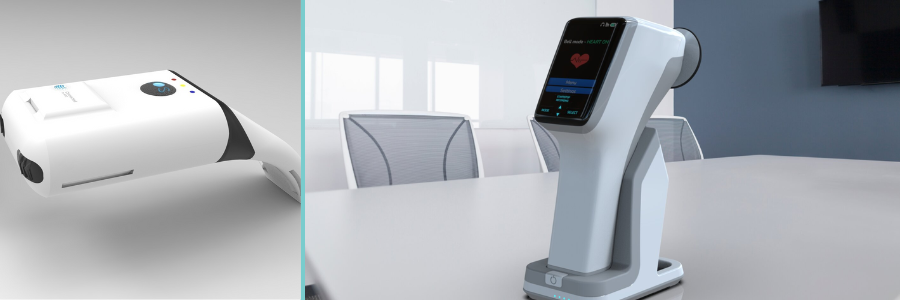
Connect with me: LinkedInXCad Crowd