Key Tips About CGI in Corporate Office Interior Design and 3D Rendering Services


Today’s post covers a few tips about CGI in corporate office interior design and 3D rendering services. Corporate offices are among the most important spaces in modern life. Considering how every decision made in those spaces on a daily basis have the power to affect product planning, research and development, marketing strategies, public relations, employees’ welfare, finances, and just about everything else even remotely connected to the company’s operation, it makes perfect sense if corporate offices are fashioned to be as business-centric as possible by incorporating a lot of design cues from their respective brands’ visual identities. 3D Rendering professionals can do just that.

You can even say that a corporate office is a lot more than just a place of work. It is a physical expression of a company, a statement of the brand’s vision, a testament to its reputation, and to some extent a strategic tool to attract and retain talent. The office isn’t just a structure, a building where the C-suite and their subordinates assemble to perform their roles, but a purposeful asset that facilitates all the company’s activities to make sure everything functions as intended.

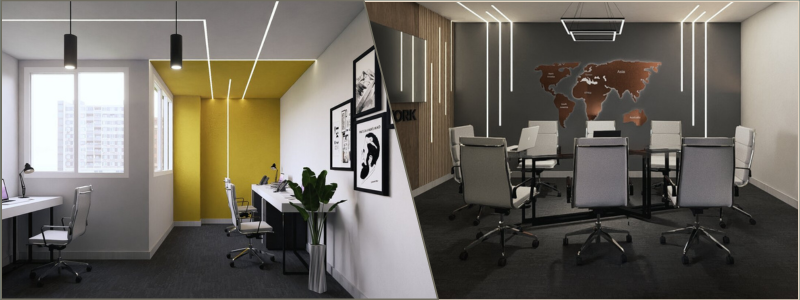
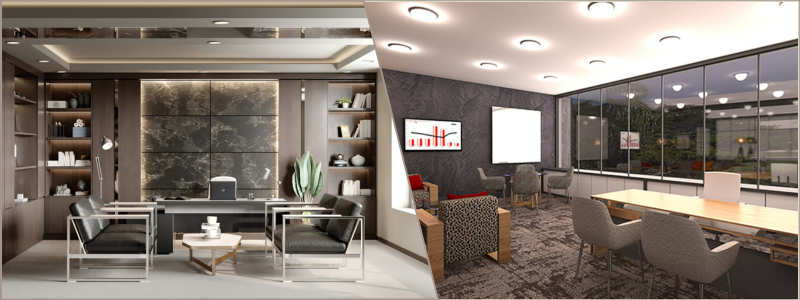
With that in mind, a corporate office needs a design that represents its importance. It should therefore surpass the mere purpose of polishing the space up with furniture and ornaments, but also to communicate the overall experience and ideas of the company itself. An expert 3D interior rendering firm can help.The lobby must bring forward collaborative energy, the executive boardroom has to outline the sense of sophistication, and even the library is supposed to be framed in a productive atmosphere.

RELATED: Top 41 Interior 3D Design Firms for 3D Rendering Firms & Visualization Companies in the US

For architectural render artists, visualizing a corporate office always presents an assortment of unique challenges. You can’t depict it simply as luxurious, because it’s not the place people have in mind when they want to feel glamorous; focusing entirely on the industrial side also isn’t true, either, as the atmosphere should also promote comfort. The visualization has to be well-balanced; a visualization that embodies corporate culture, ideals, professionalism, productivity, and visions for success.

Like the trade of 3D rendering itself, interior visualization is a blend of art and technical proficiency. A good interior has to be precise with hyper-realistic details, but without the lack of artistic touches for storytelling. And suppose a combination of technical mastery and distinctive styles is what you’re after. In that case, Cad Crowd can help you connect with hundreds of skilled and experienced professionals specializing in interior rendering of commercial, residential, or industrial spaces. 

Practical guide to effective CGI of corporate office

Creating a visualization of corporate office interiors can be quite tricky. While it’s true that one of the main purposes of a render is to get the proposed design approved, a corporation (in this case, the project owner) isn’t a typical client. As a 3D visualization professional, you don’t want to present a generic, run-of-the-mill visualization to executives during a routine pitch and hope for high praise; these people need to be utterly impressed to even bother to take a second glance. C-suites are hard to please, but there is plenty you can do to try and convince them that the visualization you create is more than worth every penny.

RELATED: The Proven Impact of 3D Interior Rendering Services For Boosting Hotel and Resort Bookings

Project brief

A corporation doesn’t just give you the freedom to provide interior design services to craft an interior design for its office. It often has strict rules regarding the visual language and symbolism you must follow almost religiously. Big companies don’t make their design decisions on a whim, and neither should you about the visualization. Make sure you understand everything in the brief, even before the first polygon happens. When it comes to corporate design, the project brief must be treated as law.

Any information you can get about the company’s profile, brand identity, culture, goods and services, corporate structure, size, and areas of operation can contribute to the visual style. Think of the visual style as an extension of the company’s logo (with all its colors and typography), reflecting its values and visions. And then there’s also the “objective” of the interior design itself. Modern corporate offices are set to feel like a small neighborhood that consists of multiple zones with their own specific purpose. For example, the boardroom is intended to be a formal space designed to evoke the sense of prestige and sophistication, whereas the collaboration hub needs to showcase warmth and a stimulating atmosphere.

Reference board

A mood board is useful. It takes you to the right path leading to the visual style you should pursue and the message you want to convey with 3D rendering services. But since you’re working on a visualization of a corporate office, a mood board alone might not be enough; you need a reference board to keep you on track. References can be in any form and shape, from sample images of interior designs for commercial spaces and illustrated guides on how light behaves when it hits translucent objects, to a catalogue of fabric patterns and a database of material textures under a microscope.

RELATED: 3D Interior Rendering Services for Interior Design Firms How to Make Your Company Stand Out

3D interior design firm

Real-world photography also makes for an excellent point of reference. In fact, photographs of high-end interiors and office spaces should be your primary source of ideas. A lot of modern corporate office designs aren’t too far away from those of luxury retail and renowned hotels. We’re not just talking about the executive boardroom here, but also the lobby, reception desk, lounge, and sometimes, work bar. You’re not trying to imitate every detail from a specific building, but have a glimpse at the lighting positions, the scale of things, and perhaps at the type of premium materials in use for the flooring, furniture pieces, or ornaments.

Curated library

Now that you have loads of reference images and reading materials needed for the 3D modeling design service project, you can begin collecting digital assets (3D models, patterns, textures, materials, etc.) relevant to the project brief. It might serve you well to search only for premium assets instead of the generic low-poly ones. This is not to say you can’t use free assets from the Internet and polish them up later on; it’s just that you have a better chance of finding exactly the assets you need from premium libraries.

One of the issues with free assets is that most of them look somewhat “standard” or commonplace. Corporate offices are supposed to be filled with custom millwork, top-tier furniture brands, state-of-the-art lighting, and more. You see bespoke elements everywhere you look. For instance, you can’t just download free high-poly 3D models of Haworth or Herman Miller layout studio; they’re premium assets with hefty price tags attached to them. If you use premium assets, make sure the prices are well covered by your employer.

Don’t forget about tech elements such as modern laptops, smart boards, video-conferencing screens, touch panels, and audio equipment, among others. Corporate office 3D interior visualization services must demonstrate a seamless blend between technology and the rest of the design elements in a way that conforms with the atmosphere of the room. 

RELATED: How to use SketchUp for Interior Design Modeling

Scale is everything

In every 3D architectural visualization designer’s design, the scale is a non-negotiable groundwork on which everything else rests. It’s how you determine proper geometry and accuracy of each model in the frame. Scale is the bedrock of rendering, and even more so when you’re dealing with the likely spacious and complex corporate office interiors. Before you put the first model in the scene, be absolutely certain that the software tools (both the 3D modeling and rendering applications) are set to use a particular system unit, either metric or imperial, to match the design drafts and stick to it.

Never deviate from the initial system unit throughout the task to avoid confusion. Physical or geometry measurements seem trivial indeed, but they’re actually much more important than you think. Take, for example, the reflection of light: the distance between the object and the light source should determine how bright or dark the object appears in the scene. Say a library is 4m tall, while the ceiling of a meeting room is almost twice as high.

If the two rooms have the same total square footage, flooring type, as well as type and number of recessed lighting in a 3D photorealistic rendering, then the rays of light that directly hit the floor should look different. The same rule applies to Subsurface Scattering, Index of Refraction, and PBR materials. Camera angles and depth of field will only look realistic if the scene is adjusted to the right scale. 

RELATED: 7 Ways 3D Interior Designer Services Are Used to Maximize Living and Working Spaces

No sharp edges

Perfect 90-degree corners are almost non-existent in real-world objects. Nothing is perfectly sharp, even in critical structural elements like structural beams or glass panels. Chamfer and bevel, on the other hand, are everywhere. Even a tiny, seemingly insignificant 1mm chamfer all around the edges of a bookshelf or a massive industrial desk in the middle of a conference room can help catch light and create the impression of geometrically perfect lines. A minuscule bevel is a subtle yet effective trick for realism. Besides, nobody wants to have sharp edges on objects they interact with on a daily basis.

Minding the invisibles

A good architectural visualization designer includes not only the visible elements in the scene. To know whether the design will actually work in real life, you need to include every single object that’s supposed to be in the room, even if you can’t see them. For instance, a ceiling system consists of housing for lights, acoustic tiles, a linear bar grille diffuser, and sprinkler heads. They are not likely to be the focal points of any corporate office interior visualization, but the ceiling is an element that affects the overall design.

The placements of those objects might have something to do with the furniture layout and size, or the positions of doors and windows. Every single design decision has to make sense and serve a purpose, and you can’t have that without taking into account all the objects in the room, visible or otherwise. Also, it would be very difficult to produce an accurate depiction of the light that bounces off the thin tablecloth if you don’t model the table materials, textures, and patterns underneath the fabric.

It’s the same thing with a drapery liner for glass windows, light switches on the wall, a hidden lamp in the middle of a hollow-center meeting table, etc. The transition of lighting effects between different materials also matters, such as from stone flooring to a metal door sill or from the flat surface of a wall to the slightly recessed power outlets.

RELATED: 5 Benefits of Using 3D Rendering and 3D Visualization Services for Interior Design

Precision is the hallmark of a high-end visualization from an experienced 3D artist. Every object must be modeled to the highest level of accuracy, down to the smallest details, including parts of an object that are otherwise usually invisible or at least unnoticed. This is especially important for an object that’s supposed to be the main highlight of an interior. A custom credenza in an executive office, for example, can shine as the hero piece of the scene if the visualization highlights the decorative inlay, the hand-carved handles, or the shiny polished surface. 

interior rendering services

Instances or proxies

An open-plan office layout is perhaps out of fashion these days, but it doesn’t mean they’ve completely disappeared. Some companies still implement the concept to encourage collaboration, especially among those working on developing new ideas for products or services. When it comes to 3D visualizer services, an open-office concept can turn into a rendering nightmare. Imagine having to include many dozens of similar-looking chairs, desks, laptops, and office supplies within a single scene. And each object has to be a high-poly model.

One of the most effective workarounds is the “proxy” feature in the rendering software. It allows you to use lower-resolution models while editing and use only the high-poly ones for the final render. Either proxy and “instance” function helps improve performance in the viewport without sacrificing quality in the resulting imagery. It’s worth noting that not all the chairs and desk lamps in the scene are observed the same way; some of them are probably 100m away from the camera position, so you can use models with simpler geometry for those when creating your furniture rendering design, thanks to depth of field. If you decide to go this route, or if the scene allows for such an approach, the foreground and mid-ground should be the main areas of focus.

RELATED: How Do 3D Interior Design Rendering Services Use Space Planning for Floor Plans?

Corporate lighting

The only good lighting strategy for a corporate office interior is flexibility, meaning the lighting scheme has to cover multiple necessities. It needs to be bright enough for productivity, soft enough for comfort, sophisticated enough to impress clients, and versatile enough to cater to different settings or moods. A professional lighting design visualization requires layering, in the sense that you cannot rely on a single light source.

At the very least, you need three sources: the ambient light for base illumination (such as ceiling panels or cove lighting), accent light for when you need to highlight specific design features (typically lights to illuminate ornaments, textures, logos, etc.), and task-related light that facilitates the functions carried out in the room (for example under-cabinet in kitchen area or linear lights over desks).

Your selection of color temperature can make a huge difference in mood. As a general rule, a warm light between 3000 and 3500 Kelvin is suitable for hospitality areas like a collaboration hub, lounges, and lobbies. A neutral or cool light, anywhere from 4000 to 5000 Kelvin, is best for productivity zones such as open-office layout, boardroom, etc. Of course, the interior rendering designer may have to mix and match the different color temperatures to produce the layered scheme mentioned earlier.

Daytime render presents its own unique challenge for corporate interior space. Since the primary light source likely comes through a series of glass windows, everything may appear overly bright in the scene. High Dynamic Range Image (HDRI) is an excellent tool to create a natural-looking scene with proper reflections on glass and metal surfaces. If the project requires a view of the sky or outside environment, configure the exposure control to maintain a bright interior while preserving visibility and details of the exterior view.

RELATED: Top 5 Challenges in Interior Design Solved by Outsourcing CGI Services at Freelance CAD Firms

Imperfection

It has been said time and again that perfection isn’t always the best move in 3D architectural rendering services. This doesn’t mean you’re allowed to make a lot of mistakes. The imperfection here refers to the scene itself, not the visualization. A perfect scene negates the realism effect, so it might be a good idea to introduce some smudges on the glass panels, a thin layer of dust on the surface of a tall bookshelf, or subtle wear on the polished stone flooring.

The “UVW Randomizer” feature in a rendering software can help create a realistic imperfection. It allows you to use different texture maps for similar objects to avoid repetitive details. For instance, not every wooden cabinet in the entire office has the same grain and shine.

Takeaway

From the perspective of rendering skill requirements, there doesn’t seem to be much of a difference between corporate offices and any other commercial spaces. What sets the former apart is perhaps the use of high-quality 3D models and how the objects are arranged in the scene to tell a story about brand identity. While the logos are used sparingly across the interior, the brand image must be everywhere in the scene, from the use of the logo’s accent colors to the way every screen displays the company’s name.

How Cad Crowd can help

A high-end rendering isn’t merely about the realistic lighting, shadows, and detailed 3D models; it’s also about how effective the imagery is at conveying a narrative. Cad Crowd is home to professional render artists experienced in creating hyper-realistic visualizations of corporate offices that seamlessly incorporate brand identity and compelling narrative to impress even the most demanding clients. Contact us today to get a free quote.

author avatar

MacKenzie Brown is the founder and CEO of Cad Crowd. With over 18 years of experience in launching and scaling platforms specializing in CAD services, product design, manufacturing, hardware, and software development, MacKenzie is a recognized authority in the engineering industry. Under his leadership, Cad Crowd serves esteemed clients like NASA, JPL, the U.S. Navy, and Fortune 500 companies, empowering innovators with access to high-quality design and engineering talent.

Connect with me: LinkedInXCad Crowd
How to Create Stunning Room Renderings: Your Guide for Interior Design Services


This post provides a guide for interior design services and how it’s used to create beautifulo room renderings. Interior rendering, as a trade within the architectural industry, refers to the production of design visualization to showcase how a room is supposed to look before it’s constructed. The visualization is typically used as a presentation tool to communicate design concepts and ideas to clients and stakeholders for reviews and approval.

Gone are the days when architectural designers and design firms rely solely on the traditional 2D drawings to make sales pitches. While the industry hasn’t reached a point of complete transformation from conventional drafts to the more advanced 3D renderings, it’s pleasing to see how professionals and clients alike no longer treat photorealistic visualization as an expensive add-on but a necessity in the design process.

The primary goal of a room rendering process is to make the final image as photorealistic as possible. In other words, the computer-generated imagery needs to look as if you’ve taken a photograph of the room using a professional-grade camera and add some final edits to it. All that sounds simple on the surface, but in reality, photorealistic rendering services are a pretty intensive process that requires not only technical precision and understanding of camerawork but also artistic touches.

RELATED: Virtual Room Design Services and 3D Room Design Tips: Complete Breakdown for Companies and Firms

It takes skills and experience to turn a design draft, whether a floor plan or an interior sketch, into an accurate, lifelike image. Familiarity with a range of 3D modeling and rendering software packages is a must; otherwise, you might miss out on specific features, tools, or functionalities required to achieve the level of detail needed for the work. A high-quality render isn’t just a snapshot of a design translated from a draft; some might say it should be nothing short of artistic expression to evoke emotional responses from the audience.

Photorealistic rendering isn’t exactly a new thing, but looking for a professional and experienced 3D render artist for a project can still prove to be quite a challenge these days. Cad Crowd appears to be the safest bet for now. The AEC-focused freelancing platform is home to hundreds, if not thousands, of the world’s most talented render artists, offering their services at reasonable prices. In any case, every render artist has to start from a place where they almost have no idea what they’re doing before they get to a professional level. It’s not going to be a quick jump, but the following guides should help you get a grasp of the essentials a little bit better.
Practical guides to interior rendering

Photorealistic visualization of an architectural project can be a daunting subject. But the good thing is that, sometimes, a deeper understanding of the basics goes a long way to improve your skills. What you’ll see below won’t be much of a deep dive into the intricacies of interior rendering services, but it might just be enough to lead you in the right direction toward visualization fluency.

RELATED: Types of 3D visualization for architectural design and CGI projects

Learn from references

Just because rendering doesn’t come with exactly the same workflow as photography, it doesn’t mean you can’t use images captured by cameras as references. Even for a project brief that’s uniquely specific, there’s a good chance that you can find photos online that at least partially meet one of the requirements. For instance, if the client wants an interior with an industrial style that uses furniture from a particular brand, the Internet is a good place to start hunting for some inspiration. You might not be able to get any image that ticks all the boxes, but even in the worst-case scenario, you’ll bump into one or two images usable as points of reference.

If photographs are hard to come by, you can always resort to online libraries for rendering. Websites like DeviantArt and Behance have loads of samples to explore and observe. ArchDaily and Divisare also offer curated selections of interior visualizations by well-known designers and render artists. Even Pinterest should be good enough to get you started. There’s nothing wrong with using the works of others for inspiration, so long as you don’t produce an exact copy, which is highly unlikely anyway because their project briefs can’t be identical to yours either.

References allow you to “indirectly” learn from other render artists and 3D designers. All those images might tell you which color combination works best for a small room, what visual style conforms with a home office, how to present a corporate office render, and so forth. Every little detail you see is a lesson to remember.

RELATED:  7 ways 3D interior designer services are used to maximize living and working spaces

Use high quality 3D models

3D modeling design services are the underlying work of an interior rendering. You can’t have a proper render without making sure that you have all the correct models to represent objects in the scene. Remember that you’re not actually capturing photos of physical objects, but generating a visualization of those objects in a digital environment using specialized software. Accurate 3D models are a prerequisite for high-quality rendering. Many things can make your visualization look unrealistic, and poorly-built 3D models are among the worst of them all.

One of the main problems with high-end interior rendering is that you can’t always source quality models from just about any 3D model marketplace online. Let’s assume the client wants the visualization to include objects (furniture, ornaments, fixtures, etc.) from specific brands. In many cases, it’s perfectly fine to model those objects yourself, but make sure that you get clearance from the clients. Some furniture design companies actually sell high-poly 3D assets of their patented design or products, so make time to discuss the matter with the clients to avoid any legal issues.

3D interior visualization firms

If you have to model some objects from scratch, remember the following key principles:

  • Respect the real-world dimensions: it’s best to model an object according to its actual measurements. If possible, look for the manufacturer’s specification.
  • Clean geometry: overlapping meshes aren’t the best solution to achieve a shape or design. They can result in unwanted artifacts in rendering or shading issues.
  • Avoid low-poly: any object, whether you plan to use it in the foreground, mid-ground, or close-up view, should be modeled as a high-poly 3D asset. Even if you want to use it as a background object and blur the color for a realism effect, it’s better to have a detailed object converted into a low-poly one than the other way around.

RELATED: How Architects and Companies Leverage 3D CAD Technology to Develop Architectural Models

Be that as it may, modeling from scratch is usually not the priority for efficiency reasons. 3D modeling is a time-consuming task, especially considering the fact that you have the option to source premium assets from online marketplaces. Such platforms as TurboSquid, RenderHub, BlenderKit, and CGTrader, to name a few, have thousands of ready-made 3D models used for architectural rendering services. Assets include furniture, decorations, ornaments, lamps, doors, windows, stairs, and more. 

Map the project brief

Reading the brief over and over again does seem like a waste of time and effort, but it’s advised against simply combing through the instructions for the obvious reason that you can easily miss something crucial. To avoid the hassle, make the effort to “map” or outline the brief during the first re-read. This is where you answer questions like:

  • What is the intended visual style? Is it minimalist, industrial, contemporary, classic, or something else?
  • Is there any particular color combination that best complements the style?
  • Does the instruction mention anything specific about the furniture design, brands, ornaments, decorations, wall paints, or other objects and elements?
  • What should be the focal point? Is there any object to highlight?
  • What time of day will the rendering be? If the 3D visualization design depicts the interior at nighttime, how many light sources are there in the room?
  • Does the client provide images or photos for references? If so, what makes the references stand out?

There are no right or wrong answers to any of those questions. Take another look at the client’s references (if any) or other images you’ve already collected to gather ideas and develop a design concept. It’s important to have a clear style direction early on in the process; otherwise, you’ll be doing everything seemingly at random without a well-defined objective.

Unsurprisingly enough, 3D CAD render artists are prone to falling into the trap of repetition. This is when they unknowingly use the same design ideas and visual styles over and over again. Everything looks just fine for the first dozen or so renderings, but then the portfolio shows very little variation in terms of perspectives, composition, lighting effects, color, etc. It’s understandably difficult to come up with a fresh design concept each time, and that’s why everyone needs to take inspiration from other designers and render artists at times.

RELATED: How 3D Modeling Has Impacted the Architecture and Design Industry throughout the Last 30 Years

Camerawork

The hallmark of a high-quality render is when the audience cannot seem to tell if what they see is a computer-generated visualization or a photograph. In other words, you need to try to render like a photographer. Remember that the virtual camera (this is the camera position that gives you the viewing angle for the rendering) essentially follows the same optical principles as an actual DSLR. As a 3D architectural visualization designer, to produce professional-grade images, you shouldn’t stick to the default setting, then do the routine point-and-shoot. There are plenty of settings to configure, including object placements within the frame (composition), to get the best results. 

A typical challenge with interior rendering is space limitation. Field of View (FOV) and focal length matter the most here. An easy solution is to use a wide-angle perspective to cover the entire room and therefore fit every object in the frame. But an easy solution isn’t always the best available. If you include everything in the frame, the image most likely ends up with poor composition, with a weak focal point. The sweet spot for interior visualization is a focal point between 28mm and 35mm, or the “prime lens” shot. The viewing angle from these lenses closely mimics the human natural field of view, making the image look realistic.

Detailed shots or vignettes are best when captured using a medium telephoto or “portrait” lens. This allows you to focus on or highlight specific objects or areas while compressing the background at the same time. Experiment with the Depth of Field option for more dramatic blur effects. The next in line is composition, or the arrangement of objects in the scene. Some of the most common composition techniques for interior visualization services include:

  • Rule of Thirds: placing the focal point or highlighted features of the room slightly to the right or left of the center.
  • Framing: the use of objects such as windows, doorways, ornaments, or even furniture to frame the key features.
  • Leading Lines: utilizing noticeable lines (from the objects) in the scene to guide the viewers’ eyes toward the key features.
  • Asymmetry: introducing too much symmetry to the scene makes the image look generic, so a touch of imbalance is good.
3d interior rendering designers

RELATED: Tips for 3D Rendering with Photorealistic Results at Your Firm

Don’t be afraid to explore the different options of camera angle, height, focal point, and composition. You can’t really see what’s the most effective solution until you compare at least two or three finished renderings. It’s best to do the exploration in the “grayscale render” stage. Also commonly referred to as “white box rendering,” this is the stage where the 3D models are still devoid of color and textures. Professionals use the technique to experiment with camerawork without the need to do full-scale rendering each time.

Mind the lights

The way the 3D modeler set the lighting effects can make or break the rendering. Different times of day have a huge impact on how the room looks and feels. A lot of times, it has everything to do with the kind of room you want to visualize. For example, a bedroom is best encapsulated with artificial light sources during the night, whereas a home office appears to have its most energetic atmosphere during broad daylight. If you decide to use the sun as your primary light source, make sure it’s dispersed enough across the room to maintain a comfortable level of brightness without making everything too dim.

Artificial lights are a little more complicated, as the 3D interior rendering designer have to work with three different types of them, including ambient, accent, and statement. Ambient lights are the base illumination (this is the brightest lamp in the room), accent lights are complementary in nature, such as desk lamps or LEDs behind the TV, whereas statement lights are only for style purposes, like a chandelier. Each type serves its own functions to contribute to the realism effect. 

RELATED: 3D Interior Rendering Services for Interior Design Firms How to Make Your Company Stand Out

Free experiments

As mentioned earlier, interior rendering is a little bit of both technical mastery and artistic expression. The mastery portion of the equation calls for software know-how, understanding of the physics of lighting, and material realism. On the other hand, the artistic part is all about visual storytelling; it’s how you convey messages and trigger emotional responses from the audience with imagery. Utilize lighting effects to build an atmosphere, explore different viewpoints to create a narrative flow, or use a specific color scheme to introduce a specific mood within the frame. 

In many respects, interior rendering is like product development services, where prototyping is an iterative process. Through subtle yet continuous improvement and structured practice, every image should come out better and more refined than the previous one. More attentiveness to details, combined with valuable lessons from yesterday’s mistakes, can really turn pencil sketches and simple illustrations into emotionally resonant visualizations. Every room and its unique design present their own rendering challenges, but that’s how you afford the chance to try and explore different methods for a visual storytelling that communicates design concepts, lifestyle, or perhaps brand identity.

Whether you’re generating a visualization for a small kitchen or corporate office, every instance is an opportunity to experiment with ideas. This kind of “experiment” will mostly revolve around using more tools and features in the rendering software, but the truth is that you can only improve by being more familiar with the software you have. It’s how you hone your skills in creating different visual styles, not just to get to know the intricacies of each, but to understand which style does best for any given project brief.

RELATED: Differences Between 3D Rendering and 3D Visualization Services

Some ideas will work and others won’t, but mistakes are as effective at giving valuable lessons as success. The point is that experimenting with software tools, lighting effects, perspectives, composition, textures, materials, patterns, colors, and everything else related to rendering will broaden your knowledge. It’s all part of a creative process, and the experience you gain over time can only serve you well.

Takeaway

Apart from skills and experience, high-quality interior rendering from expert 3D photorealistic rendering artists also demands patience on your part. It’s almost an interdisciplinary field that requires technical understanding of lighting physics, the vision of a professional photographer, the artistic expression of a storyteller, and 3D modeling know-how. Chances are, you can’t have all of those overnight. Even a quick learner can take months, if not years, to feel comfortable with the complexities of interior rendering, beyond learning about software tools and understanding what every feature does. Creating a photorealistic visualization forces you to think like an architect and designer while trying to stand in the client’s shoes.

Now that 3D modeling and rendering software have become smarter and faster, the barrier to entry has also gotten lower. Modern software can automate geometry calculations, read textures and patterns, predict light behaviors, and even offer instant color balance correction. However, there’s always the artistic barrier. No software has the power to determine the best light source position to evoke a sense of comfort, energetic lifestyle, or joy. Software can’t replace human touch because it doesn’t have artistic expression.

RELATED: 3D Modeling vs. 3D Rendering Services

How Cad Crowd can help
A professional render artist bridges the gap between a design concept and its eventual materialization. Rendering should be an extension of the designer’s idea – an extension that allows the audience to picture themselves living in a place that doesn’t yet exist and make a buying decision long before construction begins. At Cad Crowd, the focus of architectural rendering isn’t just on realism, but also on believability through artistry. The professionals on the platform have undergone strict screening and vetting processes to maintain high-quality standards and make sure that every client gets the chance to work with the best in the trade. Get a free quote today.

author avatar

MacKenzie Brown is the founder and CEO of Cad Crowd. With over 18 years of experience in launching and scaling platforms specializing in CAD services, product design, manufacturing, hardware, and software development, MacKenzie is a recognized authority in the engineering industry. Under his leadership, Cad Crowd serves esteemed clients like NASA, JPL, the U.S. Navy, and Fortune 500 companies, empowering innovators with access to high-quality design and engineering talent.

Connect with me: LinkedInXCad Crowd
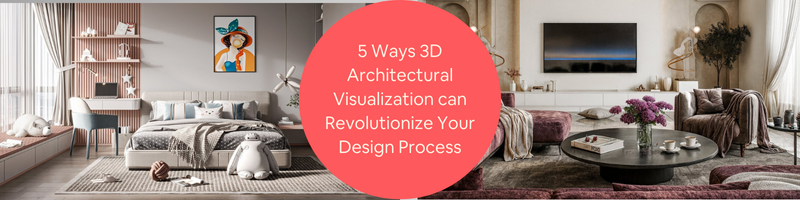
5 Ways 3D Architectural Visualization Can Revolutionize Your Design Process


The practice of architecture is nearly as old as human history itself. Admittedly, the first humans probably didn’t bother themselves with building complex houses with proper indoor plumbing. Still, at least they had nests, huts, or some other kind of dwellings to stay warm and protected from other carnivores. Humans then learned how to use and craft tools, which enabled them to build more complex structures like semi-sedentary dwellings and wooden houses later on.
Fast-forward a couple of thousand years, and they figured out that building a proper home required planning, and that’s when architectural drawings came into existence. It turned out the drawings were found to be useful, and that modern civilizations all around the world still use the same practice now. Of course, ancient architectural drawings from the bygone millennia were nothing in comparison to construction plans created in today’s digital age in terms of clarity or complexity. What started as relatively simple illustrations and hand-drawn blueprints has now become sophisticated data-rich visualizations generated on computers.

We now rely on CAD software to ensure precision, perfect geometry, and error-free structural engineering calculations. And more recently, the advent of 3D architectural visualization services has introduced a massive improvement in how we plan, perceive, and execute construction projects. Instead of seeing a project plan as a complex two-dimensional image, 3D hyper-realistic rendering allows you to visualize just about every single detail of the construction process (especially with BIM) and how the final building should look and feel, even before the actual construction happens. 

RELATED: Architectural Illustrations vs. Architectural Visualization Services

Creating two-dimensional construction drafts is one thing, but transforming the plans into a realistic imagery of the structure is another matter. In fact, 3D architectural visualization has become a trade of its own. You need skilled professionals with the right tools to generate realistic imagery that accurately represents architectural designs. But renderings can be expensive.

One of the best places to look for those experts is the AEC-focused freelancing platform, Cad Crowd. Populated by hundreds if not thousands of experienced 3D render artists from every corner of the world, Cad Crowd is your one-stop shop to discover and connect with some of the most talented freelancers specializing in architectural renders, whether for residential, commercial, industrial, or civil projects – at affordable rates.

How accurate visualizations enrich the design process

Having realistic 3D architectural visualizations can improve the construction workflow and design process by leaps and bounds. Not just on the technical level, but the benefits touch on the communication process and collaboration, too.

All-around better clarity

In principle, 3D renderings transform construction drafts and two-dimensional design illustrations into photorealistic imagery of the finished structure. All the lines and shapes you see in a conventional 2D drawing are no longer there, and instead, you get an image that looks as if somebody has captured a photograph of the structure when construction hasn’t started at all. To some extent, the client gets to see how the project should materialize early on in the design process. If the rendering also includes 3D interior visualization services, taking a look at the imagery can feel like having a quick walkthrough inside a building that still only exists as a design plan. 

RELATED: Camera Angles in the 3D Architectural Visualization Realm for Your Projects

Conventional 2D architectural drawings are tricky to understand. The walls, doors, windows, appliances, and furniture pieces are outlined together on a two-dimensional plane visible only from a bird’s eye perspective. Unless you pay close attention to the symbols and annotations, it can be difficult to tell a table from a tub, because both are observed from a top-down view. There is no sense of height from the walls, and the drawing for the roof is probably on an entirely different sheet. In short, it takes some serious mental translation to have a good grasp of the design.

Architects, engineers, designers, and contractors are trained to build structures from 2D drawings, so they have no problem understanding all the details and visualizing the design at a glance. For the non-technical people, on the other hand, making a correct interpretation can be a monumental challenge. Photorealistic 3D architectural visualizations make such a cognitive barrier disappear in an instant. You can clearly see where the walls stand, the placement of furniture, the positions of doors and windows, and how every room is connected to the others. A 3D exterior rendering also clearly visualizes the roof, the facade, the wall paint, and even the landscape and the surrounding environment.

Architectural visualizations come in several different forms, including floor plans, aerial views, interior design, and more. Each of them provides an immersive view of design, allowing you to gain a clear understanding of the structure’s spatial relationships from a human-friendly, comfortable viewing angle. High-end visualizations even render the lighting, shadows, material textures, and surface patterns. Everything appears crisp, detailed, and yet completely natural to the point where you might think that you’re looking at a photograph. Advanced rendering software can simulate the position of the sun and artificial light sources along with light intensity and direction adjustment for contextual accuracy as well.

3d interior rendering firm

RELATED: Techniques for 3D Architectural Visualizations and Tips for Your Services Firm

Rapid design iterations

Render firms use 3D models (as opposed to photographs of physical artifacts) as objects in the final render. This allows architects and designers to experiment with practically limitless combinations. The configuration and specification of load-bearing components might not be as flexible, but everything else can be modified without altering the structural integrity. Suppose the design of a house features a sizable living room with a large glass window on the east-facing wall; because the homeowner isn’t fond of the idea of a single massive glass panel for sunlight, the architect decides to use two smaller windows instead.

Making this kind of change in a digital environment is easy (in the hands of professionals, of course), quick, and definitely inexpensive. 3D rendering for architectural projects cannot happen without 3D architectural modeling services first. In the best-case scenario, the rendering process happens only when the 3D models of the design have been finalized and approved by the clients. Unfortunately, this isn’t always the case because without the photorealistic render, there’s no hint at how the lighting works or if the furniture pieces blend well with the overall color accents. But even with the back-and-forth of reviews and revisions, making changes to the rendering is still much cheaper and quicker than altering an already constructed design.

This kind of rapid design iteration puts 3D visualization way ahead of traditional 2D drawings. Clarity has everything to do with this advantage. When clients can see and understand how the proposed design will materialize in the end, they feel eager to provide feedback and propose modifications if necessary. The architectural designer can also provide multiple design options to begin with, allowing the client to explore variations in interior layout, facade treatments, material options, rooflines, and more. But then again, everything can be modified to cater to every client’s specific requirements on a computer screen for design process efficiency. 

RELATED: Architectural Visualization Services: A Complete Comprehensive Guide to Mood and Atmosphere

Keep in mind that expensive redesign and rework can happen because the client only understands the design concept after the structure, or at least parts of it, have been constructed. When things don’t look exactly like what the client imagines in the first place, modifications are likely expensive. Photorealistic rendering moves this hassle (if any) to the design process, where corrections remain within the confines of digital space and are cheap.

Engineering and design coordination

There might be multiple instances of disagreement between the engineers and designers in the project. However, this is exactly what you should expect in a carefully put-together team of professionals, where all the members perform their roles to the best of their ability. For example, a designer may propose an intricate room layout for the interior or complex geometry for the roof and facade. While all of those ideas are far from impossible, they might be an engineering nightmare due to resource limitations. 3D rendering isn’t all about aesthetics, but it’s also a tool for objective technical review where an interdisciplinary team can coordinate and make educated design decisions.

Let’s say the windows in the living room are supposed to be made of stained-glass because the client requires a unique lighting effect when the morning sunlight shines through. There are many different types of stained-glass (opalescent, streaky, flashed, iridescent, etc.), and the client gives the freedom to the architecture designer to determine what’s best. Instead of physically testing every type of glass, it is much easier and cheaper to simulate the lighting effect using the PBR (physically based rendering) feature in the software. The architect can then show the client how each type produces its own lighting effects in the room in broad daylight.

Simulation isn’t limited to lighting effects only. Engineering software with an FEA (Finite Element Analysis) tool can simulate how materials behave under real-world conditions, including mechanical and environmental stresses. FEA isn’t actually a rendering tool, but a construction project can take advantage of the analysis to accurately predict how the physical characteristics of specific materials change over time. It can tell you whether the structural strength will degrade or remain intact after long-term exposure to real-world conditions.

RELATED: Top 6 Architectural Visualization and 3D Rendering Trends for Your Company to Follow

Furthermore, the combination of 3D rendering and BIM (building information modeling) facilitates early clash detection in construction design. BIM is essentially an accurate visualization loaded with detailed specifications of every element that forms the structure, including mechanical, electrical, and plumbing. The software can handle even the most complex structures and the interactions among the various systems in the building. Clashes may include improper placement of structural elements, the lack of geometric tolerance, construction scheduling conflicts, and more.

Permit approval

In most, if not all, countries around the world, the process of acquiring construction and building permits still requires the use of conventional 2D architectural drawing services. That being said, it doesn’t mean that 3D visualizations have no place in the procedure. Quite the contrary, photorealistic rendering can be a significant factor in the approval decision. Most large-scale projects require approval from local authorities like the planning commission, the city council, or community boards. Each of those bodies needs to scrutinize certain aspects of the architectural drawings to determine if they warrant a permit. Much of the approval process relies on the information provided by the 2D drafts, but 3D renderings might serve as invaluable additions.

One of the best things about photorealism is the lack of ambiguity in the image it represents. It tells the reviewing parties how the new structure will look after completion, where the external lights illuminate the property boundaries at night, and if the new building integrates well (doesn’t break any zoning law, for example) with the existing neighborhood. Imagine a scenario where a brand-new house is being built in a city or area that imposes strict requirements focused on eco-friendliness and sustainability. It’s either a green building or none at all. Photorealistic visualization designers have what it takes to showcase important features like natural ventilation, solar panels, and rainwater harvesting systems.

Not only does the visualization highlight the “green” features, but it also illustrates how everything works with pleasing visuals. For example, the ventilation design displays arrows and other symbols to show the direction of airflow in and out of the building, the drainage diagram shows where wastewater goes, and the solar panels include a diagram specifying their average efficiency year-round. Regulatory approval isn’t exactly an integral part of the design process, unless disapproval calls for design modification, in which case the building must be redesigned, remodeled, and re-rendered.

3d interior visualization services

RELATED: Turning Concepts Into Stunning 3D Renderings with Architectural Visualization at Your Services Firm

Digital fabrication

As mentioned earlier, 3D modeling is the underlying process that makes photorealistic rendering possible. In fact, you can say that 3D modeling designers provide the most important building block of modern construction planning because it also opens the door for parametric and generative designs. Visual design tools such as Dynamo and Grasshopper enable architects to explore and experiment with complex geometries and see the results through rendering. The method is usually intended for the design and construction of customized elements.

Both the visual programming and rendering tools allow verification that the addition of any unique element or design will not affect the structural integrity of the building. No matter how you put it, there’s no way you can do this with conventional 2D drafting, unless you’re willing to risk an expensive rework. 3D architectural modeling services are also useful for the off-site manufacturing of prefabricated components. Although most fabricators still use traditional shop drawings as standard documentation, rendering helps visualize how the final product should look and perform.

Things like custom millwork, sheet metal, and curtain wall systems are likely fabricated off-site. And the fabricators rely on shop drawings to build the elements as specified. Even if the realistic renderings have little technical information, they can at least provide visual hints to the aesthetic details of the finished products. Many large-scale projects use BIM software not only to render structural elements but also to digitally capture and preserve material technical specifications, such as reinforcement bar detailing.

RELATED: 13 Mistakes When Employing 3D Architectural Visualization Specialists for Companies

Takeaway

3D rendering isn’t just a trend in the architectural sector. Given the benefits of accurate visualization for the architectural design process, it appears the AEC industry at large is ready to adopt the technology as the next big change from conventional 2D-based construction drafts. A large chunk of the industry still cannot make the transformation right away; 2D construction drafts, including as-built and shop drawings, remain the standard used for construction permit applications, component prefabrication, and archiving, among others. But the future is bright for 3D visualization companies, partly thanks to the rapid development of computer technologies as well as the growing number of professionals specializing in the field.

Architects, engineers, and designers can also benefit from the faster iteration cycles and clear communication with clients. Accurate visualization improves the chances of the final structure being more closely aligned with the initial design plans, while reducing the risk of construction mistakes along the way. Cost-efficiency is also a big part of the equation here. Architects have the freedom to experiment with the design in a digital environment, meaning there’s no need for a physical model at all. 

In architectural projects, especially the complex and expensive ones, there might be a big time gap between ideation and execution. From the moment the initial design idea comes up, it can take quite a while before the actual construction begins. It is within that gap that the design is scrutinized for possible flaws and errors, analyzed for cost estimation and completion timeline, and reviewed for approval by the project owners. Also taking place during the gap is a series of feedback loops to bring about design improvements.

RELATED: From Concept to Client: The Power of Architectural Visualization Software for 3D Services

Proper integration of 3D architectural visualizations by expert 3D visualization designers both simplifies and accelerates progress significantly, without sacrificing accuracy. Realistic visualization ensures that clients and architects are on the same page throughout the design process. There’s practically no more language barrier; the client isn’t bewildered by the complexities of conventional 2D drafts, and the architects can explain every design decision without resorting to jargon. That being said, you don’t want the 3D renderings to be nothing but pretty pictures to impress clients.

How Cad Crowd can help

Renderings must serve a practical purpose of illustrating a structural design as accurately as possible. It has to be an effective tool that allows everyone involved in the project to accelerate the design process and make informed decisions. Precision is of the utmost importance, and Cad Crowd is loaded with just the right professionals to help you achieve that very objective. Get a free quote today!
author avatar

MacKenzie Brown is the founder and CEO of Cad Crowd. With over 18 years of experience in launching and scaling platforms specializing in CAD services, product design, manufacturing, hardware, and software development, MacKenzie is a recognized authority in the engineering industry. Under his leadership, Cad Crowd serves esteemed clients like NASA, JPL, the U.S. Navy, and Fortune 500 companies, empowering innovators with access to high-quality design and engineering talent.

Connect with me: LinkedInXCad Crowd

Best 22 Freelance Websites to Hire SAP2000 Engineers for Construction and Architectural Firms


The major challenge for these construction and architectural firms was finding qualified SAP2000 engineers who would provide them with the desired result efficiently and in an organized manner. Their challenge has always been knowing precisely where to find people qualified to handle the software, hence support demanding project requirements.

In that regard, freelancing platforms have made the search so easy and opened access to qualified experts living in various parts of the world. Cad Crowd leads the long list of those options, featuring experienced SAP2000 specialists, professionals with the technical and practical needs of the industry. That said, here is how you can use these top 22 freelance websites to find the best SAP2000 engineer for your next project.

Best 22 freelance websites to hire SAP2000 engineers for construction

Cadcrowd

1. Cad Crowd

Cad Crowd is a great platform for finding professional engineers in SAP2000 who can deliver on structural analysis, modeling, and project-specific technical requirements from the perspective of a construction and architecture firm. It helps connect clients with freelancers who understand complex design requirements and enable delivery from the perspective of meeting the objectives of the projects. Cad Crowd boasts efficiency in matching up clients and freelancers while cutting down on waste when browsing through the big pool of talent. Further, it provides pre-screened experts, making the experience even smoother than many general freelance marketplaces. Cad Crowd allows construction and architecture design firms to post projects, review proposals, and hire SAP2000 specialists who consistently bring practical experience and technical accuracy in their work.


Website: Cadcrowd.com

RELATED: Top 30 Steel Detailing Companies for CAD Drafting and Engineering Design Services in the US

JOT Solutions

2. J.O.T. Solutions

J.O.T Solutions serves as a practical way to find SAP2000 engineers for construction and architectural firms involved in structural analysis and modeling. It allows posting one’s projects, reviewing candidate profiles, and finding professionals possessing the required technical skills. All in all, it is about making talent options available for those firms that need support concerning project-specific calculations and design requirements. Though it does provide useful tools when it comes to sourcing engineers, the process for matching talent is less specialized when compared with Cad Crowd. Capable SAP2000 specialists are available who understand the internal details of structural workflows and offer dependable project support for a wide range of engineering needs, from a reliability perspective.

Website: Jot-solutions.com

Engibrain

3. Engibrain.com

Engibrain is the place where engineering and architecture firms find SAP2000 engineers who can handle structural analysis and modeling. The website enables clients to add their projects effortlessly, scan candidate profiles, and spot engineering design professionals with relevant technical capabilities. It is all about accessible talent options for firms in dire need of support with regard to project-specific calculations and design requirements. While the site offers various useful tools for finding engineers, its talent matching is less specialized than Cad Crowd’s. One can definitely get in touch with capable SAP2000 specialists who understand structural workflows and provide reliable project assistance for a range of engineering needs.

Website: Engibrain.com

Experfy logo

4. Experfy

Indeed, Experfy makes it easy for construction and architecture firms to source the SAP2000 engineers needed for important structural analysis and 3D modeling design services. One may post one’s projects, review candidates’ profiles, and hence find professionals with relevant technical skills. Indeed, it zeroes in on easily accessible talent for firms in need of special project calculations and designs. While Experfy boasts very impressive tools in sourcing engineers, talent matching is less specialized in comparison with Cad Crowd. Even today, users can source capable SAP2000 specialists who understand structural workflows and offer dependable project support fitted to a number of engineering needs with better project reliability.

Website: Experfy.com

RELATED: Top 37 Platforms to Hire Freelance EPLAN Engineers & Designers for Automation & Mechatronics 

SAP Contractors

5. SAP Contractors

SAP Contractors is an excellent channel through which construction and architecture firms find those SAP 2000 engineers who will be in a position to handle the structural analysis and modeling work. This allows users to post projects, view candidate profiles, and find professionals with technical skills in relevant areas. That means it is created to find options for firms that want some support with the calculations and designs that particular projects require. Though pretty useful and with all the tools needed in sourcing the services of engineers, it is less specialized in matching talents than Cad Crowd. One is able to connect with capable specialists in SAP 2000, understand the structural workflows, and hence deliver trustworthy project assistance on a number of engineering needs that assure reliability for one’s projects.

Website: Sapcontractors.com

Sourcebae

6. SourceBae

SourceBae outsources SAP2000 engineers to construction and architecture firms to efficiently cope with the workload related to structural analysis and modeling. That means this is a website where you post your projects and then view candidate profiles to rule out professionals with technical competencies in your project. Of course, it is very useful in the finding of the engineers themselves; the platform does not specialize in the matching of talents. This platform provides reliable support for several engineering requirements, enhancing project reliability by connecting users with proficient engineering services professionals who understand the structural workflow.

Website: Sourcebae.com

G2i

7. G2i

G2i is a direct channel to the construction and architectural firms in search of sources of SAP2000 engineers who can take on jobs in structural analysis and modeling. Clients post projects, review candidate profiles, and select CAD engineering professionals whose technical ability fits their project requirements. The idea here is to facilitate access for firms needing talented solutions for backup on certain calculations and the design approach to a particular project. While helpful, the means they provide for sourcing the engineers are less specialized in terms of matching talent than Cad Crowd. That does not exclude engaging competent specialists in SAP2000, who understand structural workflows and can provide reliable project support, just what fits into a wide range of engineering applications with increased project reliability.

Website: G2i.co

RELATED: Top 37 Civil Engineering Companies & CAD Design Services Firms in the US

Techmunus

8. Techmunus

TechMunus represents the practical way construction and architecture firms source SAP2000 structural engineers for structural analysis and modeling tasks. Through this web interface, clients get access to projects, post, review candidate profiles, and filter professionals possessing technical experience relevant to the job that is being handled. What is more important is the ability to choose options with regard to available talent for the firms needing help with certain calculations and design needs of the project. There are excellent channels to find engineers, but not specialized in talent matching as Cad Crowd does, although that is not to say you cannot get in touch with capable specialists in SAP2000, those who understand the ins and outs of structural workflows and offer dependable project assistance fitted for various engineering needs with a view to improving project reliability.

Website: Techmunus.com

RemoteOK logo

9. RemoteOK

RemoteOK is one of the best job platforms on which construction and architectural structural design companies can find services offered by SAP2000 engineers who can handle various structural analysis and modeling jobs. It allows posting projects, reviewing candidate profiles, and finally choosing professionals with relevant technical skills. This platform has become key for firms that need support in the calculation and design of each particular project. While it provides useful tools to find engineers, the process of matching talents is less specialized in comparison with Cad Crowd. Capable specialists with knowledge of the structure workflow can still be found, and dependable project assistance can be provided to suit various engineering needs with a view to enhancing the reliability of the project.

Website: Remoteok.com

Cloudstaff

10. Cloudstaff

Cloudstaff has grown to become a trusted platform where companies hire the best freelance professionals, including SAP2000 engineers. It connects businesses with a pool of top remote talents focused on structural analysis, civil engineering design services, and project design. Cloudstaff is scaling up the engineering teams without compromising quality and professionalism. Carefully selected and managed for reliability, you will most definitely have zero problems finding specialists who can easily take on even the most complicated projects in SAP2000. It offers long-term collaboration apart from short-term assignments, which allows flexibility and integrates seamlessly with your engineering workflow.

Website: Cloudstaff.com

RELATED: How Do Engineers Evaluate Different Design Ideas?

ZipRecruiter Logo

11. ZipRecruiter

ZipRecruiter would allow construction and architectural firms in need of structural analysis and modeling to find an SAP2000 engineer easily by allowing the posting of a project description, reviewing candidate profiles, and then searching for professionals who have certain technical skills. This would fall more toward accessible talent options, which firms need to assist with project calculations and design requirements. Even though it is among the very fine means of finding engineers in general, the manner in which it matches talent is less specialized in comparison to Cad Crowd. One would still manage to get in contact with skilled structural engineering professionals who have experience with SAP2000 and enough knowledge concerning structural workflow in such a way as to deliver reliable support to your project and satisfy many different engineering application needs for improved project reliability.

Website: Ziprecruiter.ie

Workana logo

12. Workana

Workana is the practical means for construction and architecture firms to find SAP2000 engineers who can competently accomplish the job of structural analysis and modeling. It helps in posting projects, going through candidate profiles, and narrowing down on structural design and analysis professionals whose technical experiences meet the sought-after requirements. The main focus of the platform is to deliver options available for the required talent in those firms that need help with the calculations and design of the project. While valued as a means of sourcing these engineers, it has less specialization in matching than Cad Crowd. You can find competent SAP2000 specialists who understand workflow and, therefore, are able to offer trusted help about structures for projects to fit varied needs, hence enhancing the reliability of a project.

Website: Workana.com

contracom logo

13. Contra

Contra is a contemporary freelance platform for the hiring of the best independent professionals, including SAP2000 engineers. Contra directly connects businesses to the best talent; therefore, companies can outsource experts in structural modeling and analysis, among other projects dealing with civil engineering. Contra is an open and flexible marketplace where freelancers are able to present their competencies, experiences, and portfolios that allow clients to make the right choice of hiring. With an interface that’s user-friendly and focused on quality over quantity, Contra can make integrating freelance SAP2000 engineers into your firm seamless, whether that be for project-based work or for ongoing collaboration.

Website: Contra.com

RELATED: Key Factors to Consider When Vetting Engineering Firms for Design & Consulting Services

arcdev logo

14. Arc.dev

Arc.dev is the functional way of finding SAP2000 engineers for construction and architectural firms that deal with tasks in the field of structural analysis and architectural modeling services. It helps the user in posting projects, reviewing candidate profiles, and thereafter finding professionals with relevant technical capabilities. What is mainly emphasized is making more accessible options concerning talent for firms needing help to make the calculations and designs for certain projects. While Arc.dev does provide helpful tools to source engineers, the talent matching is less specialized than Cad Crowd. However, from here, capable SAP2000 specialists who understand structural workflows can be connected and provide dependable project assistance that can be used for a wide array of engineering needs concerning improved project reliability.

Website: Arc.dev

toptal

15. Toptal

Toptal provides a very comfortable way of finding SAP2000 engineers for construction and architecture firms that can handle the work of structural analysis and modeling. It takes the user through posting their projects, reviewing candidate profiles, and ascertaining structural detailing professionals with relevant technical expertise. This places an emphasis on making talent options available to firms in need of support with particular project calculations and design requirements. Though it does provide some useful tools in sourcing engineers, the process of matching talent at Toptal is less specialized than Cad Crowd. Users do, however, get connected to capable SAP2000 specialists who understand structural workflows and deliver dependable project assistance suitable for various engineering needs, ensuring improved project reliability.

Website: Toptal.com

kolabtree logo

16. Kolabtree

Kolabtree provides service and support for construction and architectural planning and design firms by making SAP2000 engineers available for work related to structural analysis and modeling. The platform lets one post projects, peruse candidate profiles, and recognize professionals with relevant technical capabilities. Accessible options of talent are covered in those cases when the firm needs support in regard to calculation and design requirements related to the project. Although it will provide useful tooling to source engineers, it is less specialized in matching talent than Cad Crowd is. Nevertheless, a competent SAP2000 specialist who understands the structural workflows of the projects and can deliver reliable project assistance to fit various engineering requirements can be found, hence assuring better reliability of the projects.

Website: Kolabtree.com

RELATED: Top 51 Best Platforms to Hire Freelance Civil Engineers & Civic 3D Designers for Your Company

insolvo logo

17. Insolvo

Insolvo makes it easier to find SAP2000 engineers for certain tasks of structural analysis and modeling. It helps construction and architectural firms post their projects, review the candidate’s profile, and find the professional whose technical capabilities fit the needs of the firm. It is focused on easily available talent options for companies in need of help regarding project-specific calculations and design requirements. Although it indeed does provide tools that would be of assistance in finding the required civil engineers, the matching of talents is less specialized than Cad Crowd. Nonetheless, it will be possible to connect with a competent professional in SAP 2000 who understands the structural workflow and thus provides dependable project assistance fitted for the satisfaction of diverse engineering needs toward enhanced reliability.

Website: Insolvo.com

Guru logo

18. Guru

Guru provides a direct route for construction and architecture firms needing SAP 2000 engineers who can take up the work of structure analysis and modeling. The platform has made it easy to post projects, browse candidate profiles, and conduct a search for 3D engineering professionals offering their technical skills. With this focus, the emphasis is based on deducing easily accessible talent options for firms needing help with regard to project-specific calculations and design requirements. However, while the provided tools might be of help in finding the required engineers, matching talents are less specialized than those at Cad Crowd. It is still possible to connect with competent professionals in SAP 2000 who understand structural workflow and provide dependable project assistance to fit diverse needs in regard to engineering projects toward enhanced reliability.

Website: Guru.com

Truelancer logo

19. Truelancer

Truelancer comes as a solution to find SAP2000 engineers for construction and architecture drafting firms that need to do structural analysis and modeling. One can simply post his or her project online, review the candidates’ profiles, and filter the search down to pros by technical experience that best fits a given job. Its objective is to deduce easily accessible talent options for firms in need of help with project-specific calculations and design requirements. While Truelancer does well in setting forth solutions to find the engineers, matching of these talents is not particular to Cad Crowd. In this respect, one will still be in a position to find a capable specialist in SAP2000, understand the workflow related to the structures, and therefore be able to offer reliable help with the projects one works on, valid for a variety of engineering needs in which better reliability is pursued.

Website: Truelancer.com

RELATED: Top 33 Sites to Hire Freelance Tekla Designers, Remote Detailers & Structural Engineers

Freelancer

20. Freelancer

Freelancer.com is a global market where clients can hire freelance SAP2000 engineers for any job, among other technical design engineering professionals. Hence, the projects call for qualified professionals who have experience in structural analysis, civil engineering design, and modeling on SAP2000 to bid for work on the site. Freelancer.com has tools that facilitate smooth collaboration in project management and milestone tracking, and ensure that payments are secure. A huge and varied pool of talent like this will make sure that finding engineers suited for either short-term or long-term engagements is done with ease, hence flexibility and access to a host of skill levels and expertise in the field will be accorded to companies.

Website: Freelancer.com

Fiverr

21. Fiverr

Fiverr is the most efficient platform to find freelance SAP2000 engineers in terms of speed and efficiency. On Fiverr, freelancers offer services ranging from structural analysis and modeling to full-project support of any type in SAP2000. Clients can then review extensive profiles, examples of previous work, and ratings to identify and hire architectural design and drafting professionals who meet their needs for a specific project. Everything remains crystal clear on Fiverr’s streamlined interface: communicate properly, deliver quickly, and pay safely for everything from small jobs to big engineering projects. Easy to reach, adaptive, and versatile, businesses will find reliable SAP2000 expertise on demand. 

Website: Fiverr.com

Upwork-logo

22. Upwork 

Upwork is a practical platform for construction and architecture firms to source SAP2000 engineers for tasks requiring structural analysis and modeling. It provides easy avenues for posting projects, profiling candidates, and selecting the best professionals to deliver technical know-how for specific tasks. In that respect, it’s an easy option for talents, mainly for firms in need of help with project-specific calculations and design requirements. While it is a great way to source engineers, matching talent isn’t as specialized as Cad Crowd. You can, however, connect with capable technical writing for engineering specialists who understand structural workflows and provide reliable project support tailored to various engineering needs, with the aim of improving project reliability. 

Website: Upwork.com

RELATED: Top 35 Structural Design & Engineering Companies for Architectural Services in the US

How Cad Crowd can help 

Of course, finding the best SAP2000 engineers is no easy task, but if you look in the right places, locating freelance expertise becomes much easier and far more rewarding. Whether one needs structural analysis, model refinement, or full project support, there are indeed talented design engineering freelancers ready to plunge in and deliver. Of all the options available, Cad Crowd stands out because of its robust network of highly qualified SAP2000 professionals who understand the needs of construction and architectural firms. If you’re ready to begin your search, look at Cad Crowd and find talented freelance SAP2000 engineers ready to help bring your next project into being. Get a quote today!

author avatar

MacKenzie Brown is the founder and CEO of Cad Crowd. With over 18 years of experience in launching and scaling platforms specializing in CAD services, product design, manufacturing, hardware, and software development, MacKenzie is a recognized authority in the engineering industry. Under his leadership, Cad Crowd serves esteemed clients like NASA, JPL, the U.S. Navy, and Fortune 500 companies, empowering innovators with access to high-quality design and engineering talent.

Connect with me: LinkedInXCad Crowd

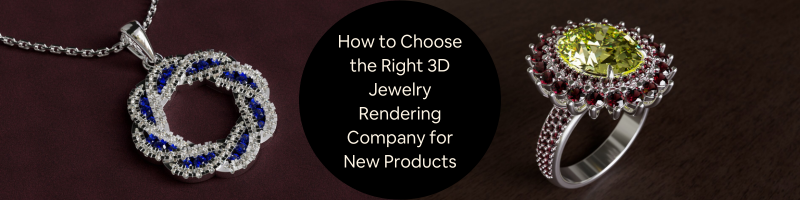
How to Choose the Right 3D Jewelry Rendering Company for New Products & Marketing Material


In today’s digital space, beautiful visuals are not optional; they are your ticket to the attention, trust, and finally, sales of a viewer. Whether it is launching new lines or refreshing the marketing material of your jewelry business, it’s the quality of the renderings that makes all the difference in that first impression. A flat, lifeless image just would not do justice to the artistry involved. But one breathtakingly realistic render? That can have customers reaching for their wallets well before the product hits the market.

Of course, not all companies specializing in 3D rendering services of jewelry are created equally. Some promise realism and then deliver something that resembles a shiny toy. Others charge a fortune and still somehow manage not to capture the sparkle that makes your design special. Especially for those just getting started with this digital craft, finding just the right partner might prove daunting.

The good news is that you don’t need to make your way through this shiny maze all by yourself. There are pretty cut-and-dry ways to identify the company that will bring your vision into life with precision and style. If you don’t mind working with talented freelancers instead of large agencies, Cad Crowd is a very good place to look for 3D jewelry rendering experts. You will be working directly with highly skilled artists who will make sure your designs look irresistible for marketing campaigns, e-commerce websites, or investor presentations.

Before getting to what makes a rendering company right, let’s talk about why 3D jewelry rendering matters in the first place.


🚀 Table of contents


Why 3D jewelry rendering is a modern-day jeweler’s best friend

Jewelry is personal; it’s emotional. It tells stories of love, celebration, and life’s milestones. In this competitive jewelry market, pure beauty does not sell; presentation does. And that is where 3D rendering changes the game.

With a good render, you can present your designs even before they ever exist. It’s able to show multiple angles, zoom in on intricate details, and even simulate different lighting conditions. You could show how a ring looks in rose gold versus white gold or how it sparkles with emeralds instead of sapphires, all without lifting a polishing cloth.

The following are some real advantages that make 3D jewelry rendering powerful:

1. Cost efficiency: Traditional photography requires prototypes, studio setups, and even retouching. In photorealistic rendering services, you do not require an actual sample for each variation of the designs you are to work on. You save on material, production time, and shipping.

2. Design flexibility: Want to try new materials or different arrangements of gemstones? A rendering artist makes those changes in a few minutes. You can test dozens of variations without making a single prototype.

3. Marketing powerhouse: Social media, catalogs, websites, and ads all need striking images. The 3D renderings offer a sharp and detailed picture that makes an instant effect. The customer can almost feel the shine and the weight of this jewelry.

4. Faster time-to-market: Fashion design software helps you market your designs even before manufacturing gets underway, which means quicker pre-orders and timely market feedback, hence more confident production planning.

5. Consistency across channels: Every render is equally well-lit, from the same perspective, with the same amount of polish. No more bad product photography or awkward shadows making your listing look mismatched.

In other words, 3D jewelry rendering services are not a luxury but a must-have marketing tool for every modern jewelry business, from boutique designers through to luxury brands, that is ready to bring their new collection to the world.

RELATED: High-quality custom 3D jewelry design costs, 3D modeling rates, and rendering pricing

Jewelry CAD design and engineering by Cad Crowd jewelers and design experts

Step one: Knowing what makes for a great 3D jewelry rendering

It’s good to know what makes one render great and the other average before choosing either a company or a freelancer for your needs.

A good rendering in jewelry has much more to do than form and material; it’s emotive and desirable. It should make the viewer say, “I want that,” not “That looks computer-generated.” To get to this level of realism, it takes technical skill, an artistic eye, and an understanding of jewelry craftsmanship.

Look for renderings that include the following:

  • Precision of details: All the claws, settings, and facets should be well-defined. It is in the thickness of the prongs, or unnatural floating of stones, that an illusion gets broken.
  • Realistic lighting: Light can make or break jewelry; it should reflect naturally to highlight the edges and bring out brilliance in the stones.
  • Material accuracy: Looks to be gold, not yellow paint. Diamonds sparkle – not glow. Textures of surfaces must act correctly with respect to the real world.

Composition and presentation must be appealing for this render, via angle, background, and focus. It must have the same appeal as any professional studio photograph or CAD design service.

Once you have an idea of what great rendering looks and feels like, then you’ll be able to assess which companies or freelancers will be able to deliver that quality.

Identify your project’s goals:

First, define exactly what you need, and then the search for a rendering company can start. Not every project needs a high level of detail, realism, and creativity.

Is this for a social media marketing image, or are you looking for a technical render to use in production? Do you need animated 360-degree views, or would still images suffice? Will you need photorealistic lifestyle settings or clean white backgrounds for e-commerce listings?

Being clear about your goals will save time and allow you to state your expectations. That said, some rendering studios have high expertise in product visualization, while others are great at conceptual design. Others may also have additional skills in animation. The clearer you are, the more likely you are to get the perfect match.

Make a checklist of your project requirements:

  • Number of designs or models to render
  • Desired style: studio, lifestyle, catalog.
  • Resolution or format specifications.
  • Deadlines and turnaround expectations.
  • Price bracket

You can start by looking up those on the list.

Step two: Choosing between a company and a freelancer

Along with the full-cycle 3D HDR rendering company, there is a freelance artist, each with their own strengths.

The rendering firms can complete large projects with regular output and an organized workflow since they have teams of different specializations. However, they are usually more expensive and less personalized.

Freelancers can offer flexibility and individuality that may not be found with larger design studios. Working directly with an artist facilitates smoother communication and quicker creative changes. Freelance rates can also be budget-friendly without having to give up quality.

That is where Cad Crowd comes in: connecting you to a network of pre-vetted freelancers specializing in 3D jewelry rendering. You can check their profiles, take a look at their portfolio of work, and hire pros whose style will fit your brand. Then, the platform will even help you with project management so that you can collaborate seamlessly without the concerns about missed deadlines or miscommunication.

If you want your jewelry to be rendered by someone who understands artistry and technology, then Cad Crowd is a brilliant place to start.

Step three: Review portfolios with a critical eye

Every company and every freelancer is going to only put up their best, but not all portfolios by jewelry design experts are created equal, and you need to look beyond the initial “wow” factor.

What to check is as follows:

  • Variety: Are they working with various styles, using different materials? If you just see one type of jewelry, that may mean a lack of variety.
  • Realism: Check the reflection in the metals and the behavior of the gemstones. Is the gold deep? Do the diamonds sparkle as brightly as they should?
  • Consistency: Is the quality the same throughout all the pieces? A portfolio with just one impressive render and the rest average may denote inconsistency.
  • Lights and shadows: Even a great design will look flat because of poor lighting. Shadows should be soft and natural, not fake or wrongly placed.
  • Presentation: Professional rendering firms understand composition. Backgrounds, reflections, and color balance matter.

Spend some time critically reviewing the portfolios, and you may be able to spot the red flags more easily. If it doesn’t feel quite right, go with your gut.

Technical competencies and skills assessment

After having selected a few rendering companies or freelancers, the next sensible thing would be to check their technical skill level. Jewelry rendering is not just about clicking “render” and letting the computer do the job; it’s about mastery over software, deep understanding of materials, and capturing even the minutest nuances that define your design.

Most professional 3D jewelry rendering artists work in Rhinoceros, Blender, 3ds Max, KeyShot, or MatrixGold. These can create phenomenally realistic views, but only if in the right hands. Therefore, when reviewing candidates, pay close attention to whether they mention those or similar industry-standard tools. Powerful software does not guarantee brilliance, but more often than not, it is a sign that they are working at a professional level.

One good test for a renderer is to ask them to describe their process in rendering. How do they handle the lighting setups? How do they achieve metal realism? How does one render gemstones? The answers will tell just how much they actually understand about the craft.

One could say that he just tweaks lighting until it looks good; that sounds good enough on the surface, but the professional will explain High Dynamic Range Imaging, ray tracing, or caustics simulation-things which separate the good from the jaw-dropping.

Another technical marker is respect for scale and precision. A couple of millimeters in jewelry makes all the difference. If a prong happens to be just one or two millimeters too big, or a gem misaligned by a fraction of a millimeter, the final image effect would look unreal. Skillful renderers respect measurements and work well with CAD models to give physical accuracy.

RELATED: Top 31 platforms to hire freelance Rhino 3D & Rhinoceros designers for 3D Modeling & CAD design

Talking is everything

Now, let us address one of the most underestimated aspects of choosing a rendering partner: communication.

Even the best artist in the world will provide the wrong outcome if you don’t communicate well. 3D rendering is one of those collaborations that thrive on clarity and mutual understanding. You need a person who will listen, ask questions, and clearly explain their jewelry design company’s approach.

When you contact companies or freelancers, pay attention to the response you get. Are they eager to respond, asking smart, insightful questions about your project? Do they seem genuinely interested in your vision? Quite often, a couple of messages will tell you what it’s going to be like to work with them.

Ideally, a rendering artist doesn’t just take your files and disappear into digital silence. He or she should keep you informed of the work in progress, request your feedback, and give previews in the rendering process. This level of communication is important in the early detection of issues, therefore ensuring the results turn out as expected.

Cad Crowd can help in that respect, too, because through their community-based freelance platform, good communication is nurtured between the clients and the artists. Thus, you are able to share your project briefs, exchange updates, and even track the progress of your work all in one place. This will cut down the chaos that sometimes happens when one has to work with freelancers on not-so-structured platforms.

That’s if this rendering partner is clear in explanations, listens well, and is patient about revisions or questions; you probably have a keeper.

Textures and lighting: How important is realism?

Now we get to the good stuff that makes renderings of jewelry so gorgeous: textures and lighting, something that jewelry sketching services are hard-pressed to match.

These two elements take the average render and make it a masterpiece. A very talented artist knows how to make gold deep and reflective, not flat and yellowish. They know diamonds don’t sparkle; they refract light in complex, beautiful ways.

It’s all about authenticity with render samples: is the surface accurately reflecting the environment, for instance, or are the gemstones deep and brilliant? Are the shadows natural or hard and unrealistic?

In particular, lighting is the soul of jewelry rendering: realistic lighting requires a mixture of art and physics; the renderer should realistically simulate how light would behave on different surfaces, from metal and stones to glass and even background materials.

It would also be a good idea to ask the would-be rendering company or freelancers how they go about setting up the lighting environment. Professionals use HDRI maps capable of simulating real-world reflections and soft ambient lighting. If someone glosses over that, that is a red flag.

Of course, the same thing happens with textures: from polished to brushed, matte, or faceted, all the surfaces vary between different pieces of jewelry. A renderer who’s able to replicate those textures will make your designs look photo-real. If all of their pieces in the portfolio look identical, that could suggest they are relying on generic texture presets rather than doing custom material work.

Price and the factors affecting it

3D jewelry rendering prices can be all over the spectrum, really. Some CAD rendering artists charge per render, some per hour, and others by project difficulty. The range goes from super affordable freelance rates to high-end studio fees.

What counts is transparency, so avoid anyone who will not quote a straight price or “it depends” without explanation of what the determining factors are. You want to be sure precisely what you pay for and what you will get in return.

Here are some of the common elements that affect price.

  • Complexity of design: an intricate design entails engraved details, filigree, or lots of gemstones; hence, more time is required in modeling and rendering.
  • Number of angles or images: With every new angle and every variation that even shows metal color or stone type, the cost goes up.
  • Level of realism: Consequently, highly realistic renders featuring complicated light setups will take more time to complete and cost more since they require more technical ability.
  • Turnaround time: Most rush projects involve an extra charge.
  • Animation or static images: The prices are higher where the rotation of 3D animation services or an interactive model is needed, as there will be an extra load in the rendering.
Pendant and ring design by Cad Crowd jewelry design experts and freelance jewelers

RELATED: Boost your fashion business with beautiful CAD fashion design services

Always ask for an itemized quote at the start, which saves you from ‘surprise’ charges at the end. A good company/freelancer should not have any problem justifying how their pricing works.

And just one last word: never for the lowest price, because cheap rendering will give you poor lighting, unreal material, and will waste your time afterwards to sort out all the problems. But focus on value: finding a balance between price and quality.

With Cad Crowd, many of the freelancers quote transparently for your needs, with samples of their previous work. You are then able to easily compare options and find one that will meet your quality needs without overspending on features that you’ll never use.

Revisions, feedback, and collaboration

Great skill and clear communication do not make any first draft perfect. A good partner in rendering would always include revision rounds in the process.

Before you commit to a firm or CAD freelancer, understand from them what their revision policy is: how many are included, what constitutes major versus minor revisions, and whether there is any additional editing billed. It is better in writing to save frustration later on.

The best artists welcome feedback. They realize this is very often the way the best results are achieved: through collaboration. Look for someone to whom revisions are a part of the process of creation, not an inconvenience.

Practice giving specific feedback when you comment on renders and avoid general comments like “it does not look right.” State exactly what should be different. For example:

“This gold tone is too bright.”

Sharpen the facets of the diamond.

“The reflection on the band looks a bit too strong.”

Precise feedback can allow the artist to make the right changes much sooner.

Cad Crowd makes it easy to collaborate: share files, comment directly on images, and keep all messages in one place. With such a structure, each version and note of feedback is clear and traceable; hence, saving you much time and sanity.

RELATED: Top 51 3D product rendering design & best 3D visualization services companies in the US

Project workflow and timeline

A structured workflow can make or break a rendering project. The best companies, along with freelancers, have clear processes that then keep everything transparent and predictable.

This is what a typical day looks like for a regular 3D jewelry rendering professional or a fashion design company:

  1. Pre-consultation: You provide your jewelry designs in the form of CAD files, sketches, or photos, mentioning the objectives, references, and your style preferences.
  2. Quotation and agreement: The artist provides a detailed proposal, including scope, deliverables, cost, and timeline.
  3. Model preparation: Refining or creating a 3D model by an artist with all the details according to your specification.
  4. Preview rendering: You have been provided with draft images of lighting, materials, and angles. Now is a good time to request changes.
  5. Final rendering: Once you approve the previews, the artist goes ahead to create high-resolution images in their final form, ready for marketing or manufacturing.
  6. Supplies and support: Files are delivered by the artist, who also assists with format changes or resizing needed for web use.

That would be a very good sign if the rendering partner could outline their workflow clearly. In the same vein, anyone who seems vague or disorganized in how they handle a project should be avoided.

It’s also good to confirm the timeline in advance. Many jewelry marketing campaigns depend on very strict deadlines, and you need someone who won’t disregard schedules. You could ask for an estimated time of previews and final renders. Simple renders take several days, while complex or animated ones take a week or more.

Freelancers on Cad Crowd give an upfront estimate of when the job will be finished and show reviews from previous customers in order to help find a professional that you can rely on to meet your deadlines.

Finding the perfect match

The selection of the correct 3D jewelry rendering company is not about outsourcing, but it’s about amplifying your creativity and building a brand image. The right partner would turn your concepts of jewelry into colorful, emotive, and convincing visuals that would make people fall in love with your designs before they ever exist physically.

Look for technical excellence, clarity in their communication, transparency in pricing, and an honest understanding of your brand identity. Take your time in this decision and don’t be afraid to test a few different artists until you find your right fit.

From creating marketing materials for the new collection, through building an online catalog, and even to presenting photorealistic visualizations to investors, a good photorealistic rendering service is worth its weight in gold.

Cad Crowd is your go-to destination for skilled professionals who live and breathe 3D jewelry rendering. It connects you with skilled freelancers who know just the way to make your jewelry designs sparkle, quite literally and figuratively.

Browse through portfolios, compare skills, and hire experts to transform your imagination into photorealistic brilliance. Your next collection deserves visuals shining as bright as the jewelry itself.

Hire the perfect freelancer to meet your design needs for jewelry on Cad Crowd today. Get a free quote.

author avatar

MacKenzie Brown is the founder and CEO of Cad Crowd. With over 18 years of experience in launching and scaling platforms specializing in CAD services, product design, manufacturing, hardware, and software development, MacKenzie is a recognized authority in the engineering industry. Under his leadership, Cad Crowd serves esteemed clients like NASA, JPL, the U.S. Navy, and Fortune 500 companies, empowering innovators with access to high-quality design and engineering talent.

Connect with me: LinkedInXCad Crowd

Designing for Visual Impact with Your Product Design Services Company


How do you design for visualo impact as a product design services company? The aesthetic aspect of a product might not seem to be the most important thing to consider in the development process, but it doesn’t mean the designers should ignore it entirely. While aesthetics is often a complementary element in a design workflow that prioritizes function, the appearance of a product (and the packaging) has a massive impact on how it is recognized, identified, and classified by potential buyers. Although the design principle of “function over form” is applicable to most products, it remains true that there’s a complex interplay between aesthetic factors and user perception (which leads to either sales or avoidance).

Even subtle changes in aesthetic design have the potential to affect customers’ purchase decisions, which determines success. People tend to associate somebody’s appearance with certain characteristics; the well-dressed are seen as serious and professional, while the casually outfitted ones are often regarded as laid-back. And it’s pretty much the same with objects, in the sense that everybody projects certain qualities onto products based on their form. For example, a sports car is associated with the sense of speed, performance, and in many cases, wealth; a station wagon, on the other hand, may be linked to family life where practicality triumphs.

RELATED: 15 Engineering Design Constraints that Product Design Companies & Engineering Firms Can’t Avoid

All these personalities emerge in the buyers’ perspective almost immediately after the first visual contact. It’s safe to say that aesthetic design plays an important role in 3D product rendering services, shaping the emotional connection between people and the products they see. And this is why designing for visual impact matters a lot. It’s not just about making a product as aesthetically pleasing as possible, but ensuring that the design or form of a physical object complements its functions and contributes to a positive visual impact on buyers.

To some extent, the form itself must be treated as an important feature that represents the product’s characteristics and the brand’s identity at the same time. The realm of physical product design traditionally falls within the scope of work of an industrial designer. Cad Crowd is home to hundreds of talented industrial designers experienced in creating physical products that are not only purposeful and functional but also carry an effective visual impact on buyers.

Communication through form

While the aesthetic of a product appears to be superficial at a glance, it actually holds a much more important role in consumer product design services than many people seem to think. Buyers’ perception of a product is a complex, if not abstract, concept triggered by a number of factors such as price, popularity, and brand reputation. Before all those factors register in their mind, however, the visuals of a product design create the first impression.

RELATED:  Best 50 Platforms to Hire Freelance Mechanical Designers, Engineers & 3D CAD Modeling Experts

A product’s aesthetics build the first layer of that complex perception. You can think of the aesthetic design as a language with which the product expresses itself. Attributes of aesthetic design, such as shape, height, curvature, color scheme, materials, button layout, and so forth, should act as meaningful symbols that represent the product’s quality and characteristics. These attributes play significant roles in influencing how consumers perceive the product, associate it with any particular trait, and make the purchase decision.

Product aesthetic as brand identity

As far as visual impact is concerned, one of the most challenging tasks of an industrial designer is to infuse a symbolic language into a product’s aesthetic in such a way that it communicates brand identity. To add to the complexity of that matter, the communication cannot be one-sided. Consumers must be able to understand the symbolic meaning; otherwise, the aesthetic design fails to speak for the brand.

Strategic use of materials, geometry, texture, shape, form, colors, and even smell can stimulate specific emotions, which eventually evoke a perception about a product, and by extension, the brand. This perception may create an intangible yet perceivable value that makes a product stand out from the crowd in the market. By emphasizing the importance of visual impact across all touchpoints, including the packaging and interface, a product designer should be able to strengthen brand identity and recognition.

RELATED: Top 35 CATIA Design Companies & Engineering Services for Product Design & 3D Modeling

product design services

User experience and visual impact

The big idea of proper product development is to create something that looks good and works effectively. No matter what product you want to make, the ultimate goal is to make sure that it ticks all the boxes, in terms of both aesthetic and functionality. This requires a seamless integration between form and function, rather than prioritizing one over another. An industrial designer knows all too well that every interaction with a product can contribute to brand image, and therefore, it’s entirely possible to create a visual impact that reinforces user experience.

Even from the earliest stages of development, the 3D design firm should consider how a typical user will interact with the product. It’s a question of ergonomics and aesthetics, about how the product can be used safely, comfortably, and effectively while still delivering good visual impacts with its appearance. It’s undeniable that the product remains functional without losing the ability to evoke positive emotional responses through its aesthetic appeal. This is how an industrial designer can tailor a product to better suit the users’ needs with effective functionality and their preferences for good aesthetics. Such an attention to detail likely results in a product design that’s not only visually appealing but also functional for a satisfying user experience.

Balanced form and function formula

Striking a proper balance between form and function has always been a monumental challenge for any product designer, regardless of the product. If the focus tilts heavily toward the “form” or aesthetic, the final product might be only superficially good; it’s eye candy with skin-deep beauty. On the other hand, placing too much emphasis on function while having little regard for visual impact risks making the product unattractive. In this case, even if the product actually works, the lack of positive visual impact leads to poor user experience at best and perhaps complete avoidance at worst.

RELATED: Important Benefits of Industrial Product Design – Using Industrial Product Design Services

The “function over form” approach has always been a guiding principle in industrial design. But in today’s increasingly competitive market for consumer products, product design companies just cannot afford to lose sight of how aesthetics play an influential role that affects sales.In a physical product, every element of functionality contributes to the aesthetic aspect. For instance, the design of ballpoint pens uses pretty much the same basic idea. It has a plunger at the top, a clip directly below, followed by a barrel, and finally the tip. The mechanism inside is also relatively simple, consisting of a back spring and a front spring to slide the ink cartridge up and down to reveal or hide the actual ball point.

Every single one of those parts serves a specific purpose, and it’s almost universal how they’re put together into a functioning instrument. But then again, ballpoint pens come in numerous models and variations – each carries a different visual impact, so it may stand out and improve the handwriting experience. All the components of a physical product can be designed to deliver as much visual impact as possible. In the case of a ballpoint pen, an product design and development designer can fabricate such parts as the plunger, clip, barrel, and tip from materials like metals, plastic, carbon fiber, wood, or any combination of those in a unique way. There are probably countless combinations because the materials also offer a broad range of selections.

Metals can be aluminum, stainless steel, tungsten, titanium, magnesium, and alloys. Plastics also have a wide variety of options, including ABS, PMMA, PVS, and so forth. The finishing layer also has multiple options, like the use of colors, coating, polishing, and engraving, to add to the aesthetics. And then there’s the shape itself, which arguably is the biggest and most important ingredient to build visual impact. It acts as the foundation of the form and might be composed of a combination of easily visible elements such as lines, curves, angles, sizes, and the relationships between them.

RELATED: How to Make a Prototype for Your New Product Design

Achieving a balanced formula for function and form would require a thorough evaluation by the new product design professional of all aspects of product design to make sure that each element can contribute to good aesthetics while maintaining flawless functionality. The delicate blend of appearance and usability happens when well-made product parts assemble into a functioning design that also captures consumers’ admiration, both when sitting still and in use.

automotive engineering design services

Materials and finishes

While it’s true that “beauty is in the eye of the beholder,” there might be a consensus as to what specific design elements make a physical product objectively beautiful, namely, materials and finishes. Referring back to the previous example about a ballpoint pen, industrial designers are spoiled with an abundance of material options. Apart from metals and plastics, they can also use unusual choices like carbon fiber, bamboo, wood, and more. Just about every part of a ballpoint pen can be fabricated from any of those materials; of course, each has its own characteristics and properties such as tensile strength, durability, corrosion resistance, reflectiveness, etc.

That being said, whichever material ends up being the barrel or a clip of a ballpoint pen, it’s not just about a matter of usability and practicality, but also aesthetics and visual impact as a whole. And this is where “finishes” come in. When the product modeling expert chooses the right finish, like polished, brushed, textured, glossy, or matte, it can further enhance the look and feel of the pen. But because the purpose is to improve the user experience through good aesthetics, the finish itself needs to serve a specific purpose rather than merely beautifying.

RELATED: How Are Product Design vs. Industrial Design Services Different?

A designer might choose a textured surface on the barrel to improve grip, polished steel for easy cleaning, matte finish because it hides fingerprint smudges, engraved bamboo/wood as it’s biodegradable, and so forth. The point is, even the aesthetic element must be purposeful to achieve a good balance between form and function.

Ergonomics for visual impact

Say you’re holding a well-designed ballpoint pen that somehow fits perfectly in your hand, with nice lines and curves placed exactly where your fingers naturally reside. It also has a textured grip made from high-quality rubber that cushions the tip of your fingers while maintaining good resistance for a comfortable handwriting experience. It has a clip made of high-quality material with a spring mechanism that holds the pen firmly upright inside your pocket. The plunger produces a nice, unobtrusive sound of a click when you press it down, and the actual ball points glide with consistent smoothness across the paper. And the overall pen has a nice weight; it’s neither too hefty nor too light that it doesn’t give you discomfort even during a long note-taking session.

Furthermore, the pen doesn’t just look good lying still on a desk; it still appears visually pleasing when you’re actually using the product for its intended purpose. This is because the natural positions of your hand and fingers never really negate the aesthetics. It’s safe to say the ballpoint pen is the result of a design process that takes both ergonomics and visual impact into account. When a product is easy and comfortable to use, the design tells consumers that the company cares about their needs and preferences as well, creating a positive brand perception.

RELATED: Trends Shaping the Future of Product Design for Industrial Design Services

The role of colors in physical product design

There are several ways in which colors can influence how an industrial design works:

  • Brand identity: think about some of the world’s most iconic brands. Coca-Cola has its signature red, black, and white palette. Tiffany & Co. is always associated with a bright shade of blue so specific that the color is now often referred to simply as Tiffany blue. There are also Caterpillar’s yellow, Cadbury’s purple, and more. All those brands have consistently used the same color palette across their products as a way to establish brand identity. Consistent visuals make the brand easily recognizable everywhere.
  • Emotional connection: Based on popular belief, colors do affect emotions. For example, red is often associated with excitement, energy, love, and even danger, while green is regarded as a shade that represents peacefulness, sustainability, safety, and relaxation. Other colors like blue, orange, yellow, black, and white also have their own implicit connotations and meanings. In short, colors can evoke certain feelings, and brands utilize this connection to communicate with consumers. It’s worth noting that different cultures have different perceptions of the meaning of colors. Graphic designers should consider such cultural nuances when implementing colors to a product or brand logo.
  • Visual hierarchy: Colors are effective tools to highlight the best features and functionality of a product. Thoughtful use of contrasting shades of colors can help guide consumers’ eyes to all the highlight-worthy elements of a product with minimal effort. If used strategically, colors may even improve usability. For example, the design of a ballpoint pen may use different shades of colors for the barrel and the tip to break down the otherwise continuous line. Apart from being an aesthetic choice, the colors also mark the positions users should hold when opening the tip to replace the ink cartridge.

RELATED: How You Benefit from a 3D Graphic Designer Creating Your Company’s 3D Logo

Colors have always been important aspects of industrial or mechanical engineering services as they can really make or break the product’s aesthetics. Proper use of colors and finishes may transform an otherwise typical, ordinary object into something exquisite to behold. Most people would think of colors as nothing more than simple embellishment, but a professional industrial designer should understand how shades and hues can be made into integral parts of a product’s usability that also evoke positive emotions through efficient visual impacts. An industrial designer has what it takes to harness the power of colors and utilize them to their full potential to shape a product’s visual narrative, leaving a long-lasting impression on consumers.

Action camera and headphones by Cad Crowd product design experts

Takeaway

The form and aesthetics of a physical product play key roles in creating emotional connections with consumers. Because elements like materials, shape, textures, and colors affect not only how a product looks but also the way it feels in the hands of users, they contribute to both the appearance and usability of the product. In fact, those elements can also tell stories about their perceived characteristics and target market. For example, a ballpoint pen of which the external components are made entirely out of polished metal with a textured finish might appeal to consumers looking for luxurious aesthetics; meanwhile, a similar product that features warm colors and soft curves is often seen as an image of practicality.

RELATEDE: Using 3D Visualization Services to Communicate Design Intent to Clients and Firms

With that in mind, a 3D visualization designer can use those elements to create visual impacts that trigger specific emotional responses from the right consumers. It’s also possible for a brand to establish a bond with consumers through this kind of visual interaction. A product’s aesthetic can actually influence consumers’ perception of quality, but this is not to say that an industrial designer should use visuals to deceive buyers. Quite the contrary, consumers should be able to make an informed judgment about the products’ overall quality, reliability, and performance by paying attention to the aesthetic details.

How Cad Crowd can help

In a product designed to have a well-balanced combination of function and form, the visual impacts delivered by the “form” must be indicative of its performance and functionality. In a highly saturated market for consumer products, you need nothing short of experienced industrial designers capable of creating powerful visual impacts to reinforce a positive emotional connection with consumers. When it comes to hiring expert industrial designers, Cad Crowd comes at the top of the recommended list thanks to its rigorous freelancer vetting process, IP protection services, and affordability. Contact us for a free quote.

author avatar

MacKenzie Brown is the founder and CEO of Cad Crowd. With over 18 years of experience in launching and scaling platforms specializing in CAD services, product design, manufacturing, hardware, and software development, MacKenzie is a recognized authority in the engineering industry. Under his leadership, Cad Crowd serves esteemed clients like NASA, JPL, the U.S. Navy, and Fortune 500 companies, empowering innovators with access to high-quality design and engineering talent.

Connect with me: LinkedInXCad Crowd

Top 27 Sites to Hire HVAC CAD Designers & 3D Modeling Drafters for Architectural Projects


Todays post features 27 top site to hire HVAC CAD designers and 3D modeling drafters for your architectural projects. It is not always simple to find the best 3D model drafter or HVAC shop drawing designer for construction work on buildings. It is similar to searching for that particular missing Lego block in the toy mess. You know it is there, but have no clue where it may be. That is where this top website list proves to be useful. They are all highly competent personnel prepared to dissect intricate blueprints into understandable and implementable designs. They include Cad Crowd, which is a promise due to its highly competent freelancers who will be capable of bringing your project ideas to life without the inconvenience of having to surf through what appears to be an infinite amount of surfing.

cadcrowd-logo

1. Cad Crowd

Cad Crowd is where to get the best 3D modeling drafters and CAD HVAC designers. Cad Crowd website offers the customer a pre-screened list of technical precision specialists and creative problem-solving skills specialists. From one HVAC drawing to 3D building models, to complete drafting solutions, Cad Crowd is the quickest solution to obtain the best HVAC design freelancer. Cad Crowd stands out among the rest of the firms in that it is a reliability and quality-based firm which makes every effort to ensure that the correct talent is allocated to the project. Such companies would be ideal for them in view of their fussiness towards creative problem-solving, precision, and timeliness.

Website: Cadcrowd.com

caddrafter logo

2. CADDrafter

CADDrafter provides a low-profile platform through which a person gets enabled to access CAD professionals who provide any drafting service, ranging from HVAC plans to 3D modeling. The company provides technical drawings with precision through exposure to industry standards. Members gain a head start by witnessing professionals with books of experience in the industry, where the HVAC system gets its place in the master plan in case of full building plans. The company is most suitable for companies that need assistance with complex schematics, proofreading, and customized drafting services. Although less exhaustive than Cad Crowd, CADDrafter is a good choice for organizations and companies looking to outsource expert drafting services for their construction and building company.

Website: Caddrafter.us

RELATED: HVAC Duct Shop Drawings: The Complete 2025 Guide for Freelancers and Construction Service Firms

Uppteam logo

3. Uppteam

Uppteam is a website that utilizes freelancing to hire an army of professionals on the payroll, such as CAD designers and draftsmen. Not CAD or HVAC design itself, the site does, however, provide the customer with a means of access to individuals who do have such capability. The job can be put out on bid, bids sought, and a freelancer employed who otherwise would have been sought as an employee. Uppteam can even be used for professional personnel for construction project work done on mechanical system drawings or 3D modeling software. As the site is global and multi-industry, customers prefer to spend time sorting through the choices in attempting to recognize professionals who truly have expertise in HVAC. 

Website: Uppteam.com

kwork logo

4. Kwork

Kwork is one of the freelancing sites where buyers browse rows of professionals’ services. There are indeed CAD and drafting services, but the site is not specialized in offering such services. Advance-booked customers make the process of hiring them simple and quick. If an air con service, Kwork can offer a transport service with the aim of getting CAD drawing drafting specialists or 3D building drawings specialists. The site has ginormous lists of irrelevant services, so there will not be many professional HVAC drafting experts. But one that you can use in case you want a hassle-free and easy recruitment process. 

Website: Kwork.com

Naukri logo

5. Naukri

Naukri is said to be among India’s finest job websites where the employment partners and the employment seekers interact with each other in sizable numbers from various sectors. It is freelance CAD drafting of HVAC or 3D modeling only but there also exists a method for advertising full-time or permanent employment vacancies. Indian companies can utilize it as an entry point for talent pool. To freelance drafter customers who buy on demand, they will never obtain Naukri so welcoming and accurate to use as sites that provide technical design engineering services independently. It suits those companies, which have requirements in-house, need to hire in house employees rather than project-based freelancers.

Website: Naukri.com

Uptalent

 6. Uptalent

Uptalent is a freelancer site where one is exposed to a talent pool of many professionals such as CAD designing and drafting. There is a site where clients list their projects and allow them to be bid upon by freelancers who list their experience and qualifications. Rather than purchasing technical assistance in 3D modeling and HVAC CAD designing, Uptalent can serve as an alternative where one can outsource. But because it is known that the site has sufficient work to keep me busy that renders it wastage of time to be and be too an assessor while seeking specialty HVAC experience, it is an open market for companies who would prefer purchasing skill and pay but is not one-to-one service like Cad Crowd. 

Website: Uptalent.com

RELATED: Relevance of MEP Drafting Services for Architectural Design Firms & Construction Companies

DesigningDraftingServices

7. DesigningDraftingServices

DesigningDraftingServices is an elite firm offering technical drawing and drafting services of the highest quality to mechanical engineering design, construction, and architecture clients. It offers tailored services such as 3D architecture models and HVAC design. It offers customers with customers who need the best schematics that only insert into completed projects. It accomplishes this in accuracy and according to specifications in the widest meaning of the term. 

DesignDraftingServices is for companies needing professional work in urgency mode rather than window shopping in a bazaar. Though less varied in freelance service providers than Cad Crowd, its past experience in providing drafts of the service would compel architecture firms to be compelled to use it for precise, precise, and customized technical reports. 

Website: Designingdrafting.com

CADhero

8. CADHero

CADHero produces a drafting and design firm whose service is actionable to use in engineering, construction, and architecture. It provides skilled professionals with the art of modeling HVAC systems and precise CAD drawing that can be integrated into master building plans. Clients require professional work from conceptual drawings to highly detailed specifications for projects. CADHero provides personal one-on-one service, and customers are able to talk to draftsmen directly in their efforts to communicate requirements. It is not as big in professional staff as Cad Crowd but is a great 3D architectural drafting firm. It is perfect for customers that require professional assistance and precise 2D and 3D modeling for architectural design and mechanical engineering design. 

Website: Bluebyte.biz

enginerio logo

9. Enginerio

Enginerio is an engineering outsourcing company with design and drafting capabilities to serve the needs of many different industries. As an electrically, mechanically, and building systems-capable firm, it also has draft support services for HVAC in 3D modeling. There are customers who are able to outsource the skill of veteran lead drafters and design engineering professionals in an effort to achieve form and function when producing drafts. Enginerio is appropriate for organizations that would never hire a lone freelancer but would outsource to specialized firms. Though smaller than Cad Crowd, Enginerio possesses the technical draft and design capability of firms seeking such capability. 

Website: Enginerio.com

Australian Design Drafting Services

10. Australian Design & Drafting Services

Australian Design & Drafting Services is an Australian company providing bespoke architectural, civil engineering, and mechanical designs. It is an Australian business company whose customers require 3D modeling and HVAC CAD drafting service adequate for regional legislation and law. It is best suited to provide technical drawings adequate to fulfill the needs of the construction industry. The technical drawings are guaranteed by clients to provide full documentation, one-to-one service, and on-time turnover. Though it does not have Cad Crowd’s global talent pool of freelancers, the service is more than valuable for Australian businesses seeking skilled local services to deliver design for HVAC, CAD drafting, and project assistance. 

Website: Astdcad.com.au

RELATED: Differences between 3D Modeling, CAD, and BIM Explained

StartCAD

11. StartCAD 

StartCAD is an organization that offers professional CAD and drafting services for building work, engineering, and architecture clients. It offers solutions for 3D modeling, mechanical drawing system design, and HVAC design. StartCAD is a service one can rely on to provide accurate technical drawings that will be part of larger building plans. Even though as good as the service is, its pool of talent to work with is not as large as Cad Crowd, whose larger talent pool of experienced experts are at your beck and call. StartCAD would suit best companies who would like to have direct access to professional engineers and drafters who will industry standard target-design and model support. 

Website: Startcad.com

PZ Drafting

12. PZ Drafting 

PZ Drafting offers CAD drafting, mechanical, and architectural design services. Technical drawing, 3D modeling, and HVAC system designing is offered. Professional schematics and project specification suggestions are offered to the customers. While augmented by reliable draft services, the site is not welcoming in the global freelance base and talent pool to Cad Crowd. It is best suited for clients that are being driven toward hiring an efficient small group to create satisfactory technical output. Companies that must be able to come back with elastic options will enjoy the convenience and predisposition of massive freelance sites. 

Website: Pzdrafting.com

Chemionix

13. Chemionix 

Chemionix offers technological accuracy in construction drawing and construction engineering. Chemionix can deliver HVAC CAD drafting, 3D building models, and mechanical drawings with minute details. The clients have direct access to the 2D and 3D drafting experts with deep experience of the finer aspects of construction and specification drafting. Chemionix does not enjoy access and freelancer numbers of network Cad Crowd. The service works best for firms that would prefer an in-house team of drafts to provide on a project-by-project basis rather than with heaps of freelancers. Chemionix is a great piece of software but never left the world. 

Website: Chemionix.com

CAD Outsourcing

14. CADOutsourcing 

CADOutsourcing provides drafting business solutions and CAD to architects, building contractors, and engineers. CADOutsourcing allows preparation of 3D modeling and HVAC design and technical drawing. The firm is most suitable where it is a matter of meeting industry and precision requirements, and on the most complex work requiring skilled hands. Even though it offers good blueprints, CADOutsourcing is behind Cad Crowd in alternatives as well as 3D design freelancers. Those looking for alternatives or need a right freelancer within a timeline can use other websites. CADOutsourcing is suitable for businesses requiring regular service from a professional vendor who will produce technical drawings and modeling according to project specs-and standards-of quality.

Website: Cadoutsourcing.com

RELATED: Fundamentals of BIM & Modeling Design Services at Building Information Modeling Companies

Gsource-Technologies

15. Gsource Technologies

Gsource Technologies is an organization offering CAD drafting and 3D modeling solutions for building construction and engineering projects. It offers mechanical blueprints, HVAC, and accurate technical drawings. Its customers require accurate professional work to be done by skilled drafters & detailers. While Gsource Technologies is of higher precision, it is disappointing in comparison to Cad Crowd in freelancers’ numbers and world presence. It is not perfect for clients who want more than one freelancer or faster uploading of a project. Gsource Technologies is ideal for organizations that need single specialization of an activity, especially organizations where its area of focus is technical precision and touch feel with a vision drafting department. 

Website: Gsourcedata.com

Archdraw Outsourcing

16. Archdraw Outsourcing

Archdraw Outsourcing offers draftings and engineering project drawings and CAD professional services. Archdraw offers HVACS plans, 3D modeling, and technically correct plans. Precise and accurate schematics to industry standard that can improve building work can be offered to customers. Though for a low price it will be challenging to compete with Archdraw Outsourcing quality work, not always skill to compete with Cad Crowd who like having ginormous pool of pre-screened solo experts from around the world. Best value in Archdraw Outsourcing is thus to organizations who would like to have a specific provider and not the freelancers themselves. It works best with some project draft work on accuracy and reliability. 

Website: Arcdrawoutsourcing.com

Tawoostechcom

17. Al Tawoos Al Abyadh Tech Cont 

Al Tawoos Al Abyadh Tech Cont is a technologically enhanced CAD and drafting in engineering and design solution provider company. The company can provide HVAC plan, 3D modeling, and schematics with total commitment. The clients have the luxury of talking to the experts themselves who are handier in the backend of standards and accuracy. The premium nature of service cannot beat Cad Crowd’s global talent pool and marketplaces. Companies seeking the other option of freelancers or in-direct job posting may be disappointed on the platform. Al Tawoos Al Abyadh Tech Cont is best utilized for compliant work involving fewer employees and non-scalable or non-diversifiable architectural drawing needs. 

Website: Tawoostech.com

Seekcom

18. SEEK 

SEEK is an open website for jobs and does not employ freelance HVAC CAD designers and 3D modeling drafters for their firm. It is designed with regard to full-time and permanent employment in every business. One-off or temporary rough draft project-type work requested by the applicants cannot create the capacity required within the time frame. The platform is better suited for standard job searching, and it is not an immediate tech contract roll-out. SEEK is not presenting a best-of-breed freelancer website, and its ads are not traditionally formatted in the technical skill set deserving of architectural HVAC drafting. For high-end CAD firms who are seeking services, the right websites like Cad Crowd are much better and safer. 

Website: Seek.com

RELATED: MEP Shop Drawing Services: The Secret Weapon for Freelancers and Firms in Successful Building Construction 

peopleperhour logo

19. PeoplePerHour 

PeoplePerHour is a generic freelance site for any firm but not for HVAC CAD and 3D building modeling. There may be best freelancers at hand, but pools of talent change and skill tests aren’t fixed. There is much hunting and digging required to find premium-level talent who can carry out premium-quality HVAC drafting or premium-quality 3D modeling. The site is tolerable for vanilla freelance work but not yet tolerable for high-stakes architecture work with accuracy and technical skills. Companies needing quality pre-screened draft service are best served on expert sites such as Cad Crowd, which involve design and engineering professionals

Website: Peopleperhour.com

kolabtree logo

20. Kolabtree 

Kolabtree would be the most relevant to client-specialist and research collaborations, but technical draft specialist collaborations. Much less likely, however, would be using advanced 3D modelers or HVAC CAD drafters on building projects. While the website can be used as a reference for work on data analysis or research, but not for architectural or engineering blueprints. Customers to be recruited with project files would barely be provided with such profiles. The website is not so valuable for CAD architecture, and businesses in need of detailed HVAC floor planning as well as 3D modeling will find more satisfactory results on websites like Cad Crowd. 

Website: Kolabtree.com

Guru logo

21. Guru 

Guru is an open freelancers website with a good number of different services but no particular experience in 3D HVAC CAD and architectural modeling under strict control. Freelancers who lose faith in the capability of freelancers fetch freelancers hunters. Freelance work on model designing or HVAC designing cannot be promised to get done. Freelance work of any kind but independent draft work of architecture would suit Guru. Companies necessitating precision and pre-shortlisted experts are better placed on platforms such as Cad Crowd where highly restricted experts are accorded the advantage of technical design and modeling skills. 

Website: Guru.com

indeedcom logo

22. Indeed 

Indeed is a very specialized full-time and contract workers job board but not for freelance job opening employment. The clients that are seeking HVAC CAD designers or drafters that have the capability to perform 3D modeling for specialty or temporary services will not find Indeed to be of much use. The website can only be used to look for full-time work and not freelance specialty work, thus taking eons to acquire drafting expertise. Companies that require accuracy, knowledge, and round-the-clock uptime for technical services cannot obtain the required staff. These platforms will never have to contend with draft-based project specifications, but standalone markets such as Cad Crowd offer direct access to specialist professionals with the required expertise and comprehensive portfolios. 

Website: Indeed.com

RELATED: Impacts of BIM Design on Reducing Carbon Footprint for Architectural Firms & CAD Companies

Truelancer logo

23. Truelancer 

Truelancer is an open freelance platform offering services in a broad category but not architectural or engineering CAD designers. Though one can locate some of the drafters providing drafting services, it is not possible to ensure they are skilled in 3D modeling or HVAC. It is not an environment that will offer full architectural services where accuracy matters. Those companies requiring professional and skilled CAD personnel might take time and have mediocre results. For top-level drafting, the best for it to happen is on websites such as Cad Crowd where customers truly know freelancers hired who have considerable work experience done in HVAC model creation and designing. 

Website: Truelancer.com

Freelancer

24. Freelancer 

Freelancer.com is an open website with some freelance categories of employment, i.e., a number of CAD services but no HVAC CAD or for one 3D architecture modeling. Freelancers may do their best to see that they have the ability but quality checking and warrantees are unthinkable. Technical accuracy, proper schematics, and trade specifications, dandy work cannot be assured at all times. Freelancer is fine for run-of-the-mill freelance services but mission-critical schematics. Firms searching for professional HVAC CAD or 3D architecture visualization service will do best at specialty stores like Cad Crowd with maximum competency and adequate experience. 

Website: Freelancer.com

ZipRecruiter Logo

25. ZipRecruiter

ZipRecruiter is longer-term job career job promotion and shorter freelance- or project-hire work. Firms looking to employ HVAC CAD drafters or 3D drafting modelers to complete construction projects will not be blessed with the luxury of having the ability to count on the option of being able to rely on skilled temporary labor. The site has no experienced or independently managed pool of freelancers and is far too unrepresentative for technical-level or short-term drafting work.

Although suitable for long-term investment, companies that require instant access to experienced freelancers will be at a loss. Specialized sites such as Cad Crowd are more appropriate due to the immediate access provided to experienced specialists with credentials available for 3D architectural modeling and HVAC design. 

Website: Ziprecruiter.ie

Upwork-logo

26. Upwork 

Upwork is a gigantic freelancing platform with numerous categories but with no 3D modeling or HVAC CAD to play with in architecture. There are a few good freelancers, but good professionals need to be hunted thoroughly to find them. Pretty big projects that need to be worked on exactly and to specifications may not necessarily be done flawlessly. Upwork is okay for ad hoc freelance jobs but by no means technical drafting where precision is needed. Businesses would do well to hire them on platforms such as Cad Crowd with membership restricted to pre-approved professionals who have some technical design, HVAC drafting, and 3D modeling experience on their résumés. 

Website: Upwork.com

RELATED: Architectural Plans, CAD Drawing Costs & Architect Service Pricing: Full Breakdown

fiverr-logo

27. Fiverr 

Fiverr is a high-volume freelancing platform with an overwhelmingly enormous list of services that have no or minimal relation to one another, typically in infinitesimally small quantities. Whereas other independent contractors may be qualified to do CAD or 3D modeling, the platform is not architectural drafting- or HVAC drafting-based. Possessing technical expertise, precision, and complying with regulations for work can be targeted by the cracks. Micro or technical work is best done on Fiverr than high-end HVAC drafting or high-end 3D modeling. Companies that need top-notch skilled technical engineers to perform architectural tasks will perform far better on specialty boards like Cad Crowd where they can have A-list pre-screened technical experts on their payroll. 

Website: Fiverr.com

The bottom line 

All architectural projects always have problems that they carry with them, but not when you utilize the services of the perfect HVAC CAD designer or 3D modeling drafter. With all of these sites at your fingertips, now you have your own way of being able to get to some of the most sought-out sites to get the information to the experts and allow time for the overall picture. 

How Cad Crowd can help

From developing hundreds of HVAC floor plans to precise 3D models, we have a lot of professionals waiting to get contracted and assist. In case you don’t want to test and re-do, then visit Cad Crowd to get HVAC CAD designers & 3D modeling drafters for architectural work and start your project with the right professional today. Contact us for a free quote.

author avatar

MacKenzie Brown is the founder and CEO of Cad Crowd. With over 18 years of experience in launching and scaling platforms specializing in CAD services, product design, manufacturing, hardware, and software development, MacKenzie is a recognized authority in the engineering industry. Under his leadership, Cad Crowd serves esteemed clients like NASA, JPL, the U.S. Navy, and Fortune 500 companies, empowering innovators with access to high-quality design and engineering talent.

Connect with me: LinkedInXCad Crowd

Top 51 Medical Device Design Companies for New Prototype Engineering Services in the US


With few exceptions, new product development companies almost never specialize in just one product category. For example, if a prototype design firm develops medical devices, chances are it also provides similar services in other sectors, like consumer goods such as home appliances and electronics. Some even offer to develop more sophisticated industrial equipment, like robotics and laboratory instruments, as well. Medical device development is a complex undertaking, often a multidisciplinary effort involving user research, design engineering, safety and risk management, pre-clinical and clinical tests, and interactions with regulatory bodies (FDA in the United States, MDR in Europe, or their equivalents in other regions).

Even well-known medical device brands turn to new product development companies not only to transform ideas and concepts into real products but also to manage regulatory compliance. Apart from design firms, specialized freelancing platforms like Cad Crowd can be an excellent alternative, as they allow you to collaborate directly with pre-qualified engineers and designers at an affordable rate. To help find a competent partner, here is a list of 51 companies providing medical device development services.

RELATED: How to Design Medical Products that People Actually Want

In the United States

Working with an onshore design firm simplifies a lot of things in an otherwise intricate project. Maintaining good communication and collaboration isn’t always easy, but you can avoid potential difficulties throughout the partnership in the project by working with a domestic product development firm.

cadcrowd-logo

1. Cad Crowd

Perhaps a peculiar name in the list, yet the most likely option for everyday inventors, startups, and small businesses alike. Cad Crowd comes up at the top for its massive range of services, straightforward user interface, and affordability. This isn’t your run-of-the-mill medical device development company; instead, it’s a specialized freelancing platform to help you connect with multidisciplinary engineering and 3D design professionals of any product category.

The “professionals” in question may include mechanical engineers, electrical engineers, industrial designers, firmware developers, and project managers with proven track records in the field of product development. The design and manufacturing services cover such medical applications as surgical devices, dental equipment, orthopedic braces, veterinary equipment, and customized prosthetics. In short, the services are available for the development of medical instruments under FDA classifications, including Class I (low-risk), Class II (moderate-risk), or Class III (high-risk) devices.

One of Cad Crowd’s biggest strengths lies in its ability to match clients (or rather their projects) with 2D & 3D design professionals who have domain-specific expertise. Within the context of medical device development, you’ll be granted access to a massive database of engineers specializing in biocompatible materials, ergonomics design, microfluidics, regulatory-compliant systems, interoperability, user safety, CAD modeling, DFM (Design for Manufacturing), digital and physical prototyping, and so forth.

Cad Crowd gives the options to launch a design contest or work directly with the professionals you choose under NDA to ensure privacy and IP protection. If you want, the platform can function as a project manager to help you on an ongoing basis, practically facilitating an end-to-end medical device development service. Flexibility is another major reason why Cad Crowd makes for an excellent choice. The medical devices design service encompasses the entirety of the project workflow, from ideation and prototyping to product certification and manufacturing support.

But it doesn’t mean you can’t hire professionals from the platform to handle only certain portions of the development stage. Say you’ve already had a 3D model made, and now you need a qualified engineer to fabricate a physical prototype. Cad Crowd can step in at any point in the development and connect you with a professional to handle the task. It also provides complementary services such as patent finding and filing, product licensing, and invention marketing.

Website: Cadcrowd.com

RELATED: How Design Firms Use Prototypes to Develop Critical New Medical Devices

Karten-design-logo

2. Karten Design

An established medical device design company, Karten Design, maintains a long-term partnership with hospitals and clinicians to help inventors get the necessary funding and acknowledgement for their product development projects. The company also serves on boards at accelerators in various healthcare institutes and C-suite committees in the United States. Having been around for more than 30 years, Karten Design is among the most knowledgeable product design companies to recognise some of the biggest obstacles in medical device development overcome the challenges.

Thanks to its deep access into the healthcare landscape, the company has a unique insight into the market, ensuring quicker adoption across the ecosystem. Some of its best works include the Cardiac Science Automated External Defibrillator (AED), the Starkey Livio AI hearing aid, the MedVector Telemedicine Device, and the Bruin Biometrics OrthoSonos monitor. Karten Design is based in Los Angeles, California.

Website: Kartendesign.com

whipsaw logo

3. Whipsaw

Throughout 25 years of history, Whipsaw has completed more than 1,000 projects for clients of all sizes and accumulated over 700 patents to its name. Whipsaw also boasts a strong history of partnerships with early-stage companies as well as international corporations in popular projects like the Dell Precision computers, the Dropcam home security cameras, the Google Chromecast and OnHub router, and the TP-Link networking devices, among others. In the medical device category, some of Whipsaw’s project highlights include the Aescape Fully Automated Massage Experience, the Omnicell Syringe Dispenser, and the Empatica EmbracePlus Health Smartwatch. The company is situated in San Francisco, California. It’s spearheaded by Dan Harden, who, in 2014, was listed in Fast Company’s 100 Most Creative People in Business.

Website: Whipsaw.com

Starfish Medical

4. StarFish Medical 

Every new product development project must deal with the challenges in market adoption, and even more so if the product is a medical device from a relatively unknown brand. StarFish Medical is a new product design and development company with a strong focus on commercial launch. More than just creating a new product based on an idea, the company helps you tackle the potentially complex regulatory landscape and navigate the intricate path to compliance.

It provides a comprehensive range of services for clinical trials and even facilitates tech transfers if needed. Based in Irvine, California, StarFish Medical is powered by a multidisciplinary team of experienced product engineering professionals and in-house capabilities to transform a mere concept of a design into a fully functional product. It has state-of-the-art facilities in the United States and Canada, equipped with everything you need to handle not only rapid prototyping, but also Verification and Validation testing and pilot-scale manufacturing.

Website: Starfishmedical.com

RELATED: Manufacturing Materials for Medical Devices

Delve logo

5. Delve

For more than 55 years, Delve has been a prominent name in the product development sectors, specializing in medical devices, commercial and industrial equipment, and consumer products. Along the way, it has earned more than 200 design awards and more than 1,500 patents. Delve maintains four locations in the United States, including Boston (Massachusetts), Madison (Indiana), Philadelphia (Pennsylvania), and San Francisco (California). Some of its best-known works in the medical device category are the BK Ultrasound’s Sonic Window, the Dexco G6 Continuous Glucose Monitoring System, and the Phlex EDGE goggle-worn fitness tracker. In fact, the Sonic Window earned a gold recognition in the Radiological and Electromechanical Devices category from the Medical Design Excellence Award (MDEA) in 2016.

Website: Delve.com

Goddard Technologies

6. Goddard Technologies

As an industrial design and low-volume manufacturing company, Goddard Technologies provides new product development services not only for medical devices but also for consumer products, robotics, and automation as well. It caters to both an end-to-end 3D design service and an on-demand engineering assistance at any phase of the development of new medical devices and launching them to market. Goddard Technologies is an ISO 13485:2016 certified company, meaning it has put in place internationally recognized standards for safety, efficacy, and regulatory compliance in the design and manufacturing of medical devices. Some of its best works include the Guard Medical Negative Pressure Wound Therapy and the Arthrex MIS Hip Distractor System. Goddard Technologies is based in San Diego, California.

Website: Goddardtech.com

Battelle

7. Battelle

Gordon Battelle founded the institute in 1929. The institute initially focused on contract development and research projects in material science, but quickly expanded the specializations to cover the larger scope of applied science and technology. As it stands today, Battelle is a private nonprofit company that offers its services in the development and commercialization of technologies as well as the management of laboratories.

Around the 1960s, Battelle added medical technology to its service portfolio, offering expertise in medical device designs, life science research, and chemical and biological countermeasures. Since then, the institute has amassed over 100 patents (granted and pending) in related fields of study. Some of its most notable works in the medical field are the COVID rapid test equipment and the N95 respirator decontamination. Battelle is headquartered in Columbus, Ohio, with satellite offices across the United States.

Website: Battelle.org

RELATED: All You Need To Know About Medical Prototype Design Factors for Companies: Costs, Rates, and Pricing

Veranex

8. Veranex

Although a relatively new company founded in 2021, Veranex has a respectable history spanning more than 20 years in the industry. It has been around long enough to oversee the development of more than 1,000 products and get involved in over 2,500 preclinical and clinical trials. Veranex claims to be the industry’s first global Innovation Contract Research Organization (iCRO), which operates with a profoundly different approach compared to traditional CRO. In a typical medical device development workflow, there might be multiple companies involved in the process to handle separate stages of development, including design and engineering, preclinical research, clinical research, commercialization, regulatory affairs, pathology, quality management, and manufacturing.

Because each specific task is handled by a separate team, the entire workflow is interrupted by frequent handoffs that decelerate progress. Veranex takes care of all eight distinct phases under one roof for better efficiency. According to Veranex, an integrated team can cut development time by up to six months per phase compared to silo practices and increase the regulatory clearance rate to 96%. Veranex specializes in microfluidics, optics, sensing systems, artificial tissue, and advanced analytics. The company is based in Raleigh, North Carolina.

Website: Veranex.com

MED Institute

9. MED Institute

The medical device engineering experience of MED Institute’s medical device designers covers the studies of orthopedics, cardiology, urology, endoscopy, biologics, and endovascular. Its range of services includes concept development, product planning, and therapeutic device design. The company also offers comprehensive design controls for a range of Class II and Class III medical devices. Like many other product development companies specializing in medical devices, MED Institute is ISO 13485 certified. But the biggest promise revolves around the claim that the company has what it takes to help slim down the budget for early R&D phases to accommodate small businesses and startups, who often have limited funding. MED Institute is based in West Lafayette, Indiana.

Website: Medinstitute.com

DeviceLab logo

10. DeviceLab

Situated in Tustin, California, DeviceLab offers a comprehensive medical device development service that encompasses early research and study, design and engineering services, prototyping, and pre-production. The company is known for its expertise in developing medical devices and instruments for home use, point of care, and hospital environments. DeviceLab maintains a strategic collaboration with Microchip’s 32-bit MPU Design Partner Program, LabVIEW, and Texas Instruments to speed up product development in most projects. The ISO 13485 certified company is also a recipient of the gold medal from MDEA. Some of its best works include the Zoom Dental UV Lamp designed for Philips, the TracPatch developed for Consensus Orthopedics, and the ARGOS optical biometer built for Santec.

Website: Devicelab.com

RELATED: New Medical Device Development Life Cycle

RKS Design

11. RKS Design

While RKS Design doesn’t explicitly mention that it specializes in medical device development, it’s an industrial design company that builds physical products of various categories across all industries, including healthcare. The company is known for its “Psycho-Aesthetics” approach, which focuses on how a design makes users feel about themselves rather than asking users about how they feel about the product.

Having been around for more than 45 years, RKS Design has developed a number of innovative medical devices, including the ViSi Mobile wearable continuous vital monitoring platform for Sotera Wireless, a wearable stroke detector for StrokeDx, composite resin syringes for Dental Discuss, CleanTech EVO Automated Handwashing Station for Meritech, cardiac ablation platform for Synaptic, and Juvederm Syringe for Allergan. RKS Design makes clear that the clients have complete ownership of the IP of the device, unless the company makes a significant contribution to the final design, in which case there might be shared ownership of the patents. RKS Design is based in Thousand Oaks, California.

Website: Rksdesign.com

Paragon Medical

12. Paragon Medical

A turnkey medical device development company, Paragon Medical, boasts a massive rapid prototyping center and a separate manufacturing facility reserved for complex products. Apart from making high-precision surgical instruments, the company also caters to the development of drug delivery devices, implants, and cases and trays. The end-to-end service covers medical device design and development, testing and validation, contract design engineering services, contract manufacturing, and even product assembly and packaging. That being said, Paragon Medical is willing to lend its expertise at any stage of your product development project; whether you’re still in the early stages or already approaching the commercialization phase, the company can help bridge the milestones to reach full market launch. Paragon Medical is an ISO 9001:2015 and AS9100D certified company, situated in Pierceton, Indiana.

Website: Paragonmedical.com

Frog Design

13. Frog Design

An industrial design company with a long history, Frog Design made a name for itself in the business when the company developed its earliest works for WEGA, a German consumer electronics manufacturer that was later bought by Sony. It maintained partnerships with Sony and was involved in the development of a few renditions of the Walkman. Some of its more prominent design works include the case of the portable Apple IIc and several Macintosh models, the NeXT Computer, and Sun Microsystems’ SPARCstations.

In the ice category, Frog Design is known for such innovative products as the UV-C Enhanced Respiratory Protection for XCMR, the aScope Duodeno single-use sterile endoscopy device for Ambu, the Aixplorer Mach 30 Ultrasound platform for SuperSonic, a fully automated retinal imaging device for identifeye HEALTH, the Lumen CO2 tracker, and the MeMed Key portable multiplexed protein measurements device. In 2021, Frog Design became part of Capgemini Invent. Frog Design is headquartered in San Francisco, California.

Website: Frog.co

RELATED: What to Look for When Choosing a Medical Device Design Service for Your New Prototype or Product Design

Ideo-logo

14. IDEO

A global industrial design company, IDEO offers first-class product development services covering a broad range of industries and sectors, including but not limited to consumer goods design services and retail, climate, manufacturing, media and entertainment, mobility, technology, and health. The company has been around for more than 40 years, creating innovative products and providing creative capabilities for clients worldwide. In the health (medical device category), most of the products in IDEO’s portfolio are developed in collaboration with Eli Lilly and Company, a multinational pharmaceutical company operating out of Indianapolis, Indiana. Examples of such products include the HumaPen SAVVIO insulin injection pens, the refillable kid-friendly HGH injector, and a reconstitution device to mix Lilly’s liquid-and-powder HGH. IDEO is based in San Francisco, California.

Website: Ideo.com

Ammunition Group Industrial Design

15. Ammunition Design Group

Winner of the Cooper Hewitt National Design Award for Product Design (2016), the Ammunition Design Group is best known for its involvement in the development of such popular consumer electronics as Beats by Dr. Dre, the Polaroid Cube, the Square Stand, Adobe Ink and Slide (internet-enabled stylus compatible with iPad), Lyft Glowstache, the UNICEF’s Kid Power Band, and the packaging for NOOK e-book readers, to name a few. Ammunition has also created medical devices before, for example, the Larklife fitness tracker developed for Lark and an invisible hearing device for Fargo. The company is based in San Francisco, California, and Brooklyn, NYC.

Website: Ammunitiongroup.com

Smart Design

16. Smart Design

Another industrial design company in Brooklyn, New York City, Smart Design specializes in five industries, including technology, healthcare, consumer goods, financial services, sports and fitness, and mobility. In the healthcare category, the company works in several sub-sectors such as fitness, medical devices, consumer health and retail, nutrition, patient education, and mental health. Among the highlighted medical devices in the company’s portfolio are the AutoClicks disposable autoinjector pen developed for UCB, an acne-healing face mask for La Lumiere, and the Gx Sweat Patch for Gatorade. Smart Design’s product designers are popular for their tendency to produce prototypes quickly and iterate on them in rapid succession throughout the development process.

Website: Smartdesignworldwide.com

beyond-design-logo-2

17. Beyond Design

Since 1994, Beyond Design has been providing industrial design consultancy and engineering services for NPD (new Product Development) projects. It specializes in consumer electronics, commercial equipment, and, of course, medical devices. Some of the company’s best medical devices so far include the point and measure thermometers developed for 180 Innovations & CVS Health, the WP-600 Oral Hygiene Orator created for Waterpik, the AirGuard XP advanced aerosol guard for AirGuard Health, and the GUM Proxabrush Go-Betweens interdental brushes for SUNSTAR. Beyond Design is headquartered in Chicago, Illinois.

Website: Beyonddesign.com

RELATED: How Cutting-Edge Medical Prototyping Design Services Help Your Firm Design New Products

studiored logo

18. Studio Red

Situated in Palo Alto, California, Studio Red boasts an advanced prototyping facility capable of producing photorealistic models and high-tolerance parts for just about any physical product engineering project. The company is backed by a team of mechanical engineers with extensive experience in end-to-end product development of various complexity levels, from simple consumables to high-tech equipment. Thanks to the in-house expertise and prototyping capabilities, Studio Red has what it takes to implement the DFM approach from the get-go while ensuring tooling cost efficiency and safety compliance. A few examples of medical devices in the company’s portfolio include the LAP-BAND System developed for Allergan, the LifeChoice portable oxygen concentrator for Inova Labs, the Aluma skin renewal system for Lumenis, and the Heartstring III Proximal Seal System built for Getinge.

Website: Studiored.com

Newdealdesign

19. NewDealDesign

At the helm of NewDealDesign is Gadi Amit, who earned the National Design Award in 2013 for his commitment to building creative designs in everyday tech objects. The company has been around for more than 25 years, providing new product development services to consumer electronics, health and wellness, commercial equipment, robotics, and automation industries. NewDealDesign is probably best known for its long-running collaboration with Fitbit, which resulted in well-received products such as the Fitbit Zip and the sporty Fitbit Charge. It also played a pivotal role in the development of Avive’s connected AED (Automated External Defibrillator).

Website: Newdealdesign.com

Fuseproject logo

20. Fuseproject

Founded in 1999, Fuseproject has developed hundreds of new products for Fortune 100 brands and launched at least 90 early-stage ventures as well. The company is known for its many unique approaches to product design, often resulting in innovative solutions created on behalf of disruptive startups and established companies alike. In the medical device category, some of its best works include the Juno high-throughput DNA testing platform developed for Fluidigm, the mobility-enhancing robotics suit built for Seismic, and the Neural Sleeve bionic clothing for CIONIC. Fuseproject, in collaboration with CIONIC, also developed a modular, pneumatically driven ventilator during the COVID-19 pandemic. The company is based in San Francisco, California.

Website: Fuseproject.com

RELATED: Advancements in 3D Visualization Services for Medical Device Prototyping Companies

Bleck Design Group

21. Bleck Design Group

An end-to-end industrial design company, Bleck Design Group’s product developers specialize in the development of medical devices, consumer goods, office products, and industrial equipment. The range of services in the medical device category covers capital medical instruments, surgical tools, clinical test platforms, and consumer health products. Its portfolio includes such products as the PicoSure laser skin revitalization device developed for Cynosure, an app-controlled smart thermometer created for Kinsa Health, the PillStation for SentiCare, the Endo360° suturing device for EndoEvolution, and the Xhale medication adherence system for Xhale. Bleck Design Group is based in North Chelmsford, Massachusetts.

Website: Bleckdesigngroup.com

Speck Design logo

22. Speck Design

Yet another turnkey product development service, Speck Design transforms an idea into a fully functional product and provides manufacturing support for clients. The service covers major business sectors including consumer goods, retail, industrial, transportation, telecommunication, wearable, robotics, and medical devices. Speck Design has been around for more than 25 years, creating innovative medical devices such as the Intellisense Medical Drill and the Rainin Medical Pipettes. In collaboration with Providence Medical Technology, the company developed the DTRAX minimally invasive surgical tools for cervical spinal surgeries. Speck Design maintains three locations in the United States, including San Jose and San Francisco (California), and NYC.

Website: Speckdesign.com

Mako Design + Invent logo

23. MAKO Design

In the United States, you can find MAKO Design in Austin, Texas, and Oakland, California. The company is now part of the TriMech Group. They are industrial engineering specialists with the resources and expertise to help you develop products of just about any category in existence, from toys and office supplies to garden tools and medical devices. MAKO Design is known for its inventor-friendly services, in which the company sets up a client-specific approach and provides the necessary resources to transform ideas into tangible products. Its works in the medical device category include the crossbody training machine developed for Pro X and the MedTech Mobility Headrest for Adaptive Switch Labs & Invacare.

Website: Makodesign.com

Porticos

24. Porticos, Inc.

A turnkey industrial design company with post-production support, Porticos promises to stay engaged with your venture for as long as you need, even after market launch. The post-production support covers such services as component obsolescence, feature enhancements, and sustainable engineering throughout the entire life of the product. Porticos has handled more than 200 projects over the course of 20 years. Medical devices in its portfolio include the TelePatch cardiac monitoring device developed for Medicomp, the Optical Coherence Tomography (OCT) systems for Bioptigen, the adaptable medication-dispensing device for Livi, the Portray dental imaging system for Surround Medical, and the Cap Tube and Medication Dock for Sensal Health. Porticos is headquartered in Morrisville, North Carolina.

Website: Porticos.net

RELATED: The Faster, Easier Way to Develop New Medical Devices

Brash Inc

25. Brash Inc.

In the US, the Brash product development company is situated in Carlsbad, California. It also maintains a location in Ottawa, Canada. Their new product development team specializes in the development of consumer products, IoT, and medical and dental devices. For more than a decade now, the company has served startups, entrepreneurs, and well-known companies, transforming mere concepts and ideas into market-ready products. Its portfolio highlights various medical devices such as the touch-control patient lift developed for Handicare International, the Metered Dose Inhalers (MDIs) for Breathesuite, the SoloWalk movement recovery robotics for GaitTronics, and the robotic enclosure for the Kinarm Brain Injury Recovery device.

Website: Brashinc.com

More US-based medical device development companies to consider

MCRA

26. MCRA

One of the leading regulatory advisors for medical device industries in the United States, MCRA claims to have cultivated strategic relationships with government agencies and invaluable insights to help you go through the regulatory application clearance. The company understands all too well the typical lifecycle of medical devices, making it uniquely qualified to be a reliable partner all the way from conception to commercialization. MCRA is based in Washington, DC.

Website: Mcra.com

Emergo

27. EMERGO by UL

In 1997, Emergo first came into existence primarily to assist IVD (In Vitro Diagnostics) and medical device manufacturers with regulatory affairs. It has since grown into a full-scale product development company designing hardware medical devices, software interfaces, and instructional materials. Emergo is situated in Concord, Massachusetts, and Austin, Texas.

Website: Emergobyul.com

Flex

28. Flex

An end-to-end 3D product modeling company that’s willing to partner with you at any point of the product development stage. With more than 35 years of experience creating medical equipment and drug delivery systems for clients worldwide, Flex has what it takes to build any medical device and meet even the most stringent regulatory standards in the US. The company is based in Austin, Texas.

Website: Flex.com

RELATED: How 3D Modeling Is Revolutionizing the Healthcare Industry for Companies and Medical Experts

HS Design

29. HS Design

An ISO 13485 certified company and a Qmed qualified supplier, HS Design takes pride in its “common sense” approach to medical device development practices. This means the designers and engineers strive to build a product that’s both aesthetically pleasing and fully functional. The company says the approach makes it easier to uncover a lot of ergonomic concerns during the prototyping stage. HS Design is based in Morristown, New Jersey.

Website: Hs-design.com

Glassboard

30. Glassboard

Backed by an in-house team of specialists and generalists, Glassboard isn’t fixated on any specific approach to medical device development. Instead, everything is done in accordance with what’s best for the clients’ needs and business strategies, all the way from concept stage to market launch. Glassboard is headquartered in Indianapolis, Indiana.

Website: Glassboard.com

Plexus

31. Plexus

Primary services from Plexus include new invention development services, manufacturing, and supply chain solutions. Within the healthcare sector, it focuses on developing FDA Class II and III devices, including therapeutic technologies for point-of-use applications and at-home monitors. Plexus is known for the DFX (Design for Excellence) approach, where product development is optimized for manufacturing, testing, and cost efficiency. The company is based in Neenah, Wisconsin.

Website: Plexus.com

Kapstone Medical

32. Kapstone Medical

Since 2007, Kapstone Medical has developed and launched more than 150 products and filed over 75 regulatory submissions. It serves clients of all sizes, including individual inventors and large medical device OEMs. Kapstone Medical is an ISO 13485-certified and FDA-registered company, situated in Charlotte, North Carolina.

Website: Kapstonemedical.com

RELATED: Designing New Medical Products & Devices: A Step-by-Step Guide for Your Company

Biomerics

33. Biomerics

Every medical device development handled by Biomerics follows the established ISO requirements and standard operating procedures, including the validation protocols. Biomerics is a proponent of a proactive DFM service approach to bring clarity to product specification, confirm quality, and provide cost-effective pricing options. The company is located in Salt Lake City, Utah.

Website: Biomerics.com

Omnica

34. Omnica

Over the last 36 years, Omnica has worked on an average of 80 projects annually. It serves startups, medium-sized companies, and big corporations from all around the world. Omnica’s main office is in Irvine, California, but it has a separate engineering and industrial design facility situated in Los Angeles.

Website: Omnica.com

DK Engineering

35. D&K Engineering

The Total Commercialization Solutions by D&K Engineering provides support through the entire product lifecycle, from concept creation and system architecture to rapid prototyping services and post-launch. Apart from specializing in medical device development, it also serves the military and defense as well as the life science industries. D&K Engineering is based in San Diego, California.

Website: Dkengineering.com

Outside US

If you plan to sell medical devices in Europe or outside the United States in general, it might be a good idea to partner with offshore companies based in the target market location. Some of the best firms are as follows.

RELATED: Innovating Burn Patient Care: 3D Printed Masks and Medical Device Design for Healing 

PQ Design Group

36. PQ Design Group

Throughout 15 years of history, PQ Design Group has managed to handle more than 250 product development projects; every single one of them was an end-to-end effort, transforming an idea into a functioning design. The company specializes in medical devices, design services for wearable products, and toy design. For the medical device specialization, PQ narrows it down a little bit further to focus on consumer health, neonatal care, and hospital-based applications. Some of its best works so far include the smart drone or capsule intended as a medical product (medicines, organs, blood, etc.) delivery vehicle developed for ABZero, a distribution arm to be used in operating rooms for LM Medical, and the DOC.D saliva-monitoring toothbrush for AICube. PQ Design Group is located in Pisa, Italy.

Website: Pqdesign.com

CLEIO

37. CLEIO

Established in 2005, CLEIO has now completed more than 2,500 medical device and high-tech product development projects; most of them were end-to-end services. In the medical technology and healthcare category, the company focuses on developing wearable devices, RPM (remote patient monitoring) tools, surgical instruments, catheters, drug delivery systems, and medical imaging equipment. CLEIO also offers manufacturing support that covers supplier sourcing, manufacturability verification, lab testing, and cost estimation. Some of its best works include the osmolarity test device for dry eyes developed for I-MED Pharma, the tinnitus assessment device for Menodys, the veterinary anesthesia ventilator for Dispomed, and the FreeO2 medical oxygen therapy device for OxyNov. CLEIO is based in Quebec, Canada.

Website: Cleio.com

Wilddesign

38. WILDDESIGN

One of the best things about WILDDESIGN is the all-encompassing regulatory compliance medical device development services, whether you plan to market the product in the United States, Europe, or China. The company makes sure to integrate product requirements set by regulatory bodies such as the FDA, MDR, and NMPA into its development services from the outset to improve the chances of approval. WILDDESIGN’s range of services includes industrial design, rapid prototyping, DFM (Design for Manufacturing) services, ergonomics study, 3D visualization, packaging, labeling, and IFU design.

Some of the highlighted projects in the company’s portfolio include the Polaris operating light for Dräger, the PraluBase medication pens for SANOFI, the Magnos digital dermoscopy system for Magnosco, the Basic Orthopedic Instrument Set for Aesculap, the ELISA clinical intensive care ventilation systems for SALIVA (now Löwenstein Medical), and the laparoscopic instruments for Erbe. WILDDESIGN is based in Gelsenkirchen, Germany.

Website: Wilddesign.com

RELATED: Medical Device Design: A Guide to Service Pricing, Costs, and Rates for Companies

Design1st

39. Design 1st

One of the best things about Design 1st is the ability to transform or translate technical sophistication into user-friendly products. Simplification doesn’t mean reducing features; instead, the company identifies the product’s core functions and presents them in an approachable way so that users quickly recognize and master them without the need for extensive training. The approach proves to be useful, especially in the development of medical devices. The company’s portfolio includes the Universal High-Speed Dental Drill System developed for ProDrive, the pain and addiction therapy using neuromodulation for Nuraleve, the pharmaceutical tank cleaning device for Swabbot, and the therapeutic tool for myofascial release and trigger massage for SoloRolo. Design 1st is based in Ottawa, Canada.

Website: Design1st.com

Haughton Design

40. Haughton Design

Initially specializing in automotive design & engineering services and the aerospace sector when it was founded 25 years ago, Haughton Design gradually shifted focus to medical device development along the way. The UK’s Companies House listing describes the company’s nature of business as “specialized design activities” and “manufacture of medical and dental instruments and supplies.” It’s an ISO:9001 and 13485 certified company, with a flexible quality management system to make sure that all the product development projects under its roof are compliant with the EU MDR and the US FDA. Highlighted products in its portfolio include the Stomacher 400 laboratory paddle blender developed for Seward, a blood sampling device for Sirus Diagnostics, and various pharmaceutical testing instruments for Copley Scientific.

Website: Haughtondesign.co.uk

More design firms to consider

TTP

41. TTP

The medical device development services from TTP cover biosensors, neurotechnology, drug delivery systems, surgical instruments, ophthalmology, and optometry. Despite being situated in Cambridge, England, the company also offers services to US-based clients and builds products to meet FDA regulations. TTP is an ISO 13485-certified company.

Website: Ttp.com

RELATED: Freelance CAD Prosthetic Designer: Complete List of Cost, Rates, and Pricing for Individuals and Companies

Design-industry

42. D+I

The product development services from D+I include industrial design, mechanical engineering, hardware electronics, and software. Part of Capgemini, the company has been developing a range of complex medical devices for nearly four decades now. It has worked with such big-name clients as Siemens Healthcare, Chattanooga, and Trajan Scientific & Medical. The company is based in Melbourne, Sydney, and Newcastle (Australia).

Website: Design-industry.com.au

Celestica

43. Celestica

Besides developing medical devices, Celestica also specializes in the aerospace, defense, smart energy, and communications industries. The company focuses on rapid prototyping and supply chain management for its NPD services. The supply chain management solution would involve local and global sources to help optimize product design so that it meets the regulatory requirements. Celestica is headquartered in Toronto, Canada.

Website: Celestica.com

Marturion

44. Marturion

The main capabilities of Marturion are electronic device design and firmware for medical devices, but it also develops in-vitro diagnostic (IVD) readers. The services include on-site support at external test laboratories and device submission for regulatory compliance, such as the 510(k) to the FDA, and technical files for CE approval. Marturion is based in Lisburn, Northern Ireland.

Website: Marturion.co.uk

Nordson Medical

45. Nordson Medical

One of the biggest selling points of Nordson Medical is the PDP (Product Development Process) Service, which aims to develop medical devices in alignment with ISO and FDA regulations, standardized practices, and concurrent engineering. PDP also implements a flexible business model to cater to different project scopes. Nordon Medical is located in Boyle, Ireland.

Website: Nordsonmedical.com

RELATED: How The Healthcare Industry uses 3D Printing and 3D Bioprinting For Treating Patients

Cortex Design

46. Cortex Design

Working with Cortex Design means you’ll be connected to a vast network of product development partners for die casting, injection molding experts, metal forming, and PCBA to make sure that the final product comes out exactly as intended. You also receive assistance from a team of NPD advisors who operate under ISO 9001:2015 and ISO 13485:2016 standards. Cortex Design is headquartered in Toronto, Canada.

Website: Cortex-design.com

Fearsome

47. Fearsome

The full in-house team of product design & development expert designers and engineers at Fearsome all specialize in the development of high-risk medical devices, or the equivalent of FDA Class III. The company has been making ocular equipment, surgical instruments, drug delivery systems, neurosurgical tools, and diagnostic devices since 2002. Fearsome is based in Glasgow, Scotland.

Website: Fearsome.co.uk

Creation Technologies

48. Creation Technologies

An NPD company, Creation Technologies works in the aerospace, defense, and healthcare industries. The company boasts advanced manufacturing systems for the development of Class I, II, and III medical devices and pharmaceutical OEMs. Every product development process is done with the proprietary LEAP (Launch with Excellence to Advanced Production) approach. Creation Technologies is situated in Burnaby, Canada.

Website: Creationtech.com

Tiller Design

49. Tiller Design

The core product prototype team at Tiller Design is composed mainly of program managers with expertise in production, industrial design, regulatory compliance, and commercialization. In the development of medical devices, the company works with its CRO (Clinical Research Organization) partner, Mobius Medical. Tiller Design is based in Rozelle, New South Wales, Australia.

Website: Tillerdesign.com

RELATED: Cad Crowd 3D Design – Stay Healthy with Medical Product Development Services

Planet Innovation

50. Planet Innovation

A healthcare product specialist, Planet Innovation focuses its development services on medical devices such as wearables, consumables, and high-tech laboratory equipment. It’s a full-spectrum industrial design company with engineering and manufacturing capabilities to transform your concepts into commercialized products. Planet Innovation is headquartered in Melbourne, Australia, but it also maintains a US location in Irvine, California.

Website: Planetinnovation.com

Freudenberg Medical

51. Freudenberg Medical

The journey of Freudenberg Medical began in 2004 when it acquired Jenline Industries in Massachusetts. Since then, it has grown into a specialized medical and pharma development company boasting more than 800,000 square feet of manufacturing facility and 12 production sites worldwide. Freudenberg Medical is headquartered in Kaiserslautern, Germany.

Website: Freudenbergmedical.com

How Cad Crowd can help

Developing a new medical device and actually bringing it to market are rarely straightforward processes. A small oversight can lead to excessive delays and costly modifications. In most cases, you must work with a development and prototyping partner to help you navigate the technical, clinical, and regulatory challenges along the way.

An end-to-end industrial design company can be a good choice, but engineering-specialized freelancing platforms like Cad Crowd might be even better, as they allow you to assemble your own team of professionals while maintaining affordability. Cad Crowd also provides a comprehensive IP protection service through NDA, patent search, and filing, and product licensing. Contact us for a free quote.

author avatar

MacKenzie Brown is the founder and CEO of Cad Crowd. With over 18 years of experience in launching and scaling platforms specializing in CAD services, product design, manufacturing, hardware, and software development, MacKenzie is a recognized authority in the engineering industry. Under his leadership, Cad Crowd serves esteemed clients like NASA, JPL, the U.S. Navy, and Fortune 500 companies, empowering innovators with access to high-quality design and engineering talent.

Connect with me: LinkedInXCad Crowd

Top 31 3D Architectural Rendering Platforms for Freelance Maya 3D Modelers & Artists


Ever looked at a 3D architectural rendering service and asked yourself, “How in the world do they make concrete look like that?” You’re not the only one. Behind each and every one of those lovely virtual buildings is a skilled Maya 3D artist with the skill to transform blueprints into halfway decent photographs.

The problem? Getting someone to do the job. Depending on the nature of your business, whether you are a design house, real estate developer, or just somebody who’s made up your mind your final product is going to be pretty brilliant in pixels, finding good freelancers is usually a wade through an obstacle course of models and mockups.

This is where platforms like Cad Crowd shine. It’s one of the best places where you can outsource the best freelance 3D modelers and rendering artists to assist you in bringing your architectural design to life. Don’t go swiping at billboards yet, debating photorealistic lighting trends before you show us a tour of the best 31 places where you can hire incredible Maya talents who will assist you in making concepts, life-like pictures.


Cadcrowd

Cad Crowd

Cad Crowd is also among the major destinations to hunt down single architectural rendering artists and Maya 3D modelers for global clients. It performs only design work, 3D modeling, CAD, and quality assurance and reliability assurance for freelancers. The platform provides an uninterrupted process from posting a job to completion of work and a one-to-one debugging service. Its prevalence in vision-synoptic 3D and architecture design work specifically makes it appropriate for high-end professional projects that involve vision-synoptic 3D and architecture design work. With reasonable remuneration, secure clients, and a diversified range of projects on their agenda, Cad Crowd presents a more comfortable and secure freelancing experience.

Website: CadCrowd.com

twine logo

Twine

Twine is an online platform that brings together professional creatives, such as 3D modeling experts and architectural modelers, with companies that need professional design services. The platform provides freelancers with a professional-level portfolio website, bids for projects, and efficient handling of client communication. Twine is able to handle short- and long-term projects and is best suited for one professional. In either aspect, as much as what it can provide different creative solutions or design services and 3D modeling, they are strong enough to handle specialty projects. Experts can pick nice jobs based on their capabilities, gain clients, and become well-known in the design community. Its simplicity and business platform turn it into the best choice for creative people.

Website: Twine.net

flexiple logo

Flexiple

Flexiple only cares to match the finest freelancers and companies seeking the best talent developers and designers, like Maya 3D experts and architecture visualization professionals. Flexiple is quality-oriented since it filters freelancers prior to hiring them, hence giving the clients the best experts. Freelancers will perform different jobs from architectural perspectives to complex 3D modeling jobs, and have safe communications and payment terms. Though Flexiple is optimally capable of performing technological design tasks, its application to creative tasks will be suitably restricted compared to websites that are more flexible in terms of creative capability. But through quality match and specialization, the organization focuses, and it is the go-to destination for professional skill-based independent work.

Website: Flexiple.com

TypeScouts logo

TypeScouts

TypeScouts is a website where independent designers make contact with potential buyers who require design and 3D visualization services. It is where there can be a listing of portfolios by Maya 3D specialists and architecture modelers, and bidding against projects in the specialist field. Client-freelancer matching is done through the website, making it easier to arrange for the provision of support to a project. While TypeScouts assists with exposure and networking, its exposure to 3D architectural skills might not be as vast as that of enormous professional niche websites. However, it offers platforms for professional expertise in skilled imagination, where an individual can gain access to working with paying customers who value quality. Freelancers can find suitable projects based on their capabilities and build portfolios accordingly.

Website: TypeScouts.com

3D Architectural rendering examples by Cad Crowd experts

RELATED: Pricing factors for architectural visualization and hourly 3D rendering rates for your firm’s projects

Paperub

Paperub

Paperub is a website of freelance workers where designers, i.e., architectural designers and 3D modelers, and such clients looking for innovative solutions meet. Freelancers can create profiles, upload portfolios, and bid on the right jobs. The site practices professional communication and safe transactions in an effort to offer freelance work on a safe platform. Although Paperub does have some unique features, it will likely be less accurate for 3D architecture than business websites and might bring more competition to some jobs. But with its global clients and streamlined process, it’s a handy option for freelancers who need work every now and then to model and design.

Website: Paperub.com

hiredevelopers logo

HireDevelopersBiz

HireDevelopersBiz offers businesses the ability to hire independent professionals providing design and development services, such as 3D and architectural design. The website offers the learning platform, marketing platform, and project sourcing platform of diverse projects to Maya 3D designers. Freelancers are offered an open communication and payment process to facilitate their securing cooperation. Even though the platform is technically high in terms of style, the amount of work that needs to be performed on it might be lower than in design platforms, and thus, there will be more competition for specific work for some freelancers. HireDevelopersBiz is still available for developers who need structured freelance work with structured client communication and repeated process steps.

Website: HireDevelopers.biz

Artstation

ArtStation

ArtStation is another website for digital creatives such as 3D modelers and architecture visualizers. It’s one of several sites that enable freelancers to upload portfolios, view clients, and bid on work orders on creative scope projects. It is extremely design-focused in its approach and best suited to high-end clients and studio-level professional-grade requirements. While it excels at art networking, its freelancing project management is weak compared to some serious freelance sites. ArtStation is best utilized well, however, by established professional artists who want to stay so, gain customers, and network with peers in architectural rendering and 3D modeling.

Website: ArtStation.com

invedus logo

Invedus Outsourcing

Invedus Outsourcing provides freelance and contract employment as 3D modelers and architectural artists, among others. The platform allows freelance designers to access customers who require design, development, and visualization. It is applicable to professional business, clear expectations, and secure business. It gets one into diverse projects, but it isn’t specific to 3D or architectural projects, which would restrict highly technical work. Freelancers will continue to be able to secure good work and build client bases but will get moderately priced out of opportunities by bigger talent pools. It is mostly a great choice for those who enjoy structured freelance work.

Website: Invedus.com

Upstack Logo

Upstack

Upstack is a site where high-end freelance experts are matched with businesses that require technical and artistic ability, i.e., architects and Maya 3D modelers. The site focuses on quality through pre-screening of the freelancers and allocation to clients of the same need levels and capabilities. The freelancers are able to relish structured projects, seamless communication, and guaranteed payments. Upstack, with the benefit of talent-talent matching as opposed to real clients, the alternative for creative projects is low compared to the larger marketplaces, whose alternative may entice freelancers into snatching available leads. Upstack continues to provide a secure and professional environment for freelancers to find well-structured skill-based work in 3D modeling, architectural design, and visualization.

Website: Upstack.com

yunojuno logo

Yunojono

Yunojono will match businesses with design and development expertise with technical and creative freelancers. Architectural illustrators and Maya 3D modelers can create profiles, upload portfolios, and receive matching jobs for architectural design firms. The site provides equal contracts, fair pay terms, and polite communication. Yunojono will be suitable for exposure and experience, but on a long list of career choices; thus, architecture-based 3D work will be short of specialty websites. Freelancers can handle greater competition but receive excellent projects according to their qualification set. It is mostly a professional and rewarding space for independent creatives ready to plan freelance projects.

Website: Yunojono.com

insolvo logo

Insolvo

Insolvo gets together freelancers with companies that seek design, development, and 3D modeling assignments. Maya 3D professionals and architects can post portfolios, add profile information, and bid on suitable projects based on their capabilities. The site is driven by powerful workflow optimization and secure payments, and enables freelancers to concentrate efforts on high-quality deliverables. While Insolvo offers professional-grade settings and consistent client referrals, the site is not as specific to architectural 3D projects as sites like Cad Crowd. Freelancers will face higher overall competition per project, but still, the site offers a good experience, exposure, and steady freelance work for technical design professionals.

Website: Insolvo.com

Jobgether logo

Jobgether

Jobgether is a web-based freelance site that strives to bring together technical and skilled experts with organizations in need of technical skills. Selling Maya 3D and portfolios of architecture designers, accepting projects, and getting paid becomes easy on the site. Jobgether has a free-schedule freelance assignment to fulfill, but it isn’t so technical in the case of architectural designing and 3D modeling, thus fewer tech opportunities. Freelancers are exposed to more competition in some work environments, but the site offers regular assignments, professional assistance, and a quick process. It still remains a choice for freelancers seeking quality project shares.

Website: Jobgether.com

Arc.dev

Arc.dev

Arc.dev brings professional freelance developers and designers together with businesses looking for professional freelance professionals. 3D Maya building architects and designers can benefit through the use of the platform in the sense that they can leverage taking advantage of access to precisely similar work for their technical and creative ability. The platform is focused on quality filtering, open contracts, and organized collaboration to allow freelancers to access long-term client relationships. Arc.dev project launch is perfect, but its function as part of design and architecture can be less than 3D visualization sales sites. The site gives freelance professionals competitive projects and premium clients, but limited mobility to provide freelance professionals with other architectural design projects.

Website: Arc.dev

Dice logo

Dice

Dice is a development and tech site, but it gives freelance opportunities for designers like Maya 3D modelers and architects’ visualizers. Freelancers can post their profiles, look for projects, and be allocated to customers who are looking for professional design work. Clients are compensated with quality protection and a business platform to place orders. Since Dice is suitable for computer and technology specialists, emphasizing computer and technology jobs could mean that special architecture or 3D modeling design services are fewer. There is perhaps more competitive bidding for the highest quality of work, but otherwise, the site is a good one to seek technical and creative professional clients.

Website: Dice.com

Jobright logo

Jobright

Jobright is a freelance website with technical and creative professional job postings, such as Maya 3D designers and architects. Freelancers can create profiles, post portfolios, and bid on similar work by experience. The site offers convenient communication means, a payment gateway, and customer care so that one can work without any discomfort. Though Jobright offers regular freelancing work because it is an open freelancing site and not professional architecture or 3D work, it will not offer highly professional work. Freelancers would be more competitive but still have plenty of opportunities to gain significant experience, build their client base, and work on continuous streams of projects in the broad spectrum of technical and creative domains.

Website: Jobright.ai

CGtrader

CGTrader

CGTrader is a live marketplace for 3D modelers, Maya designers, and architecture visualizers. Freelancers can sell 3D models, display portfolios, and bid on project-based projects from clients requiring high-end visualization work. The site provides licensing and safe payments, so the site is a professional website for creative work. While CGTrader is professional-only, there will be competitive work between some of the work because there is a huge talent pool globally. Freelance designers in search of architectural rendering can indulge in lucrative works, but must be presented with a promise of work for fair payback. By default, CGTrader is still the most suitable portal for 3D modelers seeking sales and freelancing for modeling and visualization.

Website: CGTrader.com

Architectural rendering of a mall and suburban home by Cad Crowd design experts

RELATED: Why 3D modeling is used in building architectural projects with freelance designers and firms?

Naukri logo

Naukri

Naukri is a fine job portal that unites professionals and freelancers with enterprises in a huge list of diverse categories ranging from design to 3D modeling. Architect modelers and Maya modelers are also allowed to post their profiles and look for freelance job postings. Although Naukri is significantly ahead on most projects with diversification, the website is nowhere near 3D or architecture-based project-based, and hence, by default, has fewer best-of-the-best projects. Freelancers have to be prepared to face tough competition and should properly filter through in order to secure a good project. However, the high number of clients offered by the site and ongoing project availability make it an actual choice for freelance designers seeking exposure and work in visualization and design.

Website: Naukri.com

CGHERO logo

CGHero

CGHero is a freelancing site designed especially for 3D and architectural visualization designers and, therefore, ideal for experts specializing in architecture rendering as well as Maya modelers. Freelancers transition from small projects to big client projects with guaranteed on-time payment and a proper description of the project. The site is client- and quality-focused to allow freelancers to establish professional reputations. CGHero is specialisation-based, and repeat work will vary with differences; freelancers will need to bid for large projects. While it gives adequate experience, skill acquisition, and client awareness about relationship 3D modeling skill and architectural visualisation, poor quality of work will be rejected there. It suits dedicated professionals.

Website: CGHero.com

peopleperhour logo

PeoplePerHour

PeoplePerHour is another large freelance site where Maya 3D modelers and architectural visualisation specialists can find clients with design requirements. Freelancers can create portfolios, work biddings can be offered, and the projects finalize the employment with payment made. While the site has an enormous amount of freelance projects, as a generalist, it just means more competition for 3D-solo and architecture projects. Freelancers can wait as they establish rapport with the customers to be hired to do tailored work. PeoplePerHour is best for buying freelance skills, recruiting experts, and discovering match projects to develop the skill sets in technology or design fields.

Website: PeoplePerHour.com

gigster logo

Gigster

Gigster is a place where freelance masters work together with customers seeking work on a project basis, i.e., Maya 3D modeling and architectural visualizations. Well-defined projects with a schedule and pay are pre-scaffolding for freelancers. The platform is technology-focused, and slave collaboration-centered and client excellence-centered. Gigster welcomes technology-focused and innovative freelancers, but opportunities in exact architectural visualizations or 3D modeling may be limited. Freelancers are less competitive and need to pass through projects strictly. Overall, Gigster has good workflows, quality expert services, and access to serious clients and is thus a suitable alternative for freelancers who require formalized, documented project proposals.

Website: Gigster.com

contracom logo

Contra

Contra matches independent professionals with companies looking for tech and creative professionals. Maya 3D modelers and architecture visualization experts can make profiles, post portfolios, and bid on projects they are most qualified for. The site is founded on direct client contact, opportunistic contracts, and protection from payment. Whereas Contra provides diversified opportunities to career artists as much as anything, its architecture-based production in 3D will be less on highly specialized sites. Freelancers are provided exposure, networking, and a variety of projects, but with intelligent project selection for optimization of fit. Overall, Contra is a good place to work for freelancers with varying schedules and increasing rosters of clients.

Website: Contra.com

indeedcom logo

Indeed

Indeed is the most frequented career website with freelance, contract, and full-time job listings. Maya 3D designers and design architects can search for corresponding listings and identify companies looking for professional design expertise. It also provides ample opportunities to tender for work, so there will be higher chances of getting the desired projects. Its view is, however, that specialist architectural or 3D work will be hard to come by, and there will be intense competition. Architectural design freelancers will need to search high and low in adverts and reapply if there is any chance of a lead being found. In reality, though, it is an ideal option for specialists who need exposure to a large number of freelance or contract work.

Website: Indeed.com

LinkedIn logo initial

LinkedIn

LinkedIn is where professionals connect with clients, demonstrate portfolios, and bid for job postings in emerging markets. Maya 3D graphics artists and architectural modelers can leverage the platform to demonstrate talent, network with industry experts, and find freelance projects. Reputation and a business networking system help gain credibility and client work assignments. While LinkedIn gets one ahead of a very large set of people, competition for a particular 3D model or architecture job is lovely, and bids do not appear as well on specialist marketplaces as they would. Freelancers are aided by reputation, visibility, and networking, but are generally put on hold and begged to be handed repeat order work assignments.

Website: LinkedIn.com

Glassdoor

Glassdoor

Glassdoor was used mainly for research on jobs and companies, i.e., freelancing. Maya 3D artists and architecture visualization experts would have been in a position to obtain prospective employers and familiarize themselves with an organization before working with it. Freelancers would have bid for job listings posted and viewed client expectation details on the website. Whereas Glassdoor does offer information on company profile and working environment, there would be fewer freelance 3D modeling or architectural freelance employment, and work would be fewer in number on specialist freelance websites. Freelancers will still gain from its use by researchers and networkers, but quality work will take a little longer, with more reservations in choosing projects to match capacity.

Website: Glassdoor.com

RELATED: Ultimate guide in choosing a freelance structural engineer for companies and firms

ZipRecruiter Logo

ZipRecruiter

ZipRecruiter brings together job seekers and freelancers with businesses across different industries. Maya 3D architects and designers can view and freelance on a project list. It has a simple interface along with reminder notices for the right projects on the platform. Though it gives exposure to a very broad range of projects, it is not specifically looking for architecture or 3D modeling as such, and therefore, competition for quality projects could be high. Freelancers will have to struggle around and lose time applying. All these points in mind, ZipRecruiter also makes it easy to find freelance jobs and clients, and plain freelance jobs and clients for freelancers who would love to broaden their horizons.

Website: ZipRecruiter.com

SimplyHired logo

SimplyHired

SimplyHired is a free freelance search and job website upon which Maya 3D modelers and architectural visualizers can bid on work. Freelancers are able to view the listings, bid on, and take jobs with clients for architectural planning and design services. Although the site does promote its own jobs, it is not a specialty 3D nor a specialty architecture, and as such, there is more competition and less special hire work. Freelancers will need to spend more time finding sufficient work. But SimplyHired offers access to huge numbers of customers, quality job postings, and professional services, and thus is also for freelancers seeking exposure and quality freelance work.

Website: SimplyHired.com

Guru logo

Guru

Guru is an internet service to obtain computer experts and designers for clients. Maya 3D modelers and architects may put up profiles, show portfolios, and bid. The platform offers facilitated communication facilities, safe payment, and contract management. While Guru possesses good freelance work in plenty, top-level strategy could restrict top-level architecture-type of work. Freelance professionals can endure tough competition for quality work and are forced to make individual decisions while selecting work. Nevertheless, Guru is an option for freelance professionals to accomplish diverse jobs, receive timely payments, and communicate with clients in the majority of technical and creative industry sectors.

Website: Guru.com

Truelancer logo

Truelancer

Truelancer connects freelance professionals and customers searching for technical and creative solutions, such as construction designs and 3D models. Freelance Maya 3D experts are able to bid on a project, demonstrate a portfolio, and build their profile. The platform has secure payment and workflow. All can be done on Truelancer, but it is an open platform, and therefore, there is uneven competition, and architecture work is not so common. Freelancers would need to sift and sort through in order to gain access to work that would be commensurate with their ability. But the site provides visibility to international clients and diverse projects, and therefore, there is space for specialists looking for freelance employment in 3D visualization and modeling.

Website: Truelancer.com

freelancercom

Freelancer

Freelancer is a large site where technical specialists and creative professionals can get together with international buyers. Maya 3D designers and architects can bid on projects. They can monitor projects and be paid securely. Though career prospects in the site are relatively broad, the site is competitive in nature since it is overpopulated with freelancers, and niche architecture project opportunities could be very small. Freelancers would have to produce fabulous-profile work and a classy choice of work. In spite of all those barriers, Freelancer is still a working opportunity for exposure, client finding, and work fulfillment for individuals working in the technological and design fields, including 3D modeling and architectural visualization.

Website: Freelancer.com

fiverr logo

Fiverr

Fiverr is an open freelance platform that gives Maya 3D modelers and architectural model-making services an opportunity to deliver their services to the client directly. Freelancers are selling “gigs” to showcase their talent and earn some money. As wonderful as Fiverr is to provide around-the-clock access and worldwide in scope, too much competition and a market of numbers can be against quality architectural work. Freelancers waste time creating profiles and promoting services with the hope of being remembered. Under such limitations, Fiverr can help solo professionals find clients in real-time, get noticed immediately, and enjoy seamless workflows, especially for small-scale 3D modeling and rendering work.

Website: Fiverr.com

Architectural design of a luxury home and childrens hospital by Cad Crowd freelance designers

RELATED: Scan To BIM: Advice for working with an architectural design services firm

Upwork-logo

Upwork

Upwork is a wide-open freelance platform with broad gigs across many fields. Maya 3D modelers and architecture visualization experts can place bids, sign up, and earn money for work booked. Though Upwork exposes to millions of worldwide customers and diverse work, exorbitant fees and vast amounts of competition could make the top work unprofitable. 3D modeling and architectural labor are present but in abundance to buy. Freelancers get visibility and project management features, but specialist architectural content finders will be getting the site less personally.

Website: Upwork.com

Wrapping it up

The balance in choosing projects is the optimal way to maximize it. Whether it is a trendy new-build apartment picture or a wide-angled view cityscape landscape bathed by virtual sunbeams, the creative Maya 3D artist can be your gateway to town. Because talent is all over the globe on every platform, things can really be limitless, but quality prevails.” Cad Crowd stands out because it pairs you with competent, professional freelance designers who both offer creative vision and technical accuracy.

It’s where you’ll want to start if professionalism, creativity, and lasting impression are more important to you. So grab a wave, browse the talent pool, and ride Cad Crowd today for the freelance Maya 3D modelers and artists that will bring that little extra bit of magic to your next project. Get a free quote today.

author avatar

MacKenzie Brown is the founder and CEO of Cad Crowd. With over 18 years of experience in launching and scaling platforms specializing in CAD services, product design, manufacturing, hardware, and software development, MacKenzie is a recognized authority in the engineering industry. Under his leadership, Cad Crowd serves esteemed clients like NASA, JPL, the U.S. Navy, and Fortune 500 companies, empowering innovators with access to high-quality design and engineering talent.

Connect with me: LinkedInXCad Crowd

How Innovative Design Techniques Can Supercharge Your New Product Concept


You just had a flash of inspiration for a new product that will change your game. It feels new, exciting, and like it could change the game. But then reality sets in: how do you turn that idea into something real that people will want to buy?

Most new ideas die in this space between a great idea and a successful product. The idea stays stuck in planning meetings that never lead to action.

Product design service innovation techniques fill in the gaps by providing structured ways to transform raw ideas into products that customers actively seek and purchase.

The Cad Crowd professionals’ innovative design isn’t just about how something looks or seems cool. As the number one freelance design marketplace, its experts possess a tactical force that combines creativity, technology, consumer knowledge, and smart problem-solving to turn a simple idea into a game-changing product. Think of it as a magic sauce that turns your idea from “just another idea” into something that people can’t imagine living without.


🚀 Table of contents


Human-centered design

Let’s talk about the real magic behind successful product design that puts people first. Think about this: trying to make something without knowing who will use it. Doesn’t that sound like a recipe for disaster? That’s exactly what innovative design wants to do by putting users in the spotlight.

Designing with people in mind is more than just making something that works well. It’s about really getting to know the users, what they need, what frustrates them, what makes them tick, and even the little things they might not even be aware of. The goal is to make things that not only work but also feel like they were made just for the user.

Consider a fitness tracker, for instance. A product design expert team may, at first glance, home in on technical aspects such as heart rate monitoring sensors, GPS precision, or battery endurance. But a people-first strategy challenges them to dig deeper. When exactly do people really want to check their numbers? What truly drives them to get going? How can the device slide into their daily habits seamlessly without being an annoyance?

By putting themselves in the user’s shoes, designers gain insights that result in smarter, more intuitive products. The outcome? Solutions that not only solve problems but also build emotional connections. And those connections? They’re what drive loyal customers who return again and again—not just for the tech, but for the experience.

To innovate in a way that truly connects with people, human-centered design is essential, not just good practice.

Rapid prototyping: Fail fast, learn faster

Remember the traditional school days when developing a product prototype was costly tooling, waiting for ages, and much guesswork? Innovation turned the tables by adopting rapid prototyping methods. Now, with developments in 3D printing design services, computer-aided design (CAD), and virtual reality (VR), designers are able to iterate designs in days or hours rather than months.

Rapid prototyping changes everything because it facilitates experimentation and early failure, which may not seem intuitive but is the ultimate path to winning. When you can rapidly flesh out sketches in three dimensions, try them on real people, and get reactions, you’re learning what’s going to succeed and what’s not nearly as you go along. It’s as if providing your product idea with a speeded-up option of trial and error.

This back-and-forth cycle tends to create breakthrough innovations. Perhaps that flexible piece you didn’t think you needed ends up being the key to user comfort. Or that small adjustment in the user interface makes the product instinctively easy to use. Without quick prototyping, these observations may never surface until it’s too late.

Cad Crowd design of a wireless earphone system and large TV stand by professional prduct designers

RELATED: Why most products fail and proven tips for success with new product design services firms

Taking advantage of cross-disciplinary collaboration

Think of innovation as a special sauce, and one of the things that makes it so powerful is when people from different fields work together. There was a time when teams worked separately, each in their own bubble. To really bring a new product idea to life, you need a wide range of skills, including designers, engineers, marketers, psychologists, and sometimes even artists, all working together.

What makes it so strong? Real innovation often occurs where these areas intersect. A designer might come up with a great design, but without engineering design services, it may not be possible to bring it to life, or it may be too costly to produce. Engineers can build something that works but doesn’t connect with users. Marketers tell us what customers really want, and psychologists help us understand how people think and feel.

From the start, teams can identify problems early, generate new ideas, and create products that the market loves, not just ones that work. Working together is what makes the difference.

Embracing digital tools and data-driven design

Welcome to the product development era of the digital age, where data and innovative tools are not niceties but necessary ones. Next-generation design leverages the capabilities of analytics, artificial intelligence (AI), and simulation software to build smarter products and smarter development processes.

Data-driven design lets you avoid using your gut or assumptions. Rather, you are able to dissect user behavior, preferences, and feedback at a very detailed level. For instance, by observing how users engage with an early prototype of an app or device, you will be able to discern pain points and areas for optimization.

AI-based systems can create several design options, optimizing for considerations such as cost, performance, or user comfort. Simulation software can simulate how a product will react under varying conditions without creating a physical prototype through prototype engineering services. This minimizes risk, reduces costs, and accelerates time-to-market.

In addition, digital solutions facilitate more engaging presentations to customers and stakeholders. Virtual and augmented reality allow individuals to try out a product idea before it is even made, creating buzz and insights that can guide its development in the right direction.

RELATED: From sketch to prototype with product design services for companies at Cad Crowd

Sustainable and responsible design: The future-proof strategy

Innovation these days is not about being flash or high-tech; it is about being responsible. Shoppers and regulators are themselves demanding products that have less environmental footprint and give back to the planet.

Having sustainable design methods integrated at an early stage can boost your product by aligning it with these expanding expectations. That could be selecting green materials, making products for simple disassembly and recyclability, or developing products that use less power.

Innovative design also means considering the whole product life cycle. How is it made? How long will it last? What happens after its useful life is over? This kind of thinking tends to create breakthroughs, such as modular designs where users can replace parts rather than the entire product, or packaging design services that minimize waste.

A product built with sustainability has the potential to build a strong brand story that deeply resonates with consumers and differentiates you from competitors.

Storytelling through design

Let’s discuss a hidden ingredient in wonderful products that most people miss: storytelling. Every product, regardless of how mundane, has a story to share. And clever, innovative design is the ideal method to tell that story in a manner that captures attention and resonates emotionally with your audience.

A great design has so much to say without having to say one word. A product’s form, color, texture, and even the manner in which an individual uses one all combine to tell a narrative. This narrative communicates what a product represents and how it needs to make individuals feel.

Consider legendary brands such as Apple and Tesla. Apple’s minimalist, sleek design communicates a tale of simplicity and refinement, whereas Tesla’s futuristic, bold design conveys innovation and eco-friendliness. Your product’s design can be just as compelling—a visual language that tells your story and makes your product resonate deeply with customers.

Thinking beyond the product: service and experience design

Yes! The smartest product innovation services no longer just care about creating a great product; they think much further ahead. It’s all about the whole experience, from the first time someone sees the product to how it fits into their life. This means that product design and service design must work together.

Consider how challenging it is for customers to receive assistance when they need it. Can customers customize the product to make it their own? There may be an app or extra feature that makes the product even better. All of these elements work together to ensure that customers return, providing them with a smooth and pleasant experience.

When you create something with the entire journey in mind, you open up new ways to sell it and build a larger ecosystem around it. That’s where real loyalty and innovation happen.

Cad Crowd design of medical devices by Cad Crowd design experts

RELATED: The simple secret to unlocking new product innovation at design services companies

A culture of innovation: the ongoing engine

Innovative design isn’t just a one-time thing; it’s a way of life and a way of thinking. Companies that push their products forward are the ones that make innovation a part of their DNA. This is making a culture where people can share their ideas, learn from their mistakes, and let their curiosity guide their decisions. It means putting money into learning new things, trying out new technologies, and always putting the customer first.

When you make innovation a habit, your new product ideas turn into a stream of new products that keep you ahead of the competition. What does all of this have to do with your new product idea? Design is not an extra step or an afterthought; it is the very heart of innovation. You can turn your idea into a product that people love, connect with, and last by using human-centered principles, rapid prototyping design services, cross-disciplinary teamwork, data-driven methods, sustainable innovation, storytelling, end-to-end experience design, and a culture of continuous innovation.

Cad Crowd is here to help!

Are you ready to supercharge your new product idea? Cad Crowd is the best freelance marketplace to find the best product, architectural, and engineering talent. Think of design not just as a way to beautify, but as a strategic engine that drives every phase of your product’s journey. Transforming your innovative idea into a market sensation. Contact us at Cad Crowd today for a complimentary quote, and let’s bring your vision to life!

author avatar

MacKenzie Brown is the founder and CEO of Cad Crowd. With over 18 years of experience in launching and scaling platforms specializing in CAD services, product design, manufacturing, hardware, and software development, MacKenzie is a recognized authority in the engineering industry. Under his leadership, Cad Crowd serves esteemed clients like NASA, JPL, the U.S. Navy, and Fortune 500 companies, empowering innovators with access to high-quality design and engineering talent.

Connect with me: LinkedInXCad Crowd